


The heart of the Canadian Prairies is far more varied than a flat line of horizon. Between Saskatchewan and Manitoba, three national parks showcase everything from open shortgrass prairie and eroded badlands to island-dotted boreal lakes and wooded uplands. Grasslands, Prince Albert and Riding Mountain each offer a different version of prairie country, and choosing the right one can shape your entire trip. This guide compares the three parks in plain language, with practical examples to help you decide where to spend your time and how long to stay.
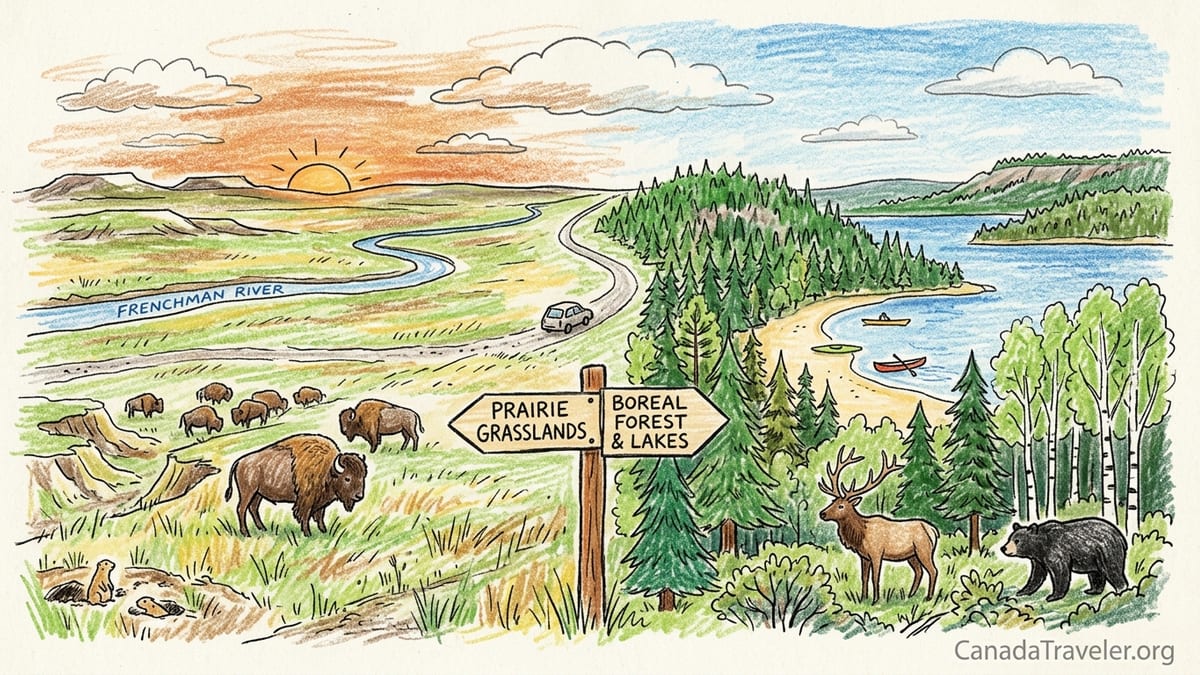
Prairie Grasslands vs Boreal Lakes and Forested Uplands
If your mental image of the Prairies is a straight highway past wheat fields, Grasslands National Park will change that quickly. The West Block opens onto a wide bowl of native mixed-grass prairie cut by the Frenchman River, with distant buttes and a big resident bison herd. The East Block is more dramatic, with badlands-style coulees and hoodoos. Here, viewpoints like the 70 Mile Butte area give you an almost uninterrupted 360-degree horizon, especially striking around sunset when the light softens and the hills turn coppery.
Prince Albert National Park is a transition zone. Drive north from Saskatoon and you move from farm fields into aspen parkland and finally full boreal forest. Around Waskesiu Lake, the park’s hub, white-sand beaches, spruce and jack pine frame a classic cottage-country scene rather than open prairie. The farther you go from the main road, the more you see chains of lakes, peatlands and mossy forest, ideal for paddlers and hikers who prefer water and trees to open grassland.
Riding Mountain National Park sits atop the Manitoba Escarpment, a forested plateau rising above the surrounding farmland. From the highway approach you clearly see the wooded ridge in the distance, and once you are inside, the feel is closer to a mixed-forest highland than a low prairie. Clear Lake, near the Wasagaming townsite, anchors a landscape of rolling hills, lakes and wetlands with pockets of fescue prairie and a fenced bison enclosure at Lake Audy. It is a good compromise for travelers who want some prairie scenery without giving up shaded forests and lakeside towns.
In practical terms, Grasslands is the best place to feel exposed to sky and wind and to see undisturbed native prairie plants. Prince Albert and Riding Mountain are better if your priority is swimming, boating and forest hiking. Many road trippers will pair Grasslands with at least one of the more forested parks to experience the full cross section of the central Prairies.
Hiking, Wildlife and Bison Encounters
Hiking in Grasslands is about big views more than bagging summits. Signed trails around the Frenchman Valley Campground and in the East Block, such as the 70 Mile Butte and Valley of 1,000 Devils routes, often start right from gravel pullouts. They are generally under 10 kilometres but feel remote because there are few trees and almost no buildings. Expect to see black-tailed prairie dogs, pronghorn on distant slopes and, with luck, short-eared owls quartering over the grass at dusk. The plains bison herd in the West Block often grazes near the Ecotour Scenic Drive, so many visitors spot them without leaving their car.
Prince Albert offers a mix of short, family-friendly paths near Waskesiu and longer backcountry routes. The Boundary Bog and Treebeard trails give you a safe introduction to boardwalk hiking over boggy ground, while the Narrows and Fisher trails follow the lakeshore. Backpackers and strong paddlers can link multi-day trips across lakes like Kingsmere and Crean, camping at basic backcountry sites with bear caches and pit toilets. Wildlife sightings tend to include loons, beavers, elk and white-tailed deer; black bear are present and occasionally seen along quieter roads and trails.
Riding Mountain stands out for its accessible wildlife viewing. The Lake Audy Bison Enclosure typically allows visitors to drive through a large fenced area containing a herd of plains bison, often seen right from the vehicle. Elsewhere in the park, moose, elk and black bear are all possible, especially on early morning drives along Highway 19 or at trailheads away from Wasagaming. Well-known hikes such as the Gorge Creek Trail on the escarpment edge provide viewpoints over the surrounding farmland, while lakeside walks near Clear Lake combine easy grades with regular chances to see loons and pelicans.
For travelers focused on bison, Grasslands offers the most natural setting, where bison share unfenced prairie with prairie dogs and pronghorn and can sometimes block gravel roads. Riding Mountain’s enclosure offers a more guaranteed but less wild experience. Prince Albert does not have bison viewing, so wildlife enthusiasts there usually focus on boreal species and birdlife.
Camping, Paddling and Dark Skies
In Grasslands, camping is part of the park’s atmosphere. The Frenchman Valley Campground in the West Block sits in the open valley with only a few low cottonwoods, so you feel the wind and see lightning storms sweep across the horizon. Sites are a mix of unserviced and basic serviced options, and Parks Canada also offers simple roofed accommodations like oTENTiks or tipi-style setups some seasons, which appeal to travelers who do not want to haul a full tent kit. There are also designated backcountry sites that you hike or ride into for an even more isolated experience.
Grasslands is also famous for dark skies. Recognized as a dark-sky preserve, the park draws amateur astronomers and photographers who plan trips to coincide with new moons. On a clear late-summer night, you can often see the Milky Way stretching from horizon to horizon without needing to leave the campground. Travelers who are used to light-polluted skies often find that simply lying back beside their campsite and watching satellites and shooting stars becomes a highlight of the trip.
Prince Albert and Riding Mountain are stronger choices for paddling. Around Waskesiu in Prince Albert, visitors rent canoes, kayaks and stand-up paddleboards from lakeside outfitters and explore sheltered bays suitable for beginners. More experienced paddlers plan overnight canoe trips to lakes like Kingsmere, using portage carts and designated boat launches. In Riding Mountain, Clear Lake supports everything from quiet morning paddleboard sessions to motorboats under a tagging and inspection program, while smaller lakes such as Moon Lake and Lake Audy appeal to those seeking a quieter canoe circuit.
Dark skies in Prince Albert and Riding Mountain are still impressive once you move away from the main townsites, but nearby cottage development means more ambient light than in Grasslands. For travelers who specifically want to see an intense, star-filled prairie sky or try night-sky photography with minimal interference, Grasslands remains the top choice, especially outside peak summer weekends.
Access, Nearby Towns and Road Trip Logistics
Grasslands requires the most deliberate detour. The West Block is typically accessed from towns like Val Marie, while the East Block is reached via rural roads south of Assiniboia. Services are limited, so it is common for travelers to stock up on groceries and fuel in larger centres like Swift Current or Moose Jaw before heading south. Roads inside the park are mostly gravel, and after heavy rain, some sections may be rough; drivers in regular sedans use them, but need to slow down and watch for washboarding.
Prince Albert National Park is more straightforward for first-time visitors. From Saskatoon, paved highways lead to the park entrance and on to the Waskesiu townsite, which feels like a compact lakeside resort village. Within a few blocks you have a grocery store, restaurants, a bakery, rental shops, a small cinema and multiple hotels and cabin operations, many open through the main summer season. For travelers who want a car-free day or two, it is easy to park and walk everywhere in Waskesiu.
Riding Mountain sits just off the main Trans-Canada corridor between Saskatchewan and Manitoba, making it an obvious stop for drivers crossing the Prairies. Many visitors enter via Highway 10 and base themselves in or near Wasagaming, the park’s main service area on Clear Lake. Here you find a range of motels, resort cabins, lakeside lodges and campgrounds, along with ice cream stands, cafes and small shops. Towns just outside the park, such as Onanole and Erickson, add more motel-style rooms and newer small resorts. This cluster of services means you can treat Riding Mountain as a multi-night vacation base rather than just a scenic detour.
For a road trip that links Saskatchewan and Manitoba, a common pattern is to spend two or three nights in Grasslands, then drive north and east to Prince Albert or continue straight toward Riding Mountain before heading to Winnipeg. Drivers short on time sometimes skip Grasslands, but those who make the detour often describe it as the most memorable landscape of their trip, precisely because it feels so removed from the highway corridor.
Reservations, Passes and Current Parks Canada Requirements
All three parks fall under Parks Canada’s national admission system. Visitors pay either a daily admission fee per person or vehicle, or use a Parks Canada Discovery Pass, which covers entry for a year. Current base daily fees for national parks of this type typically fall in the range of a modest per-person charge for adults, with reduced rates for youth and seniors and a capped family or group maximum. Exact prices change periodically, so it is best to check Parks Canada’s current fee schedule before your trip, especially if you are budgeting for a multi-park itinerary.
Camping and roofed accommodations at Grasslands, Prince Albert and Riding Mountain all use the Parks Canada Reservation Service. For peak dates in July and August, especially weekends, frontcountry campgrounds near main townsites such as Beaver Glen and Red Deer in Prince Albert or Wasagaming and Moon Lake in Riding Mountain often book up shortly after reservations open in late winter or early spring. In Grasslands, the Frenchman Valley Campground and East Block sites are more limited in number, so it also pays to reserve in advance if you plan to arrive on a Friday or Saturday night.
When you reserve, you pay both a nightly camping or accommodation fee and a non-refundable reservation charge per booking. In addition, some activities require separate permits or tags. For example, motorized watercraft on Clear Lake in Riding Mountain are subject to an inspection and tagging program designed to prevent aquatic invasive species, and anglers in all three parks must hold appropriate provincial fishing licenses plus any required park-specific permits. Backcountry campers in Prince Albert and Riding Mountain need to register their routes and carry proof of payment for backcountry permits.
Travelers who prefer flexible schedules can often find last-minute unserviced campsites midweek in May, June or September, particularly in Grasslands and at secondary campgrounds away from the main hubs. However, if you are traveling with a family in a larger trailer that needs electrical hookups, or if you want a specific oTENTik or cabin, advance reservations are strongly recommended. Parks Canada also posts current bulletins on fire bans, trail closures and wildlife advisories, which can influence where you camp and hike once you arrive.
Which Park for First-Timers, Families and Wildlife Lovers
For a first-time introduction to prairie landscapes, Grasslands is the purest experience. Standing on a rim in the East Block and looking across layered badlands and open grass to the horizon gives you an immediate sense of how vast the northern Great Plains once were. Travelers who grew up in forested regions often comment that simply hearing the wind in the grass and the calls of meadowlarks feels new. If you have only one or two days to experience real prairie and can handle basic services and gravel roads, Grasslands is the park that will upend your expectations.
Families, especially those with younger children, tend to find Prince Albert and Riding Mountain easier bases. In Prince Albert, Waskesiu offers playgrounds, a supervised beach area in summer, mini-golf and short interpretive trails that can be walked in under an hour. It is realistic to spend the morning on a sandy beach, take a nap back at a lakeside cabin and then go for a short evening hike without long drives. Riding Mountain’s Wasagaming townsite provides a similar mix, with ice cream shops, bike rentals and easy waterfront paths, plus the novelty of driving out to the Lake Audy Bison Enclosure for a short wildlife-focused outing that does not require hiking.
Wildlife-focused travelers may want to combine parks. Grasslands offers bison in a natural setting, prairie dog towns, pronghorn and a good chance of raptors. Prince Albert is stronger for boreal birdlife, loons, beaver and opportunities to see elk and black bear. Riding Mountain layers in its own mix of elk, bear and bison enclosure viewing, with the added bonus of easy roadside sightings near wetlands and meadows along park roads. Photographers who want a variety of species and backdrops will get the richest portfolio by visiting at least two of the three parks during the same trip.
For serious hikers, Prince Albert and Riding Mountain have more kilometres of forest and lake trails, including multi-day routes and combined paddle-hike itineraries. Grasslands’ treeless exposure and hot summer temperatures mean hikers must plan carefully, carry ample water and start early in the day. Campers looking for quiet and night skies gravitate to Grasslands and the more out-of-the-way campgrounds in Riding Mountain and Prince Albert, while those who like an evening walk to a café or bakery typically prefer staying near Waskesiu or Wasagaming.
Designing a Trip Between Saskatchewan and Manitoba
Many travelers driving between Saskatchewan and Manitoba use Prince Albert or Riding Mountain as anchor points. For example, a week-long loop from Saskatoon might spend three nights in Prince Albert around Waskesiu Lake, two nights in Riding Mountain near Clear Lake, and then two nights in Grasslands on the way back south, tying together forest, uplands and open prairie. This pattern keeps individual driving days under five hours while still giving full days on the ground in each park.
Shorter trips can still be rewarding. If you have four or five days, you might choose just Grasslands and Riding Mountain. Spend a night in Val Marie and two nights at Frenchman Valley Campground for open prairie and dark skies, then drive east to Riding Mountain for two nights near Wasagaming, adding beaches, cafes and bison viewing. Travelers starting in Winnipeg often reverse this sequence, visiting Riding Mountain first for a familiar cottage-country feel, then venturing farther into the prairie interior at Grasslands as their confidence with remote driving increases.
Travelers who value ease of access and amenities but still want a sense of the Prairies may decide to focus only on Prince Albert or Riding Mountain on a first trip, then return for a dedicated Grasslands visit later. This can be a smart approach for families with very young children, those towing large RVs, or visitors flying in from overseas who are adjusting to long drives on unfamiliar roads. Because all three parks require Parks Canada admission and use the same reservation system, it is straightforward to add a second park to a future trip using the same planning tools.
Whatever route you choose, allow time in your itinerary for weather. Prairie storms can bring strong winds and heavy rain, temporarily making gravel approaches in Grasslands slower and limiting paddling on exposed lakes in Prince Albert and Riding Mountain. Building in at least one “flex day” that can shift between parks or activities will make it easier to adapt, whether that means swapping a planned hike for a museum visit in Prince Albert or lingering an extra night in Grasslands after a particularly clear night of stargazing.
The Takeaway
Grasslands, Prince Albert and Riding Mountain are three distinct faces of the central Canadian Prairies. Grasslands delivers the archetypal open sky, shortgrass prairie and badlands that many visitors imagine but rarely see. Prince Albert offers a comfortable blend of boreal forest, beaches and lakeside village life, while Riding Mountain layers rolling forested uplands and Clear Lake’s resort-style scene onto a prairie backdrop. Together, they form a natural arc for travelers driving between Saskatchewan and Manitoba who want more than a straight dash along the highway.
Choosing the right park starts with your priorities. If you want to feel alone under a huge sky and count shooting stars, steer toward Grasslands. If you prefer swimming beaches, rental kayaks and café patios after a hike, Prince Albert or Riding Mountain will serve you better. Families often appreciate the structure and services of Waskesiu and Wasagaming, while wildlife travelers and photographers may plan loop routes that capture bison on open prairie, loons on glassy lakes and elk in forest clearings all in one trip.
On a practical level, all three parks share common threads: Parks Canada admission, reservation-based camping, and a strong emphasis on respecting wildlife, dark skies and local Indigenous cultures. Build your trip around two or three nights in at least one park, consider adding a second for contrast, and leave room for weather and serendipity. The prairies between Saskatchewan and Manitoba reward travelers who slow down enough to watch a storm roll in, listen to coyotes at night or simply stand still and realize that the horizon is much farther away than it looked from the highway.
FAQ
Q1. Which park is best for a first-time prairie landscape experience?
Grasslands National Park is the strongest choice for a first-time prairie experience because it protects large areas of native mixed-grass prairie and badlands with very few buildings or trees. Standing at viewpoints in the East Block or hiking from Frenchman Valley Campground, you get an immediate sense of the open sky, rolling grass and distant buttes that define the northern Great Plains.
Q2. Which park works best for families with children?
Prince Albert and Riding Mountain are generally better for families. Both have compact townsites with beaches, playgrounds, short walks and easy access to groceries, restaurants and ice cream. In Prince Albert, Waskesiu Lake offers calm swimming areas and flat lakeside trails. In Riding Mountain, Wasagaming combines a sandy beach, bike rentals and the family-friendly drive to the Lake Audy Bison Enclosure, which lets kids see bison without a long hike.
Q3. Where will I most likely see bison?
Grasslands and Riding Mountain both offer good chances to see bison, but in different ways. In Grasslands, the plains bison herd roams freely in the West Block and is often visible along the Ecotour Scenic Drive, creating a wild, open-prairie feel. In Riding Mountain, bison are kept in a large fenced enclosure at Lake Audy where visitors usually see them from their vehicles. Prince Albert does not currently feature bison viewing, so wildlife sightings there tend to focus on elk, deer, loons and black bear.
Q4. Which park has the best hiking options?
For variety and trail length, Prince Albert and Riding Mountain come out ahead. Both parks offer networks of forest and lake trails ranging from short loops under an hour to full-day or multi-day routes, many with boardwalks and lookouts. Grasslands also has excellent hiking, particularly in the East Block badlands and around 70 Mile Butte, but routes are fewer, more exposed to sun and wind, and require careful planning for heat and water.
Q5. Which park should I choose if I want to paddle and swim?
Prince Albert and Riding Mountain are the strongest paddling and swimming destinations. Around Waskesiu in Prince Albert you can rent canoes, kayaks and paddleboards and explore sheltered bays or plan multi-day canoe trips to lakes like Kingsmere. In Riding Mountain, Clear Lake supports everything from quiet morning paddles to motorboats under an inspection and tagging program, while smaller lakes like Moon Lake provide quieter canoeing. Grasslands has some river and coulee areas but is not a major paddling focus.
Q6. How many days should I plan for each park?
A practical minimum is two nights per park. In Grasslands, two or three nights give you time for at least one sunrise, one sunset and a clear night of stargazing plus a couple of hikes. In Prince Albert, three nights around Waskesiu allow for a beach day, a paddling outing and one or two hikes. Riding Mountain also rewards three nights, with time for Clear Lake, a drive to the bison enclosure and a day hike on the escarpment. Travelers with a full week often choose two parks rather than rushing through all three.
Q7. Do I need to reserve campsites in advance?
During July and August, advance reservations are strongly recommended in all three parks, especially for serviced sites, oTENTiks and popular campgrounds near Waskesiu and Wasagaming. Grasslands’ smaller campgrounds also benefit from advance booking on summer weekends. Outside peak season or midweek in shoulder months like June and September, you sometimes find first-come, first-served or last-minute sites, particularly in less central campgrounds, but flexibility is essential if you do not reserve.
Q8. What kind of Parks Canada pass or admission do I need?
You pay Parks Canada admission either through daily park entry fees or a Discovery Pass that covers multiple parks for a year. If you plan to visit more than one of Grasslands, Prince Albert and Riding Mountain in the same year, or stay several days in a single park, a Discovery Pass often works out cheaper than paying daily entry. Exact prices change periodically, so it is wise to check Parks Canada’s current fee schedule when planning.
Q9. Which park is easiest to visit on a Saskatchewan–Manitoba road trip?
Riding Mountain is the most convenient for drivers crossing between Saskatchewan and Manitoba because it sits close to Highway 10 and within a practical detour of the main Trans-Canada route. Many road trippers plan an overnight or multi-night stay in or near Wasagaming as a break from highway driving. Prince Albert requires a longer northward detour from the main east–west route, while Grasslands sits well south of the Trans-Canada and suits travelers who deliberately prioritize prairie scenery over minimizing driving distance.
Q10. Can I visit all three parks in one trip?
Yes, if you have at least 10 to 14 days and are comfortable with moderate driving days. A common pattern is to start in Saskatoon, spend several nights in Prince Albert, then drive southeast to Grasslands for open prairie and dark skies before continuing east to Riding Mountain and finally on to Winnipeg. Shorter itineraries can still link two parks, such as Grasslands and Riding Mountain, for a strong contrast between open grasslands and forested uplands.