


The Canadian Prairies are often marketed as a single postcard of wheat fields and Rocky Mountain backdrops, yet the true prairie heartland lies further east in Saskatchewan and Manitoba. For travelers who want big skies, Indigenous-led experiences, wildlife viewing and rail journeys but do not want to organize long remote drives on their own, a growing range of guided and packaged options makes these provinces far more accessible than many imagine. This guide focuses on real-world tours and packages that actually spend time in Saskatchewan and Manitoba, and explains how they work in practice so you know exactly what you are buying.
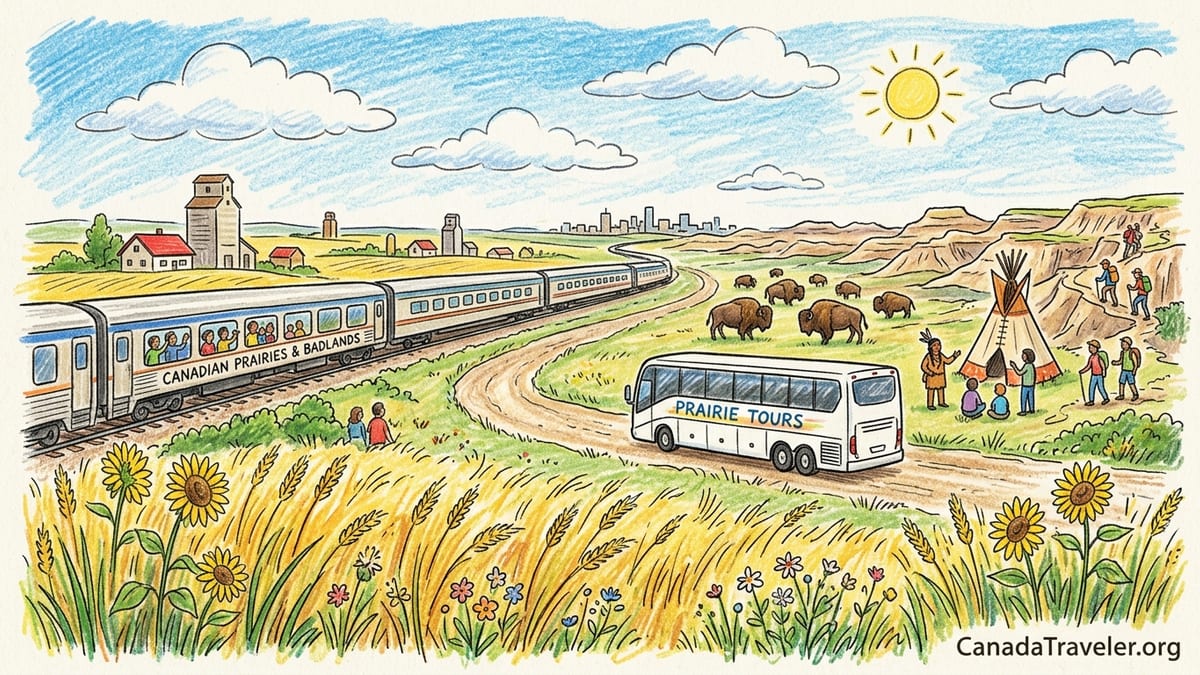
Understanding What “Canadian Prairies” Really Means
On many international tour brochures the phrase “Canadian Prairies” is used loosely, often as shorthand for a trans-Canada coach itinerary that spends most of its time in Alberta or the Rocky Mountains before racing east by train. These trips might include a quick photo stop in a city like Regina or Winnipeg, but the bulk of the sightseeing and overnights focus on mountain scenery around Banff and Jasper. If your goal is to wake up among wheat fields, experience Indigenous life on the plains, or explore the badlands and prairie parks, this style of tour can be disappointing once you realize how little time is actually spent in Saskatchewan or Manitoba.
By contrast, true prairie-focused tours are built around multi-night stays in places such as Saskatoon, Regina, Moose Jaw, Brandon, Riding Mountain National Park or Churchill, with daily excursions into the surrounding countryside. A prairie and badlands itinerary might feature the Big Muddy Badlands in southern Saskatchewan, the Frenchman River Valley around Grasslands National Park, or the rolling agricultural landscapes west of Winnipeg. Rail-based packages that highlight the Winnipeg–Churchill train, for example, cross thousands of kilometers of real prairie and boreal forest, with commentary about farming towns and Indigenous communities along the Hudson Bay Railway line rather than just treating the region as a transfer corridor between big-ticket sights elsewhere.
As you compare options, check the day‑by‑day itineraries rather than relying on tour names alone. If a “Canadian Prairies and Rockies” package lists more nights in Calgary, Banff and Jasper than in Winnipeg, Regina or Saskatoon, it is better thought of as a Rockies tour with a prairie transit day attached. In this guide, the examples highlighted are trips where Saskatchewan and Manitoba are central, not incidental, and where the logistics of long-distance driving across remote country are handled for you.
Guided Saskatchewan Prairie & Badlands Tours
Saskatchewan is one of the best places in Canada to experience open prairie, eroded badlands and dark night skies, yet the distances between small towns can make self-drive intimidating. Escorted coach companies based in Western Canada periodically offer seasonal tours that combine Regina or Saskatoon with the Big Muddy Badlands, the Cypress Hills area or Grasslands National Park. These multi-day trips typically use mid-size coaches carrying roughly 25 to 40 passengers, with a professional driver and a tour director who narrates the landscape and coordinates local guides at stops such as Historic Reesor Ranch or the interpretive centres in and around Grasslands National Park.
On a typical badlands loop, transport is fully included from the starting city, along with hotel accommodations in simple but comfortable properties such as branded highway hotels or long‑running independent inns. You might spend one night in a small prairie town near the park boundary and another back in Regina or Moose Jaw. Breakfast is usually included daily at the hotel, with some group dinners planned in advance, while lunches are often at local cafes in very small communities. Travellers have a few hours of independent time most days, usually in the late afternoon or early evening once the coach returns to town, to walk main streets, visit small museums or sit in local diners, but daytime schedules around the parks are fairly structured.
Inside national parks, guided walks are normally led by Parks Canada interpreters or certified local guides, and park admission is pre-paid as part of your package. Expect easy to moderate hikes on gravel or grass trails to viewpoints where you can look across coulees and badlands formations, with commentary on Indigenous histories and the near‑extinction of the plains bison. Itineraries generally avoid very rough backroads, so you gain access to viewpoints and visitor centres without needing to drive gravel yourself. Lodging standards in rural Saskatchewan are simpler than in big cities, but rooms are private with en‑suite bathrooms, and most tours are pitched at a comfortable, not luxury, level aimed at couples, solo travelers and retirees.
Indigenous Cultural Tours in Saskatchewan and Manitoba
For travelers seeking Indigenous perspectives on the prairie landscape, Saskatchewan and Manitoba both offer Indigenous-led and community-based tours that can be joined as standalone experiences or integrated into wider escorted itineraries. In Saskatchewan, operators such as Aski Holistic Adventures work in the Saskatchewan River Delta region, where Cree-Métis guides weave together canoeing or hiking with teachings about plant medicines, land stewardship and traditional food. Experiences might run for one to several days, including tent or cabin overnights, with all ground transportation provided from a meeting point in a nearby town so that guests do not need to navigate remote backroads on their own.
Elsewhere in the province, First Nations initiatives such as Pêmiska Tourism in central Saskatchewan focus on trail systems, outdoor experiences and cultural interpretation on reserve lands. Organized groups arriving on broader prairie tours can often book half‑day visits that include storytelling, drumming or guided walks, while independent travelers can join scheduled departures if they align with their travel dates. These experiences tend to be small group by design, often fewer than a dozen participants, which allows for conversation and questions. Meals may feature bannock, local game or other traditional foods, and guides will usually invite visitors to reflect on reconciliation, the history of residential schools and the contemporary realities of Indigenous communities.
In Manitoba, Indigenous Tourism Manitoba promotes a network of operators including Turtle Tours in Winnipeg and Indigenous-led walks at sacred places such as the Whiteshell Petroforms in Whiteshell Provincial Park. A Whiteshell Petroforms tour, for instance, involves meeting a local Anishinaabe guide at a trailhead around 90 minutes east of Winnipeg and spending roughly 90 minutes on a guided walk through boreal forest to stone formations that have been arranged over many generations. Travelers who prefer to avoid renting a car can sometimes book these as part of a day trip with transport arranged from Winnipeg through a tour operator or group charter, so it is worth checking if your wider Manitoba package can add an Indigenous component rather than trying to arrange a self-drive.
Prairie Wildlife & Northern Manitoba: From Bison to Belugas
Wildlife is one of the strongest reasons to choose a guided package in Manitoba instead of trying to go it alone. In the south, Riding Mountain National Park and nearby towns such as Wasagaming and Brandon are common bases for guided wildlife tours that look for plains bison, black bear and birdlife along forested trails and lakeshores. These are usually van-based day trips with groups of 8 to 12 guests, starting from established hotels or lodges where breakfasts are included and picnic lunches or cafe stops are built into the schedule. Park entry fees are bundled into the package cost, and local nature guides know where wildlife is most likely to be spotted without disturbing animals or damaging sensitive habitat.
Much farther north, around Churchill on Hudson Bay, wildlife trips are often structured as complete packages because of the remoteness of the region and the absence of road access from southern Manitoba. Frontiers North, Churchill Wild and several local outfits in Churchill offer seasonal tours built around polar bears, beluga whales or northern lights. A typical polar bear viewing package might last six to seven days and include return air or rail from Winnipeg to Churchill, several nights in a local hotel or remote eco-lodge, daily excursions by specialized tundra vehicles or boats, and most meals. Group sizes are generally kept to between 12 and 22 travelers on each departure so that everyone gets window or deck space when wildlife appears.
Prices vary widely depending on season and accommodation level. Simple multi-night packages based in Churchill town with hotel stays and shared tundra vehicle excursions can start around the mid four figures in Canadian dollars per person, while fly-in lodge stays that include private rooms, gourmet meals and intensive guiding can be significantly higher. Because demand is strong, particularly in peak polar bear season in October and November, departures often sell out many months ahead and train seats between Winnipeg and Churchill are heavily booked by tour blocks. For many travelers, the convenience of bundled wildlife guiding, transfers, meals and outerwear rental far outweighs the challenges of trying to piece together separate services in such a small community.
Rail-Based Packages Across the Prairies
Rail travel is one of the most atmospheric ways to experience the scale of the Canadian Prairies without driving long distances yourself, and both national and regional operators sell packages that integrate Via Rail services with guided touring. The Winnipeg–Churchill train travels more than 1,600 kilometers through Manitoba and a slice of eastern Saskatchewan along the Hudson Bay Railway, typically over two days and two nights each way. Package designers use this service as the backbone of multi-day itineraries that include pre- and post-rail hotel nights in Winnipeg, a berth or private cabin on the train, and then a series of guided activities once you reach Churchill.
Companies such as Rail Travel Tours and regional coach operators combine rail segments with hotel stays and local day tours to create week‑long programs like “Ride the Rails to See the Whales” or “Churchill Explorer.” A sample seven-day group tour might include an overnight in Winnipeg, two nights on the train in sleeping accommodations, two nights in a full-service hotel in Churchill and then the return train journey south. Onboard, travelers have access to a dining car or cafe service depending on the season and train consist, but meals on the train are not always included in the tour price and can be pay‑as‑you‑go unless specifically stated. Once in Churchill, meals are more often bundled, with breakfasts and several dinners pre-arranged at local restaurants to simplify logistics in a small, busy town.
Rail-based prairie trips are usually escorted by a tour director traveling with the group from Winnipeg, handling check‑ins, luggage and activity coordination. Group sizes typically range from 16 to 30 travelers. While there is considerable unstructured time on the train itself, when you can read, chat in the lounge or watch grain elevators and wetlands roll past, days in Churchill are more scheduled, with time set aside for boat tours, cultural presentations and visits to Parks Canada interpretive centres. For travelers not keen on organizing lodging, train tickets and local guiding independently, these packages provide a relatively frictionless route from southern prairie cities into some of the most remote landscapes in Manitoba.
How Guided Prairie Packages Actually Work
Across Saskatchewan and Manitoba, the underlying structure of most escorted prairie tours is similar, whether you are joining a badlands loop, an Indigenous cultural program or a rail-and-wildlife package. Transportation is typically by modern coach or minibus on paved highways in the south, shifting to trains, vans or specialized tundra vehicles in the north. Luggage handling is often included between hotels, so you usually only move your hand baggage yourself. Airport or downtown transfers at the start and end of the trip may or may not be bundled in, and it is important to check whether your tour begins at a specific hotel, a rail station, or with an airport meet-and-greet.
Accommodation standards tend to be mid-range: chain hotels in cities like Saskatoon, Regina and Winnipeg; locally run motels or lodges in smaller towns; and established hotels or wilderness lodges in Churchill. Rooms are private with en‑suite bathrooms, and pricing is usually based on double occupancy with a single supplement for solo travelers. Only a handful of ultra-luxury products exist in these provinces, and those are mostly in remote wildlife lodges rather than on broad prairie itineraries. Meals follow a predictable pattern: hot buffet breakfasts at hotels, group dinners on select nights, and free-choice lunches. Alcohol is rarely included except during occasional welcome receptions or special dinners.
Guiding is shared between the main tour director, who travels with the group for the full itinerary, and a changing cast of local specialists: Indigenous Elders on reserve lands, naturalists in national parks, or park interpreters at historic sites. Group sizes on broad coach tours are larger than on specialized Indigenous or wildlife trips, so if you value close contact with guides and time for questions, it can be worth paying more for small-group products capped at 12 to 16 guests. Independent time is generally more generous on city days, when you might have entire afternoons free to explore Winnipeg’s Exchange District or Saskatoon’s riverfront, and more limited on intensive wildlife or cultural days, where daylight hours are packed with scheduled activities.
Choosing the Right Kind of Prairie Experience
With so many different operators using similar language, the key to choosing the right Saskatchewan or Manitoba package lies in reading beyond the brochure headlines. If you picture yourself walking through grasslands and badlands at a gentle pace, look for itineraries that specifically name places such as Grasslands National Park, Cypress Hills, or Riding Mountain National Park, and that describe multiple guided walks rather than city sightseeing drives. If Indigenous culture is a priority, check that at least one or two days are dedicated to Indigenous-led experiences, whether through organizations such as Aski Holistic Adventures, Turtle Tours or Petroforms guides in Whiteshell Provincial Park, and that time with Elders or knowledge-keepers is not just a brief photo stop.
For wildlife, clarify whether polar bears or belugas are a core focus or simply an optional day tour. A rail package that uses the Winnipeg–Churchill train primarily as transportation to a northern hotel with two full days of wildlife touring feels very different from a trip that rides the same train but offers just a single half-day excursion for bear viewing. Ask about the number and duration of tundra vehicle outings, boat tours, or guided hikes included in the base price, as well as how much time is left unscheduled if you want to add extra photography or cultural options. Travelers wary of very large groups might gravitate toward small-group safaris or Indigenous retreats, while those looking for value may find that more conventional coach tours deliver a lower per‑day cost even if they are somewhat less flexible.
Finally, consider your tolerance for remote logistics. If you do not want to worry about rental cars, winter driving or booking long-distance trains, lean toward fully escorted tours that begin and end in major gateways like Winnipeg, Saskatoon or Regina, with transfers and baggage handling included. Independent-minded travelers who are comfortable flying or taking the train on their own can combine shorter local tours in each region, such as a day on the prairie with a local guide, a scheduled Indigenous cultural walk, and a wildlife excursion, but should be prepared to invest more time in stitching these pieces together. Either way, focusing on tours that genuinely prioritize Saskatchewan and Manitoba will reward you with the expansive skies, cultural depth and abundant wildlife that define the true Canadian Prairies.
The Takeaway
Travelers drawn to the idea of the Canadian Prairies often discover that many glossy “prairie” packages barely graze Saskatchewan and Manitoba before pressing on to the Rockies. By paying close attention to where nights are spent and how many days are devoted to open grasslands, Indigenous communities and wildlife-rich parks, you can select trips that bring you into the genuine prairie landscape instead of treating it as an interlude. From Saskatchewan badlands tours and Indigenous-led retreats to Manitoba rail journeys and Churchill wildlife packages, escorted options now cover a broad range of comfort levels and interests without requiring you to navigate long, remote highways yourself.
Whether you are watching a summer storm roll over a wheat field near Moose Jaw, listening to an Elder share stories among the Whiteshell Petroforms, or leaning over a ship’s rail as beluga whales surface in the Churchill River, the right guided experience lets you focus on the moment rather than the map. With clear expectations around transportation, group size, hotel standards, meals and independent time, you can match your own travel style to the many ways of experiencing Saskatchewan and Manitoba. The result is a prairie journey that feels both logistically simple and deeply connected to the land and the people who call it home.
FAQ
Q1. How can I tell if a “Canadian Prairies” tour really includes Saskatchewan and Manitoba?
Look beyond the tour title and check the day‑by‑day itinerary. If most nights are in Calgary, Banff or Jasper, with only a quick stop in Regina or Winnipeg, it is mainly a Rockies trip. A true prairie tour spends multiple nights in Saskatchewan and Manitoba towns and names specific prairie parks, badlands or Indigenous sites in its daily descriptions.
Q2. Do I need to rent a car to see the prairies in Saskatchewan and Manitoba?
No. Many escorted coach tours, Indigenous cultural programs and rail-based packages are designed for travelers who do not want to drive. They bundle transportation, guiding and hotel stays, and in remote regions like Churchill, there are no roads from southern Manitoba anyway, so tours naturally rely on trains, planes and local vehicles.
Q3. What level of hotels should I expect on prairie and wildlife tours?
Most prairie-focused packages use mid-range hotels: familiar chains in larger cities and clean, simple motels or lodges in small towns. In Churchill, packages range from standard local hotels to higher-priced remote lodges. Private bathrooms are the norm, and truly basic dorm-style lodging is rare except on some specialty adventure or retreat products.
Q4. How large are typical tour groups in Saskatchewan and Manitoba?
Conventional coach tours usually carry about 25 to 40 guests, while small-group Indigenous or wildlife trips often limit groups to 8 to 16 people. Rail-and-wildlife packages to Churchill usually fall somewhere in between, with group sizes structured so everyone has good viewing opportunities on vehicles and boats.
Q5. Are meals and park admissions usually included in these packages?
Breakfasts are commonly included at hotels, and many tours add several group dinners, especially on the first and last nights. Lunches are often at your own expense. Park admissions and key guided activities are usually bundled, particularly for national parks, badlands walks and Churchill wildlife outings, but optional extras are often priced separately.
Q6. How much independent time will I have on a guided prairie tour?
You can generally expect some free time in cities and towns, such as free afternoons in Winnipeg or Saskatoon, while days in parks or on wildlife excursions are more structured. Rail journeys naturally offer unstructured hours onboard, but schedules in remote destinations like Churchill tend to be busy to make the most of limited time.
Q7. When is the best time to visit Manitoba’s Churchill area on a package tour?
Peak polar bear viewing usually falls in late autumn, while beluga whales and tundra wildflowers are most common in summer. Northern lights packages cluster around the darker months. Because space is limited, especially on the train and in small hotels or lodges, it is wise to book many months ahead for any of these seasons.
Q8. What should I consider if I want Indigenous-led experiences on my trip?
Confirm that your itinerary includes time with Indigenous-owned operators or community programs, not just museum visits. Look for specific names or descriptions of Indigenous partners and ask how long you will spend in those activities. Small-group walks, storytelling sessions and land-based programs usually provide more meaningful interaction than very short cultural “stops.”
Q9. Are rail-based prairie packages suitable for families or only for older travelers?
Rail-and-coach packages attract a wide mix of ages, though many guests are couples and retired travelers. Families with school-age children often enjoy the novelty of the train and wildlife viewing, but should check minimum age policies for polar bear or beluga tours and consider whether long train segments and structured days will suit their children.
Q10. How far in advance should I book Saskatchewan and Manitoba tours?
For popular seasons, such as autumn in Churchill or summer prairie trips tied to festivals, it is prudent to book at least six to nine months in advance, especially if you need specific train dates or room types. Shoulder-season packages and shorter cultural or city-based tours may be available closer to departure, but availability can still tighten quickly.