


Driving across the Canadian Prairies is less about ticking off sights and more about settling into the rhythm of big skies, long horizons and quiet two-lane highways. A road trip that links Manitoba and Saskatchewan, from Winnipeg and Riding Mountain National Park to Regina, Grasslands, Saskatoon and Prince Albert National Park, can feel like a true journey rather than a forced march, as long as you build your route around realistic distances, smart fuel stops and well-chosen overnights.
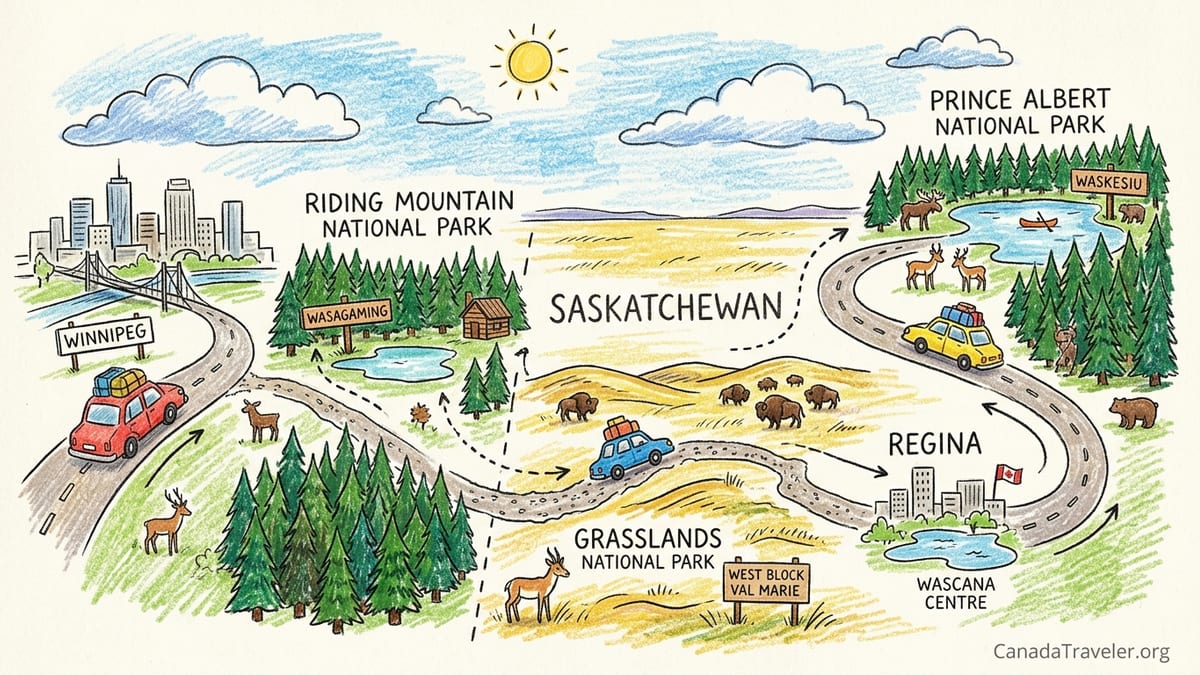
How to Think About a Saskatchewan–Manitoba Road Trip
The instinct with a vast region like the Prairies is to design one heroic loop that tries to cover everything. In practice, that often leads to days of six to eight hours of driving, rushed evenings, and a sense that you spent most of your holiday in the car. A better approach is to treat Winnipeg, Riding Mountain, Regina, Grasslands, Saskatoon and Prince Albert as flexible anchor points. From there you can build two or three shorter sub-routes that you connect, depending on how much time you have.
For example, many travelers start and finish in Winnipeg because of the major airport and competitive car rental prices. From there, they might build a gentle three-stop arc of Winnipeg, Riding Mountain National Park and back, then connect by bus or rental car to a separate Saskatchewan loop that links Regina, Grasslands, Saskatoon and Prince Albert National Park. Others fly into Winnipeg, drive to Regina via Riding Mountain, then finish in Saskatoon and fly out from there, accepting a one-way rental fee in exchange for not backtracking.
The key is to decide early whether you care more about minimizing driving days or minimizing rental costs. Round-trip routes typically keep prices lower, but one-way routes can save you 500 to 800 kilometres of backtracking. Once that trade-off is clear, you can start slotting in national parks, cities and small towns in a way that matches your pace.
Understanding One-Way Rentals and Big Distances
On paper, Prairie distances look manageable: Winnipeg to Riding Mountain National Park’s south gate near Onanole is about 260 kilometres and roughly three hours of driving, while Regina to Grasslands National Park’s West Block near Val Marie is around 300 kilometres and four hours. The challenge is that many of the most rewarding areas, such as Grasslands and the backroads around Prince Albert National Park, lie beyond those main paved highways, at the end of slower gravel roads where you will not be averaging highway speeds.
One-way rentals are possible between major Prairie cities, but they can be surprisingly expensive. Travelers who have priced a simple Regina to Saskatoon one-way, a drive of only about two and a half hours, have reported quotes in the hundreds of dollars just for the “drop” fee on top of the daily rental rate. That can outstrip the cost of an extra rental day and fuel to loop back to your starting point. If you are watching your budget, it is often cheaper to design a loop that begins and ends in the same city, even if it means adding one longer driving day.
If you do choose a one-way itinerary to save time, keep the route between larger hubs where agencies have branches. Winnipeg to Regina or Winnipeg to Saskatoon is usually easier to arrange with a mainstream brand like Enterprise, Budget, Avis or Hertz than a smaller cross-border drop such as Regina to a minor town in Alberta. Always run test bookings on agency websites before you lock in your flights so that rental costs do not surprise you.
Route Structure 1: Winnipeg, Riding Mountain and Back
A classic Manitoba loop begins and ends in Winnipeg and focuses on Riding Mountain National Park. From Winnipeg, most travelers drive north-west on the Trans-Canada and Highway 10 to Onanole, the small community at the south entrance to the park. The townsite of Wasagaming, inside Riding Mountain, has seasonal restaurants, small hotels, lakeside cabins and a cluster of campgrounds. The drive is long enough to feel you have escaped the city but short enough that you can leave Winnipeg after breakfast and still arrive in time for an afternoon hike or paddle.
This structure works well for travelers who want to limit driving to three or four days in total. You might spend a night in Winnipeg to get over jet lag, drive to Riding Mountain for two or three nights, then return to Winnipeg and either fly home or continue west by bus or a new rental vehicle. Within Riding Mountain, you can keep daily drives short by basing yourself in or near Wasagaming and exploring the surrounding lakes and short scenic roads rather than criss-crossing the entire park by car.
Because Riding Mountain is a popular summer and long-weekend destination for Manitobans, accommodation in Wasagaming and nearby Onanole can book out early in July and August. Waterfront cabins and higher-end lodges may be reserved months in advance. If you are visiting in peak season and you want a particular style of stay, such as a lakeside cottage with kitchen, it is worth booking as soon as your dates are firm.
Route Structure 2: Winnipeg to Regina via Riding Mountain and the Open Prairie
For travelers who want to combine Manitoba’s forests and lakes with Saskatchewan’s big-sky grasslands, a one-way route from Winnipeg to Regina works well. After a night or two in Winnipeg, drive to Riding Mountain as above and spend a couple of days exploring the park. From there, instead of returning east, drop back to Highway 1 or Highway 16 and continue west across Manitoba’s farm country, aiming for a mid-sized town such as Brandon or Yorkton for a break before you cross into Saskatchewan.
From the Manitoba–Saskatchewan border, it is a straight shot to Regina on divided highway. The capital makes a handy urban pause with walkable neighborhoods, Wascana Centre’s lakeside parkland and a good choice of hotels. Many visitors leave rental cars parked for a full day to explore on foot, then stock up on groceries and supplies before heading south-west to Grasslands. This rest day helps balance the longer prairie drives.
In this structure, Winnipeg and Regina act as bookends, with Riding Mountain as your Manitoba wilderness anchor. If dropping a rental car in Regina proves too costly, you can adapt the route into a loop by returning from Regina to Riding Mountain or Winnipeg, but this will add an extra full day of driving. Some travelers handle this by breaking the return into two shorter hops with an overnight in Brandon or Portage la Prairie to keep fatigue at bay.
Route Structure 3: Regina, Grasslands, Saskatoon and Prince Albert
If your focus is Saskatchewan, a powerful but still practical route links Regina, Grasslands National Park, Saskatoon and Prince Albert National Park. Many travelers fly into Regina, spend a night in the city, then drive south-west to Grasslands’ West Block near Val Marie. This leg is often four hours or more once you include fuel and a grocery stop. The final approach from the town of Val Marie into the park involves gravel side roads and slower speeds, so it is wise to reach the area well before dark, especially if deer and pronghorn are active on the shoulders.
After two or three nights using Val Marie or the West Block campground as a base, you can loop north and west on smaller highways toward Swift Current and the Trans-Canada, then turn north to Saskatoon via communities such as Moose Jaw or Rosetown. This creates a long but varied day that breaks up the landscape: rolling ranch country near Grasslands, then fields of canola and wheat, then the denser services and restaurants of a larger city as you approach Saskatoon.
From Saskatoon, a straightforward drive north on Highway 11 and connecting highways leads to Prince Albert National Park and the lakeside resort town of Waskesiu. Official driving information puts Saskatoon to Prince Albert National Park at around 200 kilometres and roughly two and a half hours. Once you turn off the main highway into the park, the road curves past lakes, small resorts and forest. Many visitors choose to stay three nights here, using one full day for hiking, one for paddling or a lake cruise, and one as a flexible buffer for weather.
To close the loop, you can drive south from Prince Albert National Park to Saskatoon and either fly out or continue on to Regina along Highway 11. This last leg is about two and a half hours of easy divided highway driving. If you want to shorten the trip, you can skip either Grasslands or Prince Albert, but most travelers find that visiting both parks showcases very different sides of Saskatchewan, from arid coulees and prairie dog colonies to boreal forest and shield lakes.
Driving Realities: Distances, Fuel and Gravel Roads
Prairie maps can be deceptive. A distance of 250 to 300 kilometres on a major divided highway might take two and a half to three hours, but once you leave those routes for park access roads and gravel grid roads, average speeds drop sharply. Access to Grasslands National Park, in particular, often involves stretches of maintained gravel. The main Ecotour Road in the West Block and the approach to viewpoints in the East Block are not technically difficult in dry summer conditions, but they demand slower, more attentive driving.
Fuel planning is critical in the southwest corner of Saskatchewan and around sections of Grasslands. Small prairie towns may have just one fuel station, with limited opening hours, and there are no pumps inside the park. Many visitors top up in larger service centers such as Swift Current, Moose Jaw, Maple Creek, or Val Marie before heading into the park areas, then keep the tank above half until they are back on the main highway network. Around Prince Albert National Park and Riding Mountain, fuel is easier to find, with stations in gateway communities like Onanole, Waskesiu and the nearby regional hubs.
Gravel roads across both provinces are generally passable in a normal two-wheel drive rental car in summer, but they can turn muddy and rutted after heavy rain or spring thaw. In early season, travelers have reported stretches of Grasslands’ backroads becoming soft enough that low-clearance vehicles risked getting stuck. Check provincial highway hotlines and park advisories before you set out each day. If a park ranger or local farmer tells you a road is questionable after recent weather, believe them and choose another route, even if the detour adds an hour.
Wildlife is another reason to avoid marathon driving days. White-tailed deer, mule deer and pronghorn antelope are common near Grasslands, while moose and elk are occasionally seen around Prince Albert National Park and Riding Mountain. On summer evenings, it is normal to slow for animals on the shoulder or even standing in the road. Plan your drives so you reach your overnight base before dusk whenever possible, especially on rural stretches without fencing.
When to Book Ahead and How to Avoid Driving Every Day
One of the joys of a Prairie road trip is the sense of spontaneity, but there are a few places where booking ahead really matters. Prime-season sites and cabins in Riding Mountain’s Wasagaming townsite can sell out well in advance, particularly lakefront options and fully serviced RV sites. Similarly, Prince Albert National Park’s popular campgrounds and resort cabins in Waskesiu book early for July and August weekends. In Grasslands, overall visitor numbers are lower, but serviced campsites and roofed accommodations in nearby Val Marie and East Block communities are limited in number, so it still pays to reserve once your dates are set.
Between those hotspots, you can often keep your schedule looser. Towns such as Brandon, Moose Jaw, Swift Current and Prince Albert have a mix of chain hotels and independent motels that rarely fill except during local events. This allows you to commit early to your high-demand nights inside or right next to the national parks, while leaving buffer nights in larger centers more flexible for weather and fatigue.
To avoid feeling like you are always in motion, structure your trip so that no more than half of your days involve significant driving. For example, on a two-week holiday split between Manitoba and Saskatchewan, you might drive on six days and spend the other eight based in just three or four locations. In practice, this could look like three nights in Riding Mountain, three in Grasslands, three in Prince Albert National Park and three divided between Winnipeg, Regina and Saskatoon for city time and logistics.
Another tactic is to plan one “short hop” driving day for every long one. If you know you will be on the road for five hours getting from Grasslands to Saskatoon, follow it with just a two-hour leg from Saskatoon to Prince Albert National Park, leaving plenty of time at each end for walks, groceries and slow meals instead of gas-station dinners.
Safety, Weather and Practical Considerations
Prairie weather shifts quickly. Summer thunderstorms can roll across open farmland with little warning, bringing strong crosswinds and reduced visibility. On gravel, sudden rain can turn the top layer to slick clay. In shoulder seasons, snow and freezing rain can affect even major highways. Before each driving day, especially one heading toward remote areas like Grasslands’ East Block, check provincial highway conditions and park alerts, and be ready to postpone or re-route if conditions deteriorate.
Cell coverage is patchy in many rural areas of both provinces, more so in the southwest near Grasslands. Expect to lose signal on backroads and inside the park blocks. Download offline maps before leaving cities such as Winnipeg, Regina or Saskatoon, and carry a paper provincial roadmap as backup. Let someone know your planned route and timing if you are heading into particularly quiet areas, and allow enough daylight margin that an unplanned detour does not leave you navigating unfamiliar gravel in the dark.
A basic emergency kit is important here. At minimum, carry drinking water, snacks, a warm layer even in summer, a reflective triangle or flares, and a compact shovel if you are traveling early in the season when roads can be soft. Many travelers also pack a small air compressor and tire repair kit, since sharp gravel can occasionally cause slow leaks. Rental agencies normally provide a spare tire, but it is wise to confirm this at pickup and check that you know where the jack is stored.
Wildlife safety extends beyond driving. In Grasslands, you may encounter bison on some roads or trails. Give them plenty of space and stay in your vehicle if they are near the roadside. In all three national parks, black bears are possible, especially around forest and lake areas, so follow standard precautions: store food securely, keep a clean campsite and give animals a wide berth if encountered on the trail.
The Takeaway
A road trip across Manitoba and Saskatchewan can feel immense, but it does not have to be exhausting. By treating Winnipeg, Riding Mountain, Regina, Grasslands, Saskatoon and Prince Albert National Park as flexible anchors rather than a rigid checklist, you can build a route that matches your appetite for driving, hiking and quiet time under huge skies. Accept that you will not see everything in one go and focus instead on a handful of well-chosen bases connected by realistic, well-planned driving days.
Think of your itinerary in segments: perhaps a Winnipeg and Riding Mountain loop, followed by a Saskatchewan circuit through Regina, Grasslands, Saskatoon and Prince Albert. Decide early whether to pay for one-way car convenience or design cheaper loops that return to your starting city. Book ahead where it matters most, especially inside the national parks, and leave breathing space elsewhere so you can follow weather, local advice and your own energy.
Above all, resist the temptation to treat the Prairies as something to power through on the way to somewhere else. Give yourself time to watch a thunderstorm building on the horizon, to linger over a long twilight in Grasslands, or to paddle a still lake in Prince Albert National Park. With the right route structure, the long distances become part of the experience rather than a chore.
FAQ
Q1. Is it better to start a Prairie road trip in Winnipeg, Regina or Saskatoon?
There is no single best starting point. Winnipeg often has the widest flight options and car rental availability, while Regina and Saskatoon are more central for a Saskatchewan-focused loop. If you want to include Riding Mountain National Park, Winnipeg makes sense. If your priority is Grasslands and Prince Albert National Parks, starting and ending in Saskatoon or Regina can reduce backtracking.
Q2. How many days do I realistically need for a trip that includes Riding Mountain, Grasslands and Prince Albert?
A workable timeframe for all three parks plus city stops is roughly two weeks, but you can design shorter versions. In less than ten days, most travelers are happier choosing two parks, such as Riding Mountain and Grasslands or Grasslands and Prince Albert, instead of trying to visit all three and spending most days on the road.
Q3. Do I need a four-wheel drive vehicle for Grasslands National Park?
In dry summer conditions, most park roads and the main gravel approaches are usually passable in a standard two-wheel drive car. However, after heavy rain, spring thaw or early snow, some gravel roads can become muddy and rutted. A vehicle with slightly higher clearance helps, and in shoulder seasons it is wise to speak with park staff about current road conditions before driving lesser-used routes.
Q4. How often will I find fuel between cities and parks?
Between Winnipeg, Regina, Saskatoon and larger towns like Brandon and Swift Current, fuel is frequent. In more remote areas, especially near Grasslands National Park, gas stations are farther apart and may have limited hours. A common strategy is to fill up in larger centers before heading into park regions and avoid letting the tank drop below half when driving quieter secondary highways.
Q5. Is one-way car rental worth the extra cost?
One-way rentals between Prairie cities are convenient, but drop fees can be high, sometimes adding several hundred dollars to a short itinerary. It becomes worthwhile if it allows you to avoid a full day or more of backtracking and you value time over budget. If you are cost-conscious, compare the one-way price against a loop that starts and ends in the same city, including an extra night of accommodation and fuel.
Q6. When should I reserve accommodation in the national parks?
For peak summer visits in July and August, book Riding Mountain, Grasslands and Prince Albert National Park accommodations as soon as you are confident of your dates. Lakeside cabins, popular campgrounds and serviced RV sites can sell out months ahead for weekends and holidays. Shoulder seasons are more forgiving, but even then it is smart to reserve at least your first choice of park base in advance.
Q7. Can I shorten the trip without feeling rushed?
Yes. The most effective way to shorten is to focus on one province or two core park regions instead of three. For example, you could plan a Winnipeg and Riding Mountain loop for one week or a Regina, Grasslands and Saskatoon circuit for ten days. Keeping at least two nights in each main stop prevents the trip from feeling like a continuous transfer.
Q8. How dangerous is wildlife on the roads?
Wildlife is common, especially at dawn and dusk. Deer, pronghorn and occasionally moose can appear suddenly on or near the road. Collisions are rare if you reduce speed in low light, avoid night driving on rural stretches where possible, and stay alert on forested or river valley sections. In parks, obey posted speed limits and be prepared to stop if animals are on the shoulder.
Q9. Will I have mobile phone coverage in remote areas?
Expect good coverage in and around Winnipeg, Regina, Saskatoon and major highways, but patchy or no service on sections of gravel and inside parts of Grasslands and Riding Mountain. Coverage around Prince Albert National Park is generally better near the townsite but still inconsistent away from main roads. Download offline maps, share your route with someone, and do not rely on your phone as your only navigation tool.
Q10. What is the best season for a Saskatchewan and Manitoba road trip?
Late spring through early autumn is the most comfortable period for a Prairie road trip. June brings wildflowers and fewer crowds, July and August offer warm temperatures and the fullest range of park services, and September often combines pleasant weather with fall colours and quieter campgrounds. Winter driving and park access are possible but require more preparation, cold-weather gear and comfort with snow and ice conditions.