


British Columbia’s hot springs range from full-service mountain resorts to steamy pools tucked beside northern rivers and wave-battered coastal rocks. With new closures, renamings and access rules in recent years, planning a soak now requires more homework than simply following map pins. This comparison looks at seven notable hot springs across the province through four lenses: how you get there, what the water experience is actually like, how each place connects to local culture and ecology, and whether it is open and safely managed today.
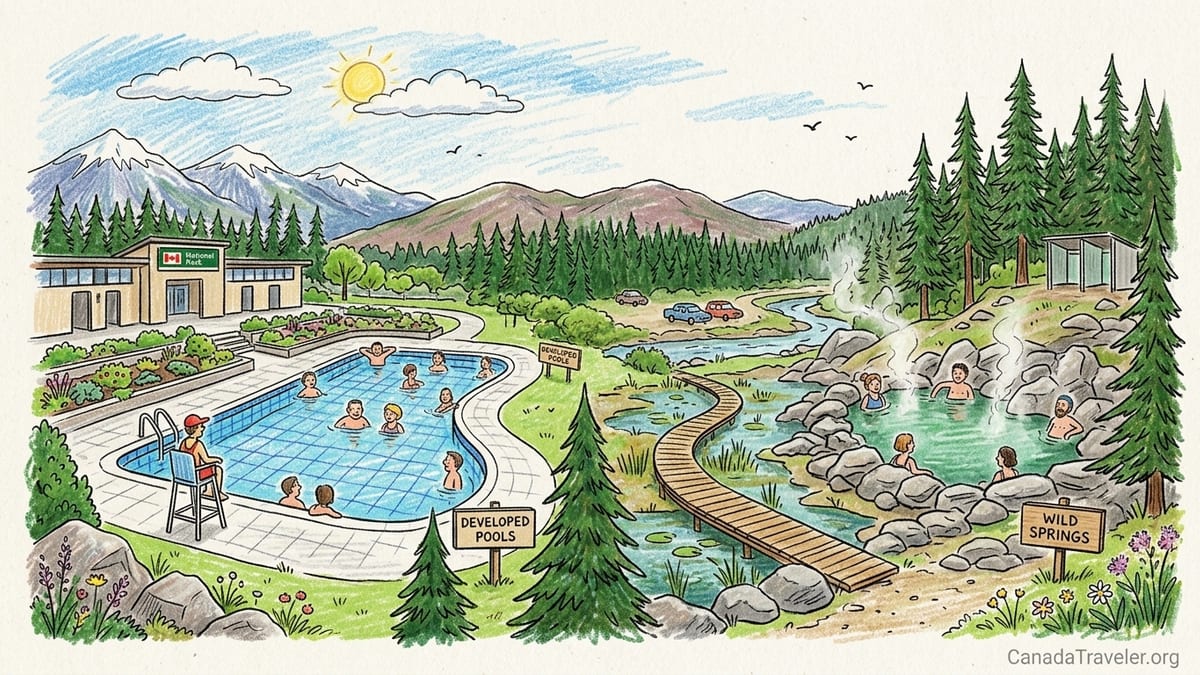
Developed Pools vs Wild Springs: Understanding the Tradeoffs
Across British Columbia, “hot springs” can mean anything from a tiled national-park pool with lifeguards and showers to a rocky basin reached by logging road and a scramble down to a river. Developed mineral pools, such as Radium Hot Springs or Nakusp Hot Springs, capture geothermal water and channel it into engineered basins with filtration systems, temperature controls and regular water-quality testing. That infrastructure supports change rooms, lifeguards and reliable hours, but it also means sharing the water with more people and paying admission that typically falls in the mid-teens to just under twenty dollars for adults.
Remote or semi-wild springs, by contrast, are defined more by their setting than their facilities. Liard River Hot Springs in northern British Columbia, for example, remains largely natural in appearance even though boardwalks and basic structures have been added. Before its closure, Lussier Hot Springs offered rock-walled pools carved into a riverbank in a forested provincial park, with no buildings at the water’s edge. These experiences feel closer to soaking in a truly wild landscape, but they also carry more variables, from slippery rocks and uneven pool depths to limited shelter and rapidly changing conditions.
There is also a management difference. Developed pools usually sit within municipalities, national parks or resort properties, with staff on-site daily and clear opening hours posted. Wild or lightly developed sites are often within provincial parks where infrastructure is minimal and seasonal. When safety issues emerge, such as unstable rock at Lussier, closures can be sudden and lengthy. Travelers who understand these distinctions are better prepared to choose a soak that matches their comfort level, risk tolerance and expectations for amenities.
Finally, there is a cultural dimension. At places like Nism̓aakqin Park near Tofino, the hot springs occupy land that has sustained Indigenous communities for generations. Visitors are increasingly asked to recognize that these are not just recreational spots but parts of living territories, with stewardship fees and protocols that sit somewhere between a wild spring and a commercial spa. Knowing whether you are entering a private resort, a provincial or national park, or an Indigenous-managed coastal territory is as important as checking pool temperatures.
Radium Hot Springs: Accessible National Park Classic
Radium Hot Springs sits just inside Kootenay National Park, within walking distance of the village of Radium Hot Springs in the East Kootenay region. Access is straightforward: travellers arrive by Highway 93/95, park in a paved lot and enter a Parks Canada facility. Unlike some remote springs, no four-wheel drive is needed and the site is open year-round, weather and maintenance permitting. This makes Radium one of the more predictable hot-spring stops for road trippers moving between the Okanagan, Banff and the Columbia Valley.
The hot soaking pool at Radium is usually maintained around 37 to 40 degrees Celsius, warm enough for long sessions even in winter. A separate cooler lap pool sits adjacent for those who want to swim. The water itself is clear, with a mild mineral odour that many visitors find less intense than at more sulfurous springs. Because the pool is large and deck space generous, it often feels less crowded than its popularity would suggest, especially outside peak holiday periods.
As a national-park facility, Radium charges a hot springs admission in addition to any applicable park entry fees. Recent fee schedules put an adult soak around 19 to 20 Canadian dollars, with slightly lower rates for youth and seniors. In return, visitors get full changing rooms, showers, towel rentals and on-duty lifeguards. Families often appreciate the easy entry ramps and relatively shallow areas, though in the coldest months some users report that only the shallow end feels truly hot while deeper sections can feel closer to warm pool temperature.
Accommodation options are plentiful in the adjacent village, ranging from simple motels to condo-style lodges and small inns. This makes Radium well suited for families and couples who want a soak as part of a larger Rockies itinerary, rather than a full destination resort stay. The main limitations are its popularity on winter weekends and holidays, and the more urban feel of a big pool complex compared with quieter, forest-set springs.
Ainsworth Hot Springs: Cave Experience on Kootenay Lake
Perched above the western shore of Kootenay Lake, Ainsworth Hot Springs offers a distinctive experience: a curved, roughly 45-metre (about 150-foot) cave where mineral-rich hot water streams along the rock walls. Access is by paved road along the lakeshore from Nelson or Kaslo, making it manageable in most seasons with standard vehicles, though winter driving conditions can be challenging after storms. The resort property houses the pools, meaning casual visitors interact with a more compact site than Radium’s national-park complex.
The water at Ainsworth is piped into a main outdoor pool, maintained around typical soaking temperatures, and into the warmer cave, where headroom is low and steam thick. Many visitors alternate between the bright, mountain-view pool and the darker, almost grotto-like interior where mineral deposits have created shelves and stalactite-like formations. A small cold plunge pool near the cave exit offers a bracing contrast for those who enjoy temperature cycling.
Ainsworth’s pools operate with scheduled public hours and capacity controls. Recent Kootenay tourism information, cross-checked with the resort, lists adult admission in the high teens, around 18 Canadian dollars, with reservations strongly recommended in busier seasons. Guests can shower and change in indoor facilities before stepping out to the pool deck. The atmosphere is more intimate and resort-like than a municipal facility, and families with young children may find the cave’s heat and low lighting better suited to short visits rather than long play sessions.
The on-site hotel and restaurant allow visitors to treat Ainsworth as an overnight escape, but there are also lakeside motels and guesthouses in nearby communities for those who prefer to stay elsewhere and visit the pools for a timed session. Limitations include narrower walkways, occasional closures for maintenance, and weather-dependent lake road conditions. For couples and small groups focused on the unique cave experience, Ainsworth offers something not replicated elsewhere in the province.
Nakusp Hot Springs: Municipal Mountain Retreat
Owned by the Village of Nakusp, Nakusp Hot Springs is a municipally operated facility set in a forested valley north of Upper Arrow Lake. Access involves a scenic drive on a paved but winding road from the village into the Selkirk Mountains. Unlike remote springs that may require long gravel-road approaches, standard vehicles handle the journey comfortably in most conditions, though snow tires are advisable in winter.
The site features two adjacent outdoor pools supplied by a nearby spring, generally maintained at approximately 38 degrees Celsius in the main pool and about 41 degrees Celsius in the hotter pool, depending on season. The water is clear and gently mineralized, with the surrounding trees and cliffs creating a more enclosed alpine ambience than at many lakeside or highway-adjacent pools. Evening soaks under snow-laden branches are a key part of the appeal in colder months.
Recent municipal fee schedules place a single adult admission in the mid-teens, around 15 Canadian dollars, with a family rate available and discounts for seniors and youth. Facilities include indoor change rooms, showers and a simple reception area, along with adjacent campground and rental chalets that allow visitors to stay overnight very close to the pools. Compared with large resort complexes, Nakusp maintains a quieter, community-oriented feel while still offering reliable amenities and staffing.
Nakusp Hot Springs is generally open year-round but closes for scheduled maintenance in spring and fall. Prospective visitors should check current hours before driving up the valley, particularly outside summer. Families will find the pools suitable for children who are comfortable in warm water, and the village of Nakusp itself offers additional accommodation for those preferring to stay by the lake and drive up for a soak. For road trippers circling the Kootenays, Nakusp offers a balanced blend of infrastructure and mountain atmosphere.
Liard River Hot Springs: Northern Boardwalk into a Wild Valley
Located along the Alaska Highway in far northern British Columbia, Liard River Hot Springs combines elements of a wild spring with careful park management. Visitors park in a provincial campground lot, then follow an elevated boardwalk of roughly 700 metres through warm-water wetlands to reach the pools. The walk itself is part of the experience, with rising mist visible long before the pools come into view, and occasional wildlife sightings in the surrounding marsh.
The main soaking area, known as Alpha Pool, retains an organic shape, edged by rocks and vegetation rather than concrete walls. Water enters at the upper end at about 42 to 52 degrees Celsius and cools as it flows downstream, allowing bathers to choose the temperature zone that suits them. There is minimal artificial lighting and limited built shelter, so the setting feels much more like a natural riverside pool than a resort, even though there are basic change structures and safety measures in place.
Liard operates with a seasonal day-use fee collected by BC Parks. Current schedules list adults at 5 Canadian dollars, children at 3 dollars and families at 10 dollars per day, applicable from roughly May 1 to Thanksgiving, with the hot springs gate locked at night. Outside that period, access can vary and conditions can be severe. There are no tiled change rooms or indoor lounges here; instead, visitors change in simple shelters and must be prepared for cold air when exiting the water during shoulder seasons.
Accommodation nearby consists mainly of the adjoining provincial campground and private lodges or motels along the Alaska Highway. The remoteness of Liard means that nearly every visitor arrives by vehicle on a long-distance journey rather than for a quick day trip. Families with outdoor experience often rate Liard highly, but those used to full resort services should understand that this is a boardwalk-and-log-staircase environment with limited services and wildlife in the broader area. For travellers prioritizing wild-feeling water within a managed framework, Liard is among the standout springs in the province.
Harrison Hot Springs: Resort Pools and a Village Mineral Pool
Harrison Hot Springs, on the shore of Harrison Lake east of Vancouver, is one of the best-known names in Canadian hot springs, yet current access is more complicated than many first-time visitors expect. The natural springs themselves are tapped and the water is piped to two places: the Harrison Hot Springs Resort, which operates five mineral pools for overnight guests, and a separate public mineral pool operated in the centre of the village. As of 2026, the resort’s outdoor and indoor pools are reserved for hotel guests and spa clients, identified by wristbands, rather than sold as general day passes.
Travelers who simply book a motel elsewhere in town or drive in for the day typically use the village’s public mineral pool. That facility draws on the same hot-spring source but presents it in a large, conventional pool building with change rooms and lifeguards. Admission fees for the public pool are set by the municipality and are generally lower than major private resorts, though visitors should be prepared for a more municipal-recreation-centre atmosphere and, at times, crowding or cosmetic wear. Some hotels in the village advertise packages that include public pool access as part of the room rate.
Reaching Harrison is straightforward via paved highways from the Fraser Valley, making it one of the easiest hot-spring destinations to access from Vancouver and the Lower Mainland. The village offers a dense cluster of accommodation, from lakeside hotels and family-oriented motels to vacation rentals, along with restaurants and lakeshore walks. This combination of ease, amenities and scenery attracts many families and groups looking for a short getaway rather than a wilderness soak.
Recent local discussions have focused on the limited access to truly natural pools in the area and on gates and fencing around the spring source, which is no longer an informal soaking site. For visitors, the practical takeaway is that Harrison today is about managed pools in a small resort town, not riverside rock basins. Couples seeking a quiet, boutique spa atmosphere may still enjoy a stay at the main resort, but travelers whose priority is a wild or secluded hot-spring setting may prefer to look to other regions of British Columbia.
Nism̓aakqin Park near Tofino: Coastal Springs in Ahousaht Territory
Nism̓aakqin Marine Provincial Park and Protected Area lies north of Tofino in Clayoquot Sound and protects Ramsay Hot Springs, a cluster of geothermal pools set into rocky shoreline near a sheltered cove. In March 2025, the park’s name was officially changed from Maquinna Marine Provincial Park to Nism̓aakqin, a Nuu-chah-nulth term meaning roughly “our land that we care for.” The renaming recognizes the Ahousaht Nation’s relationship with this coastal landscape and its role as steward and primary operator.
Visitors typically reach the hot springs by boat or floatplane from Tofino. Water taxis depart from town and, depending on vessel and sea conditions, take around 1.5 hours to reach the docking area near the park. Floatplanes cut the journey to roughly 30 minutes. Once ashore, a raised boardwalk trails through old-growth rainforest before emerging onto the rocky shore where hot water emerges from the rocks and is captured in a series of small pools above the tide line. Because the springs sit right beside the ocean, swell, tides and storms can significantly shape the day’s experience.
Ahousaht stewardship bodies oversee visits to Nism̓aakqin, working with BC Parks. Current visitor information describes an Ahousaht hahoulthee access fee per person per day, as well as a recommended per-visit contribution for the hot-springs site itself. Commercial tour operators must be licensed, and some water taxis operate under agreements with the Nation. This framework aims to support environmental protection, cultural values and community benefit from tourism. Travellers should expect to pay stewardship and park-related fees on top of their boat or flight costs and to receive orientation on respectful behaviour around the pools and in nearby waters.
Unlike inland developed pools, there are no large changing buildings or lifeguards at the water’s edge. Facilities are rustic, and ocean spray and weather can make rocks slippery. Operators often cancel or modify trips during heavy swell or high-wind events due to safety concerns at docks and along the outer coast. Families should be prepared to closely supervise children around tide pools and uneven terrain, while couples and small groups with a good tolerance for West Coast weather often find the mix of rainforest walk, ocean views and steaming rock basins deeply memorable. This is a destination where cultural context and environmental conditions are as central to the experience as the temperature of the water.
Lussier Hot Springs: Former River Pools Now Closed for Safety
Set within Whiteswan Lake Provincial Park in the East Kootenay region, Lussier Hot Springs built a reputation as one of British Columbia’s most photogenic wild-feeling springs, with multiple stone-lined pools cascading down to the Lussier River. Access involved driving a gravel forestry road from Highway 93/95 and descending a short trail and staircase to the riverbank. There were no buildings at the pools themselves, only simple change structures up the slope, and the water flowed through a series of basins that cooled progressively as it approached the river.
In recent years, however, BC Parks has closed Lussier Hot Springs due to serious safety concerns. Reports in 2024 and 2026 describe instability in the retaining walls and natural rock that framed the upper pools, including shifting support boulders and rockfall hazards. As of mid-2026, the closure remained in effect, and provincial communications framed it as indefinite while engineers and managers assess options. The combination of eroding slopes, river energy and earlier modifications to the site has made reopening a complex question rather than a simple maintenance task.
Before closure, Lussier’s pools ranged from very hot in the upper basins, with estimated temperatures in the mid-forties Celsius, to cooler, more swimmable water near the river. The site drew a mix of local residents, long-distance van travellers and social-media-driven visitors, leading to ongoing discussions about crowding, roadside parking and respect for park rules. Its relatively easy access by logging road, compared with long hikes into backcountry springs, contributed to both its popularity and its management challenges.
Given the current closure for rock and retaining-wall instability, travellers should not plan on visiting or soaking at Lussier Hot Springs. Alternate plans in the region might include the developed pools at Radium Hot Springs or Fairmont Hot Springs, or further-afield options such as Nakusp. Any future reopening will likely be announced through official BC Parks channels. Until clear, updated advisories state otherwise, this guide cannot recommend Lussier as an accessible or safe hot-spring destination.
Comparing Access, Costs and Suitability Across the Springs
When comparing these seven destinations, access is often the decisive factor. Radium, Harrison and Nakusp are all reached by paved roads within a few hours’ drive of regional centres, making them viable for weekend trips and family outings. Liard and Lussier sit along or beyond longer highway and resource-road routes, historically appealing to road trippers and those comfortable with remote driving, though Lussier is presently off the table due to its closure. Nism̓aakqin stands apart as a boat-and-plane destination, where sea conditions and operator schedules are as important as vehicle readiness.
In terms of cost, developed inland pools such as Radium, Ainsworth and Nakusp cluster around adult admissions in the mid-teens to just under 20 Canadian dollars per soak, with family and youth discounts. Liard’s current provincial schedule of 5 dollars per adult day-use from spring to Thanksgiving is noticeably lower, reflecting its park status and simpler infrastructure, though it is embedded in the much higher overall expense of an Alaska Highway trip. Nism̓aakqin’s stewardship and park-related fees are modest on their own but sit on top of significant boat or flight fares from Tofino. Harrison’s public pool admission tends to be similar to other municipal facilities, while overnight guests at the main resort effectively pay for pool access through room and package rates rather than separate day tickets.
Water experience and facilities also diverge. Radium and Nakusp offer large, open-sky pools suitable for families who appreciate lifeguards, shallow entries and clear sightlines. Ainsworth adds the distinctive cave, attracting adults and older children looking for something beyond a simple soak. Liard offers a semi-wild feel where bathers move up and down a natural-feeling pool to find their preferred temperature but still benefit from a boardwalk approach and basic structures. Nism̓aakqin’s tidal-rock pools deliver the drama of Pacific surf, at the cost of exposure to wind, swell and rain. Harrison’s options now revolve around an indoor-style public pool and, for resort guests, manicured hotel decks with multiple mineral pools.
Seasonality and family suitability intersect across all sites. Winter soaks at Radium and Nakusp can be magical, but driving conditions and young children’s tolerance for cold air between pool and change room must be considered. Ainsworth’s lake road can be snowy and icy, while Liard’s northern latitude means very short days and extreme cold outside the main operating season. At Nism̓aakqin, winter storms and short daylight windows can disrupt boat schedules and make coastal rocks hazardous. Harrison, lower in elevation and close to Vancouver, often remains accessible year-round, though weather still shapes visibility and comfort. Travellers should match not only the pool style but also the journey and season to the ages and abilities within their group.
The Takeaway
Choosing the “best” hot spring in British Columbia ultimately depends on what kind of experience a traveller values most. Those who prioritize ease of access, full facilities and predictable water temperatures tend to gravitate toward developed mineral pools such as Radium, Nakusp and the managed portions of Harrison. Others seek wild-feeling landscapes where pools blend into rivers or ocean-swept rocks, leaning toward Liard and Nism̓aakqin and, historically, Lussier before its closure.
For couples, Ainsworth and Nism̓aakqin stand out. Ainsworth offers the intimacy of a mountainside resort with its distinctive hot-water cave and a range of lake and alpine views, all reachable by car. Nism̓aakqin demands more effort and weather tolerance but rewards those willing to ride boats or floatplanes into Ahousaht territory with a combination of rainforest, ocean and steaming tidal pools that feels far from city life. Radium and Nakusp also serve couples well when paired with hiking, skiing or lake days as part of a broader Kootenay or Rockies itinerary.
Families often find the most comfort at Radium, Nakusp and Harrison’s public mineral pool. These sites provide lifeguards, clear rules, defined shallow zones and amenities such as change rooms and snack options nearby. Liard can be excellent for families experienced with road trips and camping, provided adults are prepared to supervise closely around hot, uneven natural-feeling pools and consider wildlife and weather. Nism̓aakqin can work for families with older children who are steady on slippery rocks and excited by boat travel, but it is less appropriate for toddlers or anyone with mobility limitations on rugged shorelines.
Road trippers will naturally be drawn to Liard, Radium and Nakusp, which line up well with highway journeys through the Rockies, Columbia Mountains and north toward the Yukon. In contrast, travellers specifically seeking natural, non-resort pools should look foremost to Liard and Nism̓aakqin, recognizing that each is managed within a park or Indigenous stewardship framework rather than left entirely unregulated. At the same time, it is crucial to respect current closures at places like Lussier, where appealing photographs from past seasons now mask real safety concerns. Wherever you choose to soak, planning with up-to-date operating information, cultural awareness and a clear sense of your group’s comfort level will lead to a better experience than simply chasing the next pin on a map.
FAQ
Q1. Are any of these hot springs suitable for a quick day trip from Vancouver?
Harrison Hot Springs and, for longer days, the drive-in pools at Radium or Ainsworth can work, but Harrison is by far the most realistic same-day option from Vancouver due to its proximity.
Q2. Can non-hotel guests use the pools at Harrison Hot Springs Resort?
As of 2026, the resort’s mineral pools are primarily reserved for overnight hotel guests and certain spa packages, while day visitors generally use the separate public mineral pool in the village.
Q3. Is Lussier Hot Springs open for soaking right now?
No. Lussier Hot Springs remains closed due to unstable rock and retaining-wall safety concerns, and travellers should wait for official reopening notices before considering a visit.
Q4. How hot are the pools at Radium Hot Springs?
The main soaking pool at Radium is usually maintained around 37 to 40 degrees Celsius, with a separate cooler swimming pool nearby for those who prefer lower temperatures.
Q5. What makes Nism̓aakqin Park near Tofino different from other hot springs?
Nism̓aakqin combines coastal rock pools accessed only by boat or floatplane with Ahousaht Indigenous stewardship, cultural significance and fees that support local management of the area.
Q6. Do I need to book ahead for Ainsworth Hot Springs?
Advance bookings are strongly recommended, especially in peak seasons or weekends, because the resort controls pool capacity and walk-up visitors may find popular time slots fully reserved.
Q7. How much does it cost to visit Liard River Hot Springs?
Current BC Parks schedules list a seasonal day-use fee of about 5 Canadian dollars per adult, 3 dollars per child and 10 dollars per family from roughly May 1 to Thanksgiving.
Q8. Which of these hot springs are best for families with young children?
Radium, Nakusp and the public mineral pool at Harrison offer lifeguards, structured pool layouts and better changing facilities, which many families with young children find reassuring.
Q9. Are there truly wild, unregulated hot springs left in British Columbia?
Some undeveloped springs exist but are often difficult to reach and increasingly subject to closures or management efforts; the well-known sites in this article all have some level of official oversight.
Q10. How should visitors show respect when visiting Nism̓aakqin and other Indigenous-managed hot springs?
Travellers should pay posted stewardship and access fees, follow guidance from local operators, stay on boardwalks and designated areas, avoid alcohol and loud behaviour at the pools and treat the site as part of a living Indigenous territory rather than just a tourist attraction.