

I have driven plenty of beautiful roads, but the Sea to Sky Highway between Vancouver and Whistler is one of the few where the journey genuinely rivals the destination. On this trip I set out to treat Highway 99 not simply as a way to get to Whistler, but as the story itself. The plan was simple: leave Vancouver on a clear early-summer morning, hug the shore of Howe Sound, stop whenever the landscape demanded attention and only then climb into the mountains. Whistler would still be the end point, but not the whole point.
Leaving Vancouver and Reaching the Edge of the City
I left central Vancouver just after 8:00 a.m. on a dry June morning, with a light layer of high cloud that promised bright but not harsh light for the views to come. From downtown it took about 15 minutes to cross the Lions Gate Bridge and pick up Highway 1 west, then another 5 minutes to reach the junction with Highway 99 toward Squamish and Whistler. By the time I passed through West Vancouver the stop-and-go city traffic had settled into a steady highway flow at around 80 kilometers per hour.
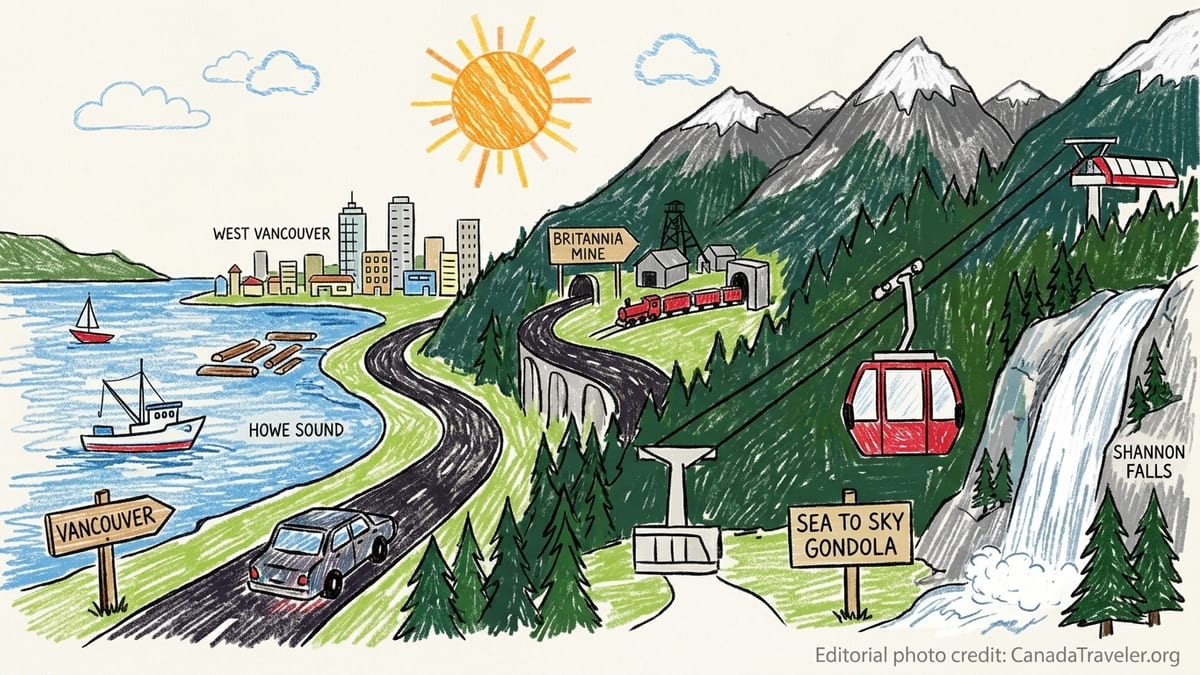
What surprised me, even though I knew it on paper, was how quickly the city falls away. One moment I was beside apartment towers and shopping centers in West Vancouver, the next the highway narrowed visually and curved against steep forested slopes. There are still houses clinging to the hillside above, but already the perspective feels different. I could sense the car edging between two worlds: the familiar grid of Vancouver behind and the wall of Coast Mountains beginning to rise ahead.
By Horseshoe Bay, roughly 25 kilometers from downtown and about a 30-minute drive with light traffic, the transition felt complete. The highway bends sharply here, with exit ramps down to the ferry terminal and a quick glimpse of ferries waiting to cross to Vancouver Island. I did not detour this time, but I pulled into a small viewpoint pullout just north of the village to look back. Behind me, the water of Howe Sound opened like a long fjord, while ahead the road clung to a narrow ledge between rock and sea. The Sea to Sky name finally made complete sense.
From this point north, the Sea to Sky Highway is officially the section of British Columbia Highway 99 that connects Horseshoe Bay with Squamish, Whistler and Pemberton. It is about 120 to 125 kilometers from Vancouver to Whistler, and on this trip my one-way drive time without long stops came in just under two hours northbound and a little over two hours southbound once afternoon traffic picked up.
Howe Sound, Weather and That First Stop at Porteau Cove
North of Horseshoe Bay, Howe Sound becomes the star. On my drive the tide was low and the water a blue-green sheet, broken by log booms and the occasional white fishing boat. The highway winds above small communities like Lions Bay, with stretches of 80 and 90 kilometer per hour limits and long concrete barriers between lanes. The upgrades done for the 2010 Winter Olympics are obvious in the wide shoulders and passing lanes that appear before hills and tighter curves.
About 40 minutes after leaving central Vancouver, I pulled into Porteau Cove Provincial Park. The turnoff is clearly signed and the access road loops under the highway into a paved parking area right on the shore. I paid for an hour of parking at the meter, which cost only a few dollars, and walked out on the old ferry dock to look back at the route I had just driven. The mountains drop almost straight into the sound here, and it is one of the first places on the drive where you can stand at sea level and look back up at Highway 99 etched into the slope.
The weather matters at Porteau Cove. On my visit the sky was bright with high clouds and patches of sun, so the views were expansive. On previous winter drives I have stopped here under low cloud when the tops of the peaks were completely hidden and the sound blended into the sky. If the forecast suggests clearing later in the morning, it can be worth timing your departure from Vancouver so that you reach this section of Howe Sound when the light is at its best.
In practical terms, Porteau Cove is a relatively low-cost stop. Aside from modest parking fees, there is no admission charge, there are toilets near the lot and picnic tables along the shore. Comparing it to some paid attractions later on the route, this was already a reminder that some of the best Sea to Sky viewpoints do not cost anything beyond the time you choose to spend.
Underground at Britannia Mine Museum and the BOOM Experience
From Porteau Cove it is only around a 10-minute drive to Britannia Beach. You see the former copper mine headframes appear above the highway before you reach the turnoff. I had pre-booked a mid-morning tour at Britannia Mine Museum, which is a paid stop that I deliberately chose in order to compare the experience with the many free viewpoints. General admission with the underground train and BOOM multi-sensory show was listed around 40 to 45 Canadian dollars for adults when I checked just before this trip, with discounted prices for youth, children and families.
The museum visit began in the heritage buildings beside the highway, where I checked in and joined a small timed-entry group for the underground tour. After being fitted with a hard hat, we boarded the narrow-gauge mine train that runs into the historic tunnel. The ride is short, only a few minutes, but the sensation of passing from bright daylight into cool rock, with the sound of the wheels echoing off the timbers, is instant and memorable. Inside, our guide stopped the train, demonstrated original drilling equipment and turned off the lights briefly so that we could feel just how dark a mine really is.
Back outside, the tour continued into the massive concentrator building for the BOOM experience. This is an immersive audiovisual show projected across the old machinery and walls. During my visit, the sequence combined narration about the mine’s history with synchronized sound effects that made the building feel like it was coming back to life. Lights flickered along the ore chutes and the deep rumble of imagined rock echoed through the structure. It felt less like a theme park effect and more like a carefully produced interpretation of the site, and it did a good job of explaining how such a remote industrial complex shaped the corridor long before tourism.
In terms of value, Britannia Mine Museum is not a quick or cheap roadside photo stop. My full visit took just under two hours, including the guided underground tour, BOOM, and time to walk through the exhibits and the gift shop. Parking was included with admission during my visit. For travelers on a tight budget, it may feel like a splurge compared to the free waterfalls and viewpoints, but as a way to understand the human story behind the Sea to Sky, I found it worthwhile and would repeat it on another trip, especially with children or anyone interested in industrial history.
Shannon Falls, Sea to Sky Gondola and Comparing the Costs
Leaving Britannia Beach, Highway 99 continues along Howe Sound for a few more kilometers before turning inland toward Squamish. Just before the town, I pulled into Shannon Falls Provincial Park, which is signed from the highway and shares the same general area as the Sea to Sky Gondola base. The parking loop at Shannon Falls was busy but manageable around midday, and importantly it was free when I visited, apart from a posted limit that discouraged all-day parking.
From the parking lot the main viewpoint trail to Shannon Falls is a very gentle, well-maintained path of about 350 meters each way. The surface is compact gravel and boardwalk, with only a slight incline through mixed forest. It took me less than 10 minutes to reach the primary viewing platform at an easy walking pace. At the platform, the falls drop in a series of white curtains down a granite cliff, framed by cedar and hemlock. There are secondary paths that continue a little farther, but the main maintained route ends at the lower viewpoints.
Shannon Falls quickly highlighted the contrast between free and paid attractions in the corridor. The falls are impressive, the walk-in is short and accessible, and the cost is essentially just your time. A few minutes away in the same corridor is the Sea to Sky Gondola, which I also chose to ride on this trip in order to evaluate its value. When I checked ticket prices just beforehand, a standard adult day ticket purchased at the window was listed in the range of 70 to 80 Canadian dollars, with small discounts for buying online in advance and for youth, children and seniors. There was free parking in the gondola lots with controlled duration, and the base area had a cafe and ticket plaza.
The gondola ride itself is about 10 minutes each way, lifting you from near sea level to a summit area with expansive views over Howe Sound, the Stawamus Chief and surrounding peaks. At the top I walked across the suspension bridge that links the two main viewing areas. On this clear day, the bridge offered dramatic sightlines straight down into the forested valley and out to the islands and water of Howe Sound. I also followed the short Panorama Trail loop, which is mostly flat and leads to another viewing platform. There is a larger network of longer hiking trails for experienced walkers, but even staying close to the summit plaza gave me a strong sense of being in the mountains.
Food and drink at the summit were priced at a typical resort premium. A simple counter-service lunch and a drink came to a little over 25 Canadian dollars. That meant my visit for one person, including ticket and food, was pushing well over 100 dollars. For a family the numbers rise quickly. Compared with Shannon Falls, which delivered a beautiful natural sight for no admission fee and required less than an hour including parking, the gondola is clearly a discretionary expense. Personally, I felt that the chance to see Howe Sound from above, walk the bridge and access easy summit viewpoints justified the cost on a good-weather day. On a low cloud or rainy day, when views are obscured and the wind at the top can be raw, the value would be much harder to justify.
Squamish: Working Outdoor Town before the Climb
Squamish lies only about 10 minutes beyond Shannon Falls. By the time I rolled down the wide commercial strip of Highway 99 into town, the character of the corridor had shifted noticeably. The sea was no longer in view and the landscape felt more enclosed by mountains. I pulled off into downtown Squamish for fuel and a late lunch. Fuel prices in town were slightly lower than in Vancouver on the day of my trip, and I filled up there more for convenience than savings, spending around 60 Canadian dollars for roughly three-quarters of a tank in a compact SUV.
Downtown Squamish has the feel of a working community that happens to attract a high number of climbers, bikers and hikers. On the sidewalks I saw people in construction gear and high-visibility vests alongside visitors in hiking boots carrying guidebooks. Cafes advertised both workday breakfasts and trail lunches. I stopped at a small independent cafe near Cleveland Avenue and spent under 20 dollars on a sandwich and coffee. Parking along the main streets was free within posted time limits, and I appreciated being able to stretch my legs on relatively flat streets before the highway began to climb again.
Unlike Whistler, Squamish has not been polished into a single-purpose resort. Industrial yards, freight trains and log booms remain part of the backdrop. For me, that mix is part of the appeal, since it reflects the Sea to Sky Corridor’s resource history that places like Britannia Mine Museum interpret. It also makes Squamish a logical pause point. If the weather ahead looks questionable or traffic reports mention accidents farther north, spending an extra 30 to 60 minutes in town is often preferable to sitting in a line of brake lights on the highway.
On this trip, the conditions remained dry and temperatures were in the low 20s Celsius through mid-afternoon. I checked a road conditions site devoted to the Sea to Sky corridor before leaving Squamish and again appreciated how often locals recommend avoiding this highway for the first time in the dark or during storms. Even in good weather, the mix of local traffic, tourists and commercial vehicles means that caution and patience make a noticeable difference in how the drive feels.
Into the Mountains: Brandywine Falls and Arrival in Whistler
North of Squamish the Sea to Sky Highway begins to feel more like a true mountain road. The views open periodically to reveal snow streaks on the higher peaks, even in early summer, and the road climbs past Daisy Lake Reservoir and through a series of sweeping curves. I passed the community of Garibaldi Highlands and the turnoff to the ski area at Black Tusk, then continued toward Brandywine Falls Provincial Park, which I chose as my final stop before Whistler.
The Brandywine Falls parking lot is on the west side of the highway, clearly signed, and accessed by a short side road. When I arrived in mid-afternoon, there were still spaces available and parking was free, with a posted closing time in the evening. From the trailhead it is an easy walk of roughly 500 meters to the main viewpoint over the falls, along a gravel path that crosses a railway line and passes through open forest. The payoff is a plunging waterfall dropping into a deep canyon, with views toward Mount Garibaldi on clear days.
Brandywine Falls felt different from Shannon Falls earlier in the day. It was quieter, for one, and the surrounding landscape had a more obviously alpine character. I spent about 40 minutes here, including time to walk to an additional viewpoint over Daisy Lake and to simply stand and listen to the sound of the water. Once again, the financial cost was zero beyond fuel and time. In the context of the full day, Brandywine proved to be one of the highest value stops and one I would easily repeat.
From Brandywine Falls it was about a 20-minute drive to central Whistler. The highway levels out as you approach the resort, and village-style roundabouts, pedestrian crossings and landscaped medians appear. I arrived at my Whistler accommodation just after 4:00 p.m., roughly eight hours after leaving Vancouver, but that day included about four hours of driving and four hours spread across stops at Porteau Cove, Britannia Mine, Shannon Falls, the Sea to Sky Gondola, Squamish and Brandywine Falls.
Whistler on Foot: Village Stroll and Lost Lake without Lift Tickets
Whistler is as polished as Squamish is pragmatic. Stepping into the pedestrian-only Village Stroll in the early evening, I passed boutique outdoor retailers, hotel terraces serving cocktails and bike shops displaying high-end mountain bikes. Many visitors automatically assume that experiencing Whistler properly requires purchasing lift tickets for Whistler Blackcomb, but on this trip I opted to explore the resort without paying for mountain access.
After checking into a mid-range hotel in the village that included underground parking in the nightly rate, I spent my first Whistler evening simply walking the Village Stroll. Dinner at a casual sit-down restaurant came to around 35 Canadian dollars before tip for a main course and a non-alcoholic drink. Prices were distinctly higher than Squamish, but the experience was also different, with live music in some plazas and a generally holiday-focused atmosphere everywhere you look. It felt more like an international resort town than a local hub.
The following morning I devoted to Lost Lake, a short walk or bike ride from the main village that does not require any lift access. The weather had shifted to partial sun with a few clouds, and temperatures were again in the low 20s Celsius. From the village, it took me about 20 minutes to walk up through a forested path to the Lost Lake area. There were no entrance fees, although parking near the lake has paid and time-limited options during busy summer days. I followed the flat, gravel loop trail around the lake for about an hour, stopping at beaches and docks where locals were swimming and paddling.
This half day at Lost Lake reinforced how much there is to do in Whistler without additional ticket purchases. While a day ticket for the Whistler Blackcomb gondola and peak-to-peak experience can run well over 200 Canadian dollars per adult during peak season, walking the village, exploring Lost Lake and accessing the Valley Trail network cost me only the price of a simple takeaway coffee and snack along the way. For travelers who have already invested in the cost of getting to Whistler, these low-cost options make it easier to justify one or two premium experiences instead of feeling obliged to pay for mountain access every day.
Driving Practicalities, Costs and Winter Tire Rules on Highway 99
Across the two days of this trip, I logged roughly 260 kilometers of driving between Vancouver, Whistler and return, plus a small amount of in-resort driving. In my compact SUV, total fuel costs came to about 85 Canadian dollars, split between top-ups in Vancouver, Squamish and Whistler. Parking varied from completely free at Porteau Cove, Shannon Falls, Brandywine Falls and downtown Squamish, to included with admission at Britannia Mine Museum, to paid in Whistler village and at some private lots.
Weather on this early summer journey was cooperative. I had dry pavement the entire way, with only occasional patches of dampness in shaded sections. That is not always the case, and anyone planning to drive the Sea to Sky Highway between fall and spring needs to pay attention to British Columbia’s winter tire regulations. Provincial law requires passenger vehicles to use winter-rated tires on designated routes from October 1, with requirements extending as late as March 31 or April 30 depending on the specific corridor. Along Highway 99, winter tire rules apply from just north of Horseshoe Bay through Squamish and Whistler during the colder months.
To meet the legal requirement, tires must carry either the mountain snowflake symbol or the M+S (mud and snow) marking and must have sufficient tread depth. Some safety organizations and many local drivers strongly recommend true winter tires with the mountain snowflake symbol rather than basic M+S all-season tires, particularly for those unfamiliar with mountain driving. Enforcement can vary, but at minimum you risk fines or being turned around at checkpoints if your tires do not meet the posted requirement, and insurance complications if you are involved in a collision without appropriate equipment.
Speed limits along the Sea to Sky Highway generally range between 60 and 100 kilometers per hour, with many curves and high-accident zones marked with advisory speeds. On my drive I frequently found that actual traffic speeds in clear conditions ran just slightly above the posted limits on straight sections, but dropped sharply whenever a line of vehicles formed behind a cautious driver or commercial truck. This is not a highway where saving 10 minutes should ever outweigh leaving adequate following distance and watching for sudden slowdowns.
Food and drink costs along the route scaled with how tourist-focused each stop was. A lunch and coffee in Squamish stayed under 20 dollars, the simple counter-service meal at the Sea to Sky Gondola summit crossed 25 dollars, and a casual dinner in Whistler village pushed 35 dollars without alcohol. Travelers on a budget can easily offset some of these costs by packing snacks or a picnic from Vancouver and using picnic tables at provincial parks instead of buying full meals at every stop.
The Takeaway
Looking back on this Sea to Sky Highway road trip, the most important realization is that the highway itself deserves as much attention as Whistler. If I were to repeat the journey, I would absolutely plan dedicated time again for Porteau Cove, Britannia Mine Museum, Shannon Falls and Brandywine Falls. Porteau Cove and Brandywine stand out as especially high-value, low-cost stops, offering dramatic views for almost no financial outlay beyond parking or fuel. Britannia Mine Museum and the Sea to Sky Gondola sit in a different category, providing strong experiences at higher prices. I would return to Britannia to share the underground train and BOOM experience with first-time visitors, and I would only ride the gondola again when the forecast promised clear views.
Squamish and Whistler complement each other rather than competing. Squamish’s working-town energy and lower prices make it a comfortable base for travelers focused on climbing, biking or backcountry trips. Whistler offers the polished resort atmosphere, dense dining options and walkable village layout that many visitors expect on a mountain holiday. Experiencing both on a single trip helped me appreciate the full spectrum of the Sea to Sky Corridor, from industry and everyday life to international tourism.
In terms of trip structure, I found that spreading the drive over at least one overnight stay in Whistler worked significantly better than trying to squeeze everything into a single long day. A focused driver could technically leave Vancouver in the morning, stop briefly at two or three viewpoints, spend a few hours in Whistler and return late at night. That version of the trip, however, would be more about ticking boxes than enjoying the coast-to-mountains transformation. With an overnight, I could linger at waterfalls, take the underground mine tour, ride the gondola, stroll Whistler Village and walk around Lost Lake without watching the clock.
Ultimately, the Sea to Sky Highway feels less like a road that happens to connect a city and a ski resort and more like a carefully arranged sequence of landscapes and stories. The sea, the cliffs, the mining history, the working town, the alpine lakes and the resort all appear in deliberate order. Driving it in daylight, in good weather, with time to stop, remains one of the most satisfying ways to experience the southwest corner of British Columbia.
FAQ
Q1. How long does it take to drive from Vancouver to Whistler without stops?
In light traffic and good weather, the drive from central Vancouver to Whistler typically takes about one hour and 45 minutes to two hours each way, following Highway 1 across the North Shore and then Highway 99 along the Sea to Sky corridor.
Q2. Is it safe to drive the Sea to Sky Highway in winter?
The highway is well maintained and plowed, but conditions can change quickly with snow, ice and limited visibility. Winter-rated tires are legally required from October 1 on the Sea to Sky corridor, and visitors unfamiliar with mountain winter driving may prefer to travel by shuttle or bus rather than driving themselves during storms or at night.
Q3. Do I really need winter tires if I am renting a car for Whistler?
Yes, if you are traveling between October and spring you should ensure your rental car is equipped with winter-rated tires marked with either the mountain snowflake or M+S symbols. This is both a legal requirement on designated sections of Highway 99 and an important safety measure on a mountain road that can experience snow and slush even when Vancouver streets are clear.
Q4. Are the Sea to Sky Gondola and Britannia Mine Museum worth the cost?
Both are worthwhile if you value their specific experiences and have room in your budget. Britannia Mine Museum offers a guided underground train tour and the BOOM show that bring the area’s mining history to life, while the Sea to Sky Gondola delivers elevated views, a suspension bridge and easy summit trails. Travelers on tighter budgets can skip one or both and still enjoy excellent free viewpoints and hikes such as Porteau Cove, Shannon Falls and Brandywine Falls.
Q5. Can I enjoy Whistler without buying lift tickets for Whistler Blackcomb?
Yes. Walking the pedestrian village, visiting Lost Lake, exploring the Valley Trail network and relaxing at lakeside parks all require no mountain lift ticket. While riding the main gondolas is a highlight for many trips, it is entirely possible to have a rewarding Whistler stay focused on walking, cycling, lakes and dining instead.
Q6. What are the best free stops between Vancouver and Whistler?
Standout free stops include Porteau Cove Provincial Park for sea-level views of Howe Sound, Shannon Falls for an easy 350-meter walk to a powerful waterfall, and Brandywine Falls for canyon and mountain vistas. Downtown Squamish also offers free short walks, river viewpoints and access to cafes without any admission fees.
Q7. Is parking easy to find along the Sea to Sky Highway?
Most provincial parks such as Porteau Cove, Shannon Falls and Brandywine Falls have dedicated parking lots close to the highway, though they can fill on sunny weekends. Parking in Squamish’s downtown core is generally free with time limits, while Whistler Village mostly uses paid underground or surface lots. Arriving earlier in the day improves your chances of finding convenient spaces.
Q8. What time of year offers the best views on the Sea to Sky Highway?
Late spring through early fall usually offers the clearest conditions, with long daylight hours, snow still visible on high peaks and minimal risk of snow or ice on the road itself. Winter can be spectacular with snow-covered scenery, but it demands more driving experience, winter tires and flexibility in case of storms or closures.
Q9. Is it better to visit the Sea to Sky Highway as a day trip or overnight?
You can complete the drive as a long day trip, but an overnight stay in Whistler or Squamish allows you to enjoy more stops without rushing and reduces fatigue. Splitting the journey across two days also makes it easier to avoid driving unfamiliar mountain sections in the dark, especially during winter.
Q10. How much should I budget for fuel, food and activities on this trip?
For a return drive in a compact car, fuel might cost around 70 to 100 Canadian dollars depending on prices and consumption. Casual meals along the route often range from 15 to 40 dollars per person, with Whistler at the higher end. Paid attractions like Britannia Mine Museum and the Sea to Sky Gondola can add 40 to 80 dollars per adult each, while many of the most scenic stops, including major waterfalls and viewpoints, remain free to visit.