


I arrived in Whistler this summer with a very clear picture in my head. Marketing images had sold me a vision of standing on a knife-edge ridge, staring across to jagged peaks and turquoise lakes, as if those views began the moment the shuttle door slid open. Instead, I wheeled my suitcase into a polished pedestrian village that felt far more like an upscale outlet mall than a wild alpine outpost, and discovered that the famous scenes on the brochures were locked behind a C$110 per adult sightseeing ticket.
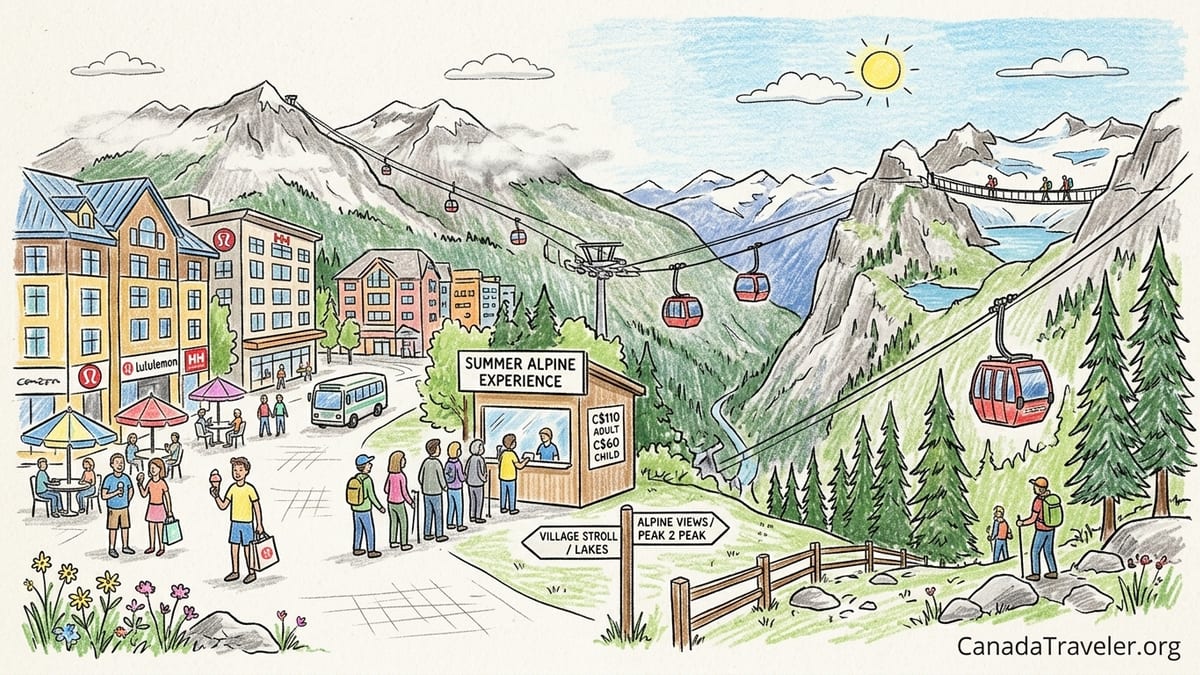
Arriving in Whistler Village: Expectations Versus Reality
Stepping off the bus in Whistler Village, I expected the mountains to hit me in the face. After all, Whistler is marketed with sweeping aerial shots of glaciers and the dramatic PEAK 2 PEAK gondola gliding above a deep valley. In reality, my first view was of branded hotel facades, patio umbrellas, and storefronts advertising yoga wear and designer outerwear. The peaks were there, somewhere above the rooftops, but they were not the immediate, cinematic backdrop I had imagined.
Walking the village stroll, I quickly realized that Whistler in summer is a resort town first and a wilderness experience second. The main plaza is full of families with gelato, bachelor parties in matching shirts, and conference lanyards. Music spills from pub patios. It is energetic and well maintained, but it feels curated and commercial. If you arrive expecting to be surrounded by raw alpine scenery from your first step, there is a disconnect. You see more of Lululemon and Helly Hansen than you do of glaciers.
The shops reflect that orientation. Outdoor gear stores like Escape Route and large brand outlets sit alongside jewelry boutiques and art galleries. Coffee can easily run to C$6 or more for a latte. A casual burger lunch with a drink in the village can approach C$30 per person after tax and tip. These prices may not shock someone used to major North American ski resorts, but they matter when you start thinking about stacking meals on top of the cost of simply getting a look at the alpine.
There are free pleasures here. The village stroll is attractive, with landscaping, public art, and a busy but relaxed pedestrian zone. Kids splash in the small streams and chase the carved bear statues. Yet the core truth is that Whistler Village itself does not deliver the signature alpine views that appear in advertising. Those views sit higher up the slopes, and access comes at a price.
The Price of a View: 2026 Summer Alpine Experience Sticker Shock
If you want to trade plaza patios for alpine views, Whistler directs you to the Summer Alpine Experience ticket. In 2026, that price settled at roughly C$110 per adult and about C$60 for children aged 7 to 12 for a single day of sightseeing access. In practical terms, a family of four with two adults and two children faces a ticket window total right around C$340 before buying a single sandwich, coffee, or souvenir.
What does that expensive ticket actually include? In 2026, a Summer Alpine Experience day ticket provided gondola upload from either Whistler Village or the Blackcomb base, access to the PEAK 2 PEAK gondola across the valley while it operated in summer, and then a download back to the base. It also included access to alpine hiking routes on both mountains and marquee features on Whistler like the Cloudraker Skybridge suspension bridge and Raven’s Eye viewing platform, when they were open and not closed by weather or lingering snow.
In pure infrastructure terms, Whistler delivers a lot. The PEAK 2 PEAK is an impressive engineering feat. The gondola cabins are spacious and comfortable, the ride between Whistler and Blackcomb takes about eleven minutes, and the valley floats far below the glass bottom in a few special cabins. On a bluebird day you can see glaciers and lakes stretching in all directions. You can easily spend several hours linking short trails from the Roundhouse Lodge on Whistler to PEAK 2 PEAK and then wandering around the Rendezvous Lodge area on Blackcomb.
The problem is that all of this assumes both perfect weather and full seasonal operation. That C$110 adult ticket price does not come with a guarantee of views. Clouds, low ceilings, or smoke can mean you ride straight into a white wall. High winds can shut down the PEAK 2 PEAK or upper lifts like the Peak Express that access the most dramatic ridgelines. What you have paid for, technically, is access, not a clear panorama. On my own visit, I watched one family debate at the ticket window, looking at a cloud-shrouded ridge while the agent politely reminded them that tickets were nonrefundable if the clouds did not lift.
How Much Mountain Time Do You Really Get?
Whistler’s official messaging emphasizes more than 50 kilometers of alpine hiking trails and a full day’s worth of mountain exploration included with a Summer Alpine Experience ticket. In practice, the amount of meaningful mountain time you receive is heavily shaped by logistics, queues, and the limitations of your group. A common pattern goes like this: you line up in the village mid-morning, wait 15 to 30 minutes to upload on the Whistler Village Gondola, ride about 25 minutes to the Roundhouse lodge, then spend time orienting yourself at the top.
By the time you have used the washroom, grabbed a coffee, checked the trail map, and marshaled kids or older relatives, an hour can evaporate. The short interpretive trails that leave from the Roundhouse, such as the short loop around the Peak Express access area, offer some nice views without committing to a major hike. Yet they are also crowded and feel more like walking paths in a busy park than a remote mountain experience. To reach the famed suspension bridge on Whistler Peak, you need an additional chairlift ride on the Peak Express and a short but exposed path, which can be intimidating for anyone with a fear of heights.
Once you factor in riding the PEAK 2 PEAK across to Blackcomb, exploring for an hour or two on that side, and then lining up for your download, you realistically might get three to five hours of actual mountain wandering. For a solo hiker in good shape determined to string together routes like High Note Trail or longer loops, the ticket can unlock a full day of adventure. For a family with young children or older parents, your “alpine experience” may look more like riding gondolas, taking photos near the lodges, and eating an expensive lunch at altitude.
This matters because that C$340 family outlay is most easily justified if you use most of the day and actually get onto the trails. If you arrive late, encounter delays, or have weather shut down key lifts, your paid access shrinks rapidly. There is no partial refund if afternoon storms close the Peak Express or if you discover at the top that your kids are too tired or nervous to walk the suspension bridge.
Weather, Seasonal Closures and the PEAK 2 PEAK Gap
One of the most misleading assumptions I heard from fellow visitors in 2026 was that the PEAK 2 PEAK gondola “runs all summer.” In reality, Whistler’s own published operations calendar told a different story. For the 2026 season, daily PEAK 2 PEAK summer operation finished on September 7, while Whistler’s broader Summer Alpine Experience continued in a more limited form until around September 20 on Whistler Mountain. In other words, you could arrive in mid or late September, see brochures advertising PEAK 2 PEAK and valley-spanning cabins, and yet find the signature gondola closed for seasonal maintenance.
This gap matters for value. If you bought a late-season sightseeing ticket expecting to float between Whistler and Blackcomb on world-record cables, you would have been disappointed to discover that your access was effectively limited to one mountain with upload, some trails, and download. Staff do try to explain what is open and closed at the window, but they cannot control muddled expectations created by older marketing or third-party tour descriptions that are not updated as quickly.
Even in the peak of summer, weather is a silent decision-maker. Cloud can roll in during the late morning and sit stubbornly around the summit. I watched cabin after cabin disappear into pea-soup fog while people who had paid premium prices pressed their noses against the glass, seeing nothing but gray. On other days, wildfire smoke dulls the views into a brown haze. The lift system itself is long and complex, which means wind or lightning anywhere on the network can interrupt service. When a key lift closes, mountain operations may try to reroute guests, but some alpine zones and viewpoints will simply become unavailable.
Whistler does not hide the fact that operations are “weather permitting,” yet in the moment that fine print feels abstract. At the ticket window it is presented as a quick verbal caveat rather than a bold warning about the risk to your C$110. If you are visiting for only a day or two, you may not be able to wait for a clearer morning. You either gamble on the sky or you give up on the alpine experience you planned your trip around.
Paid Adventure Vs Free Whistler: Where the Money Goes
Whistler in summer is built around upsells. Once you accept the baseline cost of getting up the mountain, you are surrounded by offers to spend still more: guided alpine hikes, mountain-top dining packages, zipline tours, and of course the famous Whistler Mountain Bike Park for those who ride. For non-skiers and non-bikers, many of these options are either irrelevant or financially out of reach.
A half-day zipline tour with a major operator such as Ziptrek or Superfly commonly sits in the C$150 to C$200 per adult range in recent seasons, with family totals quickly climbing above C$600 after tax. A full-day bike park ticket with a rental and protective gear can push well past C$200 per person. Whitewater rafting and ATV tours populate the brochure racks with price tags that make the C$110 sightseeing ticket start to look, perversely, like the entry-level option.
Set that against what is free, and the contrast becomes sharp. Strolling the village, lounging by the public Olympic Plaza lawn, or walking the paved path along Fitzsimmons Creek costs nothing. The Valley Trail network lets you cycle or walk from the village down to lakes like Alta Lake and Lost Lake on separated paths with good signage, all without a ticket gate. Lost Lake Park in particular offers a gentle loop trail around the shoreline with swimming docks and forested sections, and it sits a short, mostly flat walk or bike ride from the village center.
These low-cost or free experiences are pleasant and can absolutely fill a couple of summer days for a family content with lakeside picnics, playgrounds, and easy walks. The issue is not that Whistler lacks non-paid beauty. It is that the marketing gravity remains pointed at the expensive high alpine: glass-bottom gondola cabins, skybridges, and dramatic ridgelines. Visitors arrive primed to think that a Whistler trip is incomplete without them, and that belief opens their wallets.
Squamish as a Lower-Cost Alternative for Scenery
To understand Whistler’s value problem for non-skiers and non-bikers, it helps to look down the Sea to Sky Highway at Squamish. About 45 minutes closer to Vancouver, Squamish has grown into its own outdoor destination, but it still feels more like a working town backed by wild scenery than a polished resort. Crucially, many of its showpiece experiences come without a C$110 ticket attached.
Take waterfalls. In Squamish, Shannon Falls Provincial Park offers a short, free walk to a viewpoint below a 335 meter waterfall. Parking is free in the main lot outside of peak holiday crushes, and even when the secondary paid lots are used, you are not buying an expensive gondola ticket, only covering basic parking. The Chief, or Stawamus Chief, rises above the highway with a steep but cost-free hiking trail to extensive viewpoints over Howe Sound and the Squamish estuary for those fit enough to tackle the stairs and ladders.
The Squamish Estuary and North Beach area deliver broad tidal flats, channels, and mountain walls reflected in calm water. Again, the access is either free or requires only a modest parking fee. You can wander for an afternoon watching eagles and kiteboarders without ever standing in line for a lift. The Sea to Sky Gondola outside town does charge a significant fare, but important here is that Squamish’s signature feel of granite, fjord and forest is available from free roadside lookouts, river dikes, and provincial parks.
In Whistler, by comparison, the valley is narrower and more forested. You can enjoy lakes and short forest paths, but the kind of expansive, open vistas that define the region are concentrated higher on the mountains within the lift-access zone. That difference is not always obvious in pre-trip research. It becomes painfully clear when you realize that in Squamish, you are already in front of a postcard view when you step out of your car at the estuary dyke, while in Whistler, you are in front of a Starbucks and a ticket office.
When the Mountain Ticket Can Be Worth the Money
Despite my criticism, there are times when Whistler’s Summer Alpine Experience ticket genuinely earns its cost. If you are a hiker who will use a full day on the mountain, the C$110 can unlock access to high-elevation trails that would take many hours and far more effort to reach on foot elsewhere. Routes like the High Note and Half Note trails on Whistler lead to broad views over Cheakamus Lake and the surrounding peaks, providing a sense of scale that is hard to duplicate in the valley.
Photo-focused travelers can also find value, but only when conditions align. On a crisp August morning after a cold front, the air can be incredibly clear, with mountain shadows sharp and the glaciers glowing blue-white. In that scenario, riding the Whistler Village Gondola up, crossing on PEAK 2 PEAK, and circling back to the suspension bridge before descending can give you a full album of dramatic images in a single loop. If you treat the sightseeing ticket as a once-per-trip splurge and time it carefully for the best weather day of your stay, the per-hour cost feels easier to justify.
The ticket also makes more sense if you access it as part of a pass or package. Some guests hold Epic or Whistler Blackcomb passes that include summer sightseeing access, spreading the cost across a season. Others stay in packages that bundle lodging and lift tickets at a discount that can meaningfully lower the effective daily rate. If you are already holding a pass, the marginal cost of going up for a few hours is low, and the decision becomes about time rather than money.
However, those are specific cases. The average one-time visitor paying window rates, especially a family of four, needs to be honest. If your group includes people who dislike heights, tire easily, or are indifferent to alpine hiking, much of what you are buying with that C$340 will go unused. In that case, the same budget could fund several days of valley activities, a rental car to explore Squamish and provincial parks, and meals that feel less like cafeteria food priced at altitude.
The Takeaway
After my own visit, and many conversations with other travelers in 2026, I came away convinced that Whistler in summer is far from an automatic choice for non-skiers and non-bikers. The resort offers a polished village, an impressive lift system, and access to big alpine terrain. It also asks you to pay heavily for the privilege of seeing the very mountains that define its brand. If you arrive assuming the postcard views begin in the plaza, you will feel misled. The truth is that those views sit behind a C$110 adult ticket and a layer of weather and operational uncertainty.
For some travelers, that ticket is worth every dollar. Keen hikers, photographers chasing specific shots, and passholders who can go up repeatedly on clear days will find the Summer Alpine Experience a powerful tool. For many families and casual visitors, though, the free and low-cost offerings in Whistler’s valley combined with day trips to places like Squamish provide plenty of scenery, water, and walking without the financial stress of a single high-stakes gondola purchase.
If your idea of a good mountain holiday centers on cafés, relaxed lake days, easy strolls, and the occasional short viewpoint walk, you may find that Whistler’s village and nearby lakes give you enough. In that scenario, your money might be better spent on an extra night in a comfortable hotel and a rental car to reach Shannon Falls, the Squamish estuary, or other Sea to Sky viewpoints.
On the other hand, if you have dreamed specifically of walking Whistler’s high ridges, stepping out onto the Cloudraker Skybridge, or gliding across the valley on PEAK 2 PEAK, then plan firmly around that costly ticket. Watch the weather, build flexibility into your schedule, and accept that you are paying not just for transport but for a curated alpine experience at one of the most commercialized mountain resorts in North America. Only by matching your expectations and your priorities to the reality on the ground will you know if Whistler in summer is truly worth it for you.
FAQ
Q1. Do you get classic alpine views in Whistler without buying a lift ticket?
Not really. You can enjoy pretty lake and forest scenery from the valley and village, but the wide glacier and peak panoramas used in marketing are located high on Whistler and Blackcomb Mountains, which you access via paid gondolas and chairlifts.
Q2. How much does the 2026 Summer Alpine Experience actually cost for a family?
In 2026, you were looking at roughly C$110 per adult and about C$60 per child aged 7 to 12 for a single day of sightseeing. For two adults and two children that meant spending around C$340 before food, drinks, or souvenirs.
Q3. What happens if the weather is bad on the day of my sightseeing ticket?
If cloud, smoke, or rain move in, you may ride into limited or no views, and certain lifts can shut for safety. Tickets are sold as weather dependent and are generally nonrefundable once used, so poor visibility does not usually trigger a refund.
Q4. Was PEAK 2 PEAK operating all summer in 2026?
No. In 2026, PEAK 2 PEAK ran daily in peak summer but ceased its summer operation after September 7, while some Whistler alpine sightseeing continued on a reduced basis until about September 20. Late-season visitors could find the signature gondola closed.
Q5. How much time on the mountain do you typically get with a sightseeing ticket?
If you start mid-morning and return in late afternoon, many visitors end up with three to five hours of actual walking and exploring on the mountain once you subtract gondola rides, line-ups, meals, and orientation at the top.
Q6. Are there good free things to do in Whistler in summer?
Yes. You can walk the village stroll, relax in Olympic Plaza, explore the Valley Trail, and visit nearby lakes like Lost Lake or Alta Lake without paying for lift access. These free options can easily fill one or two days.
Q7. How does Whistler compare with Squamish for low-cost scenery?
Squamish offers impressive views at much lower cost, with free or inexpensive access to places like Shannon Falls, the Stawamus Chief, and the estuary. Whistler’s most dramatic vistas are more concentrated in its lift-served alpine zone, which requires paid tickets.
Q8. Is the sightseeing ticket worth it if I do not hike much?
It can be, but only if you strongly value the gondola rides and a brief taste of high alpine terrain. If you are unlikely to walk more than short paths near the lodges, the per-hour cost is very high compared with enjoying lakes and viewpoints in the valley or in Squamish.
Q9. Can I rely on PEAK 2 PEAK being open if I visit in September?
No. Operations vary year to year, but in 2026 PEAK 2 PEAK stopped its summer schedule on September 7. Always check the official operations calendar for your exact dates instead of assuming it will run through late September.
Q10. Who should probably spend their summer budget somewhere other than Whistler?
Travelers who dislike heights, rarely hike, or are sensitive to high activity prices may be better off focusing on Squamish, provincial parks along the Sea to Sky Highway, or other mountain towns where signature viewpoints are easier and cheaper to reach.