


In late September 2025, I boarded a small Pacific Coastal Airlines plane in Vancouver with a single carry-on duffel, a borrowed 400 mm lens and a knot of nervous excitement. My destination was Klemtu, a remote community on the central coast of British Columbia and home of the Kitasoo Xai’xais Nation. For years I had dreamed of coming here, into the heart of the Great Bear Rainforest, to look for grizzlies and the elusive white Kermode, or spirit bear. I knew I was chasing something that could not be guaranteed. The bears might not appear. The weather might shut down boats. Flights might be delayed. But this was precisely the point. A journey into the Great Bear Rainforest is not a packaged wildlife show. It is a step into an Indigenous-led conservation story where humans are guests, the rainforest sets the terms, and the bears decide if they will be seen at all.
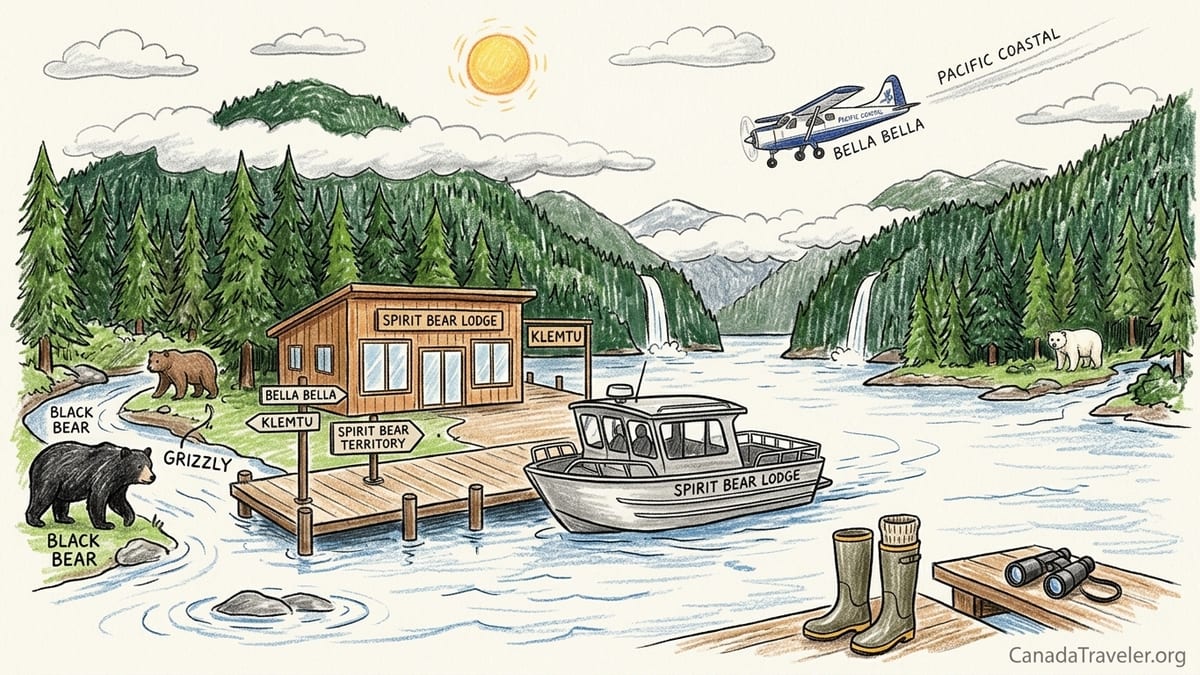
Arriving in Klemtu: First Glimpse of the Great Bear Rainforest
The trip began with the logistics that define any visit to a truly remote coast. I flew from Vancouver’s South Terminal to Bella Bella on September 24, 2025, on an early afternoon Pacific Coastal Airlines flight, a journey of about 1 hour and 10 minutes. After a brief pause in the small terminal at Bella Bella, I boarded a second, shorter hop to Klemtu. The round-trip airfare for this pair of flights ran just under 900 Canadian dollars before taxes, a reminder that reaching the Great Bear Rainforest is an investment before you even see your lodge.
As the plane descended into Bella Bella, the patchwork of islands and fjords began to take shape. From above, the Great Bear Rainforest looks like a mosaic of dark green and silver, cedar and hemlock rising almost straight from the sea. Low clouds clung to the mountaintops. Ribbons of waterfalls dropped directly into the salt water. By the time we circled over Klemtu, a compact village on Swindle Island, the runway appeared as a small clearing carved from endless forest.
A guide from Spirit Bear Lodge met our group at the dock with a skiff for the short transfer into the main village. Spirit Bear Lodge is fully owned by the Kitasoo Xai’xais Nation and sits directly on the waterfront, its cedar facade and big picture windows facing west toward the passage. It felt more like arriving at a community guest house than a conventional hotel. Over the next six days, the lodge would be our base for forays into the Kitasoo Xai’xais territory, one of the few places on Earth where the recessive gene that creates the white Kermode bear is particularly concentrated.
Check-in was informal: boots lined up by the door, a quick safety briefing, and then room assignments. My oceanview room was simple but thoughtfully finished, with local art on the walls and a view over the boardwalk and bobbing fishing boats. I dropped my duffel, layered on a fleece, and stepped outside just as the evening rain settled in, soft as mist but insistent enough to remind me that this is one of the wettest temperate rainforests on the planet.
Understanding the Spirit Bear and Indigenous-led Conservation
Before we set foot in a boat, the guides gathered us in the great room for an orientation that framed the entire week. One of the first points they made was both scientific and symbolic. The spirit bear, or Kermode bear, is not a separate species and it is not a polar bear. It is a rare color morph of the American black bear, created by a recessive gene that turns the fur cream or white while the skin and eyes remain dark. Here in Kitasoo Xai’xais territory and neighboring Gitga’at lands, the gene occurs at higher frequencies than anywhere else, but even here white bears are a minority among black bears.
The second point was about ownership and stewardship. Spirit Bear Lodge exists because the Kitasoo Xai’xais Nation chose tourism as one pillar of a larger conservation economy. The lodge’s profits flow back into the community, supporting programs such as the Kitasoo Xai’xais Stewardship Authority and a network of Indigenous Guardian and Watchmen crews that patrol their marine and terrestrial territories. They monitor commercial operators, enforce local protocols in sensitive bear estuaries and salmon streams, and act as the on-the-water face of Indigenous governance in a region that was, until relatively recently, dominated by outside logging and fishing interests.
In practice, that meant our bear-viewing days were structured around Kitasoo Xai’xais rules, not just provincial regulations. We would travel only with Indigenous guides authorized to be in particular inlets. We would keep to designated landing sites, observe strict distance guidelines around bears and never step ashore in certain estuaries that are considered off-limits for cultural or conservation reasons. Seeing a spirit bear would be a privilege extended by both the land and its people, not a product we had purchased.
The guides were also careful to calibrate our expectations. There would be no promises. Wildlife, especially in the shoulder seasons, moves on its own schedule. Runs of chum and coho salmon were already fluctuating with shifting ocean conditions. Some rivers that supported strong bear viewing a decade ago were now less reliable. We might spend ten hours in the rain on a stream and see only ravens and mergansers. If that felt like too much uncertainty for the price, they said gently, visitors should reconsider why they had come.
Life at Spirit Bear Lodge: Costs, Comfort and Community
I had booked a six-night “Spirit Bear & Coastal Adventure” package for late September, which, for 2025 and 2026 departures, runs in the range of 8,000 to 9,000 Canadian dollars per person based on double occupancy, including accommodation, meals, guided daily excursions, and marine transport from Klemtu. The figure is undeniably high, especially compared with more accessible wildlife trips on Vancouver Island or around Vancouver and Campbell River that might cost a few hundred dollars per day. But the difference became clear as soon as the rhythm of lodge life settled in.
After a family-style dinner featuring salmon, local greens and bannock, one of the senior guides walked us through the next day’s plan. Spirit Bear Lodge uses a flexible schedule that reacts to tides, weather and recent wildlife activity. Groups are small, often six to eight guests per boat, accompanied by at least two staff including a cultural guide and a driver. The price covers those high staff-to-guest ratios, fuel for hours-long boat runs deep into the channels and fjords, and the permit and stewardship fees that support Indigenous-led monitoring of the same waters.
Rooms at the lodge are simple but comfortable, with ensuite bathrooms, soft duvets and views that made it hard to close the curtains. There is no television. Wi-Fi existed but was limited and sometimes offline, and cell reception in Klemtu ranged from patchy to nonexistent once we left the village. It was understood that guests would download critical messages before arrival and then accept being mostly unplugged. Given the reality of marine radio as the primary line of communication once on the water, this felt less like a novelty and more like a sensible adaptation to a landscape where fiber-optic cables and cell towers do not reach every inlet.
From a packing perspective, I was grateful I had followed the lodge’s pre-trip checklist. In September, daytime temperatures hovered between 8 and 13 degrees Celsius, with constant dampness making it feel colder on the boat. I lived in a merino base layer, midweight fleece, and a waterproof-breathable shell, topped by the lodge-supplied flotation jacket. Waterproof pants, warm hat, thin gloves, and wool socks were essential. The footwear of choice was knee-high rubber boots for stepping into tidal shallows. Without them, every landing would have meant a soaker before the day even began.
Daily Boat Journeys and Weather-Dependent Plans
Most mornings started with the muffled thud of rain on the lodge roof and the smell of coffee drifting from the dining room by 6:30 a.m. After breakfast and a quick safety recap, we shrugged into survival suits, checked camera dry bags and stepped into aluminum boats fitted with covered cabins and open viewing decks. Out on the water, the timetable was governed not by a resort schedule but by the weather, swell and tide charts laid out on the wheelhouse console.
On our second full day, forecast gales in the outer channels forced the guides to cancel a longer run north and instead redirect us to a sheltered inlet closer to Klemtu. Nobody argued. In this part of the coast, high winds and steep chop can turn a leisurely wildlife cruise into a hazardous crossing in minutes. Caution is not an inconvenience. It is the baseline for ethical operations where the same skipper might also be responsible for getting an elder to a medical appointment or a child home from boarding school.
The hours that followed were a lesson in how much time serious wildlife viewing demands. We spent close to nine hours on the water that day, with perhaps three of those hours truly stationary, engines off, drifting silently near a river mouth watching for a flicker of white in the trees. A humpback surfaced in the distance, sea lions argued on a rocky haul-out, and the eagles were a constant presence, but no bears appeared on the shoreline. The guides quietly scanned every gravel bar through binoculars, as familiar with each rock and deadfall as a city bus driver is with traffic lights. When it became clear that bears were not feeding in that estuary, we shifted to a second site farther inside the inlet, repeated the slow vigil, and again saw only tracks and scat telling us we had missed them by a tide or two.
Lunch was eaten standing in the drizzle, leaning against the cabin wall, trying to keep a sandwich dry inside a biodegradable wrapper. It may not sound romantic, but those eight and nine-hour days at sea are what the high tariff is really buying: time and access, the staff and fuel to go where the bears might be rather than where the road or a quick out-and-back tour happens to lead.
Bear Viewing Rules, Safety and Respectful Distance
When grizzlies and black bears did appear later in the week, the care with which our guides approached them was striking. Even before we saw our first bear, we had already been walked through Kitasoo Xai’xais bear viewing guidelines. These build on British Columbia’s provincial wildlife safety advice by setting more conservative distances and emphasizing behavior over photography. We were told that at the first sign of stress from a bear pausing in its feeding, standing to look directly at us, or moving repeatedly toward forest cover without resuming normal behavior, boats would immediately back off and increase the distance, even if it meant losing a shot.
For much of our bear viewing, we watched from 80 to 150 meters away, using binoculars and long lenses rather than smartphones. That felt further than some tourists might expect, especially those used to images taken from platforms elsewhere in B.C. where bears pass almost under the viewing blind. However, on these remote streams without fixed platforms, maintaining space is what allows bears to keep their natural wariness and feeding patterns. The guides reminded us that a bear forced from prime fishing water by boat traffic loses both calories and confidence, a dangerous combination for an animal trying to fatten up before denning.
We also carried bear spray on shore excursions and moved in compact groups of at least four, speaking quietly but steadily so bears could hear us coming. Guides led, guests followed. Food never left the boat, and there were firm rules about no snacks in pockets and no scented products. The message was clear. An encounter with a food-conditioned bear is a failure of human behavior that can end with an animal being destroyed. Respecting rules about distance, food storage, and noise was not optional, it was foundational to the privilege of being in these valleys at all.
For readers considering more accessible bear viewing in British Columbia, such as guided boat trips from Campbell River or shore-based tours in the Khutzeymateen Provincial Park area near Prince Rupert, many of the same principles apply: small groups, telephoto lenses and a willingness to let bears dictate the terms. What sets Indigenous-led operations in places like Klemtu apart is the alignment between viewing guidelines and community values, enforced by Indigenous Guardian programs that are present on the land and water throughout the season.
Encounters with Grizzlies and the Elusive Spirit Bear
Our first grizzly came on the fourth day, in a side channel of a river where chum salmon were still pushing upstream in decent numbers. We had already spent close to six hours that day moving between estuaries, some nearly silent, others filled with gulls and eagles but no bears. Late in the afternoon, as the rain finally thinned to a mist, a shape materialized at the forest edge, the familiar muscular shoulders and dish-shaped face unmistakable even at a distance. The guides had us kneel low on the boat’s forward deck. The engine was cut. For the next 45 minutes, we watched a single subadult grizzly methodically work its way along the bank, head sweeping side to side, occasionally plunging after a salmon with a splash audible over the drizzle.
It was not a dramatic encounter. There were no towering rears or aggressive displays. Instead, it was a quiet window into a working day in a bear’s life. The bear barely glanced at us, more intent on the fish. Once, when it paused and looked up, the guides exchanged a look and quietly signaled the skipper to ease the boat backward a few meters, increasing the gap and letting the bear reclaim a bit more of the channel. Those extra seconds spent adjusting our position cost nothing, but they spoke volumes about the ethos on board.
The spirit bear proved more elusive. Over six days, with four dedicated spirit bear excursions, we saw multiple black bears along shaded creeks, two different grizzlies on salmon rivers, and more marine wildlife than I could log in a notebook. We found fresh white bear tracks along a mossy side creek one morning, their edges still crisp from the previous tide, and listened as our guide described the white bear she had watched raise cubs in that same drainage over several years. Yet the bears themselves did not show. On our final spirit bear day, we sat in a blind for nearly seven hours, cameras ready, as rain hammered the tarp overhead and pink salmon finned in the pool below. Bald eagles, martens and ravens came and went, but the white bear never did.
There was a flicker of disappointment among the group as we motored back to the lodge in the blue half-light of evening, but the guides did not apologize. They could not, honestly. White bears are rare even here, and changing salmon runs may be reshaping where they choose to feed in any given year. To promise a sighting would be to turn a wild animal into a scheduled performance. Instead, we shared stories of what we had seen and what it meant to spend hours in full attention to a single creek, aware that the bears had likely watched us from the treeline more than once, unseen.
The Price of Remoteness and Comparing Other Wildlife Options
Spirit Bear Lodge sits at the premium end of British Columbia wildlife experiences, both in location and cost. A multi-day stay that approaches or exceeds 8,000 Canadian dollars per person will not be feasible for every traveler, and it should not be framed as the only path to meaningful bear encounters. More accessible options exist, often at a fraction of the price, particularly around Vancouver Island, the Fraser Valley and the Cariboo, where guided day trips to view black bears, grizzlies or whales might cost between 200 and 500 dollars for a full day on the water.
What the premium in Klemtu buys is not luxury in the conventional resort sense. Rooms are comfortable but not opulent. There is no spa, no swimming pool, and no evening entertainment beyond slide shows and conversations. Instead, the cost reflects remoteness, Indigenous ownership and the intensity of logistics. Everything from fresh produce to fuel arrives by barge or small plane. Guides are drawn from the local community, trained over years and paid for a full season of work that includes stewardship and monitoring beyond just tourist-facing hours. Boats travel long distances each day into exclusive access areas where only Kitasoo Xai’xais-sanctioned operators can bring guests.
The price also incorporates a form of conservation contribution. When you sign your invoice, you are paying into Indigenous-led management of salmon streams, bear estuaries and cultural sites that predate any provincial park boundary. For some travelers, especially those seeking the lowest possible per-day rate, that may not be decisive. For others, it is exactly why they choose Klemtu over a cheaper but more crowded destination.
If your budget does not stretch to a week at a remote lodge, it is still possible to build bear and rainforest experiences into a broader British Columbia itinerary. Guided tours on the Atnarko River near Bella Coola, for instance, take guests in rafts along a road-accessible salmon stream in Tweedsmuir South Provincial Park, especially during the heavy fall run from mid August into October. Here, costs are measured in hundreds rather than thousands of dollars, and visitors can base themselves in a mix of motels, cabins and campgrounds reached by the awe-inspiring but fully drivable Highway 20. The trade-off is that you will share those bears with more people, and you will be viewing from a corridor adjacent to a road rather than within an Indigenous community’s exclusive fjords.
Planning, Seasonality and Who This Journey Is For
For anyone considering a spirit bear trip, planning is both practical and philosophical. On the practical side, peak season for bear viewing in the Great Bear Rainforest typically runs from late August into early October, when salmon are moving upriver in sufficient numbers to draw bears to open banks and shallows. Many remote lodges, including Spirit Bear Lodge, open bookings one to two years ahead, and prime dates often fill quickly. For a September 2026 departure, I would advise inquiring by late 2024 or early 2025, especially if you are tied to specific school holidays.
You should also build flexibility into your travel dates. Remote flights along the central coast are vulnerable to weather delays, and sailings for the regional ferry services can be rescheduled by storms or operational needs. In my case, I padded an extra night in Vancouver on either side of the trip. If fog had grounded my Bella Bella flight, I would have missed a day at the lodge but not my international connection home. Travel insurance that covers missed connections and weather-related delays is not an accessory here, it is part of responsible planning.
Philosophically, this kind of journey is not for everyone. It is for travelers who are comfortable with long hours of patient watching, who understand that wild animals are not owed to them, and who see value in supporting Indigenous stewardship even if the star species does not appear. It is for photographers who can accept that many of their frames will be rain-streaked, distant or empty, but who know that the moments when everything aligns will mean more because of it.
If your goal is a near-certain bear sighting in a limited vacation window, a shorter grizzly viewing program on the Atnarko River accessed from Bella Coola, or a marine wildlife day tour from Vancouver Island, may be a better fit. You will still need to follow bear safety rules, dress for coastal rain and respect the animals’ space, but you will likely trade some depth of cultural immersion and remoteness for convenience and cost savings.
The Rainforest as Reward, With or Without a Spirit Bear
On my last evening in Klemtu, the clouds finally lifted enough to reveal the outline of the mountains that had been hiding behind rain all week. Low sun broke through in shafts that turned the moss on the trees almost fluorescent. The sea flattened to a pewter mirror. A thin line of smoke rose from one of the village houses, and a pair of children walked along the boardwalk below the lodge, their laughter carrying up over the water.
I had not seen a spirit bear. The white-furred icon that had drawn me north remained concealed in the cedar and hemlock. Yet as I stood on the balcony watching the changing light, I realized that my clearest memories from the week were not of individual animals but of the texture and sound of the rainforest itself: the drip of rain from cedar fronds, the booming wingbeats of ravens over creek mouths, the dense green silence of estuaries where human voices were a temporary and carefully moderated intrusion.
For me, the journey was justified by those hours of immersion. I had watched grizzlies fish on uncluttered salmon streams, traveled through fjords where Indigenous stories are mapped onto every headland, and seen how an Indigenous-owned lodge can anchor a sustainable local economy on a coast long scarred by extractive industries. I had also been reminded, repeatedly, that there is a difference between visiting wild places and consuming them. The Great Bear Rainforest does not owe visitors a checklist of species. It offers, instead, a chance to see what it looks like when human presence is negotiated on older terms.
So who should commit to a trip like this? Travelers willing to plan at least a year ahead, budget honestly for high costs, and accept that no bear, grizzly or spirit, will ever be guaranteed. People who are curious about Indigenous governance in practice, not just as a talking point. Photographers and naturalists who value time and context over volume of sightings. If that sounds like you, then even a week of rain and absent spirit bears can still be one of the richest journeys you will ever take.
FAQ
Q1. What is a spirit bear and is it a separate species?
A spirit bear, also known as a Kermode bear, is a rare white or cream-colored form of the American black bear caused by a recessive gene. It is not a separate species and it is not a polar bear.
Q2. When is the best time to visit the Great Bear Rainforest for bear viewing?
Peak viewing typically runs from late August through early October, when salmon runs draw bears to rivers and estuaries. Many lodges, including Indigenous-owned ones, set their main operating season around these weeks.
Q3. How far in advance should I book a trip to Spirit Bear Lodge or similar remote lodges?
For popular spirit bear and grizzly programs, it is wise to book 12 to 24 months in advance, especially for September departures and for travelers tied to school or work holidays.
Q4. How much does a stay at a remote lodge like Spirit Bear Lodge cost?
Multi-night packages including accommodation, meals, guided excursions and marine transport commonly cost in the range of several thousand Canadian dollars per person, with six-night itineraries often reaching 8,000 to 9,000 dollars before flights.
Q5. What does the higher cost of a remote lodge actually pay for?
The price reflects remote logistics, small group sizes, high staff-to-guest ratios, extensive boat time, Indigenous ownership and stewardship contributions, rather than conventional luxury amenities.
Q6. What clothing and gear are essential for this kind of trip?
Travelers should bring layered clothing including base layers, fleece, and a waterproof shell, plus waterproof pants, rubber boots, warm hat, gloves and dry bags for cameras. Lodges often supply flotation jackets.
Q7. Are bear sightings guaranteed on these trips?
No reputable operator guarantees bear sightings. Wildlife is unpredictable, salmon runs vary by year, and responsible guides will not pressure bears or bend safety rules to create close encounters.
Q8. How safe is it to view bears in the Great Bear Rainforest?
When visitors follow guides’ instructions, maintain respectful distances and manage food carefully, bear viewing is considered low risk. Operators follow strict safety protocols developed with Indigenous Guardians and provincial agencies.
Q9. What role do Indigenous communities play in conservation and tourism here?
Indigenous Nations such as the Kitasoo Xai’xais own and operate lodges, run Guardian and Watchmen programs, set local bear viewing rules, and direct tourism revenue into stewardship and community priorities.
Q10. Is the trip worthwhile even if I do not see a spirit bear?
Yes. Travelers consistently find that time in the rainforest, encounters with grizzlies and black bears, cultural interpretation, and witnessing Indigenous-led conservation make the journey rewarding even without a white bear sighting.