


Vancouver Island rewards slow, thoughtful travel. Distances may look short on a map, but ferries, winding mountain highways and tempting stops along the way mean you need more time than you think. This 7 to 10 day road trip itinerary from Victoria to Tofino or Ucluelet is built for first-time visitors who want coastal scenery, old-growth forests and small-town character without spending every day behind the wheel.
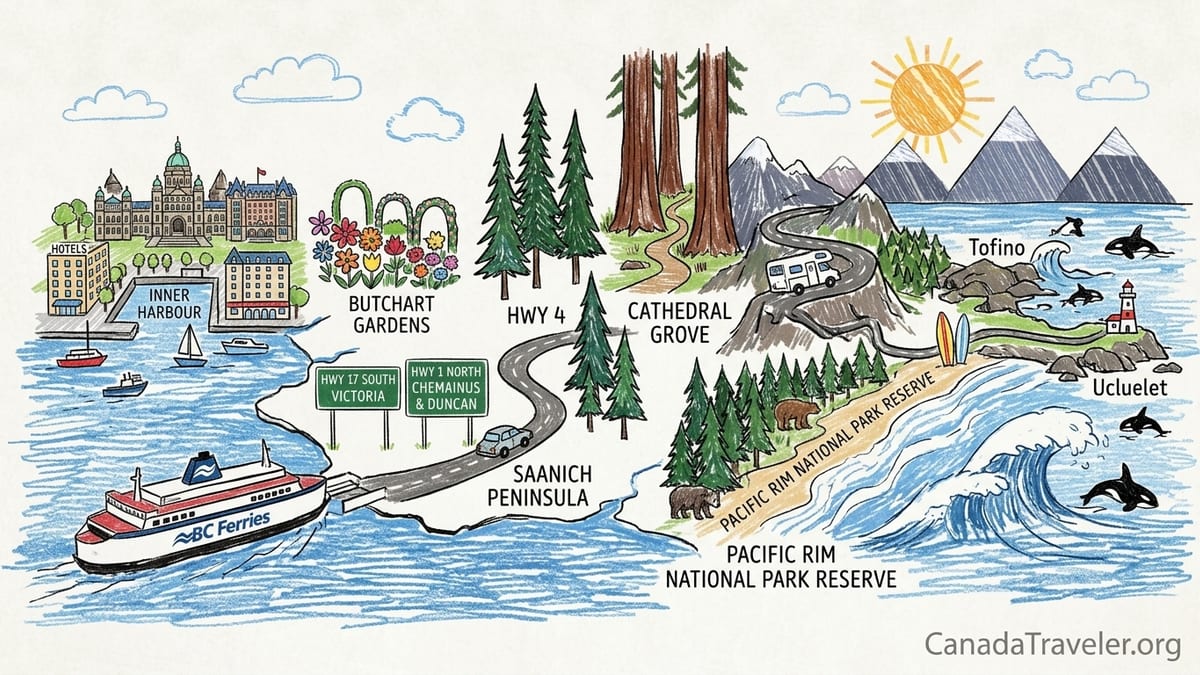
Starting Your Journey: Tsawwassen to Swartz Bay
Most travelers begin a Vancouver Island road trip with the BC Ferries crossing from Tsawwassen, south of Vancouver, to Swartz Bay on the Saanich Peninsula. The sailing itself is scheduled at about 1 hour 35 minutes and, in autumn 2026, typically runs roughly every hour from early morning into the evening, with 8 to 13 sailings daily depending on season and day of the week. Vehicle spaces can sell out on busy weekends and holidays, so reserving a specific sailing online is strongly recommended if you are traveling with a car, especially in summer.
Standard one-way fares on this main route are charged separately for the driver, any additional passengers and the vehicle. As of mid 2026, a walk-on adult ticket from Tsawwassen to Swartz Bay costs just over 22 Canadian dollars including a recent fuel surcharge, while a standard under-20-foot vehicle is charged a significantly higher amount on top of that. Exact fares vary by date and any promotional saver products, so it is worth using BC Ferries’ fare calculator before you travel to compare a regular drive-up fare with reserved or off-peak options. Families traveling with a campervan or small motorhome should budget extra, because vehicles over 20 feet are charged by the foot and the price can increase quickly once you add length from bike racks or rear storage boxes.
It is important to understand that Swartz Bay is not in downtown Victoria. The terminal sits roughly 32 kilometers north of the city on the Saanich Peninsula, about a 35- to 40-minute drive into central Victoria in typical traffic. Car-free travelers can connect by bus services that meet most sailings or by private shuttle, while drivers simply follow Highway 17 south into town. If you land late in the day, consider spending your first night in Sidney, a small seaside town near the terminal, rather than pushing straight through after a long travel day.
Lineups at Tsawwassen and Swartz Bay can be substantial in peak summer, long weekends and around major holidays. There are real-world instances of multi-sailing waits on busy days, so aim to arrive at least an hour before departure even with a reservation, and much earlier if you are driving up without one. Check live capacity information and terminal webcams on the day of travel to avoid surprises and build a buffer so your entire road trip is not rushed from the start.
Two Days in Victoria: Inner Harbour and Butchart Gardens
Plan to give Victoria at least two full days at the beginning of your road trip. The city is compact enough to explore on foot but rich in waterfront scenery, history and food. Base yourself near the Inner Harbour if possible, so that you can walk to the Royal BC Museum, the Legislature precinct, and the cafes and restaurants that line the waterfront. Parking in the core is metered, so once you have checked into a hotel or guesthouse, it often makes sense to leave the car and explore on foot.
Set aside half a day for the Royal BC Museum, which is widely considered one of Canada’s premier provincial museums. Current exhibitions focus strongly on Indigenous cultures of British Columbia, natural history, and the evolving story of the province. Admission fees are charged per adult and child, with separate pricing for special exhibitions; it is sensible to check the museum’s website shortly before your trip for current opening hours and any timed-entry requirements. Combining the museum with a stroll around the Inner Harbour makes a relaxed first day, particularly if you have just arrived from a long haul flight.
On your second day, make time for Beacon Hill Park and Fisherman’s Wharf. Beacon Hill Park stretches from downtown to the waterfront with lawns, ponds, and viewpoints across the Strait of Juan de Fuca to the Olympic Mountains. It is easy to spend a slow morning wandering its paths before walking or driving over to Fisherman’s Wharf for lunch from the floating food kiosks. The wharf is a casual place to try local seafood in a setting that feels distinctly West Coast, with colourful float homes bobbing in the small marina.
Butchart Gardens deserves its own dedicated excursion. The gardens are not in downtown Victoria but about 30 minutes away on the Saanich Peninsula, roughly on the route between Victoria and Swartz Bay. Most visitors either drive themselves, park in the on-site lot and pay a per-person admission fee that varies by season, or join an organized shuttle tour from downtown. Expect peak-season adult admission to be in the several tens of dollars range. If you visit in summer, evening openings with illuminated displays can be particularly atmospheric, while spring brings extensive tulip and cherry blossom displays. Because the gardens are a detour from the city core, plan a half day door-to-door and avoid squeezing the visit into an already full schedule.
Northbound: Cowichan Valley, Duncan and Chemainus
When you finally leave Victoria, resist the temptation to rush straight to the west coast. The drive north up Highway 1 through the Cowichan Valley is relatively short in distance but offers several rewarding stops. From central Victoria to Duncan is roughly 60 kilometers, usually about an hour’s drive without traffic, which leaves plenty of time to explore en route. The Malahat section of Highway 1 north of Langford climbs to viewpoints over Saanich Inlet; on clear days, the rest areas here are an excellent place to stretch your legs and take in your first elevated views of the Island.
Duncan bills itself as the City of Totems, and a brief stop here breaks up the drive nicely. The compact downtown has a self-guided walking route past dozens of carved poles installed in cooperation with local First Nations. Parking is straightforward and free in many central lots for short stays, and you can browse independent coffee shops and bakeries before returning to the highway. A Saturday visit adds the busy Duncan Farmers’ Market, which locals regard as one of the more substantial markets on the Island, with farm produce, artisanal foods and crafts.
Continuing north, consider a break in Chemainus, a small town famous for its large outdoor mural collection. It is about 15 minutes’ drive beyond Duncan, just off the main highway. Many travelers simply park once and wander the grid of streets filled with historic-themed murals, cafes and small shops. If you are driving a larger campervan or motorhome, parking is still manageable in designated lots near the centre, although height and length restrictions often rule out street parking directly on the main blocks.
This section of the trip does not require a full overnight for most itineraries, but if you prefer a slower pace, the Cowichan Valley offers boutique wineries, cideries and rural inns. Staying a night in or near Duncan or Cowichan Bay lets you explore tasting rooms and farm-to-table restaurants without worrying about driving afterward. However you approach it, the goal on this leg is to ease into Island driving rather than racing north to the next checkpoint.
Nanaimo, Parksville and the Transition to the West Coast
Nanaimo lies about 110 kilometers north of Victoria by highway, usually a two-hour drive with brief stops. It makes a logical transitional base before you cross Vancouver Island’s interior to the Pacific coast. The city is a transport hub with ferry connections to the mainland, a compact waterfront promenade and a growing food scene. Accommodation spans chain hotels, motels and independent guesthouses, usually priced lower than in Victoria or Tofino during peak months, which can help balance your overall budget.
A popular alternative is to continue another 35 to 40 minutes north to Parksville or Qualicum Beach. These two communities on the sheltered east coast offer long sandy beaches, shallow swimming at low tide, and a notably relaxed vibe. Many families use Parksville as a base for two or three days, combining beach time with short excursions inland. Nightly hotel and resort rates here can be significantly lower than on the Pacific coast, especially in shoulder season, and campsites in the nearby provincial parks often book up as soon as reservations open for the year.
Whether you stay in Nanaimo or Parksville, this is a good point to reassess practicalities. Fuel is generally cheaper in larger centres like Nanaimo than it will be in the remote west coast towns, so fill your tank before you turn inland. If you need groceries, camping gas, or last-minute items such as rain jackets, rubber boots or extra layers, stock up here where selection is broad and prices are closer to mainland norms. Travelers in rental cars will find full-service stations and supermarkets clustered around highway interchanges, while campervan drivers can seek out larger parking lots and propane refill stations.
For those extending the trip to 10 days, Nanaimo also serves as a natural stepping stone to the Comox Valley and Campbell River to the north. You can choose to complete the Victoria to Tofino loop first, then continue up the Island later, or reverse the order and leave the Pacific coast until the final days. In either case, keeping a night on the east coast in the middle of your itinerary gives you flexibility if weather or road conditions affect the mountain crossing.
Highway 4 and Cathedral Grove: Planning the Mountain Crossing
The journey from the east coast to the Pacific side of Vancouver Island is one of the defining segments of this road trip. From Victoria to Ucluelet, Tourism Vancouver Island cites a distance of about 293 kilometers and a driving time of roughly five hours without sightseeing stops. That time assumes steady movement and normal traffic. In practice, first-time visitors often take longer because of roadworks, slower vehicles on the hills, photo stops and rest breaks. Tofino sits farther north beyond Ucluelet, reached via the same road.
The main route uses Highway 4, which leaves the east coast near Parksville and heads west past Port Alberni before crossing the mountains. An essential stop along the way is Cathedral Grove in MacMillan Provincial Park, about 25 kilometers west of Parksville. This pocket of old-growth Douglas-fir and redcedar features accessible loop trails through trees that are several centuries old, some with diameters well over a meter. Parking for regular vehicles lines both sides of Highway 4 and is free, but spaces fill quickly in summer and on weekends, and the highway itself remains active with through traffic. Plan 45 to 90 minutes here to walk the trails and appreciate the forest without feeling rushed.
Beyond Port Alberni, Highway 4 becomes narrow and winding, with sharp curves, steep drop-offs and sections where roadworks have periodically introduced single-lane alternating traffic. This is not a highway to rush or to treat like a freeway. Travel times between Port Alberni and the west coast junction can easily exceed two hours, especially if you are driving a larger RV, towing a trailer or encountering slow traffic behind logging trucks. In recent years, scheduled construction closures and unscheduled rockfalls or accidents have occasionally closed the road for hours at a time, cutting off Tofino and Ucluelet for non-local traffic.
Highway 4 is the only practical road link between the Pacific coast communities of Tofino and Ucluelet and the rest of Vancouver Island. There is no alternative sealed highway if it closes, only limited forest service roads that are unsuitable for typical rental vehicles and often physically closed by gates. This reality has two key implications for your itinerary. First, build flexibility into your schedule, especially in the shoulder seasons when storm damage is more likely. Second, keep at least one night of your trip on the east coast that you could shorten or extend as needed if an extended road closure arises. Checking provincial highway conditions online on the day of travel is an essential step, not an optional extra.
Tofino and Ucluelet: At Least Two Nights on the Pacific Coast
Once you reach the junction near the Pacific Rim National Park Reserve, the road splits south to Ucluelet and north to Tofino. The park’s Long Beach area lies roughly in between, with signed parking areas and access to sand beaches, surf breaks and rainforest trails. Ucluelet is approximately 288 to 290 kilometers northwest of Victoria by road and Tofino another 40 or so kilometers beyond, but by the time you arrive, distance matters less than the change in atmosphere. Give this coast at least two nights, and three if you can spare them, to justify the effort of the drive.
Long Beach is one of the main draws of the Pacific Rim National Park Reserve. Day-use parking lots are operated by Parks Canada, and as of late 2026, most vehicles pay a daily entry fee to the park, charged per person or per car, depending on the pass product you choose. You can either buy a day pass for Pacific Rim or use a Parks Canada Discovery Pass that covers multiple national parks across the country. Exact prices are published annually and are best checked just before your trip, but for a family of four the cost of a day at the park often falls into a moderate double-digit dollar range. Keep your receipt or pass visible on your dashboard to avoid fines and remember that the pass applies not just to Long Beach but also to major trails and viewpoints in the reserve.
Beach choices abound. Cox Bay and Chesterman Beach near Tofino offer broad sands and popular surf breaks, with surf schools operating year-round. First-time surfers can book a half-day lesson that usually includes board and wetsuit rental; prices vary by operator but may be in the low hundreds of dollars per person. The water is cold even in August, so a thick wetsuit, booties and sometimes gloves are standard. Farther south, the Wild Pacific Trail in Ucluelet offers cliffside viewpoints, wave-washed rocks and lighthouse views without requiring advanced hiking fitness. Sections of the trail are well surfaced and accessible to a wide range of visitors, though it is important to stay behind safety railings and avoid venturing onto wet rocks close to the water.
Wildlife experiences are another highlight. From Tofino and Ucluelet harbours, operators run boat-based whale-watching, bear-viewing and hot springs tours in season. Boats range from enclosed cabin cruisers to open zodiac-style inflatables, and prices typically reflect the length of tour and vessel type. Expect wildlife tours of two to three hours to cost in the high double to low triple digits per adult, with discounts for children. When choosing an operator, look for companies that clearly describe their safety equipment, group size limits and approach distances to animals, and that acknowledge local Indigenous territories in their interpretation. Indigenous-owned or co-managed operators also offer cultural walks and canoe tours that share Nuu-chah-nulth history and perspectives in the region.
Lodging on the west coast is one of the biggest budget decisions of your trip. Beachfront lodges and boutique hotels in Tofino often command premium rates, particularly in July and August, with nightly prices for a standard hotel room frequently reaching several hundred dollars. Ucluelet typically offers slightly lower average rates, with a growing mix of motels, cabins and vacation rentals. Campgrounds within and around the national park can sell out minutes after reservations open and charge per-site fees that, while lower than hotel rates, are still significant once park entry fees are added. If you are traveling in a campervan, factor in the cost of powered sites, on-board propane use for heating, and any additional ferry charges for your vehicle’s length.
Extending to 10 Days: Comox Valley, Campbell River and Telegraph Cove
With 10 days available, it is worth extending your road trip beyond the Victoria to Tofino axis to include the Comox Valley, Campbell River and Telegraph Cove on the northeast side of Vancouver Island. From the Parksville area, the drive to Courtenay and Comox is around 90 kilometers, usually about an hour and a quarter on Highway 19. The Comox Valley blends small-town centres, farms and easy access to outdoor activities, with Mount Washington Alpine Resort inland and long beaches to the east. It works well as a gentle pause between more driving-heavy days, with comfortable mid-range hotels and local food options.
Campbell River sits another 45 to 60 minutes north of Comox and serves as a gateway to the Discovery Islands and the more sparsely populated north Island. The town’s waterfront walkway, fishing pier and nearby parks make it an appealing overnight stop. Many visitors use Campbell River as a base for guided grizzly bear viewing in the autumn months, where jet boats or small vessels take small groups up coastal inlets to see bears feeding on salmon. These tours are relatively expensive, often priced in the several hundreds of dollars per person, but include meals and interpretive guiding and are regulated under provincial and Indigenous stewardship agreements.
From Campbell River, a half-day drive brings you farther north to communities such as Port McNeill and Telegraph Cove, classic launching points for whale-watching and kayaking in the Johnstone Strait. Telegraph Cove is a tiny historic boardwalk settlement with a mix of heritage buildings and modern lodgings, very atmospheric but limited in capacity. Reservations here are essential in peak season, and campervan drivers should confirm site dimensions before booking. While the distances on this stretch look long, road conditions on Highway 19 are generally good, and traffic is lighter than on the southern portions of the Island.
It is important to note that no continuous outer-coast road exists between the Tofino/Ucluelet area on the west coast and the Port Hardy region in the far north. Maps may show logging or resource roads inland from the Pacific, but these are typically unpaved, may be restricted industrial routes and are not viable for standard rental cars or as part of a safe, realistic tourist itinerary. To connect the Pacific Rim region with the north Island, you must always return via Highway 4 to the east coast, then head north on Highway 19. Any itinerary that suggests a simple coastal drive connecting Tofino directly to Port Hardy without backtracking across the Island is not accurate.
Costs, Fuel, Campervans and Indigenous Tourism
Budgeting carefully for this road trip will help you make informed choices about transportation and experiences. Beyond the major Tsawwassen to Swartz Bay ferry crossing, you should factor in Pacific Rim National Park Reserve entry fees, provincial park camping fees if relevant, fuel, and the often higher cost of food and lodging in remote tourist towns. For example, BC Parks’ 2026 camping fee schedule shows per-night charges for front-country sites at coastal parks that are noticeably higher than basic inland campgrounds, and many private campgrounds along the route price powered RV sites at or above local motel rates in shoulder season.
Fuel prices on Vancouver Island tend to be higher than in many parts of mainland North America, and they are usually higher still in Tofino and Ucluelet than in Victoria, Nanaimo or Courtenay. A practical approach is to fill your tank in a larger centre before driving Highway 4 and top up when prices look relatively favorable. Standard rental cars will have no trouble with distances between fuel stations, but those driving older campervans or towing trailers may prefer to keep at least half a tank when heading into the mountains. In remote northern stretches near Telegraph Cove and Port Hardy, stations are less frequent, so check opening hours ahead of time if you are traveling early or late in the day.
Choosing between a standard car and a campervan is as much about travel style as cost. A compact car usually pays a lower ferry fare, uses less fuel and is easier to park in cities and small towns. You can then mix city hotels, roadside motels and perhaps one or two cabin stays along the coast. A campervan, on the other hand, consolidates transport and accommodation into one, but ferry fares rise quickly once you exceed 20 feet in length, and nightly campground fees plus propane and maintenance costs add up. On busy summer dates, it is not uncommon for an RV couple’s combined camping and ferry costs to approach what they might have paid for a smaller car and mid-range motels.
As you travel, look for opportunities to support Indigenous-owned tourism businesses. On southern Vancouver Island and around the west coast, First Nations partner with non-Indigenous operators or run their own ventures offering cultural tours, guided hikes, canoe experiences, galleries and restaurants featuring local seafood and foraged ingredients. Booking a guided walk that explains traditional plant use, for example, or joining a canoe tour that frames the landscape through Nuu-chah-nulth or Coast Salish histories, can deepen your understanding of the Island beyond its scenic surface. Prices for these experiences vary but are often comparable to mainstream wildlife or adventure tours, and your spending directly supports communities whose territories you are traveling through.
The Takeaway
A 7 to 10 day road trip from Victoria to Tofino or Ucluelet is entirely achievable for a first-time visitor, provided you respect the realities of Island travel. Ferries take time, mountain highways demand patience, and scenic stops from Cathedral Grove to Long Beach deserve more than a quick photo. Building in two days for Victoria, at least two or three nights on the Pacific coast, and flexible transition days on the east side will keep your driving hours under control and your stress levels low.
Highway 4’s importance as the only practical west coast road link means that closures can ripple across your itinerary, so keep an eye on travel advisories and hold some contingency in your schedule. Recognize that there is no through road along the Island’s outer coast from Tofino to the north, and plan your loop across the Island accordingly. With realistic expectations, thoughtful budgeting for ferries, fuel, lodging and park fees, and an openness to Indigenous-led experiences, this journey can be as enriching culturally as it is scenic.
Whether you end your trip watching the sun drop behind Cox Bay’s surf, walking the Wild Pacific Trail in heavy Pacific mist, or standing beneath the massive trunks of Cathedral Grove, the lasting impression tends to be the same: Vancouver Island rewards those who slow down. Give the Island the days it deserves, and it will repay you with a road trip that feels less like a checklist and more like a series of vivid, interconnected places.
FAQ
Q1. How many days do I really need for a Vancouver Island road trip from Victoria to Tofino?
For a first visit, plan at least 7 days: two for Victoria, one to travel via Cathedral Grove, and at least two nights on the Pacific coast plus flexible transition days. With 10 days you can also add the Comox Valley, Campbell River and Telegraph Cove.
Q2. Is the Tsawwassen to Swartz Bay ferry the best way to start this trip?
For most travelers coming from Vancouver, yes. It lands you on the Saanich Peninsula about 35 to 40 minutes north of Victoria, and sailings run frequently throughout the day with vehicle spaces available by reservation.
Q3. Do I need a car, or can I do this itinerary by public transport?
You can reach Victoria, Nanaimo and even Ucluelet and Tofino by a combination of buses and shuttles, but having a car or campervan greatly increases flexibility for trailheads, beaches and spontaneous stops. Car-free travelers should expect to rely on scheduled services and organized tours.
Q4. How long does it take to drive from Victoria to Ucluelet or Tofino?
Tourism sources estimate roughly 293 kilometers and about five hours from Victoria to Ucluelet without sightseeing stops. In reality, most visitors take longer because of traffic, construction, slow sections on Highway 4 and planned breaks at places like Cathedral Grove.
Q5. Is Highway 4 dangerous to drive?
Highway 4 is paved but narrow and winding in sections, with steep grades and sharp curves. It is safe if you drive conservatively, respect posted limits and allow faster vehicles to pass at pullouts. Avoid night driving in poor weather and give yourself more time than a navigation app suggests.
Q6. Are there any alternative roads to reach Tofino or Ucluelet if Highway 4 closes?
No practical alternative highway exists. Forest service roads in the region are often industrial, rough and not suitable for standard rental vehicles. If Highway 4 closes, you must wait for it to reopen or adjust your trip to focus on the east coast or other regions of the Island.
Q7. How expensive are park fees and activities around Pacific Rim National Park Reserve?
Parks Canada charges daily entry fees or accepts national Discovery Passes, with total costs for a family usually in the moderate double-digit range per day. Surf lessons, wildlife tours and cultural experiences often range from high double to low triple digits per adult, depending on duration and operator.
Q8. Is it cheaper to travel by car and hotels or by campervan?
A compact car plus mid-range hotels often works out similar in total cost to a campervan once you add higher ferry fares for a longer vehicle, campground fees and extra fuel. Campervans do, however, offer more flexibility in busy periods if you secure campsites well in advance.
Q9. When is the best time of year to do this road trip?
Late spring through early autumn offers the best combination of daylight, road conditions and open services. July and August are busiest and most expensive, while May, June and September can offer lower prices and fewer crowds but more variable weather.
Q10. How can I include Indigenous tourism experiences on this itinerary?
Look for Indigenous-owned or co-managed tour companies and cultural centers in Victoria, along the Cowichan corridor, and especially around Tofino and Ucluelet. Examples include guided cultural walks, canoe tours, art galleries and food experiences that share local First Nations perspectives and directly support the communities whose territories you visit.