


Nova Scotia is often reduced to a postcard of fishing boats and the lighthouse at Peggy’s Cove, but the province is far more complex on the ground. From tidal landscapes shaped by some of the world’s highest tides to highland plateaus and Acadian villages, its seven official tourism regions offer genuinely different travel experiences. This guide treats Nova Scotia as a complete destination hub, then leads you beyond Halifax and Peggy’s Cove to working harbours, vineyards, fossil cliffs and reconstructed fortresses that reward a deeper visit.
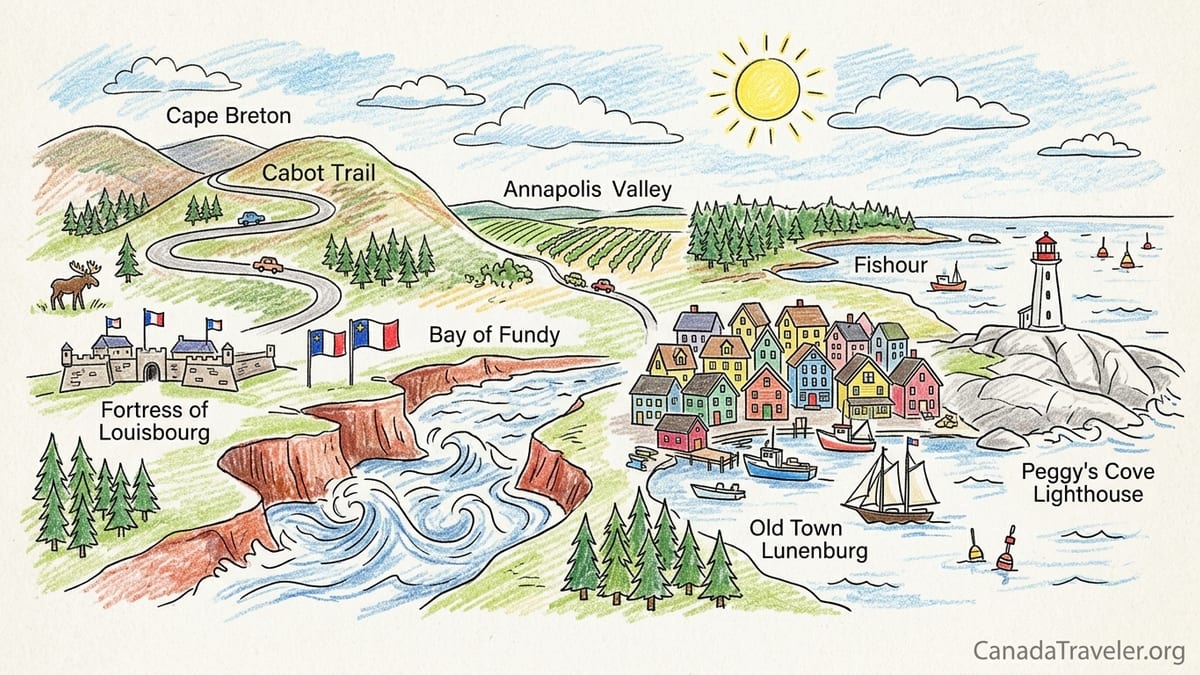
Nova Scotia’s Seven Regions: One Province, Distinct Experiences
Nova Scotia’s tourism map is divided into seven regions: Halifax Metro, South Shore, Yarmouth & Acadian Shores, Bay of Fundy & Annapolis Valley, Northumberland Shore, Eastern Shore and Cape Breton Island. These are not marketing labels for the same scenery repeated. Each region has its own coastline shape, history, dominant culture and style of travel. A day standing under steep Fundy cliffs feels nothing like driving a highland road on Cape Breton, and neither resembles walking through a UNESCO-listed grid of timber houses in Lunenburg.
Halifax Metro centres on the provincial capital, where most visitors arrive by air. South Shore stretches southwest from the city through classic fishing communities such as Mahone Bay and Lunenburg. Yarmouth & Acadian Shores occupies the province’s southwestern tip and is strongly francophone in places, with Acadian flags on houses and bilingual menus. Bay of Fundy & Annapolis Valley turns inland along orchards, vineyards and tidal mudflats, while Northumberland Shore is about warm-water sandy beaches and small towns like Pictou and Tatamagouche on the less dramatic but more swimmable Northumberland Strait.
The Eastern Shore remains one of the quietest parts of Nova Scotia, a long, sparsely populated coastline of headlands and islands east of Halifax where places like Taylor Head Provincial Park feel genuinely remote. Cape Breton Island, officially its own tourism region, occupies the northeast of the province and delivers highland scenery, the famous Cabot Trail, and living Celtic and Mi’kmaw cultures. Thinking in terms of these regions helps you decide what kind of trip you want, then fit specific destinations into a realistic route rather than trying to “do Nova Scotia” in a single loop.
Travel logistics link these regions naturally. Most visitors rent a car at Halifax Stanfield International Airport and either head south for the lighthouse coast, west to the vineyards and Fundy tides, or north to Cape Breton Island. Driving times matter. Halifax to Lunenburg is roughly an hour and fifteen minutes in light traffic, Halifax to Yarmouth about three and a half hours, and Halifax to Baddeck at the base of the Cabot Trail about three and a half to four and a half hours depending on stops. Building your itinerary around a few hubs, not nightly one-night stands, makes the experience much more enjoyable.
Halifax Metro: Maritime History and Urban Base Camp
Halifax is more than a gateway; it is one of the strongest small-city bases in Atlantic Canada. The compact waterfront is lined with boardwalks, food vendors and converted warehouses where you can walk for about three kilometres from the Canadian Museum of Immigration at Pier 21 to the casino district without needing a car. Pier 21 tells the story of more than a million immigrants who arrived in Canada by sea in the twentieth century and is a useful starting point for understanding why this harbour matters.
Up on the hill, Halifax Citadel National Historic Site anchors the skyline. The star-shaped fort, largely dating from the mid-nineteenth century, looks out over both the harbour and the modern city. Costumed interpreters, noon gun firings and guided tours connect present-day Halifax with its role as a British military stronghold. Combine a visit here with a wander through the Victorian-era Halifax Public Gardens or a stop at one of the independent coffee shops on Spring Garden Road. Expect to spend at least two full days in Halifax if you want to see Pier 21, the Citadel, the waterfront and one or two neighbourhoods beyond the core.
In practical terms, Halifax works very well as a base at the beginning or end of a trip. The largest range of accommodation in Nova Scotia is here, from full-service hotels near the waterfront to apartments in neighbourhoods like North End and Downtown Dartmouth. The city also offers car-free options such as harbour ferries, local buses and guided harbour cruises. It is a logical jumping-off point for day trips to Peggy’s Cove, Lunenburg, or the Eastern Shore if you do not want to change hotels frequently.
The main disadvantage of Halifax is traffic and parking in peak summer, especially on weekends when multiple cruise ships are in port. Hotel prices in July and August are also significantly higher than in shoulder seasons such as May, June, September and early October. If your focus is hiking, small towns or quiet beaches, you may want to limit your Halifax stay and spend more nights in smaller regional hubs like Lunenburg, Wolfville or Baddeck.
South Shore Highlights: Lunenburg, Mahone Bay and Peggy’s Cove
The South Shore region stretches west from Halifax along a coastline of coves, islands and low headlands. It is where most visitors encounter the stereotypical image of Nova Scotia, yet even here the experiences differ sharply between destinations. Lunenburg, for example, is not simply another colourful harbour. Old Town Lunenburg is a UNESCO World Heritage Site recognized as an exceptionally well-preserved example of eighteenth-century British colonial town planning, with a rigid street grid laid over challenging topography and a distinctive collection of wooden buildings in bright colours.
Lunenburg remains a working harbour, home to fishing vessels and the replica schooner Bluenose II when it is in port. Spend at least one full day exploring the waterfront, Fisheries Museum of the Atlantic, and back streets of the Old Town. Two nights in or near Lunenburg let you relax into its rhythm and eat in several of its independent restaurants. It works well as a base for visiting nearby Blue Rocks, Mahone Bay, and local beaches such as Hirtle’s or Crescent.
Mahone Bay, less than 15 minutes from Lunenburg by car, offers a smaller and slightly quieter waterfront town experience. Its row of three waterfront churches, independent boutiques and cafes make it a good half-day stop or an overnight for travellers who prefer a more low-key base. From Halifax, Mahone Bay is about an hour’s drive. One night is usually sufficient unless you want a slow-paced few days of browsing shops and exploring back roads.
Peggy’s Cove, an easy forty-five to sixty minute drive from downtown Halifax, is centred on its granite headland and lighthouse rather than on services or attractions. The village is tiny and the classic scene is of waves breaking on exposed rock beneath the light. You can comfortably visit Peggy’s Cove in half a day from Halifax, combining it with stops along the coastal route through communities such as Prospect or continuing to Mahone Bay. Crowds and tour buses are the main disadvantage, especially in July and August and on days when cruise ships are in Halifax. Early morning or late evening visits are quieter and the light is better for photography.
Bay of Fundy & Annapolis Valley: Vineyards, Tides and Acadian Memory
West of Halifax, the landscape opens into the Annapolis Valley, where orchards, vineyards and dykelands lie between two ridges. This is the heart of Nova Scotia’s wine country, with wineries clustered around towns like Wolfville and Gaspereau. Many offer tastings, vineyard views and seasonal food trucks or on-site restaurants. A common real-world pattern is to base in Wolfville for two or three nights, visit several wineries in a single afternoon using a designated driver or local tour operator, and spend another day walking dykeland trails or visiting Grand Pré.
The Landscape of Grand Pré is one of Nova Scotia’s three UNESCO World Heritage properties. It is recognized as a cultural landscape that combines reclaimed marshland agriculture with the memory of the Acadian people who settled here in the seventeenth century and were later deported in the eighteenth century. From the viewpoint above the fields, you can see the grid of dykes and canals that turned tidal flats into farmland, framed by church spires and the Minas Basin. Allow at least half a day to visit the Grand-Pré National Historic Site interpretive centre and explore the surrounding landscape, ideally combined with a night or two in Wolfville.
On the Fundy shore further west, the Bay of Fundy delivers some of the world’s highest tides, dramatic cliffs and mudflats. Five Islands Provincial Park and Cape Chignecto Provincial Park highlight this landscape. Five Islands, roughly a 90-minute drive from Truro and about two and a half hours from Halifax, offers accessible cliff-top trails, tidal beaches and basic camping. One full day here is enough for short hikes and a walk on the ocean floor at low tide. Cape Chignecto, on the other hand, is a backcountry coastal park where many visitors undertake multi-day backpacking trips or at least a long day hike to viewpoints over sea stacks and coves. The main disadvantage in this region is the need to plan around tide times; certain walks are only safe at low tide, and tidal ranges can exceed ten metres in places.
Accommodation bases for exploring the Fundy coast include Parrsboro, Advocate Harbour and small inns or cottages scattered along the shore. From Halifax, expect about a three-hour drive to Advocate Harbour and slightly less to Parrsboro. Weather along the Fundy shore can be foggy and cool even in summer, so layered clothing and flexible plans are wise. Late spring through early autumn is the main season; some seasonal accommodation and restaurants close by late October.
Yarmouth & Acadian Shores, South Shore Detours and Island Outposts
At the southwestern tip of Nova Scotia, the Yarmouth & Acadian Shores region offers a different atmosphere again. Here, Acadian culture is visible in French-language signage, tricolour flags with gold stars, and dishes such as rappie pie on local menus. The port town of Yarmouth functions as the main service centre and ferry gateway to Maine when services operate. It also serves as a base for visiting Cape Forchu, a headland light station located about 11 kilometres from downtown along the Cape Forchu Scenic Drive.
Cape Forchu Lighthouse stands on a narrow, rocky peninsula that juts into the Atlantic. The current “apple core” tower dates from the 1960s and can be visited on guided tours in season, including a climb up 77 steps into the lantern room during specific visitor experiences. The surrounding grounds provide panoramic views, picnic tables, interpretive panels and access to coastal walking paths. A half day is enough to explore Cape Forchu from a base in Yarmouth, with two nights in town giving time for a relaxed visit plus meals in local restaurants and perhaps a drive through nearby Acadian communities.
Back on the South Shore, east of Yarmouth, small towns like Shelburne and Birchtown add depth to a coastal itinerary. Shelburne’s historic waterfront has one of the most complete collections of eighteenth century wooden buildings in North America, used as a filming location for period dramas. Nearby Birchtown is significant as a historic settlement of Black Loyalists, people of African descent who came to Nova Scotia after the American Revolution. A visit to the Black Loyalist Heritage Centre provides context for this important but often overlooked chapter in Atlantic history. Shelburne makes a good one or two night stop between Yarmouth and Lunenburg, with a modest but characterful range of inns and guesthouses.
The main disadvantage of Yarmouth & Acadian Shores for time-pressed visitors is distance. From Halifax to Yarmouth is roughly three and a half to four hours by car without lengthy stops. This makes it most appealing for trips of at least a week, or for visitors arriving or departing via ferry who can build a regional loop that includes both Yarmouth and the Annapolis Valley. Seasonal closures are also a factor; Cape Forchu’s tower tours and some local restaurants operate only in the warmer months, roughly from late spring to early autumn, though the headland itself can be visited year-round in suitable weather.
Northumberland Shore, Eastern Shore and Wild Coastal Parks
Northumberland Shore and the Eastern Shore share a quieter, more low-key character than the South Shore or Halifax Metro, but they differ in coastline and activities. Northumberland Shore, facing the Northumberland Strait, is known for comparatively warm water and sandy beaches such as Melmerby Beach near New Glasgow. Towns like Pictou and Tatamagouche line this coast. Pictou promotes itself as the “Birthplace of New Scotland” due to the arrival of the ship Hector in 1773 and has a waterfront museum complex centred on a replica of the emigrant vessel. A night in Pictou or nearby gives time to tour the waterfront, visit beaches and continue either toward Cape Breton or back to the valley.
Tatamagouche, about a forty-minute drive from Pictou and a couple of hours from Halifax, is a small community that has reinvented part of its railway heritage into unusual accommodation. The Train Station Inn converts vintage railway cars into guest rooms and offers a chance to sleep in a caboose or passenger car. The village acts as a quiet base for exploring the Northumberland coastline by car or bicycle and for day trips to nearby beaches and secondary roads. One or two nights are usually enough unless you are looking for a deliberately slow, rural stay.
On the Eastern Shore, Taylor Head Provincial Park stands out as one of Nova Scotia’s finest day-hiking and beach destinations. Located near Spry Bay, about a 90-minute drive east of Halifax along a winding coastal road, the park offers forest and coastline trails with views of headlands, coves and offshore islands. Trails range from short loops to longer circuits that can take four or five hours. There are no services in the park beyond basic facilities, so most visitors base in Halifax or stay in small inns and cottages scattered along the coast. The Eastern Shore generally sees far fewer visitors than the South Shore, which many travellers see as a major advantage. The downside is longer drives between services and a limited number of restaurants, especially out of peak season.
Weather again plays a strong role in these regions. Beach-focused trips on the Northumberland Shore work best from late June through early September, when water temperatures are more comfortable and lifeguard services operate at some provincial beaches. The Eastern Shore’s appeal is more about wild scenery and solitude, which can be rewarding in shoulder seasons but also subject to fog, wind and cool temperatures that call for layers, not sun loungers.
Cape Breton Island and Louisbourg: Highlands, Cabot Trail and Living History
Cape Breton Island forms a separate region both on the map and in the way it feels. Crossing the Canso Causeway from mainland Nova Scotia brings you into a landscape of hills, lakes and highland plateaus. The Cabot Trail, a scenic highway loop of roughly 300 kilometres, climbs above the ocean in Cape Breton Highlands National Park and passes through communities with strong Scottish and Acadian roots. Many visitors base themselves for several nights in Baddeck, Ingonish, or the Chéticamp area to allow time for driving sections of the trail, hiking and cultural stops such as live music at local halls or pubs.
A realistic minimum for Cape Breton is three nights, which allows at least one full day on the Cabot Trail and another for activities around your base. Baddeck, on the Bras d’Or Lake, works as a central hub, especially for first-time visitors. It offers a range of accommodation, restaurants and the Alexander Graham Bell National Historic Site. From Halifax, the drive to Baddeck takes roughly three and a half to four and a half hours depending on traffic and breaks. Road conditions can be variable in winter; most travellers plan Cape Breton visits between late May and October, with fall foliage making late September and early October especially popular along the highland stretches.
On the east coast of Cape Breton Island, the Fortress of Louisbourg presents a very different experience from Lunenburg or Grand Pré. It is important to understand that modern Louisbourg is not an untouched eighteenth-century town but a large-scale reconstruction, one of the largest in North America. Built on and around original foundations using historical research and traditional methods, it recreates part of the fortified French town that guarded the approaches to New France in the 1700s. Costumed interpreters, working gardens and open hearths bring the period to life, but much of what you see was rebuilt in the twentieth century based on archaeological and archival evidence.
Visitors often spend a full day at Louisbourg, especially when guided tours or special programs are available. Nearby accommodation options include inns and B&Bs in the modern community of Louisbourg itself, as well as hotels in Sydney, about a 35-minute drive away. The disadvantage for some travellers is that the reconstructed nature of the site can feel less “authentic” than walking original streets in Lunenburg. Others find the scale and immersive interpretation a highlight of their Nova Scotia trip. Weather again shapes the experience; fog and wind can be intense along this coast, so pack layers even on seemingly warm days.
UNESCO World Heritage Sites, Geoparks and Biosphere Reserves
Nova Scotia has three UNESCO World Heritage properties and several UNESCO-designated Geoparks and Biosphere Reserves, which recognize different types of value. Lunenburg, Grand Pré and Joggins Fossil Cliffs are on the World Heritage List, which highlights sites of outstanding universal value either cultural, natural or both. Lunenburg represents an exceptionally intact example of a planned British colonial town with a long tradition of wooden architecture. Grand Pré is a cultural landscape that combines engineered dykelands with Acadian memory and commemoration. Joggins Fossil Cliffs on the Fundy coast are recognized for their exposed rock sequences that record a rich fossil record from the Carboniferous period, sometimes called the “coal age,” including fossilized tree trunks and trackways.
World Heritage status tends to bring interpretive centres, guided tours and international visibility. At Joggins, for example, visitors can tour an interpretive centre and join guided walks along the beach at low tide to see fossil-bearing cliffs. It is realistic to allow half a day to a full day here, often combined with other Bay of Fundy stops. The main constraint is tide timing and the need for suitable footwear on wet, uneven surfaces. Grand Pré and Lunenburg, by contrast, integrate heritage into lived-in communities and working landscapes, where you can stay overnight, dine and meet residents going about their daily lives.
UNESCO Geoparks and Biosphere Reserves operate under different designations that focus on geological heritage and sustainable community development rather than on individual monuments or cultural landscapes alone. While they are significant, they are not World Heritage Sites and should not be confused with the three properties listed above. For travellers, the practical difference is that World Heritage sites often have strongly developed visitor infrastructure and interpretive programming, while Geoparks and Biosphere Reserves may involve broader regions with trails, small towns and community initiatives tied together by an overarching theme.
When planning a trip, it can be useful to see World Heritage sites as anchor destinations and Geoparks or Biosphere Reserves as broader contexts for hiking, scenic drives and local culture. For example, you might plan a night in Parrsboro to visit Joggins and also explore coastal viewpoints, small museums and walking trails within the wider geological setting of the Fundy region. Understanding these distinctions helps manage expectations and allocate time according to your interests, whether those lie more in architectural history, living cultural landscapes, or deep geological time.
Brier Island, Kejimkujik and Other Nature-Focused Escapes
For travellers seeking quieter nature experiences beyond the main highway routes, Brier Island and Kejimkujik National Park, often called Keji, stand out. Brier Island sits at the mouth of the Bay of Fundy at the end of Digby Neck, reached by a sequence of two small ferry crossings after a drive along Highway 217 from Digby. The island is a noted area for whale watching in season, usually from late spring to early autumn, as well as for bird migration and rugged coastal scenery. Many operators run boat tours focused on humpback and other whale species when they are present offshore. A stay of two nights on Brier Island allows time for at least one whale-watching trip plus walks to lighthouses and coastal lookouts.
The main disadvantage is remoteness in terms of services; accommodation and dining options are limited, and advance booking in high season is strongly advised. Weather on Brier Island can be cool and foggy even when inland areas are warm. Access from Halifax typically involves a three-hour drive to Digby plus ferry time and the drive along Digby Neck, making this a better option for itineraries of a week or more that already include the Annapolis Valley or Fundy shore.
Kejimkujik National Park and National Historic Site offers a contrasting inland landscape of lakes, forests and Mi’kmaw cultural sites. Located about two and a half hours from Halifax by car, roughly midway between the South Shore and Annapolis Valley, Keji is a popular place for canoeing, camping and day hikes. A network of trails from short walks to longer circuits gives access to rivers, old-growth hemlock stands and petroglyph sites that can be visited on guided outings. Many visitors stay two or three nights in or near the park, combining paddling with hiking and campfire evenings. There is also a separate coastal adjunct to the park near Port Joli, with white sand beaches and coastal barrens reached by longer drives.
The main disadvantages at Keji are insects in early summer and the need to reserve campsites or roofed accommodation well in advance in July and August. Shoulder seasons from late May to June and September to early October can be ideal, with fewer crowds and pleasant temperatures. Using Keji as an overnight base also helps break up long driving days between Halifax, the South Shore and the Annapolis Valley, turning transit into a highlight rather than a chore.
Suggested 3, 7 and 14 Day Itineraries
Nova Scotia’s scale and regional diversity mean that realistic itineraries are essential. A three-day trip that tries to include both Cape Breton and Yarmouth will be spent almost entirely in the car. Instead, it is more rewarding to focus each trip on one or two regions at most, using a hub-and-spoke approach from a few bases. Driving times given here are approximate and depend on traffic, weather and stops, but they help frame what is practical.
For three days, a strong option is a South Shore and Halifax combination. Spend your first night in Halifax, exploring the waterfront, Citadel and Pier 21. On day two, drive to Peggy’s Cove early, continue along the coast through Mahone Bay and overnight in Lunenburg. Use day three to enjoy Lunenburg’s Old Town, perhaps visit Blue Rocks or a nearby beach, then return to Halifax for an evening flight or extra night. An alternative three-day plan could focus on Wolfville and the Annapolis Valley, with one night in Halifax and two nights in Wolfville to visit vineyards and Grand Pré and take a side trip to a Fundy viewpoint such as Blomidon.
With a week, you can combine two or three regions without rushing. One realistic seven-day loop might start with two nights in Halifax, followed by two nights in Lunenburg, two nights in Wolfville and a final night back in Halifax or near the airport. This allows time for Halifax’s key sights, the South Shore towns of Mahone Bay and Lunenburg, a side trip to Peggy’s Cove from Halifax or Lunenburg, and a full day each for vineyards and Grand Pré from Wolfville. Another seven-day option is a Cape Breton focused trip, with one night in Halifax on arrival, three or four nights split between Baddeck and either Ingonish or Chéticamp for the Cabot Trail and Louisbourg, and a final night near Halifax before departure.
In fourteen days, you can build a more ambitious but still manageable circuit that samples several very different sides of Nova Scotia. A common pattern is to spend two nights in Halifax, two nights on the South Shore around Lunenburg, two in Yarmouth or Shelburne for Cape Forchu and Acadian culture, three nights in the Annapolis Valley and Fundy region including time for Brier Island or Joggins, and four or five nights on Cape Breton Island split between Baddeck and the Cabot Trail. Alternatively, travellers who prefer slower travel might skip Yarmouth & Acadian Shores and instead add extra nights in Kejimkujik or on the Northumberland Shore to enjoy beaches and quiet coastal hikes.
Whatever the length of stay, building in buffer time matters in Nova Scotia. Weather along the coasts can change quickly and fog, wind or heavy rain may make one day better suited to museums and cafes than to coastal hikes or whale watching. Leaving space in a seven or fourteen day plan for a “weather day” in a place like Lunenburg, Wolfville or Baddeck, which all have indoor options, helps reduce stress. Flexibility is part of the appeal here; you are never far from a small café, a harbour walk or a side road that turns into its own memorable discovery.
The Takeaway
Thinking of Nova Scotia as a single postcard of fishing boats undersells it. The seven official tourism regions frame a province where highland plateaus, reclaimed marshes, Acadian villages and working harbours sit within a few hours’ drive of one another. Halifax anchors the experience with maritime history at the Citadel and Pier 21, but some of the most rewarding days involve tasting wine above tidal flats in the Annapolis Valley, watching fog slide past the cliffs at Cape Forchu, or walking reconstructed streets at Louisbourg with the smell of wood smoke in the air.
By choosing a handful of bases and giving each at least two nights, you can move beyond box-ticking and experience each region on its own terms. Lunenburg’s UNESCO-listed grid feels different from Mahone Bay’s intimate waterfront, which in turn contrasts with the tidal drama of Five Islands or the quiet forest lakes of Kejimkujik. Whether you come for three days or two weeks, the key is to be realistic, focus on a mix of cultural and natural highlights, and accept that you will leave with reasons to return. Nova Scotia rewards that kind of travel, and its varied regions make it easy to build a trip that fits your interests rather than a generic checklist.
FAQ
Q1. How many days do I really need to see Nova Scotia beyond Halifax?
For a first trip that includes at least one coastal region and the Annapolis Valley, seven days is a practical minimum. This allows two nights in Halifax, two on the South Shore around Lunenburg and Mahone Bay, and two or three in Wolfville or the Fundy region without feeling rushed.
Q2. Is it realistic to visit both Cape Breton and Yarmouth & Acadian Shores in one week?
It is possible but involves long driving days of three to five hours between bases. Many travellers find it more enjoyable to focus a week either on Cape Breton plus Halifax and one other region, or on a loop that includes Halifax, South Shore, Annapolis Valley and perhaps Yarmouth, leaving Cape Breton for a dedicated future trip.
Q3. Do I need a car to explore Nova Scotia’s regions outside Halifax?
For most travellers, renting a car is the most flexible option. Public transport between smaller communities is limited, and many key sights such as Peggy’s Cove, Kejimkujik, Cape Forchu, Brier Island and sections of the Cabot Trail are not easily reached by scheduled buses. Guided tours can cover some highlights but will not offer the same freedom to explore side roads and smaller parks.
Q4. When is the best season to visit Nova Scotia for outdoor activities?
Late June through September offers the most reliable weather for hiking, beach visits and whale watching, with many seasonal services operating. May and October can be excellent for quieter travel and fall foliage, especially on Cape Breton, but some smaller accommodations, restaurants and tours may be closed or on reduced schedules outside the core summer season.
Q5. How different are Nova Scotia’s three UNESCO World Heritage Sites from each other?
Lunenburg focuses on a preserved historic town and working harbour, Grand Pré on a cultural landscape of dykelands and Acadian memory, and Joggins Fossil Cliffs on exposed geological strata with important fossils. Visiting all three provides a cross-section of architectural, cultural and natural heritage rather than repeating the same type of site.
Q6. Where should I base myself if I want to visit vineyards and see the Bay of Fundy tides?
Wolfville is an ideal base, with several wineries within a short drive and easy access to the Landscape of Grand Pré and viewpoints over the Minas Basin. From Wolfville you can also reach Fundy locations such as Blomidon Provincial Park or, with a longer drive, Five Islands or Joggins, while enjoying a town with restaurants and accommodation options.
Q7. Is Peggy’s Cove still worth visiting given how popular it is?
Yes, the granite headland, lighthouse and waves remain striking, but timing matters. Visiting early in the morning or later in the evening helps avoid bus crowds and midday glare. Many travellers combine Peggy’s Cove with a broader South Shore day that includes Mahone Bay or Lunenburg so that time at the lighthouse is only one part of a varied coastal experience.
Q8. How challenging is driving the Cabot Trail on Cape Breton Island?
The Cabot Trail is paved and suitable for standard vehicles, but it includes steep grades, sharp curves and exposed sections along highland slopes. In dry summer conditions, most drivers with some highway experience handle it without difficulty by taking their time and using pullouts. In fog, rain or high winds, extra caution is needed. Winter conditions can be severe, so most visitors plan Cabot Trail drives from late spring to autumn.
Q9. Are there good options for travellers who prefer quieter, less touristed areas?
Yes. The Eastern Shore around Taylor Head Provincial Park, stretches of the Northumberland Shore near Tatamagouche, and inland areas around Kejimkujik National Park are all noticeably quieter than the main South Shore and Halifax corridors. These regions trade larger restaurant and shopping choices for wilder scenery, fewer people and a slower pace.
Q10. How far in advance should I book accommodation in popular Nova Scotia destinations?
For peak summer travel in July and August, it is wise to book key bases such as Lunenburg, Wolfville, Baddeck, Ingonish and Brier Island several months ahead, especially on weekends. Shoulder seasons usually offer more flexibility, but limited-capacity places like Brier Island, Kejimkujik campgrounds and small inns near the Cabot Trail can still fill up well in advance when conditions and fall colours are favourable.