


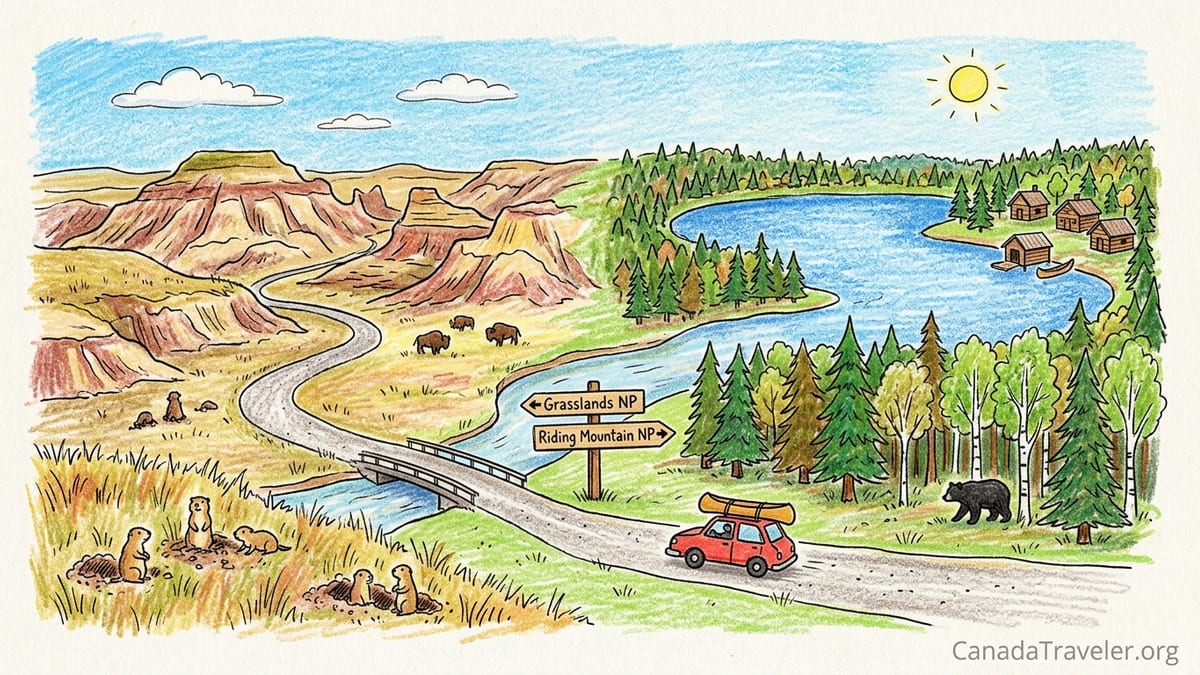
The Canadian Prairies are often reduced to a cliché of flat fields glimpsed through a car window, but travelers who stop and explore discover one of North America’s most varied and underrated regions. From bone-dry badlands and fescue grasslands to island-studded boreal lakes and lively mid-sized cities, Saskatchewan and Manitoba reward slow travel, road trips and anyone curious enough to pull off the highway and stay a while.
How to Choose Your Prairie Destinations
Think of the Prairies as a gradient rather than a single landscape. In the south, you have true mixed-grass prairie and eroded badlands. A few hours north, the land rises into forested plateaus and clear lakes. Keep going and you are in boreal wilderness, more reminiscent of northern Ontario than farm country. Layered on top of this are compact cities like Saskatoon, Regina and Winnipeg, all with walkable cores, strong Indigenous and settler heritage, and a growing food scene.
If you have a week, you can link two or three national parks with at least one city. For example, many visitors fly into Winnipeg, spend two nights in the city, drive three hours to Riding Mountain National Park for three nights, then loop back via smaller towns such as Dauphin or Neepawa. With ten days, you can add Saskatchewan: combine Grasslands National Park in the far south with Saskatoon or Regina, or arc west to Cypress Hills for elevated forests and dark skies before dropping back to the Trans-Canada Highway.
Season matters. July and August are peak for warm lakes and festivals, but June brings wildflowers in Grasslands National Park and fewer bugs in the boreal. Shoulder seasons in May and September are ideal for hiking and wildlife viewing at Riding Mountain and Prince Albert National Parks, when accommodation prices are often lower and campgrounds easier to book.
Budget-wise, national park daily entry fees are modest compared with many international destinations, and camping is usually the best-value option. A basic unserviced campsite in Parks Canada campgrounds typically costs less than a midrange motel on the highway, and small-city hotel rates in Saskatoon, Regina, Moose Jaw and Winnipeg are often noticeably below those in Canada’s larger metropolitan areas.
Grasslands National Park: True Prairie and Badlands
Grasslands National Park in southern Saskatchewan protects one of the largest remaining tracts of native mixed-grass prairie and striking badlands carved by ancient rivers. The park is split into two main areas. The West Block, reached via the town of Val Marie, offers rolling grasslands, a scenic driving loop and colonies of black-tailed prairie dogs. The more remote East Block showcases eroded buttes, coulees and multicoloured badlands where you can walk along the Rock Creek area and gaze out over a landscape that feels closer to parts of Utah or South Dakota than stereotypical farm country.
Grasslands is also one of Canada’s darkest designated dark sky preserves, with virtually no light pollution. On clear summer nights, campers at Frenchman Valley or Rock Creek campgrounds often see the band of the Milky Way stretching from horizon to horizon. This makes Grasslands a strong choice for astrophotographers and night-sky enthusiasts who want Bortle-class dark skies without international travel. Many visitors plan trips around new-moon weekends in July and August and bring tripods and fast wide-angle lenses to make the most of the conditions.
The park suits patient, self-reliant travelers who appreciate empty spaces more than amenities. Trails are mostly unsigned routes across open country, summer days are hot and services are limited. Two to three nights allow time for scenic drives, short hikes, a guided program if offered, and at least one dedicated stargazing session. Grasslands combines naturally with Cypress Hills Interprovincial Park, about three to four hours’ drive to the west, and with Regina or Moose Jaw to the north for urban comforts and hot springs after time in the backcountry.
Be prepared for practical challenges. Fuel up before leaving larger centers such as Swift Current or Moose Jaw, carry extra drinking water in summer and check gravel-road conditions after heavy rain. Simple, real-world details like stocking up on groceries at a supermarket in Swift Current or Assiniboia before heading south can make the difference between a relaxed experience and a stressful one when you realise there is no late-night corner shop near your campground.
Riding Mountain National Park: Lakes, Wildlife and Cottage Atmosphere
Riding Mountain National Park in Manitoba is a very different prairie experience, a forested plateau rising above surrounding farmland and dotted with more than 100 lakes. The park includes a resort village, Wasagaming, on the shore of Clear Lake, where you will find rental cabins, a public beach, cafés and ice-cream stands. In high summer, the boardwalk feels like a small-scale cottage town, with people renting stand-up paddleboards, booking guided lake cruises and strolling to grab coffee before a hike.
The park’s mixed ecosystems, including grasslands, boreal forest and deciduous woods, support a wide range of wildlife. Visitors have realistic chances of spotting elk in roadside meadows, black bears crossing forest clearings and beavers in marshes. Near Lake Audy, an enclosure allows you to view a small herd of plains bison from your car or roadside viewpoints, an accessible way for families to see one of the Prairies’ emblematic animals. In winter, the same area becomes a destination for snowshoers and cross-country skiers, showing that the park is not just a summer resort but a genuine year-round destination.
Riding Mountain suits travelers who like an active but comfortable holiday. Families can alternate beach days with gentle hikes such as the Ominik Marsh boardwalk, while more ambitious hikers tackle longer trails to backcountry lakes. Cyclists bring gravel or mountain bikes for rolling roads and forest tracks. Many visitors stay three to five nights, renting a cabin with a kitchen in Wasagaming or camping at the main Clear Lake campground, where serviced sites accommodate RVs and unserviced loops suit tent campers.
In trip planning, Riding Mountain pairs well with Winnipeg, about three hours’ drive away, for an itinerary that balances lakes and wildlife with museums and restaurants. It also combines with smaller Manitoba communities such as Dauphin or Neepawa, where you can stop at roadside farmers’ markets in late summer or book modestly priced motels when park accommodations are full. If you are driving across Canada on the Trans-Canada Highway, planning a two-night stop at Riding Mountain can turn a rushed transit into the highlight of the trip.
Prince Albert National Park: Gateway to the Boreal Wilderness
North of Saskatchewan’s agricultural heartland, Prince Albert National Park marks the transition into the southern boreal forest, a landscape of jack pine, spruce and aspen around a chain of clear, glacially carved lakes. The park centers on Waskesiu Lake, where a compact townsite offers lodges, basic hotels, a small grocery store and outfitters renting canoes, kayaks and stand-up paddleboards. The moment you paddle away from the marina, you leave behind the bustle of town and enter a quiet world of rocky points and sheltered bays.
The park appeals strongly to those who enjoy low-key wilderness rather than dramatic mountain scenery. Short interpretive trails such as Treebeard and Boundary Bog introduce visitors to mossy spruce woods, lichen-draped trees and insect-eating plants in peat bogs. Longer routes reach more remote lakes where you may see common loons, pelicans and, with luck, moose along the shore. The region’s boreal birdlife draws keen birders, especially in spring and early summer, when warblers and other songbirds are most active.
Prince Albert National Park works well for travelers who appreciate rustic comforts. You can book a lakeside cabin with basic kitchens, stay in small-town motels just outside the park, or choose front-country campgrounds with hot showers and reserved sites. Two to four nights allow enough time to hike several trails, paddle Waskesiu or Kingsmere Lake and enjoy slow evenings by a campfire. For those with more time and experience, multi-day canoe trips to remote lakes and hike-in backcountry camping add a deeper layer of adventure.
This park combines naturally with Saskatoon, around two and a half hours’ drive to the south, for a mix of boreal wilderness and riverfront culture. It can also slot into a longer Saskatchewan loop that includes Cypress Hills in the southwest and Grasslands in the south, giving repeat visitors a sense of how varied the province’s landscapes truly are.
Saskatoon and Regina: Urban Culture on the Prairie
Saskatoon, straddling the South Saskatchewan River, has quietly become one of Canada’s most enjoyable mid-sized cities. The riverbank Meewasin Trail, a paved and gravel pathway network, lets visitors walk or cycle for kilometres past riverside parks and modern bridges. In the compact downtown and Riversdale neighbourhood, you can find independent coffee shops, bakeries and restaurants that spotlight Prairie ingredients such as bison, lake fish and regional grains. Summer patios fill on warm evenings as locals gather after work or head out before events at the city’s galleries and live-music venues.
Saskatoon suits food-motivated travelers and those who enjoy being able to park the car and explore on foot. Two nights are usually enough to sample the riverfront, visit at least one major cultural institution and enjoy a couple of strong meals, either at contemporary Canadian restaurants or informal spots serving dishes inspired by Ukrainian, Filipino and other immigrant communities. The city is a convenient gateway for trips north to Prince Albert National Park or south toward Grasslands and the Qu’Appelle Valley.
Regina, Saskatchewan’s capital, has a different personality. Built around a central man-made lake in Wascana Centre, it feels like a government town with broad boulevards, legislative buildings and museums. For travelers, highlight stops include the provincial museum exploring natural history and Indigenous cultures, and the heritage sites that trace the evolving story of the Prairies. Sports fans are often drawn by Canadian football games, when the city’s stadium fills and local enthusiasm spills into nearby pubs and restaurants.
Regina is best for visitors interested in provincial history and those who want a low-key base between more remote destinations. One to two nights lets you explore major museums and stroll around Wascana Lake. The city pairs naturally with Moose Jaw, just under an hour’s drive to the west, and with day trips into the Qu’Appelle Valley, creating an easy three- or four-night itinerary focused on small-city life and rolling countryside.
Winnipeg: Museums, Heritage and Multicultural Energy
Winnipeg, Manitoba’s capital, anchors the eastern end of many Prairie road trips and is usually the most convenient flight gateway for visitors from the United States and Europe headed to Riding Mountain. The city has a substantial collection of cultural institutions, including large national museums, art galleries and performance venues. The Forks, a historic meeting place at the junction of the Red and Assiniboine rivers, has been redeveloped into a public market and gathering space with indoor food halls, seasonal riverfront patios and pathways popular with locals on summer evenings.
What makes Winnipeg stand out is its layered heritage and multicultural feel. Neighborhoods such as the Exchange District offer intact early-20th-century architecture, independent boutiques and cafés. Elsewhere in the city, you will find long-established communities of Ukrainian, Filipino, Indigenous and Franco-Manitoban residents, reflected in everything from perogy diners and bakeries to festivals and public art. Travelers who enjoy exploring food markets, tasting local craft beers and seeking out live music will find plenty to do.
Winnipeg deserves at least two nights on most itineraries, more if you plan to use it as a base for day trips to beaches on Lake Winnipeg or for drives into Mennonite farming areas south of the city. Many visitors book a downtown hotel so they can walk to major museums, The Forks and the Exchange District without worrying about parking. For those arriving by air, rental cars are widely available; picking one up only when you are ready to leave the city can save on costs since urban exploration is easy on foot or by rideshare.
In trip design, Winnipeg combines naturally with Riding Mountain National Park for a classic city-and-lakes pairing. For longer journeys, it can be the starting or finishing point of a cross-Prairie drive that continues west through Brandon, Regina and Saskatoon before reaching Alberta’s Badlands or the Rockies. Mapping out your fuel stops and overnight stays in advance is sensible, especially in winter when daylight hours are short and highway conditions can change rapidly.
Cypress Hills, Moose Jaw and the Qu’Appelle Valley: Smaller-Scale Discoveries
Cypress Hills Interprovincial Park, on the Saskatchewan–Alberta border, offers a rare elevated landscape in the Prairies. The plateau rises well above the surrounding plains and supports dense forests, cool lakes and rolling meadows. Visitors come to hike shaded trails, relax at campgrounds set among trees and take advantage of clear night skies. Parts of the park have been recognized as a dark sky preserve, drawing amateur astronomers and photographers who set up telescopes and cameras at designated viewing areas during late-summer star parties.
Cypress Hills is ideal for travelers who want a gentler alternative to mountain parks but still crave evergreen forests, lakes and cooler temperatures. Many people stay two to four nights, using campgrounds or simple resort cabins as a base for day hikes, canoe rentals and evening campfires. The park links well with Grasslands National Park in a week-long loop through southwest Saskatchewan, giving a strong contrast between open prairie and forested highlands without long driving days.
Moose Jaw, a small city along the Trans-Canada Highway in Saskatchewan, mixes practical road-trip services with a few distinctive attractions. The historic downtown has preserved brick buildings, independent shops and a restored theater, while popular underground tours reinterpret the city’s past through a network of tunnels. The Temple Gardens mineral spa complex, supplied by a geothermal spring, draws both locals and travelers for indoor and outdoor soaking pools, especially appealing after long hours behind the wheel or days of hiking.
The Qu’Appelle Valley, stretching across southern Saskatchewan, surprises many first-time visitors with its chain of long, narrow lakes nestled between steep, wooded slopes. Small resorts and provincial parks line the shores, with rental cabins, seasonal ice-cream stands and modest marinas where locals keep pontoon boats and fishing craft. It is an easy weekend or overnight destination from Regina, giving city visitors a chance to kayak, fish or simply sit on a lakeside deck watching sunsets that can linger well into the evening in June and July.
The Takeaway
The Canadian Prairies reward travelers who slow down and look beyond familiar postcards of mountains and oceans. In a single region, you can walk among badlands in Grasslands National Park, swim in the clear waters of Riding Mountain, paddle through boreal forest in Prince Albert National Park and spend evenings in walkable riverfront neighborhoods in Saskatoon or Winnipeg. Compact cities, reasonable accommodation costs compared with larger Canadian centers and uncrowded parks make this an accessible destination for families, couples and solo travelers alike.
Choosing where to go comes down to your priorities. If you want big skies, wildflowers and solitude, focus on Grasslands and Cypress Hills. For lakeside vacations, wildlife and cottage-town atmosphere, build around Riding Mountain or Prince Albert. If culture, food and museums matter most, give yourselves several nights in Saskatoon, Regina or Winnipeg and add a short excursion to Moose Jaw or the Qu’Appelle Valley. With thoughtful planning and realistic driving days, you can knit these places together into a trip that feels both varied and coherent.
Whichever combination you choose, remember that distances on the Prairies can be deceptive and services thin between larger towns. Carry water and snacks, refuel when you can and give yourself time for unplanned stops at grain elevators, small-town cafés and roadside viewpoints. The magic of a Prairie trip often lies in everyday details: a conversation with a campground host, a late sunset over a wheat field or the first time you see the Milky Way arch completely across a truly dark sky.
FAQ
Q1. How many days do I need to see the highlights of the Canadian Prairies? For a first visit, plan at least seven to ten days. This allows two or three nights in a major city such as Winnipeg, Saskatoon or Regina and four to six nights split between one or two national or provincial parks. With less than a week, focus on a single city and one nearby park rather than trying to cover everything.
Q2. What is the best time of year to visit Grasslands and Riding Mountain National Parks? Late June to early September offers the warmest weather and the most services, with July and August best for lake swimming at Riding Mountain and wildflower displays at Grasslands. May and September are excellent for hiking and wildlife viewing, with cooler temperatures and fewer mosquitoes, though some seasonal businesses may operate on limited hours.
Q3. Are the Canadian Prairies suitable for a family road trip? Yes, the region works well for families. Driving distances between major stops such as Winnipeg and Riding Mountain or Regina and Moose Jaw are manageable in a half day, and parks provide beaches, easy boardwalk trails and wildlife viewing that engage children. Booking cabins or motels with kitchenettes can help control food costs and make travel with younger kids easier.
Q4. Do I need a four-wheel-drive vehicle to explore these parks? For most visitors, a standard two-wheel-drive car is sufficient. Main park roads to campgrounds and trailheads at Grasslands, Riding Mountain, Prince Albert and Cypress Hills are typically gravel or paved and suitable for regular vehicles in summer. A higher-clearance vehicle can be helpful on rougher backroads, especially after heavy rain, but is not mandatory for basic sightseeing.
Q5. How far in advance should I book camping or cabins? In peak summer, it is wise to reserve national park campgrounds and popular cabins several months ahead, particularly for weekends and holiday periods. Outside of July and August, you often find more flexibility, but even then it is worth securing at least your first and last nights so you are not searching for a site at dusk after a long drive.
Q6. Can I combine a visit to the Prairies with the Canadian Rockies in one trip? Many travelers do. A common pattern is to fly into Winnipeg or Saskatoon, explore the Prairies for a week and then continue west by car or a separate flight to Calgary for time in the Rockies. If driving, allow at least two full days to travel comfortably from central Saskatchewan or Manitoba to mountain destinations, with overnight stops in cities such as Regina or Medicine Hat.
Q7. Are the cities of Saskatoon, Regina and Winnipeg walkable? The central districts of all three are reasonably walkable, especially Saskatoon’s riverfront and Winnipeg’s Exchange District and The Forks area. However, distances between neighbourhoods can be significant, so many visitors mix walking with short drives, rideshares or public transit. Booking accommodation near the areas you most want to explore can reduce your need for a car while in the city.
Q8. What should I pack for a summer trip to the Prairies? Pack light layers, including a warm fleece or sweater for cool nights, a sun hat, sunglasses and high-SPF sunscreen. Insect repellent is useful around lakes and wetlands, and sturdy walking shoes are recommended for trails that can be rocky or uneven. If you plan to camp, a quality sleeping bag and sleeping pad will make cool nights more comfortable, even in July.
Q9. Is stargazing really that good in Grasslands and Cypress Hills? Yes, both areas are recognized for their exceptionally dark skies, with minimal light pollution. On clear, moonless nights, the Milky Way is often visible to the naked eye, and constellations appear brighter than in most urban or suburban areas. Astrophotographers and amateur astronomers frequently travel specifically to these parks to take advantage of the conditions and occasional astronomy events.
Q10. Are there guided tours available, or do I need to be entirely self-guided? You can travel independently, but a mix of self-guided exploration and selected tours works well. In peak season, Parks Canada and provincial parks often offer interpretive walks or evening programs, while private operators in cities and gateway towns may run food tours, downtown walking tours or wildlife excursions. Checking schedules a few weeks before you go can help you secure spots on any tours that interest you.