


The Canadian Prairies are far more varied than many first-time visitors expect. In Saskatchewan and Manitoba, wide-open grasslands give way to rolling badlands, thick boreal forest, thousands of lakes and a handful of compact, culture-rich cities. Distances are large, towns are sparse and weather can be extreme, but with some planning this region is one of North America’s most rewarding road-trip destinations.
How the Prairie Landscape Fits Together
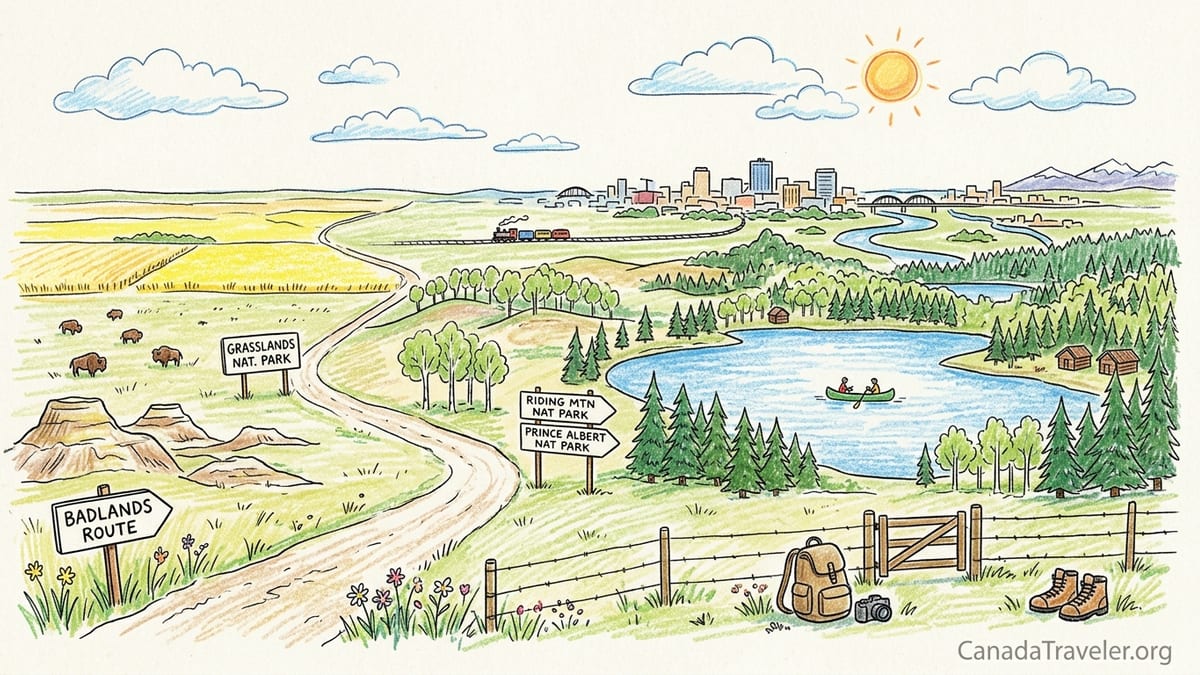
Look at a map of Saskatchewan and southern Manitoba and you will see three broad bands. The southern tier is classic prairie, with wheat and canola fields, native grassland and badlands. This is where you find Grasslands National Park and the Qu’Appelle Valley in Saskatchewan, and much of rural southern Manitoba. North of this, the land rises into treed uplands such as Riding Mountain National Park in Manitoba and the aspen parkland around Saskatoon. Further north again, boreal forest and lake country dominate in Prince Albert National Park and across northern Manitoba.
This layered geography explains why you can drive from open prairie near Val Marie in southwest Saskatchewan to thick forest and lakes around Waskesiu in Prince Albert National Park in roughly five hours, and feel like you have crossed several countries. In Manitoba, a similar contrast plays out between the flat farmland around Portage la Prairie and the wooded escarpment of Riding Mountain National Park above the town of Wasagaming. The Prairies are not a single flat plain but a series of subtle steps and transitions.
Cities slot into this mosaic as hubs along major rivers and rail lines. Winnipeg sits at the meeting of the Red and Assiniboine rivers on mostly flat terrain, while Saskatoon straddles the South Saskatchewan River in a gently rolling river valley. Regina, the provincial capital of Saskatchewan, rises from almost billiard-table-flat prairie yet lies within a few hours’ drive of both badlands and forested highlands. Understanding this layout helps you choose routes that follow natural transitions instead of criss-crossing long distances on featureless highways.
Water is another key to reading the landscape. In Manitoba, enormous lakes like Lake Winnipeg and Lake Manitoba influence local climate and recreation, drawing Winnipeggers to cottage communities and provincial parks. In Saskatchewan, long river valleys and man-made reservoirs punctuate areas of otherwise dry grassland. When planning, think in terms of blocks of experience: an open-grasslands segment, a forest-and-lakes segment and time in at least one city where you can reset with restaurants, galleries and live music.
Understanding Distances and Prairie Driving
On the Prairies, distances that look moderate on a map can feel much longer in practice. Regina to Grasslands National Park’s West Block near Val Marie is about 300 kilometers, roughly a three-hour drive in good conditions, mostly on two-lane highways with few services. Regina to Cypress Hills Interprovincial Park near Maple Creek is around 400 kilometers, or four to four and a half hours without long stops. Between the East and West Blocks of Grasslands National Park there are about 166 kilometers of road, mostly on rural highways and some gravel, which can easily take two hours or more.
In Manitoba, Winnipeg to Riding Mountain National Park and its main townsite of Wasagaming is about 260 to 300 kilometers, depending on your route, and usually takes three to three and a half hours. From Winnipeg to Saskatoon is roughly 780 kilometers, or a full day of driving at seven and a half to eight hours including fuel and food stops. These are not trips to attempt after work; they demand an early start and the expectation that scenery and sky, rather than frequent attractions, will be your main companions.
Fuel and food planning matter because small-town services can be limited, especially at night or on Sundays. It is sensible to refuel when your tank drops to half full if you are heading into Grasslands National Park, Cypress Hills or the quieter roads between Regina and Prince Albert National Park. In many communities a midrange motel room will start around a modest price per night, but options can book out during summer events and holiday weekends, so advance reservations are wise.
Weather amplifies the challenge. In winter, blowing snow and ice can slow a three-hour drive to five or make it unsafe altogether. In summer, severe thunderstorms can bring sudden downpours and high winds that make long straight highways stressful. Before setting out, check provincial road condition services and ask at visitor centers in cities such as Winnipeg’s downtown tourism office or Saskatoon’s riverfront information kiosks for current local advice, especially if you are heading onto gravel roads to trailheads or backcountry campgrounds.
Choosing Your Route: Prairie & Badlands, National Parks, or City & Culture
First-time visitors are usually best served by focusing on one of three broad styles of trip. The southern prairie and badlands route is ideal if you want big skies, quiet roads and wildlife, with camping and small-town motels rather than city nightlife. A typical loop might start in Regina, head southwest to Grasslands National Park, continue west along Highway 13 through rolling ranch country toward Cypress Hills, then return via the Trans-Canada Highway. Over seven days you could spend two nights near Grasslands, two in or near Cypress Hills and the rest divided between Regina or Moose Jaw.
A national parks and lakes trip works well in warmer months if you want a mix of hiking, paddling and wildlife viewing. One practical version starts in Winnipeg, drives to Riding Mountain National Park for a few days of camping or cabin stays, then heads west to Saskatoon and north to Prince Albert National Park. Both parks offer established campgrounds, rental kayaks or canoes and a good chance of seeing deer, black bears and loons. You might finish with a night or two in Saskatoon or Winnipeg for museums and restaurants before flying home.
The city and culture route suits travelers who prefer shorter hops and lodging in hotels or urban vacation rentals. You could fly into Winnipeg for The Forks Market, the Canadian Museum for Human Rights and the Exchange District’s historic warehouses, then take the train or drive to Saskatoon for its riverfront paths, the Remai Modern art museum and the Broadway and Riversdale neighborhoods. Regina adds the Royal Saskatchewan Museum, the Saskatchewan Legislative Building and a gateway to nearby First Nations heritage sites and the Qu’Appelle Valley, where you can make day trips rather than committing to backcountry camping.
Of course, you can blend elements of all three. For example, a 10-day loop might combine two urban nights in Winnipeg, three nights in Riding Mountain National Park, an overnight in a smaller Manitoba town, two nights in Saskatoon and a final pair of days in Prince Albert National Park. The key is to be realistic: on prairie highways, trying to link too many parks and cities in one short trip leads to long days behind the wheel and little time on trails or in museums.
Key Destinations: From Winnipeg to the Qu’Appelle Valley
Winnipeg is the natural starting point for many Manitoba-focused trips. The city combines early 20th-century architecture in the Exchange District with contemporary attractions such as the Canadian Museum for Human Rights and a redeveloped riverfront at The Forks. In practical terms, Winnipeg is also where you will find the region’s greatest choice of flights, rental cars and gear shops. Outdoor retailers and big-box stores here make it easy to pick up camping fuel, coolers and clothing before you head toward Riding Mountain National Park or north to Manitoba cottage country.
In Saskatchewan, Saskatoon often surprises first-time visitors. The South Saskatchewan River curves through the heart of the city, lined with paved multi-use trails and several bridges that offer skyline views. The Remai Modern gallery on the riverfront, live-music bars along Broadway Avenue and a growing food scene make Saskatoon a pleasant base before or after days in Prince Albert National Park. The city’s compact downtown also keeps driving times short if you prefer to walk between your hotel, restaurants and the river paths.
Regina, smaller and flatter, rewards visitors who spend time in its parks and museums. Wascana Centre, built around a large urban lake, is one of the biggest urban parks in North America and a calm place to stretch after long drives. The Royal Saskatchewan Museum and the RCMP Heritage Centre explore natural and human history in ways that give more context to the landscapes you will see later in Grasslands National Park or the Qu’Appelle Valley. Regina is also a logical stepping-off point for a southern prairie loop, with Highway 1 and Highway 6 offering straightforward access to the southwest.
The Qu’Appelle Valley, running east-west across southern Saskatchewan, is a dramatic incision in otherwise flat land. Lakeshore communities and provincial parks line a series of long, narrow lakes west and northeast of Regina. For a first-time visitor, a night or two at a lakeside cabin or campground here can offer a softer introduction to the Prairies than heading straight to the more remote grasslands. Short hikes climb from lake level to rim viewpoints where you can see how the valley slices through the plains, and in summer you can rent kayaks or paddleboards from small local outfitters to explore sheltered bays.
National Parks and Wild Landscapes: Grasslands, Prince Albert, Riding Mountain and Cypress Hills
Grasslands National Park in southwest Saskatchewan protects some of the last remaining native mixed-grass prairie in Canada, along with badlands formations and a dark-sky preserve. The park is split into East Block, known for its eroded buttes and viewpoints, and West Block, where you can follow the Ecotour Scenic Drive among grazing bison and prairie dog colonies. Services are basic: expect dry prairie campgrounds, a few oTENTik platform tents and small-town motels in nearby Val Marie. Trails range from short interpretive walks to full-day backcountry routes across open terrain where you navigate using coulees and fence lines.
Farther north, Prince Albert National Park lies in a transition zone between prairie and boreal forest. Around the lakeside townsite of Waskesiu you will find serviced campgrounds, hotels, cabin rentals and a visitor center that operates year-round with current trail and wildlife information. Trails here wind through aspen and spruce forests, along sandy lake shores and across open fescue meadows. Canoe rentals, lakeside beaches and boat tours make this a good choice for families or for travelers who want a gentler introduction to wilderness than the exposed grasslands to the south.
In Manitoba, Riding Mountain National Park rises as a forested plateau above surrounding farmland. The park forms the core of a UNESCO biosphere reserve and supports wildlife including black bears, elk, moose and wolves. The main visitor area is the townsite of Wasagaming on Clear Lake, where you can find campgrounds, small hotels, restaurants and gear rentals in summer. Visitors often combine hikes on the escarpment with paddling on Clear Lake and scenic drives that pass through aspen, spruce and grassland patches, offering a compact sample of Manitoba’s varied ecosystems.
Cypress Hills Interprovincial Park straddles the Saskatchewan and Alberta border and offers one of the highest elevations between the Rocky Mountains and Labrador. On the Saskatchewan side, the Centre Block near Maple Creek features a developed campground area with services, a resort hotel and short hikes through lodgepole pine forest to viewpoints like Bald Butte. The West Block is more remote, with rougher roads, fewer services and access to historic sites such as Fort Walsh National Historic Site. The area has also gained attention as a dark-sky destination, with exceptionally clear night skies when conditions cooperate.
Transport, Seasons and Practical Road-Trip Planning
Most first-time visitors will arrive by air in Winnipeg, Saskatoon, Regina or, less commonly for this region, Calgary and then drive into Saskatchewan or Manitoba. At major airports you will find the standard selection of car-rental agencies, but in peak summer and around major events cars sometimes sell out or become significantly more expensive. Booking a standard sedan or small SUV several weeks ahead usually offers the best balance between cost and capability, especially if you plan to drive on well-graded gravel roads into parks and rural trailheads.
Public transport between major prairie cities exists but does not easily reach the parks mentioned in this guide. There are intercity buses and long-distance trains across parts of the region, but schedules are infrequent and stations are often far from park entrances. As a result, self-drive is the practical choice for exploring Grasslands National Park, Cypress Hills, Riding Mountain and Prince Albert National Park. Before leaving each city hub, stock up on groceries, drinking water and basic car supplies, as small-town shops may have limited hours or selection.
Seasonal timing will strongly shape your experience. Late May through September is the prime season for camping, hiking and paddling, when most campgrounds, visitor centers and seasonal restaurants are open. July and August are warmest and busiest, with daytime temperatures on the prairie often climbing into the high twenties or low thirties Celsius. Shoulder seasons in late spring and early fall can bring cooler, more comfortable hiking conditions, fewer insects and better chances of spotting wildlife, but some facilities such as lakeside ice cream stands or rental kiosks may be closed.
Winter travel across Saskatchewan and Manitoba is possible but requires more preparation and a tolerance for cold and short days. Some national park roads are not plowed to every trailhead, though groomed cross-country ski and snowshoe trails may operate near main townsites. Urban visits to Winnipeg, Saskatoon and Regina can be rewarding in winter thanks to indoor museums, galleries and festival events, but if your goal is hiking remote badlands or camping under the stars, summer and early fall are the more practical choices.
Camping, Wildlife and Staying Safe on the Prairies
Camping is one of the most memorable ways to experience the Canadian Prairies. In Grasslands National Park you will find front-country campgrounds in both East and West Blocks, many with simple amenities like picnic tables, fire pits and vault toilets. Backcountry camping is possible with proper registration, and you are often alone under enormous skies. In Riding Mountain and Prince Albert National Parks, campgrounds are more developed, with options for electrical hookups, showers and nearby services. Cypress Hills offers everything from basic forest sites to resort-style lodging, making it a good option if your group includes both campers and hotel guests.
Wildlife encounters are a major draw but require caution. On the open prairie, you may see pronghorn, mule deer, bison and colonies of black-tailed prairie dogs. In forested parks like Riding Mountain and Prince Albert, black bears are common and occasionally visit campgrounds, so you must store food and scented items securely using bear-proof lockers where provided or by keeping food in your vehicle. Park staff and visitor centers provide current advice on wildlife activity, seasonal closures and safe viewing distances; taking a short orientation from them on arrival is time well spent.
Smaller animals also shape your experience. In summer, mosquitoes and biting flies can be intense near lakes and wetlands, particularly at dawn and dusk. A combination of long sleeves, light-colored clothing, a head net and repellent makes evenings more comfortable around the campfire or when walking boardwalk trails through marshes. Ticks are present in some grassland and forest areas in spring and early summer, so checking your clothing and skin after hikes and using insect repellent on socks and trouser cuffs is a sensible precaution.
Prairie weather can change quickly, so plan for extremes even on day hikes. Strong sun, limited shade and warm temperatures call for wide-brimmed hats, high-SPF sunscreen and more water than you expect to drink. Thunderstorms can build quickly in the afternoon, especially in July and August, bringing lightning that makes exposed ridgelines and open hills risky. When camping, secure tents and awnings against sudden gusts of wind and avoid pitching directly under large trees that may shed branches during storms.
Designing a First-Time Itinerary
When sketching your first Canadian Prairies itinerary, start by deciding how many long driving days you are comfortable with. If you prefer drives of three to four hours, a focused southern Saskatchewan loop from Regina through the Qu’Appelle Valley to Grasslands National Park and Cypress Hills, then back via Moose Jaw, will fill about a week without rushing. You could spend the first night in a lakeside cabin in the Qu’Appelle Valley, two nights camping or in a guesthouse near Grasslands, two nights in Cypress Hills and a final night in Moose Jaw to enjoy its historic downtown and mineral spa.
If you are drawn more to forests and lakes, consider a Manitoba and central Saskatchewan circuit. Fly into Winnipeg, rent a car and drive to Riding Mountain National Park for three nights of camping or cabin stays, using a day for a long hike on the escarpment and another for paddling on Clear Lake. Then drive west to Saskatoon for two nights in the city, followed by three nights in Prince Albert National Park. This gives a balance of nature and culture, and you can shorten or lengthen city stays depending on whether you prefer museums and restaurants or more time on the trail.
Travelers who want to sample both prairie and forest without constant packing and unpacking might anchor themselves in one city and add a single park. From Saskatoon, a four to five hour drive brings you to Prince Albert National Park, where you can stay in a lakeside cabin or campground for a few nights before returning to the city. From Winnipeg, Riding Mountain National Park is similar in distance. In each case, you avoid one-night stops and instead build a rhythm of two to four nights in each place, which is usually more relaxing and allows you to adjust for a day of bad weather.
Regardless of the route, leave some unplanned time. On the Prairies, some of the best moments are unexpected: pulling over to photograph a massive canola field under a stormy sky, chatting with a cafe owner in a town you have never heard of or spending an extra hour watching pelicans fish in the evening light. A realistic itinerary with shorter daily distances and at least one spare day gives you space to follow those impulses.
The Takeaway
For first-time visitors, the Canadian Prairies of Saskatchewan and Manitoba offer a blend of open skies, quiet roads, wildlife-rich parks and compact, engaging cities. Understanding how the region’s grasslands, badlands, forests, lakes and urban centers fit together helps you choose the right style of trip, whether that is a southern prairie and badlands loop, a national-park-focused journey or a city and culture itinerary with strategic forays into nature. Distances are large and services are spread out, but with a reliable vehicle, flexible schedule and basic preparation, travel here is straightforward.
The reward for that planning is a sense of space and calm that is increasingly rare. Sunsets stretch across the entire horizon at Grasslands National Park, forest shadows deepen around clear lakes in Riding Mountain and Prince Albert National Parks and city nights in Winnipeg, Saskatoon and Regina bring food, music and galleries that feel all the more vivid after time on the road. Approach the region with patience and curiosity, and your first trip to the Canadian Prairies is likely to be the start of a longer relationship with this wide-open part of Canada.
FAQ
Q1. How many days do I need for a first trip to Saskatchewan and Manitoba?
Most first-time visitors are happy with 7 to 10 days, which allows time for at least one city, one national park and some slower driving days between them.
Q2. Do I need a four-wheel-drive vehicle to visit Grasslands, Riding Mountain or Prince Albert National Parks?
No, a standard two-wheel-drive car is usually enough in summer and fall for main park roads and campgrounds, though a higher-clearance vehicle can be more comfortable on gravel.
Q3. When is the best time of year to visit the Canadian Prairies for hiking and camping?
Late May to September is the main season, with July and August offering the warmest weather and the widest range of services, and June and September usually quieter on trails.
Q4. Can I visit without a car using buses or trains?
It is possible to travel between major cities by bus or train, but reaching national parks like Grasslands, Riding Mountain and Cypress Hills is difficult without renting a vehicle.
Q5. Are wildlife encounters, especially with bears and bison, a serious risk?
Wildlife encounters are part of the experience, but if you follow park guidance on food storage, keep your distance and stay on marked trails, serious incidents are very rare.
Q6. How cold does it get in winter and is winter travel recommended?
Winter temperatures can drop well below freezing with windchill, and road conditions can be challenging, so first-time visitors usually prefer to come between late spring and early fall.
Q7. Do I need to book campgrounds in advance?
In peak summer, campgrounds in popular areas such as Riding Mountain, Prince Albert and Cypress Hills often fill, so advance reservations are strongly recommended when available.
Q8. Is it easy to find groceries and fuel near the parks?
Fuel and basic groceries are available in nearby towns and some park townsites, but hours can be limited, so it is wise to stock up in larger centers before you drive out.
Q9. What should I pack for a summer prairie road trip?
Pack layers for variable temperatures, a sun hat, sunglasses, high-SPF sunscreen, insect repellent, sturdy walking shoes, a refillable water bottle and a basic vehicle emergency kit.
Q10. Are there important Indigenous and historic sites I should consider including?
Yes, sites associated with First Nations communities, fur trade posts, bison hunting grounds and historic settlements are found across the region; visitor centers can highlight ones near your route.