

On the Canadian Prairies, camping is about more than a place to sleep. It is waking up to meadowlark song in Saskatchewan’s open grasslands, watching a thunderstorm roll over Manitoba’s escarpment or stepping outside your oTENTik to a sky so full of stars it feels almost unfamiliar. With three national parks offering everything from serviced RV sites to hike-in backcountry camps, Saskatchewan and Manitoba are one of the easiest places in Canada to string together a classic prairie road trip, even if you do not own a tent.
Understanding Prairie Camping: Frontcountry, Backcountry and oTENTiks
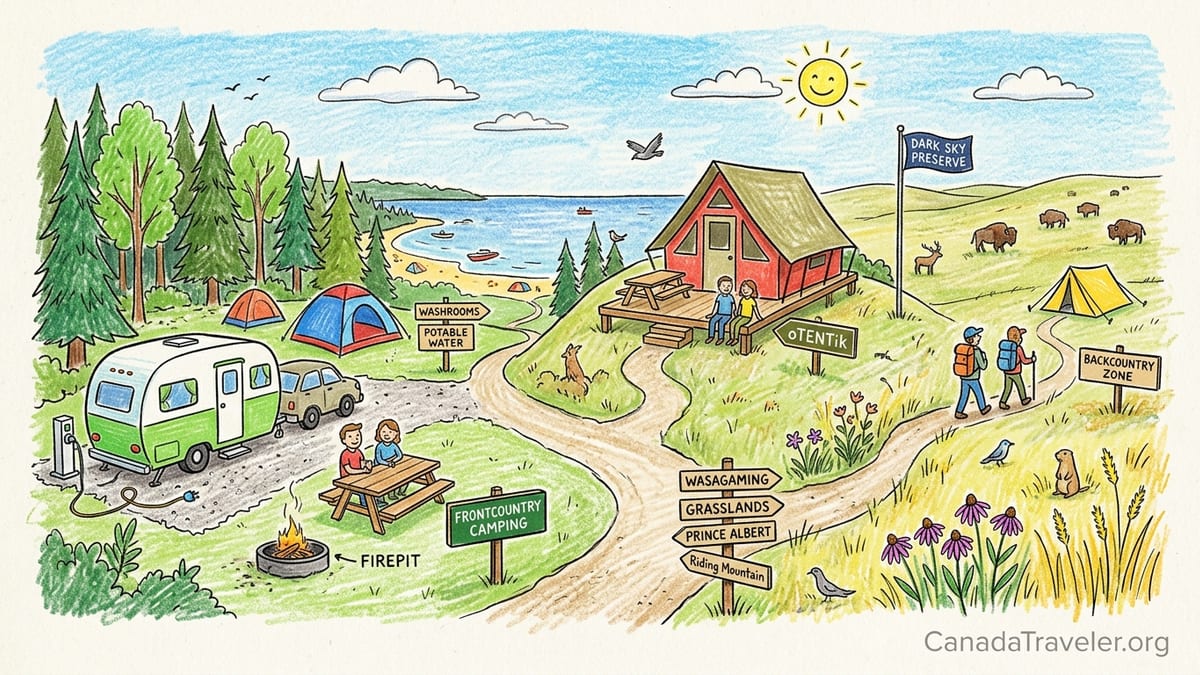
The prairie parks of Saskatchewan and Manitoba are designed to work for almost every kind of camper. In Grasslands, Prince Albert and Riding Mountain national parks, you will see “frontcountry” used for vehicle-accessible campgrounds with numbered sites, washrooms and usually potable water. Frenchman Valley Campground in Grasslands’ West Block, Beaver Glen at Prince Albert and Wasagaming in Riding Mountain are textbook examples, with drive-in sites, firepits and nearby services.
Backcountry camping in these parks means leaving the road behind. In Grasslands, this can be as simple as walking a kilometre from your car into the rolling prairie and pitching a tent within the designated backcountry zones in either the East or West Block. In Riding Mountain, backcountry sites such as those at Deep Lake or Lake Katherine are accessed by longer hikes or paddling trips, while Prince Albert’s quieter sites around Namekus Lake and Kingsmere Lake reward those willing to carry gear in by canoe or on foot.
oTENTiks, a Parks Canada invention, bridge the gap between camping and cabin. They are insulated, A‑frame structures with a raised wooden floor, beds with mattresses, a table and basic furnishings. At Grasslands, oTENTiks sit at Rock Creek and Frenchman Valley campgrounds. At Prince Albert they are grouped inside Beaver Glen Campground, while Riding Mountain scatters them around the busy Wasagaming townsite and at quieter options such as Moon Lake and Lake Audy. They are particularly useful for long-distance travelers who do not want to pack a full kit of camping gear.
Across all three parks, you will also find a mix of yurts, micro-cabins and traditional roofed accommodation, especially around Wasagaming in Riding Mountain and Waskesiu in Prince Albert. These options, combined with nearby motels and lodges just outside park gates, make the region surprisingly flexible for travelers who prefer prairie sunsets and bison encounters without committing to sleeping in a nylon tent.
Reservations, Seasons and Choosing Your Park
On the Prairies, camping season is compressed by long winters and shoulder seasons that can be snowy. In a typical year, frontcountry campgrounds in Grasslands, Prince Albert and Riding Mountain open in May and close by late September or early October, while some backcountry sites and roofed accommodations extend the season. Riding Mountain, for example, promotes winter oTENTik stays and snowshoe-in backcountry sites, while Grasslands often keeps backcountry camping available before and after frontcountry loops are closed, as long as access roads are passable.
For the 2026 season, Parks Canada announced that camping reservations for Riding Mountain open on January 30, which is a good indicator of how early to plan across the prairie parks. Grasslands and Prince Albert typically follow similar late-January or early-February booking dates for reservable sites, including oTENTiks and popular lakeside campgrounds. If you are targeting a prime summer or long-weekend stay at Wasagaming or Beaver Glen, setting a reminder for opening day and logging in as soon as reservations open dramatically improves your chances.
Each park offers a distinct prairie experience. Grasslands National Park, near Val Marie and Wood Mountain in southwestern Saskatchewan, is the most purely “prairie” of the three, with mixed-grass ecosystems, badlands and free-roaming plains bison. Prince Albert National Park, north of Prince Albert, feels more like boreal forest meeting prairie, with big lakes such as Waskesiu and Kingsmere rimmed by jack pine and spruce. Riding Mountain National Park in western Manitoba combines aspen parkland and mixed forest on the Manitoba Escarpment, with a cottage-town atmosphere in Wasagaming and quieter lakes like Moon Lake and Deep Lake further afield.
If your priority is dark skies and open horizons, Grasslands is hard to beat. For families who want beaches, bike rentals and ice cream within walking distance of camp, Prince Albert’s Waskesiu area or Riding Mountain’s Wasagaming townsite are strong choices. Many travelers build a loop, spending a few nights under the stars in Grasslands, then heading north or east toward the lake-country parks.
Frontcountry and RV Camping: Where to Park the Rig
RV travelers will find the best-serviced options at Prince Albert and Riding Mountain. Wasagaming Campground in Riding Mountain offers full-hookup and power-only loops suitable for larger trailers and motorhomes, with easy access to washrooms with showers, a sani-dump and the shops and restaurants of the Wasagaming townsite. A 25-foot travel trailer can comfortably back into most serviced sites here. Prince Albert’s Red Deer Campground fills a similar role, with drive-through and back-in sites designed for RVs close to Waskesiu’s marina and beach.
Grasslands, by comparison, feels more off-grid. Frenchman Valley Campground, reached along a gravel road southeast of Val Marie, offers a mix of unserviced pull-through and back-in sites that can handle small to mid-sized trailers and campervans, but without electrical hookups. Rock Creek Campground in the East Block is similar, with level gravel pads and pit toilets, but no power or water at individual sites. Both areas provide communal potable water sources during the main season, although early and late in the year you may need to bring jugs from Val Marie or Wood Mountain.
Within Prince Albert, Beaver Glen is the primary frontcountry campground for tent campers and smaller RVs, shaded by boreal forest and within walking distance of the Waskesiu townsite. It has powered and unserviced sites, modern washrooms and kitchen shelters, making it a good first stop for those new to national-park camping. Further out, Narrows and Sandy Lake campgrounds offer more rustic, unserviced experiences, with pit toilets and fewer facilities, but still vehicle access.
In Riding Mountain, campers seeking quieter bases than Wasagaming often look to Moon Lake or Lake Audy. Moon Lake offers basic vehicle-accessible sites beside a small lake with a day-use area, while Lake Audy adds the bonus of a nearby bison enclosure and a feeling of being far from the busy core of the park. Both are unserviced, so RVers must be self-contained, but they are suitable for smaller trailers and truck campers that can handle gravel access roads.
Backcountry Trips, Stargazing and Wildlife Considerations
Backcountry camping in the prairie parks rewards visitors willing to trade amenities for solitude. Grasslands is the most distinctive example. Once you obtain a backcountry permit, you can hike away from the roads into designated zones in either the West or East Block, choosing your own campsite among the hills and coulees. Nights here are exceptionally dark. Grasslands holds Dark Sky Preserve status, and on clear, moonless nights, the Milky Way is starkly visible, which is why photographers often plan trips specifically around new-moon weekends.
Riding Mountain’s backcountry has a more traditional wilderness feel, with forest-lined trails leading to sites such as Deep Lake, where a small number of tent pads and a fire ring sit near the water’s edge. The park’s visitor guide lists roughly a dozen designated backcountry sites spread across the escarpment, many accessible by full-day hikes or overnight loops. These sites are not serviced, and visitors must treat water from lakes or streams and pack out all garbage.
Prince Albert offers a mix of paddle-in and hike-in camping, particularly in the Namekus and Kingsmere lake areas. A common weekend trip is to launch a canoe at the south end of Namekus Lake, paddle to a designated backcountry site and spend a night listening to loons. More ambitious visitors tackle Kingsmere Lake, combining portages and paddling to reach remote sandy beaches and campgrounds that feel very far from the bustle of Waskesiu.
Wildlife is a constant presence. Grasslands is home to plains bison, pronghorn antelope, black-tailed prairie dogs and prairie rattlesnakes. Riding Mountain supports black bears, elk and moose, while Prince Albert’s forests shelter wolves and, more rarely seen, black bears and lynx. In all three parks, you will be required to store food and scented items securely. Frontcountry campgrounds typically provide metal food lockers at walk-in sites, and staff will advise you to lock food in your vehicle when you are away. In backcountry areas, bear hangs or portable bear-resistant canisters are strongly encouraged or required, depending on location, and cooking should always be done well away from tents.
Water, Fuel, Fire and Weather Planning
Prairie distances can surprise travelers used to more densely populated regions. In Grasslands, the nearest fuel to the West Block is in Val Marie, roughly 30 minutes’ drive from Frenchman Valley Campground, while the East Block is reached by rural roads south of Wood Mountain where fuel and groceries are limited. It is wise to arrive with a full tank and at least several days’ worth of drinking water, especially if you are camping in the shoulder season when campground water systems may not yet be running.
In Prince Albert and Riding Mountain, fuel and groceries are easier to find, but you should still not assume 24-hour service. Waskesiu and Wasagaming each have small grocery stores, cafes and fuel stations that operate on extended summer hours, but in May or September some services may have reduced schedules. Many experienced visitors pack a large water jug, topping it up at campground taps each evening rather than relying on single-use bottles.
Fire regulations on the Prairies are highly weather-dependent. During dry spells, especially in July and August, Parks Canada often imposes fire bans that restrict or prohibit wood fires in fire rings, even within frontcountry campgrounds. In practice, this means you may be allowed to use a propane camp stove with a shut-off valve but not to have a traditional campfire. Prince Albert has already announced that from spring 2025 onward, free firewood will no longer be provided at campgrounds, so travelers should arrive prepared to purchase bundled firewood locally when fires are permitted, or plan to cook on stoves.
Summer temperatures can swing dramatically. In Grasslands, daytime highs in July often reach the high 20s or low 30s Celsius, while nighttime lows can drop under 10 degrees. Thunderstorms build quickly on the open plains. Staking tents securely and avoiding pitching in low spots where water might pool is essential. In Prince Albert and Riding Mountain, afternoon heat can be followed by cool evenings along the lakes. A three-season sleeping bag and layers such as a fleece jacket and light down vest are useful almost any time between May and September.
Best Bases for Hiking, Lakes and Prairie Night Skies
For hikers focused on prairie vistas, Frenchman Valley Campground in Grasslands’ West Block makes an ideal base. From here you can drive the Ecotour Scenic Drive, stop at trailheads such as 70 Mile Butte and Two Trees and then return to camp in time for sunset over the Frenchman River Valley. In the East Block, Rock Creek Campground sits near the dramatic Badlands Parkway and several trailheads leading into rugged clay and sandstone formations, which glow orange and pink in evening light.
At Prince Albert, Beaver Glen Campground is a strong all-round choice. It lies within walking distance of the Waskesiu townsite and its sandy main beach, making spontaneous swims and ice cream runs easy. From camp, you can drive a short distance to popular hikes such as the Boundary Bog Trail or the Kingsmere River area, or rent canoes and stand-up paddleboards for an afternoon on Waskesiu Lake. For a quieter, more nature-focused base, Namekus Lake and Sandy Lake campgrounds offer good birdwatching and easy lake access, with fewer crowds.
Riding Mountain’s Wasagaming Campground is the park’s social hub, ideal for families who want bike rentals, lakeside playgrounds and a choice of cafes. The Clear Lake shoreline runs just beyond the campground, and popular hikes like the Ominik Marsh boardwalk and the first stretch of the North Escarpment trail are within an easy drive. Campers looking for more seclusion often gravitate toward Moon Lake or Lake Audy, which provide a better sense of Riding Mountain’s wilder side while still allowing day trips back to Clear Lake for amenities.
For night-sky enthusiasts, Grasslands remains the top destination thanks to minimal nearby light pollution and its Dark Sky Preserve designation. East Block’s Rock Creek area feels especially remote, and campers often plan their stays around meteor showers such as the Perseids in August. That said, both Prince Albert and Riding Mountain can deliver excellent stargazing on clear nights, particularly at smaller lakes away from townsites. Turning off headlamps, letting your eyes adjust for 20 to 30 minutes and using a reclining camp chair can transform even a basic campground into an informal observatory.
Prairie Camping Without a Carload of Gear
Travelers flying into Saskatoon, Regina or Winnipeg, or road tripping without space for full camping gear, can still enjoy overnight stays inside these parks. oTENTiks are the simplest option. Each oTENTik at Frenchman Valley, Rock Creek, Beaver Glen or Wasagaming typically includes beds with mattresses for up to six people, interior seating, a table, lighting and a deck or picnic table outside. You bring your own sleeping bags or bedding, cooking equipment and food. Many visitors supplement with a compact two-burner camp stove, a cooler and a simple cookware set to keep packing manageable.
Riding Mountain expands the gear-light choices with yurts and micro-cabins near Wasagaming, which often include more furnishings and, in some cases, heating and small kitchenettes. These can be appealing shoulder-season options, especially in May or late September when nights are chilly. Prince Albert, while more focused on traditional camping, benefits from the full-service tourist village at Waskesiu, where small motels, lakeside resorts and cabin rentals sit within a short walk or drive of park amenities.
For those who prefer not to camp at all but still want a prairie immersion, basing in nearby communities works well. In Grasslands, the village of Val Marie offers small inns and bed-and-breakfasts within a short drive of the West Block’s Ecotour Scenic Drive and Frenchman Valley. On the East Block side, Wood Mountain Regional Park and surrounding farm stays provide alternatives with a local ranch-country feel. Around Riding Mountain, the communities of Onanole and Erickson have motels and cottage rentals that allow day trips into the park without the need to manage a campsite.
Several outfitters and local businesses in Saskatchewan and Manitoba also rent basic camping equipment, from tents and sleeping bags to camp stoves. While offerings change from year to year, it is worth checking outdoor shops in Saskatoon, Regina, Winnipeg, Prince Albert or Brandon if you want to mix one or two nights of tent camping into a mostly roofed trip. Combining an oTENTik stay with a single night in a simple two-person tent often gives first-time visitors a low-risk taste of full prairie camping.
The Takeaway
Planning a camping trip to the Canadian Prairies is as much about matching your comfort level as it is about choosing a destination. Grasslands, Prince Albert and Riding Mountain national parks each offer a different expression of prairie and parkland, from wide-open mixed-grass plains and badlands to clear lakes fringed with jack pine. Between them you will find everything from unserviced backcountry sites to full-hookup RV loops, oTENTiks, yurts and lakeside cabins.
Book early if you want summer weekends in popular campgrounds like Wasagaming or Beaver Glen, arrive with flexible expectations about fire bans and weather, and plan water and fuel carefully in more remote areas such as Grasslands. Build in time to hike even short trails, listen for coyotes at dusk, watch bison graze or simply sit under the sky until the stars emerge. However you choose to sleep, the prairie night will likely be what you remember most vividly.
FAQ
Q1. Do I need to reserve every campsite in Grasslands, Prince Albert and Riding Mountain?
Many frontcountry sites and all oTENTiks in these parks are reservable and often book up for peak summer dates, while a portion of campsites may remain first come, first served. It is safest to reserve ahead for summer weekends and long weekends, especially at Wasagaming, Beaver Glen, Frenchman Valley and Rock Creek.
Q2. Are the oTENTiks in these parks suitable for winter or shoulder-season stays?
Riding Mountain promotes some oTENTiks for winter use, and they are insulated structures, but comfort will depend on the specific unit and weather. In spring and fall, oTENTiks in all three parks offer more warmth and wind protection than tents, making them a good choice for cooler nights.
Q3. Can I take a large RV into Grasslands National Park campgrounds?
Frenchman Valley and Rock Creek campgrounds can accommodate many small and mid-sized RVs and trailers on gravel pads, but there are no hookups and access roads include stretches of gravel. Very large motorhomes are possible with careful driving, but travelers who need full services generally find Riding Mountain and Prince Albert more convenient.
Q4. How strict are fire bans and can I still cook when they are in place?
Fire bans in these parks are taken seriously due to the risk of fast-moving grass and forest fires. When bans are active, wood campfires are usually prohibited, but propane or gas stoves with shut-off valves are often still allowed for cooking at designated sites. Always confirm current rules with park staff on arrival.
Q5. Is it safe to camp with children in areas with bison, bears or rattlesnakes?
Thousands of families camp safely in these parks each year by following basic precautions. This includes keeping children close on trails, storing all food and scented items securely, teaching kids not to approach wildlife and wearing closed-toe shoes in rattlesnake habitat such as Grasslands. Park staff and visitor centres provide up-to-date safety guidance.
Q6. Do backcountry campsites have toilets and potable water?
Most designated backcountry sites have only basic facilities, often a pit toilet and sometimes a simple fire ring. Potable water is rarely provided, so you must carry water in or filter and treat it from nearby lakes or streams. Always check specific site descriptions before you go.
Q7. What is the best time of year for stargazing in these prairie parks?
Late spring through early autumn generally offers the clearest nights, with July and August particularly good for warm evenings and meteor showers. In Grasslands, planning around a new moon will maximize dark-sky conditions, while shoulder-season trips bring longer nights and fewer bugs but cooler temperatures.
Q8. Are there options for people who want to experience the prairies without camping at all?
Yes. Val Marie, Wood Mountain, Waskesiu, Wasagaming and nearby communities offer inns, motels, cabins and bed-and-breakfasts. You can stay in roofed accommodation, then drive into the parks each day for hikes, wildlife viewing and scenic drives, returning to a private room at night.
Q9. How much camping gear do I need if I book an oTENTik?
oTENTiks provide a solid structure, beds with mattresses, basic furniture and usually a picnic table and firepit outside. You still need to bring bedding or sleeping bags, cooking equipment, dishes, food, a cooler, lighting such as headlamps and personal items. Many travelers use compact stoves and simple cookware to keep packing light.
Q10. Do I need bear spray in these parks, and where should I carry it?
Bear spray is strongly recommended in Riding Mountain and Prince Albert and is useful in Grasslands as a general wildlife deterrent. If you carry it, keep it accessible on your person, such as in a belt holster, rather than stored in a backpack. Park staff can demonstrate correct use and discuss current wildlife activity when you arrive.