


The Canadian Prairies stretch from wide open shortgrass plains in southern Saskatchewan to mixed forests and lakes in Manitoba and central Saskatchewan. Picking the right time to visit matters more here than in many regions. Heat, powerful summer storms, wildfire smoke, mosquitoes, early frosts and short winter days can dramatically change what your trip feels like. This guide looks past simple temperature charts and focuses on how each season actually feels on the road and on the trail, using real-world examples from Grasslands, Riding Mountain and Prince Albert national parks.
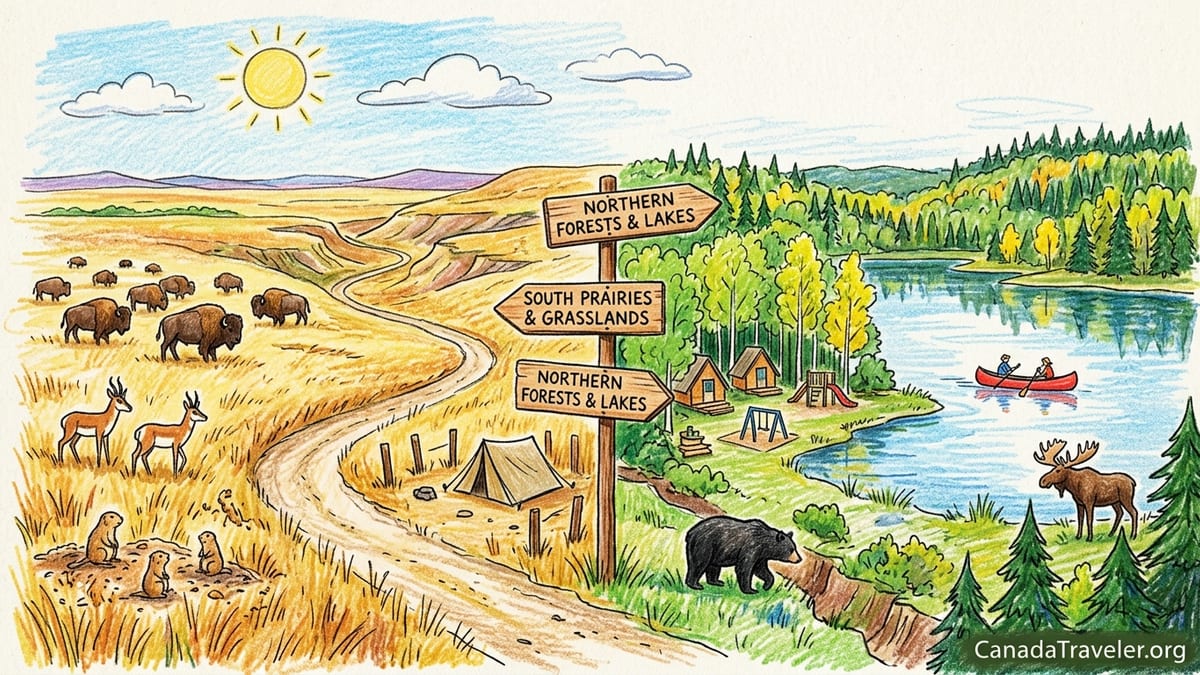
Understanding the Prairie Climate and Regions
Travelers often imagine the Prairies as one flat, uniform landscape, but the experience differs sharply between the exposed shortgrass plains in the south and the more forested uplands farther north. In southern Saskatchewan’s Grasslands National Park, campsites sit in open coulees and on ridges with almost no shade. Summer afternoons routinely feel hotter than the air temperature because sun and wind are unfiltered. Farther north at Riding Mountain National Park in Manitoba or Prince Albert National Park in Saskatchewan, mixed forest, lakes and higher elevation moderate both heat and wind. A July afternoon at the South Gillespie campground in Grasslands might feel punishing, while a lakeside site in Wasagaming at Riding Mountain feels comparatively gentle, even on the same day.
Precipitation also behaves differently here. Much of the Prairies’ rain arrives in late spring and early summer through convective storms, including fast-building thunderstorms that can drop hail and bring strong gust fronts. Aviation guidance for the region notes that convective storm season runs from roughly May to early September, with July typically the most active month. That matters if your tent is pitched on an exposed benchland above the Frenchman River or along a gravel road in farmland. In contrast, autumn often turns cool, dry and stable, providing calmer conditions for long drives and photography, although nights can drop below freezing as early as late September.
Daylight swings are another key planning factor. Around the summer solstice, places like Swift Current, Manitoba’s Dauphin and Waskesiu Lake enjoy roughly 16 hours of usable light, which is ideal for long road days followed by late-evening wildlife drives. By mid-October, daylight is closer to 10 hours, and in December it shrinks to around 7.5 to 8 hours, which changes what is realistic for winter road trips between small prairie towns and the national parks.
Finally, services and campgrounds do not follow the same schedule everywhere. In Riding Mountain’s Wasagaming Campground, most loops typically operate from early May to early or mid-October, with a handful of oTENTik cabins and some serviced sites winterized for year-round use. Grasslands closes its front-country campgrounds in winter, while Prince Albert sometimes keeps limited drive-in winter camping at Birch Bay with pit toilets and a basic shelter. Planning around these operational seasons is as important as watching the weather forecast.
Late Spring: Hiking, Wildlife and Shoulder-Season Calm
Late spring, from mid-May through June, is one of the most rewarding but underrated times to visit the Canadian Prairies, especially if you are focused on hiking and wildlife rather than swimming. As snow retreats from the uplands and fields green up, animals concentrate near new grass and wetlands. On an early June dawn drive along Riding Mountain’s Highway 19 or 10, it is common to see white-tailed deer feeding at field edges, black bears grazing in ditches and elk emerging from aspen stands. In Grasslands, bison calves, pronghorn fawns and burrowing owl chicks appear across the West Block’s prairie dog towns, making roadside wildlife viewing unusually productive without long hikes.
Trails are often at their best in late spring. Temperatures are typically mild enough for long day hikes, with daytime highs often in the mid-teens to low twenties Celsius. You can comfortably climb the 70 Mile Butte trail in Grasslands or tackle the Grey Owl trail near Waskesiu Lake without the oppressive heat and sun exposure common in July. However, this is also when trails can still hold lingering mud from snowmelt and early-season rains. In forested parks such as Prince Albert, expect some standing water on low-lying sections and consider waterproof boots rather than low trail runners.
There are trade-offs. Mosquitoes and blackflies begin to emerge as soon as thawed wetlands warm up, particularly in forested or boggy areas. An evening walk around Wasagaming in late May can involve persistent bugs near the shoreline, while the drier shortgrass of Grasslands often has fewer mosquitoes but more wind. Storm risk also ramps up. Convective storms often build by afternoon, so planning ridge hikes and exposed driving earlier in the day, followed by sheltered activities or time in town later, is wise. It is not unusual in June to have a warm blue-sky morning on the prairie turn into a late-day thunderstorm with nickel-sized hail.
On the practical side, late spring is still shoulder season for many campgrounds, which can work in your favor. At Riding Mountain, some loops open in early May with limited services, meaning lower crowds and a better chance of same-weekend reservations. Local outfitters in prairie cities such as Winnipeg, Regina or Saskatoon often run spring promotions on gear rentals and canoe trips before the peak summer rush. Road conditions are generally good on main highways, but gravel grid roads that lead to backcountry trailheads or lesser-known viewpoints can stay soft and rutted after heavy rains, so a vehicle with decent clearance is helpful if you plan to explore beyond the main paved routes.
High Summer: Camping Seasons, Heat, Storms and Smoke
July and early August deliver classic summer conditions and the fullest range of services, which makes them the default choice for many families planning a Canadian Prairies trip. Campgrounds at Grasslands, Prince Albert and Riding Mountain are typically in full operation, with interpretive programs running on summer weekends, boat and bike rentals available and visitor centers offering extended hours. For example, Wasagaming in Riding Mountain feels like a small resort town in July, with ice cream shops and lakeside patios open late. In Waskesiu at Prince Albert, lakeshore beaches are busy and outfitters rent kayaks and stand-up paddleboards for exploring the shoreline.
The cost of convenience is heat and crowding. Across much of the Prairies, average daytime highs in July are in the mid to high twenties Celsius, but exposed areas feel hotter. In Grasslands’ East Block, where shade is scarce, tent sites can become uncomfortable by mid-afternoon, and some travelers retreat to Val Marie or nearby motels for a few hours of air conditioning. Humidity is usually lower than in eastern Canada, yet multi-day heat waves with temperatures into the low thirties do occur, making mid-day hiking risky for inexperienced visitors, particularly on steep, trail-less coulees where route-finding and sun exposure combine.
High summer is also prime time for severe thunderstorms. Forecast offices for the region emphasize that convective storm activity peaks from June through August, with July particularly active. On a typical July day in southern Saskatchewan or southern Manitoba, skies may be blue at noon, yet by late afternoon towering cumulonimbus clouds build on the western horizon. Campers at Grasslands’ Frenchman Valley Campground or along Riding Mountain’s Clear Lake shoreline routinely experience sudden gust fronts, lightning and heavy downpours. It is important to secure tents and tarps carefully, avoid pitching on low ground that can pool water and have a plan to move into a hard-sided vehicle if lightning becomes frequent.
Another increasingly important factor is wildfire smoke. In recent years, large fires in northern Saskatchewan, Alberta or British Columbia have periodically sent smoke plumes over the Prairies, turning the sky hazy and sometimes degrading air quality for days at a time. Even when fires are far away, visibility at dark-sky preserves like Grasslands can be reduced, and long views from Manitoba’s Bald Hill or Riding Mountain’s lookouts may appear muted. The impact varies year to year, so flexibility is key. Many travelers now build in a couple of spare days and are ready to shift to indoor activities in prairie cities such as Saskatoon, Winnipeg or Regina if a thick smoke event coincides with their camping dates.
Late Summer to Early Autumn: Prairie Light, Stargazing and Quieter Roads
From mid-August through late September, conditions across much of the Prairies often swing in favor of road trippers, photographers and stargazers. Daytime temperatures usually ease back into the teens and low twenties Celsius, storm frequency tapers off and the light softens as the sun angle lowers. This is also when many grain fields turn golden or are harvested, creating the iconic patchwork landscapes visitors picture when they think of Saskatchewan and Manitoba. Driving secondary highways around communities such as Val Marie, Maple Creek, Dauphin or Prince Albert in late August provides endless foregrounds for sunset shots and long-lens photography of elevators, hay bales and distant thunderstorms.
Late summer is arguably the best time for stargazing on the open prairie. Grasslands National Park is an officially recognized dark-sky preserve, and local observers often time visits around the Perseid meteor shower in mid-August. By that point, nights are long enough that you do not have to stay up past midnight to experience dark skies, but temperatures are still comfortable enough to sit outside in a light jacket. August evenings in the Frenchman Valley or around Rock Creek often hover in the low teens Celsius, making it feasible to combine an evening of wildlife watching with night photography. In forested parks like Prince Albert and Riding Mountain, tree cover cuts some of the open-sky feel, but lakeshore clearings and beaches still offer strong Milky Way viewing when the moon phase cooperates.
Campgrounds and roads shift into a sweet spot too. Many families have wrapped up holidays by late August, and once local schools restart, midweek nights in places like Wasagaming or Waskesiu become quieter while services remain open. Campsites that were nearly impossible to book in July sometimes become available with much shorter notice. Rates at private campgrounds along major corridors such as the Trans-Canada Highway or Yellowhead Highway may drop slightly after Labor Day as demand eases. The main caution is that some provincial and private campgrounds begin reducing services or closing loops after mid-September, especially in northern or higher-elevation areas, so it is essential to reconfirm dates rather than assuming everything runs until Thanksgiving.
Weather remains variable, and shoulder-season realities should not be ignored. An early autumn cold front can bring frost or even wet snow to Riding Mountain’s high points or Prince Albert’s interior forests as early as late September, while southern Grasslands may still experience afternoon highs above 25 degrees Celsius. On a single road trip loop that takes in Grasslands, Cypress Hills, Riding Mountain and Prince Albert, you might encounter T-shirt weather on the plains and toques at night around northern lakes in the same week. Packing for layers, carrying insulated sleeping bags and treating forecasts as a guideline rather than a promise is key for this period.
Autumn Road Trips: Cool Air, Color and Fewer Bugs
Autumn, especially from mid-September to early October, is ideal for travelers who prioritize cool hiking weather, long drives and color rather than swimming or peak wildlife numbers. In mixed-forest parks like Riding Mountain and Prince Albert, aspen and birch stands typically turn yellow and gold during this window, creating classic North Woods scenery around lakes such as Clear Lake or Waskesiu. Driving the Wasagaming to Audy Lake loop or the Narrows road near Prince Albert in late September can feel like moving through a tunnel of color, with frequent chances to pull off at trailheads or picnic spots.
On the open prairie, autumn color takes subtler forms. Native grasses in Grasslands shift to tawny and reddish hues, and the low sun angle produces warm light that flatters rolling coulees and badlands. Photographers often time visits to the East Block’s badland viewpoints or the 70 Mile Butte area in late afternoon, then stay for twilight and early night skies. As crops come off, roads that were busy with grain trucks in August become quieter, making secondary highways and gravel backroads more pleasant for slow, exploratory drives between small towns and trailheads.
Autumn also dramatically improves comfort levels when it comes to bugs and heat. Mosquito activity drops significantly after the first hard frosts, which in parts of Manitoba and Saskatchewan can arrive in September. That means evening campfires at Wasagaming or Waskesiu are more enjoyable, and sunset hikes on open trails like Grasslands’ Eagle Butte can be lingered over without constant swatting. Daytime temperatures often sit in the single digits to mid-teens Celsius, perfect for strenuous routes or full days on the road without vehicles overheating and without the energy drain of mid-summer sun.
The trade-off is shrinking daylight and the gradual shutdown of services. By early October, many Parks Canada front-country campgrounds in the region either close entirely or shift to reduced service, with water shutoffs and fewer washroom facilities. Some private motels and seasonal restaurants in gateway communities also close after Thanksgiving. For a road trip that combines Grasslands with more forested parks, early autumn works best for those who are content with simpler services or who are comfortable mixing camping with indoor stays in places like Dauphin, Prince Albert or Swift Current as park facilities wind down.
Winter on the Prairies: Snow, Short Days and Quiet Trails
Winter on the Canadian Prairies, broadly from November through March, transforms the region into a quiet, demanding destination best suited to experienced cold-weather travelers or those using front-country comfort options. Southern Grasslands becomes sparsely visited; while the park remains open, front-country campgrounds typically close, and services in nearby communities operate on off-season hours. Snow depth can be highly variable, with some winters leaving windswept ridges almost bare and coulees holding drifts, while other years see deeper, persistent snow that makes off-trail hiking exhausting without snowshoes.
Forest-edge parks like Riding Mountain and Prince Albert adapt better to winter visitation. At Riding Mountain, Parks Canada has winterized several oTENTik units in the Wasagaming Campground and keeps a small number of serviced or unserviced sites available year-round. These insulated, heated structures allow visitors to experience overnight temperatures that can drop well below minus 20 degrees Celsius without full expedition gear. Reviews from winter campers frequently mention staying warm during cold snaps around minus 30 degrees, while enjoying ski and snowshoe trails on the escarpment during the day. Prince Albert typically closes its main campgrounds but offers limited drive-in winter camping at Birch Bay, with basic facilities and access to ice fishing on Waskesiu Lake, where a winter fishing season often runs until late March.
Road conditions are the main planning constraint. Even major highways such as the Trans-Canada or Yellowhead can experience closures or travel advisories during blizzards, and smaller provincial roads leading into the parks may be plowed less frequently. Strong winds over open fields often create ground blizzards, where visibility drops even when snowfall is light. For winter trips, a vehicle with good winter tires, a full emergency kit and flexible timing is essential. Many experienced local travelers aim for midwinter cold snaps with clear skies for photography and dark-sky viewing, but will routinely delay departure by a day if a strong system is forecast.
Wildlife viewing changes character in winter. In Prince Albert, tracks of wolves, foxes and elk are easier to spot against snow along trails like Kingsmere River or Boundary Bog, and many bird species concentrate near open water or feeders in Waskesiu. In Riding Mountain, bison in the Lake Audy area stand out sharply against the snow-covered fescue grasslands, and winter visitors often report seeing more large mammals on a single day than in a week of midsummer visits. The downside is that daylight is limited, often offering only a narrow window for activities between dawn and dusk, and cold requires more frequent warming breaks and hot drinks.
Southern Grasslands vs Forested Parks: How Timing Differs
Choosing the best time to visit the Canadian Prairies depends heavily on whether your focus is the exposed grasslands of the south or the more sheltered forests and lakes to the north. Grasslands National Park, particularly its West Block near Val Marie and East Block near Wood Mountain, is about raw prairie exposure. Summer days can be blistering, wind can be relentless in any season and shade is rare. Late spring and late summer to early autumn stand out here. In May and June, green hills and active wildlife offset the risk of afternoon storms, while in late August and September, cooler temperatures, golden grasses and dark skies combine for comfortable camping and exceptional stargazing. Many local observers specifically recommend late August to align with meteor showers and to avoid the worst heat and thunderstorm risk.
Forested and mixed-parkland destinations like Riding Mountain and Prince Albert offer a longer and more flexible season. Tree cover moderates wind and sun, lakes provide cooling in summer and winter snow creates classic ski and snowshoe settings. July and August are excellent for family camping, with warm water at lakes like Clear Lake and Waskesiu and full services in towns such as Wasagaming and Waskesiu. However, serious hikers and wildlife enthusiasts may prefer June or September, when trails are cooler and crowds thin. Autumn color, particularly in late September, is a major draw at Riding Mountain, where rolling hills of aspen, balsam poplar and spruce create a layered landscape quite different from the plains.
Wildfire smoke, insects and services amplify these differences. Grasslands often avoids the worst mosquitoes due to its drier climate, but it is fully exposed if regional wildfire smoke drifts in. When visibility drops, vistas from viewpoints like 70 Mile Butte are more affected than forest trails, where close-range scenery still has impact. In contrast, Prince Albert and Riding Mountain can feel buggy in June evenings near wetlands, yet tree cover and varying vistas provide some resilience against hazy skies. Service-wise, Grasslands gateway communities are small, with limited off-season dining and accommodation. Riding Mountain’s Wasagaming and Prince Albert’s Waskesiu function more like small resort villages, keeping a baseline of services going into shoulder seasons and around holiday periods.
For a multi-park loop that combines Grasslands with Riding Mountain and Prince Albert, a late August or early September window often delivers the best compromise. You are likely to avoid the worst prairie heat and storms, enjoy long but manageable daylight hours and still find most campgrounds and visitor services operating. Some travelers start with Grasslands around the Perseid meteor peak, then work their way northeast to Riding Mountain for hiking and wildlife, finishing at Prince Albert for lakeside camping and mixed-forest trails as early autumn color begins.
The Takeaway: Matching Your Trip to Your Priorities
When you look past temperature averages and think about how the Prairies actually feel season by season, patterns emerge that make planning simpler. Late spring favors active hikers and wildlife watchers who do not mind some mud and the possibility of strong afternoon storms. High summer works best for families and first-time visitors who want full campground services and beach weather, as long as they are prepared for heat, thunderstorms, mosquitoes and the occasional smoky sky. Late summer into early autumn is the sweet spot for road trips, landscapes and dark-sky travel, with more stable weather, softer light and quieter campgrounds. Winter is for those who either embrace deep cold with proper gear or use winterized oTENTik cabins and basic drive-in camping as a way to sample snowy trails and silent forests.
For road trips, consider late August to late September if your priority is scenic driving with minimal weather drama. You might, for example, fly into Regina, drive to Grasslands for two or three nights of prairie hiking and stargazing, then arc east via Moose Jaw and Brandon to Riding Mountain for autumn color and wildlife, finishing in Winnipeg. If you must travel in July, build flexibility into your route, allowing extra time for detours or pauses during severe thunderstorm days, and plan driving so that long open stretches occur in the morning rather than evening when storms are more likely.
Camping choices should follow both season and destination. In high summer, book serviced sites or oTENTiks in Riding Mountain or Prince Albert if you value shade, showers and family-friendly amenities, and reserve well ahead, as popular loops can fill quickly on weekends. For Grasslands, aim for June or September to balance wildlife, manageable temperatures and dark skies, and bring robust stakes and guy lines for wind. In winter, treat oTENTik stays at Riding Mountain or limited drive-in sites at Prince Albert as an introduction to cold-weather camping rather than jumping straight into tent camping at minus 25 degrees.
Wildlife, hiking, photography and stargazing each have their own seasonal sweet spots, but they overlap more than you might expect. Wildlife is excellent in late spring and again in winter, when snow makes tracks easier to see and animals stand out. Hiking is strongest from late May through early October, with June and September particularly comfortable. Photography and dark-sky travel arguably peak from mid-August through late September, when nights are dark enough, air is often less humid and color in both sky and landscape intensifies. By matching your own priorities to these seasonal patterns and considering whether you are heading for southern Grasslands or more forested parks like Riding Mountain and Prince Albert, you can turn the Prairies from a climate gamble into one of Canada’s most rewarding year-round destinations.
FAQ
Q1. What is the single best month for a Canadian Prairies road trip?
For most travelers, late August or early September offers the best balance of cooler temperatures, fewer storms, quieter campgrounds and long enough days for scenic driving.
Q2. When is the best time to visit Grasslands National Park for stargazing?
Mid-August to late September is ideal, especially around the Perseid meteor shower, when nights are dark, temperatures are manageable and campgrounds are still open.
Q3. Which season is best for wildlife viewing in Riding Mountain and Prince Albert?
Late May and June are excellent for spotting young animals and active bears, while winter makes tracks easier to see and concentrates wildlife along forest edges and fields.
Q4. How bad are mosquitoes on the Prairies, and when are they worst?
Mosquitoes are most intense from late May through July in wetter and more forested areas like Riding Mountain and Prince Albert; open, drier Grasslands usually has fewer but not none.
Q5. Is summer too hot for camping in the southern Prairies?
July and early August can feel very hot, especially in exposed places like Grasslands, but early starts, shady midday breaks and well-ventilated tents make trips workable for prepared visitors.
Q6. Are prairie roads safe to drive in winter?
Main highways are generally well maintained, but blizzards, ground drifting and ice can create hazardous conditions, so winter travelers need flexible plans, winter tires and emergency gear.
Q7. Do I need to book campgrounds in advance?
For July and long weekends, reservations are strongly recommended at national parks and popular private campgrounds; in shoulder seasons, you may find space with shorter notice.
Q8. When do campgrounds typically open and close on the Prairies?
Most front-country campgrounds open in May and close by early to mid-October, with a few winterized oTENTiks and limited sites at parks like Riding Mountain and Prince Albert available year-round.
Q9. What is the best time for autumn colors in forested prairie parks?
Late September is usually the peak for yellows and golds in aspen and birch stands around lakes at Riding Mountain and Prince Albert, though timing can shift by a week or two each year.
Q10. How should I plan around wildfire smoke on a Prairies trip?
Because smoke varies from year to year, build flexibility into your schedule, watch forecasts before driving into remote areas and have backup indoor or city-based activities as a contingency.