


The Canadian Arctic does not have a single “best month” to visit. Instead, its seasons are shaped by sea ice, migrating wildlife, 24-hour daylight and winter darkness. The right time for you depends on whether you dream of watching narwhals at the floe edge, hiking beneath granite walls in Auyuittuq National Park, joining an expedition cruise through the Northwest Passage or experiencing Inuit culture under the northern lights. This guide breaks the Arctic year into distinct experience windows so you can pick dates that match what you most want to see and do.
Understanding Arctic Seasons, Sea Ice and Daylight
In most of Canada, four familiar seasons define travel. In the Arctic, sea ice and daylight matter more than the date on the calendar. From roughly October to June, much of Nunavut and the high Arctic archipelago is locked in sea ice. Pack ice covers channels such as Lancaster Sound, while land-fast ice clings to shorelines and fiords. In late spring and early summer, that ice fractures, opens into leads of water and retreats north, briefly creating ideal conditions for floe-edge wildlife viewing before breaking up completely in many areas.
Daylight is just as important. Communities north of the Arctic Circle, such as Resolute and Arctic Bay, enter continuous daylight in April, with the sun above the horizon until early August. Farther south, in places like Iqaluit and Pangnirtung, summer still brings very long days, even if the sun dips briefly below the horizon. In winter, the reverse happens: weeks to months of polar night in the High Arctic and very short days farther south. These shifts affect everything from flight schedules to how long you can comfortably be outside.
For travelers, this means that March in Iqaluit feels like late winter, with strong sun reflecting off the snow and sea ice still firmly in place, while July in Pond Inlet can feel like a bright, cool summer with open water beyond drifting ice. Temperatures are highly variable but even in July, average highs in many Nunavut communities hover in the high single digits or low teens Celsius. Wind on open water or sea ice often makes it feel colder than the thermometer suggests, so proper layering is essential regardless of month.
Wildlife also follows the ice. Narwhal, beluga and bowhead whales move toward coastal fiords and inlets as ice retreats, usually from around June through August. Migratory birds, including thick-billed murres and kittiwakes, return to cliff colonies for a short breeding season, while polar bears patrol shorelines and ice edges where seals rest and breathe. Understanding these rhythms helps you match your trip window to the experiences you care about most.
Spring Floe Edge: Narwhals, Polar Bears and Sea-Ice Travel (April to Early June)
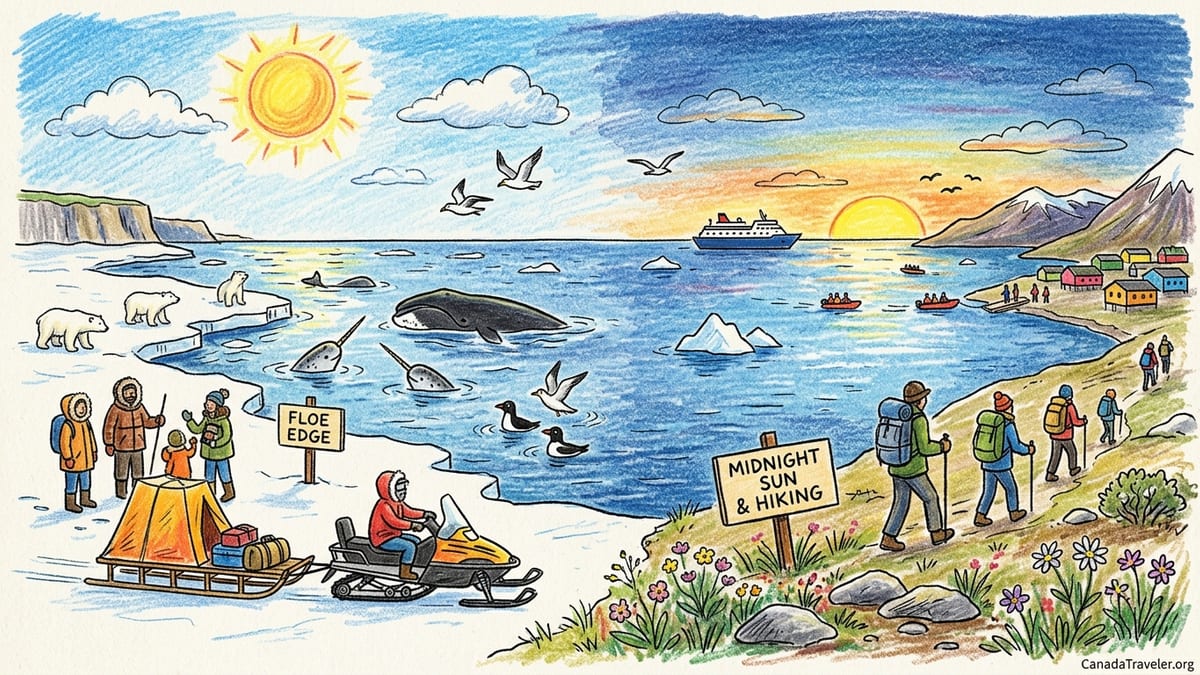
For many wildlife-focused travelers, the most dramatic Arctic experience happens at the spring floe edge, where solid land-fast sea ice meets open water. In Nunavut’s eastern Arctic, outfitters based in communities such as Pond Inlet, Arctic Bay and Qikiqtarjuaq typically operate floe-edge trips from late April through early June, depending on the year’s ice conditions. Guests travel by snowmobile and qamutiik sled across sea ice to base camps set up near the floe edge, then spend days watching for narwhal, bowhead whales, seals, seabirds and sometimes polar bears and walrus.
At this time of year, temperatures can still range well below freezing at night, often between minus 15 and minus 5 degrees Celsius on the ice, with windchill making conditions more severe. The reward is dependable, stable sea ice that supports snowmobiles, tents and on-ice travel. Operators provide heavy insulated suits, boots and heated communal tents, but you still need warm base layers and the willingness to spend long periods outdoors. The light is strong and often continuous in High Arctic locations, though in April you may still see sunset hues before transitioning to 24-hour daylight by May.
Wildlife is concentrated because the floe edge is one of the first places to open in spring. Narwhals use polynyas and leads of water along the ice edge as migration corridors. While sightings are never guaranteed, trips in late May and early June tend to coincide with peak narwhal movements in parts of the eastern Arctic. Polar bears patrol the same edges, searching for seals that haul out or surface to breathe. Birders also benefit, as thousands of seabirds raft on open water or wheel overhead. These experiences are logistically complex and are almost always arranged through specialized operators that charter local snowmobile guides, cooks and sometimes Inuit cultural interpreters.
One trade-off with spring floe-edge travel is limited access to hiking or open-water activities. You are essentially living on winter sea ice, not summer tundra. There are no mosquitoes, but you sleep in expedition-style camps, use outhouses or latrine tents and travel by snowmobile rather than boat or on foot. Flights into communities like Pond Inlet or Arctic Bay can be delayed by late-season storms or blowing snow, so building in buffer days on either side of your itinerary is wise.
Summer and Midnight Sun: Hiking, Tundra and Open-Water Wildlife (Late June to August)
Once sea ice breaks up along the coasts, usually from late June into July, the Canadian Arctic shifts from white to green and blue. This is when hikers and independent travelers have their best window. In Auyuittuq National Park on Baffin Island, Parks Canada describes late June, July and August as the primary hiking and climbing season, with July and August particularly popular on the Akshayuk Pass route between Pangnirtung and Qikiqtarjuaq. River levels can be high early in the season with snowmelt, while by August some crossings become easier though weather can start to cool.
In practice, hikers flying into Pangnirtung or Qikiqtarjuaq often aim for mid-July to mid-August to balance milder temperatures, more stable weather and open fiords for boat shuttles into the park. Shorter day trips into Auyuittuq from Pangnirtung are also common in this period, arranged with local boat operators who can drop visitors at the park boundary for a day of valley hiking before returning with the tide. Similar July and August windows apply to other tundra areas such as Sirmilik National Park, Quttinirpaaq National Park on Ellesmere Island for experienced expeditions, and day hiking near communities like Iqaluit, Clyde River and Arctic Bay.
Midnight sun is a distinctive feature of these months. In communities far north such as Resolute, the sun does not set from around late April to mid-August. Farther south, it may dip just below the horizon but sky brightness makes it easy to hike or sit by camp late into the night. Temperatures in July often reach mid-single to low double digits Celsius, but wind, fog and sudden rain are common. Travelers must be prepared for rapid changes, carrying waterproof shells, warm mid-layers and hats and gloves even in apparent summer.
The main drawback of Arctic summer is insects. From roughly late June through early August, mosquito and blackfly activity can be intense in low, wet tundra near lakes or boggy ground. On breezy ridges, rocky coastlines or on the sea, bugs tend to be less of an issue. Many travelers bring head nets and insect-repellent shirts and schedule hiking in slightly cooler, windier periods such as early July or late August to reduce exposure. In return, you get carpets of wildflowers, nesting birds and in some regions the chance to see belugas and bowheads cruising near shorelines in open water.
Expedition Cruises: July to October in a Changing Ice World
Canadian Arctic expedition cruises have their own season, generally running from July through early or mid-October. Vessels from operators such as Adventure Canada, Quark Expeditions and others time their itineraries to coincide with the retreat of sea ice and the opening of key channels. July departures often focus on the eastern Arctic, Baffin Island coast and Hudson Strait, where open water arrives earlier. August and September are popular for Northwest Passage routes through Lancaster Sound, Peel Sound and Victoria Strait, while September and early October can see late-season voyages to Greenland or Hudson Bay as ice begins to re-form farther north.
Cruise passengers experience a blend of wildlife viewing, cultural visits and remote landings by Zodiac. In July and August, you might step ashore near cliff-side bird colonies, visit Inuit communities such as Mittimatalik (Pond Inlet) or Arctic Bay, and cruise past calving glaciers in fiords like Sam Ford Fjord. Polar bear sightings from the ship or on ice floes are possible along Lancaster Sound and around Victoria Island, though regulations keep safe distances and guides carry deterrents. As the season progresses into September, there may be more open water and fewer dramatic ice floes near ships, but autumn light, fall colors on tundra and higher chances of northern lights in darker evenings become highlights.
Sea ice still dictates routing. Canada’s shipping safety control zones and ice advisories mean that even modern ice-strengthened vessels must adjust itineraries in response to current conditions. Some years, heavy multi-year ice can linger in parts of the Northwest Passage well into August, forcing itinerary changes or more time spent in ice rather than at landings. Other years, lighter ice allows earlier and more extensive navigation into high-latitude channels. Travelers should understand that expedition cruises prioritize safety and environmental protection, so flexibility is essential. You are buying into a general season, not a guaranteed set of ports.
Prices reflect the remoteness and short season. Berths on smaller expedition vessels cruising the Canadian Arctic commonly start in the several thousand US or Canadian dollars range per person, often rising significantly for longer Northwest Passage routes or premium cabins. Early July departures may be slightly less expensive than peak August sailings, while shoulder-season trips in late September can offer value with chances of northern lights but cooler, less predictable weather.
Late Summer and Early Autumn: Open-Water Wildlife and Quieter Trails (August to Early October)
Late summer, from about mid-August into early September, offers a distinct Arctic feel compared with high summer. In many coastal regions, sea ice has retreated far offshore, leaving largely open water punctuated by the occasional drifting floe or iceberg. This is a good period for boat-based wildlife viewing in places like Cumberland Sound from Pangnirtung, coastal waters near Igloolik or Arctic Bay, or estuaries where belugas and bowheads come to feed and molt. Local outfitters can take small groups out in open boats for day trips that combine marine wildlife viewing with short shore visits, weather permitting.
On land, tundra begins to turn red and gold, and temperatures start to cool. Hiking in Auyuittuq and similar parks remains possible into early September, though snow can dust higher passes at any time and river levels may change with autumn rains. The advantage is fewer insects, more comfortable sleeping conditions in tents during cooler nights and often clearer air for photography. Backpackers who do not mind cooler temperatures often target late August to catch this shoulder season atmosphere.
Wildlife behavior shifts as well. Narwhal presence in summering fiords generally declines from late August into September as they begin to move offshore toward wintering grounds. Migratory birds prepare to leave or have already departed many colonies by early September. Polar bears may become more visible along certain coasts as they wait for sea ice to return, though viewing them ethically and safely usually requires either being on an expedition ship with experienced guides or booking specific guided trips in areas with appropriate regulations.
By late September and into October, darkness returns more noticeably, especially in northern communities. While that can end the practical hiking season in exposed areas, it opens opportunities for northern lights viewing on clear nights and for travelers who want to experience early freeze-up. However, shoulder-season storms can be powerful, and flights are more prone to delay. If your priorities include both some remaining open-water experiences and a taste of Arctic night sky, aiming for late August to mid-September is often a reasonable compromise.
Winter: Polar Night, Snowmobiles and Inuit Culture (November to March)
From roughly November through March, the Canadian Arctic is in its deep winter season. Sea ice once again locks in bays, inlets and channels, creating snowmobile highways between communities and out to hunting grounds. For visitors, this is the time to experience Inuit culture during winter festivals, dog sledding excursions, aurora viewing and snowmobile-based trips on land-fast ice or frozen tundra.
Conditions vary widely by latitude. In High Arctic communities such as Resolute or Grise Fiord, polar night lasts for weeks, with the sun below the horizon from around early November to early February. In more southerly places like Iqaluit or Rankin Inlet, there are still a few hours of daylight even at the winter solstice, but temperatures can regularly dip to minus 30 degrees Celsius or lower. Wind can generate dangerous windchill, making guided trips and appropriate gear not just advisable but essential. Visitors typically rely on local outfitters for snowmobile tours, dog sled excursions and cultural programming, with warm clothing supplied or rented.
Winter experiences are less about spotting narwhals or hiking and more about learning how Arctic communities thrive through the dark season. You might attend a community feast, visit an arts co-operative, learn about traditional navigation by stars or help set a fishing net under the ice. Northern lights are a major draw from roughly late August through April when nights are dark enough, but winter often offers the clearest and longest viewing windows on cold, cloudless nights away from town lights.
Travel logistics become more challenging in winter. Blizzards and blowing snow are common, and regional flights can be delayed or cancelled for days, especially to smaller communities. Travelers must build contingency time into their plans and avoid tightly timed connections to international flights home. On the other hand, winter airfares to gateway cities like Ottawa or Winnipeg can sometimes be less expensive than peak summer travel, and accommodations in Arctic communities may be easier to book than in the short summer season.
Flight Disruptions, Park Access and Practical Planning
Regardless of when you go, planning for the Canadian Arctic means accepting that weather and logistics are in charge. Regional carriers serving Nunavut and the Northwest Territories build some resilience into their schedules, but strong winds, fog, blizzards and low visibility can ground aircraft for hours or days at any time of year. Spring floe-edge travelers often pad their itineraries with at least two extra nights in the gateway community on each end to reduce the chances that a delayed flight causes them to miss a charter departure. Summer hikers in Auyuittuq do the same, staying a night or two in Pangnirtung or Qikiqtarjuaq before or after their boat shuttles.
Park access windows are short. Auyuittuq’s main backpacking season effectively runs from late June through late August. Sirmilik and Quttinirpaaq have similarly compressed windows, influenced by sea ice near access points and by river crossings and snow conditions inland. Outside those periods, guided ski expeditions or day tours on sea ice may be possible for experienced teams, but multi-day independent travel is generally discouraged or restricted. Checking updates from Parks Canada and local outfitters for the specific year you plan to travel is crucial, as some seasons open or close earlier or later than the historical norm.
Insurance and flexibility are non-negotiable. Trip interruption and evacuation coverage tailored to remote regions is strongly recommended, since medical facilities in small Arctic communities are limited and serious cases require air evacuation to southern hospitals. Guided expedition cruises typically include contingency plans and emergency procedures, but independent travelers should discuss evacuation plans with outfitters before committing. When budgeting, factor in higher everyday costs in Arctic communities, where groceries, fuel and services are all more expensive due to fly-in or sealift supply chains.
Finally, consider cultural timing. Some communities host summer festivals or events linked to national holidays, while spring and autumn may coincide with important hunting seasons. Working with Inuit-owned outfitters and local guides both supports the regional economy and connects you with people who understand how seasonal changes affect safe travel. They can advise whether a proposed week in May is too early for safe floe-edge access that year, or whether a late August hiking plan needs to account for earlier-than-usual snow.
Month-by-Month: Matching Months to Narwhals, Hiking, Cruises and Winter
Because the Canadian Arctic spans many degrees of latitude and several seas, any month-by-month guide is a generalization. Still, it helps to think in broad bands. From January to March, deep winter dominates: prime time for northern lights, snowmobile culture trips and dog sledding, but not for open-water wildlife or hiking. April brings stronger sun and, in some regions, the start of floe-edge sea-ice travel as conditions stabilize and daylight lengthens. May and early June are often prime for floe-edge narwhal and polar bear trips in eastern Baffin regions, operated entirely on land-fast sea ice.
By late June, sea ice begins breaking up around many coastal communities, opening a short window where ski or snowmobile travel on ice overlaps with first opportunities for boat trips. July and August are the main hiking months in Auyuittuq and other tundra regions, and the core season for expedition cruises along Baffin Island and into the Northwest Passage. August and September deliver the best combination of open water for marine wildlife touring, tundra hiking in cooler bug-free conditions and, later in the period, the return of dark enough skies for northern lights.
To visualize this, imagine a simple availability matrix rather than a strict calendar. Floe-edge narwhal and polar bear viewing is realistically focused on late April through early June. Serious hiking is most feasible from early July through late August, with a shoulder into early September in some areas. Expedition cruises concentrate from July through September, with a few extending into early October. Open-water day trips for belugas, bowheads and coastal wildlife cluster from roughly late July through early September. Deep winter snowmobile and culture experiences are available from about December through March, but with the coldest, darkest period from late December through January.
Here is a high-level month-by-month snapshot to help align your priorities. January and February: winter culture, aurora, snowmobiles, no hiking, no open-water wildlife, no cruises. March: strong sun, aurora, local winter trips, limited floe-edge in some regions. April: emerging floe-edge trips, strong snowmobile season, minimal open water. May: core floe-edge wildlife season, growing daylight, still cold, no hiking. June: late floe-edge, early breakup, first boat trips, limited early hiking late in the month. July: peak hiking, core cruise month, open-water wildlife, bugs present. August: continued hiking and cruises, declining bugs, growing aurora potential late in month. September: cooler, good for open-water wildlife and tundra color, fewer cruises late, increasing storm risk. October: early freeze-up, some late cruises, northern lights, no serious hiking. November and December: early to deep winter, polar night in High Arctic, culture trips and aurora, no hiking or cruises.
The Takeaway
Choosing the best time to visit the Canadian Arctic is less about finding a single ideal month and more about deciding which Arctic you want to meet. If your dream is to stand at the floe edge watching narwhals surface through cracks in the ice, you will be looking at late April to early June and embracing cold, expedition-style camps. If you picture hiking beneath vertical rock walls in Auyuittuq, crossing glacial rivers under a midnight sun, then July and August will be your focus. Travelers who want the comfort and reach of an expedition cruise will aim between July and September, accepting flexible routes in exchange for seeing remote coastlines and communities.
For quieter tundra colors, fewer insects and a blend of open water and emerging night skies, late August and early September often strike a practical balance. Winter visitors trade wildlife variety and hiking for cultural immersion, aurora displays and the stark beauty of polar night. Across all seasons, success in the Arctic comes from respecting sea ice and weather, working with local experts and leaving room in your schedule for the unexpected. Time your trip around the experiences that matter to you rather than chasing a generic “best month,” and the Canadian Arctic will reward you with moments that feel like they could only happen there.
FAQ
Q1. When is the best time to see narwhals in the Canadian Arctic?
The most reliable window for narwhal-focused trips is generally late May through early June at the floe edge in parts of the eastern Canadian Arctic, when land-fast sea ice meets open water and narwhals use the ice edge and polynyas as migration corridors. In some coastal areas you may also see narwhals from boats in July and August, but these sightings are less predictable and strongly depend on local conditions that year.
Q2. What months are best for hiking in Auyuittuq National Park?
The main hiking and backpacking season in Auyuittuq National Park runs from late June through late August, with July and August the most popular for the Akshayuk Pass route. Early in the season, river crossings can be high and snow patches linger, while by late August temperatures cool and days begin to shorten. Outside this window, travel in the park is limited to guided ski or specialized expeditions because of snow, ice and river hazards.
Q3. When do Canadian Arctic expedition cruises usually operate?
Most Canadian Arctic expedition cruises run from July through September, with some extending into early October. July departures tend to focus on the eastern Arctic and Baffin Island as sea ice retreats, while August and early September are commonly used for Northwest Passage routes through Lancaster Sound and adjacent channels. Specific itineraries shift year to year based on ice charts and regulations, so travelers should treat all routes as flexible.
Q4. What is the best time for midnight sun and long days?
For true midnight sun in the Canadian High Arctic, look to communities north of the Arctic Circle such as Resolute, where the sun stays above the horizon from roughly late April until mid-August. In more southerly places like Iqaluit or Pangnirtung, you will still experience very long days and only brief twilight at night from about late May through July. Travelers seeking both long evenings and relatively mild temperatures often aim for late June or July.
Q5. How bad are mosquitoes in Arctic summer, and when can I avoid them?
Mosquitoes and blackflies are typically heaviest from late June through late July, especially in low, wet tundra near lakes and bogs. On breezy coasts, high ridges or at sea, bugs tend to be much less of a problem. If you want to reduce insect exposure while still hiking, consider late August or early September, when cooler nights and the first frosts significantly cut numbers, though you lose some of the warmest temperatures and longest days.
Q6. When is the best time to see polar bears in the Canadian Arctic?
Polar bears are present year-round in many Arctic regions, but visibility for travelers often peaks during floe-edge trips in late spring and on expedition cruises in July, August and early September. In spring, bears patrol ice edges hunting seals, while in late summer and early autumn they may be spotted on shorelines or remnant ice floes as they wait for sea ice to return. Ethical viewing usually means joining guided trips or expedition ships that follow strict safety and wildlife-distance rules.
Q7. Which months are best for northern lights in the Canadian Arctic?
Northern lights are visible whenever skies are dark and clear, roughly from late August through April. In practice, the most comfortable and practical times for aurora-focused trips are September, October and March, when nights are long but temperatures can be somewhat less extreme than in mid-winter. In deep winter months like December and January, aurora activity can be excellent, but intense cold and frequent storms require more robust clothing, flexibility and backup plans.
Q8. How likely are flight delays, and does this vary by season?
Flight delays are a fact of life in the Arctic year-round, but the causes vary. In winter, blizzards, extreme cold and blowing snow can shut down runways or reduce visibility for days, especially in smaller communities. In summer, coastal fog, low cloud and strong winds can cause similar disruptions. Spring and autumn shoulder seasons often mix snow, rain and ice on runways. Regardless of month, travelers should build in extra days at the start and end of their trips and avoid tight connections to long-haul flights home.
Q9. Is it ever too early or too late in the year for Arctic cruises or hiking?
Yes. For cruises, sea ice generally makes Canadian Arctic waters impractical for tourism-focused voyages outside roughly July to early October, and even within that window conditions vary year to year. For hiking, most classic routes in parks like Auyuittuq are realistically limited to late June through late August. Attempting independent hiking much earlier or later risks hazardous snow bridges, swollen rivers, rapidly changing weather and limited rescue options, which is why park agencies and outfitters strongly encourage staying within seasonal windows.
Q10. If I want a mix of hiking, wildlife and some darkness for northern lights, when should I go?
Late August into early September is often the best compromise for travelers who want to hike, see some marine wildlife and have a real chance at northern lights. In this period, many trails in places like Auyuittuq are still accessible, insects are declining, and boat-based wildlife tours for belugas or bowheads may still be operating in some regions. At the same time, nights are finally dark enough, especially farther north, to allow aurora viewing on clear evenings, though you should be prepared for cooler temperatures and the first hints of autumn storms.