

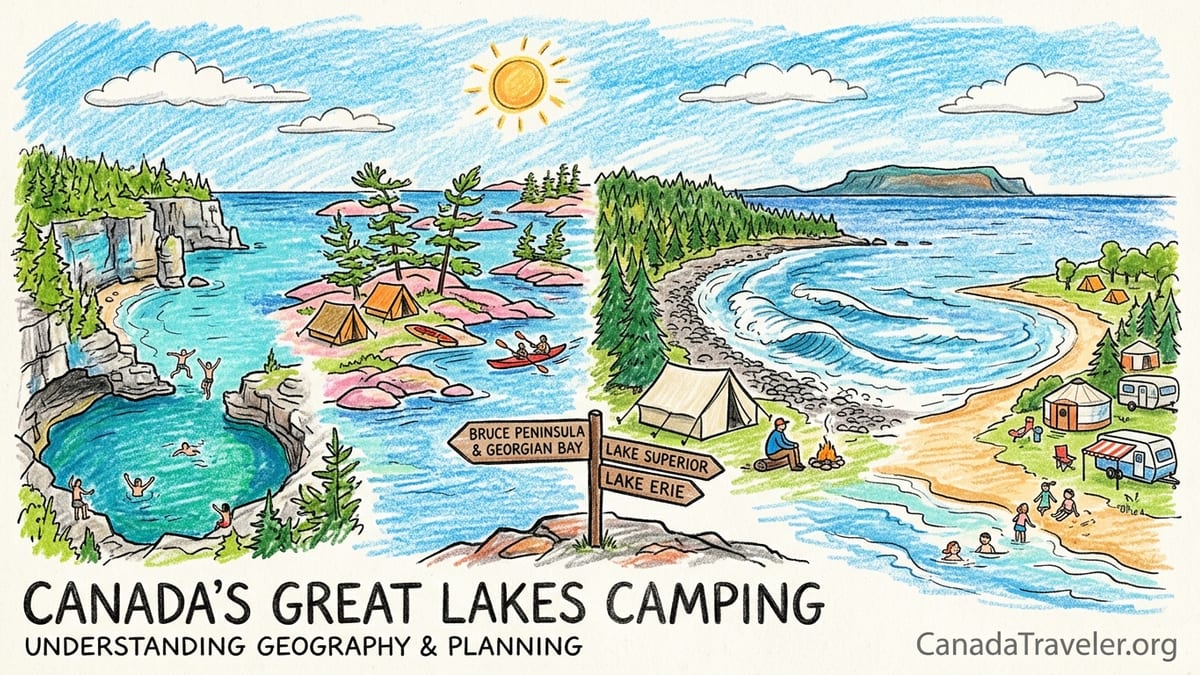
Camping along Canada’s Great Lakes delivers some of the country’s most memorable shoreline experiences: turquoise coves on the Bruce Peninsula, pink granite islands in Georgian Bay, wave-battered cliffs on Lake Superior and warm, sandy strands on Lake Erie. It can also be confusing to plan, with a maze of reservation systems, access rules and seasonal closures that change from park to park. This guide focuses on campgrounds and backcountry options with genuine Great Lakes frontage or easy shoreline access, so you can fall asleep to surf, not highway noise.
Understanding Great Lakes Camping Geography
When people talk about camping on Canada’s Great Lakes, they usually mean a handful of flagship shorelines in Ontario. On Lake Huron, that includes Bruce Peninsula National Park and the granite islands of Georgian Bay Islands National Park. Farther north on Lake Superior, the standouts are Lake Superior Provincial Park, Pukaskwa National Park and Sleeping Giant Provincial Park. Lake Erie’s Ontario shore is dotted with lower-key but very accessible beach parks, including Rondeau, Long Point and Turkey Point Provincial Parks.
Driving distances matter. From Toronto, it is roughly four hours to Bruce Peninsula National Park near Tobermory, about two hours to the Georgian Bay Islands launch point at Honey Harbour, eight to nine hours to Pukaskwa near Marathon, and ten plus hours to Sleeping Giant outside Thunder Bay. Lake Erie parks, by contrast, are within two to three hours of the Greater Toronto and Hamilton area. Many travelers stitch these regions into a loop, for example driving Lake Huron’s shore north to Superior and returning via Lake Erie.
Each area has a distinct character. Bruce Peninsula is compact and heavily visited, with iconic turquoise water and crowded viewpoints. Georgian Bay Islands feels like a cottage-country archipelago with boat-only access. Lake Superior is about scale and solitude, with long beaches and serious backcountry. Lake Erie offers warm water, easy swimming and more family-focused campgrounds. Understanding those differences helps you decide how much time and advance planning each area deserves.
Regulations also vary between federal and provincial agencies. Bruce Peninsula, Georgian Bay Islands and Pukaskwa are run by Parks Canada. Lake Superior and most Lake Erie parks are managed by Ontario Parks, while Sleeping Giant is a provincial park. The two systems have different reservation windows, cancellation rules and fees, so you will often be juggling both when putting together a longer trip.
Reservations, Seasons and When You Must Plan Ahead
Across Ontario’s Great Lakes, the high season generally runs from late June through Labour Day, with shoulder seasons in May and September and reduced services into October where campgrounds remain open. On Lake Superior, snow can linger into May and nights can be near freezing even in June, while Lake Erie’s parks often feel like summer by late May and well into September. Lake Superior Provincial Park currently opens Agawa Bay Campground around early May and closes in mid October, while Rabbit Blanket Campground operates from mid May to late October, reflecting the cooler northern climate.
Some areas require aggressive advance planning. Bruce Peninsula National Park is the clearest example. Frontcountry camping at Cyprus Lake, which offers shoreline access to famous features like the Grotto and Indian Head Cove, now books out quickly for summer dates. Parks Canada typically opens reservations for national parks in January or February for the entire operating season, and Cyprus Lake sites on July and August weekends can disappear within minutes of the system going live. Treat a July lakefront site here like a concert ticket release: know your dates, preferred loop and backup options before the launch time.
By contrast, Pukaskwa National Park’s Hattie Cove frontcountry campground currently operates on a first-come, first-served basis, even in peak season, although you must reserve oTENTik units and backcountry sites in advance. Travelers driving the Trans-Canada Highway increasingly use Hattie Cove as a spontaneous stop, but in busy periods you should arrive earlier in the day to secure a spot. Lake Superior Provincial Park falls in between: both Agawa Bay and Rabbit Blanket accept reservations through the Ontario Parks system, with bookings typically opening five months before your arrival date.
Lake Erie parks are popular with weekenders from southern Ontario and nearby U.S. states, but camping there is often less cutthroat than at Bruce Peninsula. Even so, Long Point’s radio-free or dune-adjacent loops, and prime electric sites at Rondeau or Turkey Point, can fill quickly for long weekends. Shoulder-season trips in late May or mid September usually offer more availability and lower insect pressure while keeping water temperatures pleasant for paddling and swimming, especially on Lake Erie.
Bruce Peninsula: Turquoise Coves and High Demand
Bruce Peninsula National Park protects a dramatic stretch of the Niagara Escarpment along the northern Bruce Peninsula, with steep limestone cliffs plunging into clear, deep Lake Huron water. For campers, the core is Cyprus Lake Campground, a short drive from Tobermory. Sites here are forested rather than waterfront, but a network of trails leads to the coastal cliffs above the Grotto, where swimmers and cliff-jumpers congregate on hot days. Many campers aim for July and August weekends, when water temperatures are most tolerable, though this also brings heavy crowds.
Cyprus Lake offers tent and RV-accessible sites, along with a small number of Parks Canada oTENTik units, which are insulated, furnished canvas cabins on platforms. These roofed options suit travelers without gear who still want to stay in the park. The campground is divided into loops with slightly different vibes, from more family-oriented areas to quieter, forested loops. Vehicle length limits and generator restrictions mean larger RVs should scrutinize site photos and measurements on the reservation portal.
Day-use visitation at the Grotto is now controlled by a timed parking system at the Cyprus Lake P1 lot. Even if you are camping, you must pay attention to current rules for access to the shoreline day-use area, which can include specific time blocks. Expect tightly managed parking, boardwalks and signposted routes to reduce environmental impact near the cliffs. From a planning perspective, this is not a park where you can simply roll in on a summer Saturday without advance reservations and expect to camp or park easily.
For hikers, connecting sections of the Bruce Trail link Cyprus Lake to Tobermory and beyond along the escarpment, with multiple coastal viewpoints and swim spots. Wildlife tends to be more subtle than in northern parks: you are more likely to see songbirds, small mammals and perhaps a fox than a moose or black bear. Weather can change quickly, and even in July the water remains cold enough that hypothermia is a risk for unprepared swimmers, so pack proper insulating layers and treat long swims like you would in an alpine lake.
Georgian Bay Islands: Boat-Access Only Camping
Georgian Bay Islands National Park is a true island park, reachable only by boat. Centered on Beausoleil Island near Honey Harbour, it combines smooth pink granite shorelines, windswept white pines and sheltered interior forests. This is not a drive-in campground: there are no roads or car-camping loops. Instead, you park on the mainland and arrive by water taxi, shuttle boat, kayak or your own vessel, then walk to your campsite or cabin on the island.
Cedar Spring on Beausoleil Island is the main frontcountry hub, with tent sites tucked into the forest a short walk from the dock and swimming areas. Backcountry-style sites are spread along the east and north shores, including popular areas like Honeymoon Bay, where you can step out of your tent onto bedrock sloping into clear Georgian Bay water. Boat-in campers must be self-sufficient, hauling all food and water or treating lake water carefully, and packing out all waste.
Roofed accommodation is a major draw here. Parks Canada operates oTENTiks and rustic cabins at Beausoleil Island, with boat transportation from Honey Harbour included for cabin and oTENTik stays when you book through the national reservation system. These are ideal for travelers who want an island experience without owning a boat or camping kit. Tent campers, by contrast, generally arrange private water taxis from Honey Harbour marinas or paddle their own kayaks or canoes across. On busy summer weekends, water around Honey Harbour can be choppy with heavy boat traffic, so inexperienced paddlers should choose calm weather windows and conservative routes.
Planning for Georgian Bay Islands begins with access. Parking on the mainland, arranging shuttle times, and understanding what gear you can realistically haul across water are all critical. There are no camp stores on the island, so you should arrive provisioned for your entire stay. Wildlife viewing focuses on reptiles, amphibians and birds rather than large mammals, and you will be sharing the island with many other paddlers and boaters. The trade-off for more logistics upfront is the feeling of waking up on a granite point, sipping coffee while the first light hits the bay’s countless islands.
Lake Superior: Lake Superior Provincial Park, Pukaskwa and Sleeping Giant
Lake Superior’s north shore is where freshwater meets wilderness on a truly big-water scale. Lake Superior Provincial Park lies between Sault Ste. Marie and Wawa, while Pukaskwa National Park is west of Marathon and Sleeping Giant Provincial Park is a peninsula jutting into Superior near Thunder Bay. All three offer a mix of frontcountry camping with vehicle access and more remote backcountry sites reached by foot or boat.
Lake Superior Provincial Park has two main drive-in campgrounds with genuine Superior access. Agawa Bay sits directly on a long cobble beach; many sites are only a short walk from the shore, and surf sounds carry through the entire campground. Rabbit Blanket Lake is inland but offers access to small lakes and interior trails, with some sites backed by water. Roughly a quarter of the park’s sites have electrical hookups, making Agawa and Rabbit Blanket friendly to smaller RVs and campervans. Backcountry options include coastal sites along the rugged Lake Superior Coastal Trail, which usually takes five to seven days to hike end to end.
Pukaskwa National Park feels wilder still. Hattie Cove Campground provides drive-in sites near a scenic, sheltered cove on Superior, with easy access to short hikes and viewpoints. Because Hattie Cove is first-come, first-served, road trippers often treat it as a flexible stop, but the park’s backcountry system is tightly managed: you reserve specific coastal hiking or paddling campsites in advance. Fees are charged per person per night for routes like the Coastal Hiking Trail or Coastal Paddling Route, and you must be comfortable with challenging terrain, limited cell coverage and potentially severe weather.
Sleeping Giant Provincial Park offers perhaps the most iconic viewpoint on Ontario’s Superior coast, with the Sleeping Giant mesa rising above the lake. Marie Louise Lake Campground is the main frontcountry hub, not on Superior itself but on a large interior lake with an expansive swimming area and boat rentals. Day trips lead to the Top of the Giant trail and shoreline outlooks over Thunder Bay. Backcountry camping exists both along inland routes and Superior shorelines, with some sites accessible by paddling or lengthy hikes. Black bears are common across all three Superior parks, so standard food storage practices, from bear lockers at designated sites to proper hanging systems in the backcountry, are essential.
Superior’s weather is a defining factor. Foggy mornings, sudden squalls and temperature swings of more than 15 degrees Celsius in a day are routine. Water stays dangerously cold even in late summer, with swimmers often wearing wetsuits on longer outings. Seasonally, some backcountry routes and interior roads may only become passable in late spring due to snowmelt and washouts, and autumn storms can close trails or make river crossings unsafe. Build flexibility into your itinerary and treat published opening and closing dates as weather-dependent rather than absolute guarantees.
Lake Erie’s Accessible Beach Parks
While Huron and Superior specialize in dramatic rock and cold, deep water, Lake Erie’s Ontario shore is about warm shallows, beaches and easy access. Provincial parks such as Long Point, Rondeau and Turkey Point sit on or near sandy peninsulas and bays that attract migrating birds in spring and fall and swimmers all summer. For many travelers coming from the United States through border crossings at Detroit–Windsor or Buffalo–Fort Erie, these parks are the most convenient introduction to Ontario’s Great Lakes camping.
Most Lake Erie provincial parks are designed around vehicle-accessible loops with a mix of tent and RV sites. Electric hookups are common. In Long Point, for example, different campground sections cater to various preferences, from open, social fields that suit trailers and families to quieter, more treed areas where tent campers can tuck away from lights and road noise. True lakefront sites are limited and book quickly, but even interior sites are often within a ten-minute walk or short bike ride of the main beach.
Roofed options are expanding at Lake Erie parks. Yurts and cabins, where available, typically sit in or near standard camp loops, offering basic beds, heat and electricity while sharing washroom and shower facilities with tent campers. These can be a good choice for shoulder-season visits when nights are cooler but beaches are quiet. Because Ontario Parks opens reservations five months ahead on a rolling basis, it is wise to mark your calendar if you are targeting a popular long weekend like Canada Day or Labour Day.
From a planning standpoint, Lake Erie parks are forgiving. If a beach day at Long Point is rained out, Rondeau, Turkey Point or provincial conservation areas are a relatively short drive away, and small-town amenities, grocery stores and cafes are nearby. Wildlife encounters lean toward raccoons and skunks raiding improperly stored food, plus excellent birding along boardwalks and marsh edges. The main risk is complacency: even on Erie’s seemingly gentle beaches, sudden storms and strong onshore winds can produce hazardous surf, so always follow local advisories.
Tents, RVs, Backcountry and Roofed Stays: Choosing Your Style
Each of the Great Lakes regions offers a mix of camping styles, but some lend themselves more naturally to specific types of trips. Tent camping is the most flexible and widely available option. On the Bruce Peninsula and Lake Superior, tent sites vary from shaded forest pads near parking at Cyprus Lake, Agawa Bay and Hattie Cove to small backcountry clearings on headlands that you reach via several hours on the Bruce Trail or Lake Superior Coastal Trail. For many paddlers and backpackers, the quintessential Great Lakes experience is pitching a small, freestanding tent on bare rock or sand within earshot of the waves.
RV and trailer camping works particularly well at Lake Erie parks and the more developed campgrounds on Huron and Superior. Electric sites at Rabbit Blanket Lake, Marie Louise Lake or Long Point allow you to run modest appliances and heat in shoulder seasons. Length limits and tight loops can make very large fifth wheels or motorhomes challenging in older parks, so check site dimensions carefully. On narrow peninsula roads like those leading to Long Point or Turkey Point, towing experience pays off during busy weekends when traffic is heavy and passing room is limited.
Backcountry camping is where Georgian Bay, Lake Superior Provincial Park and Pukaskwa truly stand out. In Georgian Bay Islands, you can reserve boat-access backcountry sites where you may share a cove with only a couple of other paddlers. In Lake Superior Provincial Park, coastal sites are strung along a multi-day route that frequently requires scrambling over boulders and fording small streams. Pukaskwa’s coastal campsites, which must be reserved in advance, feel even more remote, often perched on headlands or behind cobble beaches with nothing but Superior stretching to the horizon.
Roofed accommodations bridge the gap between camping and cabins. Parks Canada’s oTENTiks at Bruce Peninsula, Georgian Bay Islands and Pukaskwa offer insulated walls, simple furnishings and decks, while Ontario Parks yurts and cabins at places like Sleeping Giant or Lake Erie parks plug into campground infrastructure. These options reduce the amount of gear you need to carry, which is particularly helpful in boat-access parks. They also book extremely quickly. If your trip depends on roofed units rather than tents, plan around their availability, not the other way around.
Access, Activities, Wildlife and Safety
Access to the water is the core of Great Lakes camping, but the specifics differ by park. At Bruce Peninsula’s Cyprus Lake, you walk 30 to 45 minutes on a forest trail before emerging onto limestone ledges above the Grotto. In Lake Superior Provincial Park’s Agawa Bay, some sites are steps from the beach, while others are across the access road but still a short walk from the water. At Pukaskwa’s Hattie Cove, a calm inlet offers easy launching for beginner paddlers and sheltered evening strolls, in contrast with the often rough open coast a short hike away. In Lake Erie parks, access is usually direct: you walk or bike from your campsite to a large, sandy swimming beach.
Hiking is excellent across all these regions. Bruce Peninsula offers day hikes along the Bruce Trail with multiple access points, while Georgian Bay Islands has a network of loop trails on Beausoleil Island that pass through oak savanna, mixed forest and exposed bedrock. Lake Superior Provincial Park’s options range from short lookouts above Agawa Bay to multiday journeys. Pukaskwa’s boardwalked Hattie Cove trails are family-friendly, but serious backpackers tackle sections of the Coastal Hiking Trail. Sleeping Giant is best known for the Top of the Giant route, which climbs to a spectacular plateau above Lake Superior. On Lake Erie, longer but gentler trail systems at Long Point and Rondeau highlight dunes, marshes and migratory birds.
Paddling opportunities are abundant but should be treated with respect. Georgian Bay’s outer islands and Superior’s open coast behave like inland seas: wind, swell and cold water can turn a casual outing into a serious situation. Local outfitters in communities like Tobermory, Wawa, Marathon and Thunder Bay rent sea kayaks, canoes and stand-up paddleboards, and often provide route advice or guided trips. On Lake Erie and in sheltered coves like Hattie Cove or Marie Louise Lake, recreational kayaks and canoes are appropriate for most summer conditions, though lifejackets and basic self-rescue skills remain non-negotiable.
Wildlife ranges from snakes and turtles in Georgian Bay’s rocky shallows to moose, black bear and wolves in interior Superior forests. Bear encounters are rare in busy frontcountry areas but more likely on backcountry routes, especially in Pukaskwa and Sleeping Giant. Parks generally provide bear-proof food storage lockers at popular backcountry sites, and you should use odour-resistant bags or canisters where lockers are not available. In all parks, raccoons, chipmunks and ravens will quickly exploit poorly stored food or garbage in campgrounds, so keep coolers in vehicles, use sturdy bins and clean grills immediately after cooking.
Finally, safety on the lakes hinges on conservative decision-making. Conditions that look manageable from a cliff-top viewpoint can be deceptively rough at water level. Sudden thunderstorms, particularly on humid summer afternoons, can bring strong gusts and lightning to exposed headlands and beaches. Parks routinely post risk advisories for high waves or cold-water danger. Treat those notices as serious guidance rather than suggestions, and build layover days into your itinerary so you feel comfortable sitting out bad weather instead of pushing into risky situations.
The Takeaway
Camping on Canada’s Great Lakes is not a single experience but a spectrum that runs from crowded cliffside lookouts on the Bruce Peninsula to quiet cobble beaches in Pukaskwa and family bike loops at Long Point. The common thread is proximity to real freshwater coasts, where your campsite, trail or paddling route connects directly to the lakes rather than a distant view from a hillside campground.
For a short, high-impact trip, you might combine two or three nights at Bruce Peninsula’s Cyprus Lake with a boat-access stay on Beausoleil Island in Georgian Bay Islands National Park. With more time, you could drive the Superior shore, spending a few nights at Agawa Bay, a flexible stop at Hattie Cove and a finale at Sleeping Giant before looping home via Lake Erie’s beaches. In every case, the key is to understand which pieces demand advance reservations and which can stay loose.
Think of your plan as a hierarchy. Anchor your itinerary with the hardest-to-get reservations, such as July weekends at Cyprus Lake, oTENTiks on Beausoleil Island, or backcountry sites on Superior’s coastal routes. Then fill in around those commitments with more flexible stops like Lake Erie’s provincial parks or first-come frontcountry camping at Pukaskwa. Allow space for weather and rest days, and you will give yourself room to enjoy what makes these lakes special instead of racing between booking windows.
Above all, remember that conditions, regulations and reservation systems evolve. Before you go, check official park pages for the latest information on operating dates, parking permits, closures and safety advisories. With that groundwork in place, you can arrive ready to pitch your tent, unlock your cabin, or slide your kayak into cold, clear water and experience the Great Lakes the way they are meant to be experienced: up close.
FAQ
Q1. How far in advance should I book Bruce Peninsula National Park camping?
For July and August weekends at Cyprus Lake, it is wise to book as soon as Parks Canada opens reservations for the season, typically in winter, as prime sites can sell out within minutes.
Q2. Do I need a boat to camp in Georgian Bay Islands National Park?
Yes, access is by water only. Tent campers usually arrange a private water taxi or paddle from Honey Harbour, while cabin and oTENTik bookings often include shuttle transport in the reservation.
Q3. Are there true lakefront campsites on Lake Superior?
Yes. Agawa Bay in Lake Superior Provincial Park has sites just steps from a long cobble beach, and some Lake Superior backcountry sites in both the provincial park and Pukaskwa sit directly on the shoreline.
Q4. Can I camp without reservations at Pukaskwa National Park?
Frontcountry sites at Hattie Cove currently operate on a first-come, first-served basis, but oTENTik units and all designated backcountry campsites must be reserved in advance.
Q5. Which Great Lakes parks are best for RVs and trailers?
Lake Erie parks like Long Point, Rondeau and Turkey Point, plus Marie Louise Lake at Sleeping Giant and Rabbit Blanket Lake at Lake Superior Provincial Park, offer many electric and pull-through sites suited to small and midsize RVs.
Q6. Is backcountry camping suitable for beginners on the Great Lakes?
It depends on the route. Shorter, sheltered options such as beginner-friendly coastal sections in Lake Superior Provincial Park or boat-access sites in Georgian Bay can work for fit novices, but long routes like Pukaskwa’s Coastal Hiking Trail are best left to experienced backcountry travelers.
Q7. What kind of wildlife should I expect, and how do I store food?
You may encounter raccoons, foxes and occasionally black bears. Store food in vehicles or bear lockers where available, keep a clean campsite and never leave food unattended or in your tent.
Q8. When is the best season for camping on Lake Superior versus Lake Erie?
Lake Superior is most comfortable from late June through August due to cooler temperatures, while Lake Erie often has pleasant camping and warm water from late May into mid September.
Q9. Do I need special permits for hiking and paddling backcountry routes?
Yes. Parks like Pukaskwa and Lake Superior Provincial Park require backcountry permits and nightly fees for designated coastal campsites, and paddling routes may have specific reservation systems and group size limits.
Q10. Are there roofed accommodation options if I do not own camping gear?
Many parks offer roofed units such as oTENTiks, cabins or yurts, notably at Bruce Peninsula, Georgian Bay Islands, Pukaskwa, Sleeping Giant and some Lake Erie parks, though these often book out quickly for summer dates.