


The five Great Lakes sit astride the border of Canada and the United States, but the Canadian travel experience is concentrated on four of them. Lake Superior, Lake Huron and its vast Georgian Bay, Lake Erie and Lake Ontario shape much of southern and northern Ontario, from the big-city skyline of Toronto to the wild cliffs north of Thunder Bay. Lake Michigan lies entirely in the United States and, for trip planning, can be ignored on the Canadian side. For a first visit, understanding where each lake meets Canada, and what kind of trip each shoreline offers, is the key to choosing the right route.
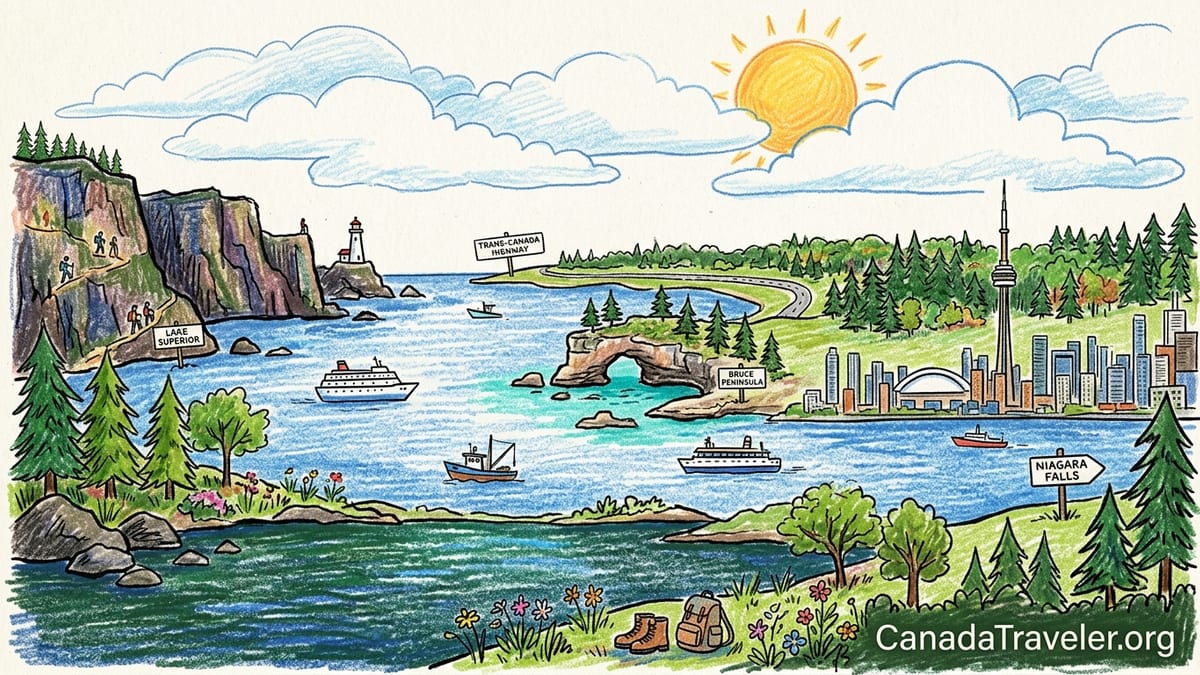
Understanding the Canadian Great Lakes at a Glance
On the Canadian side, all Great Lakes travel happens within Ontario. Lake Superior forms the rugged northern frontier between Thunder Bay and Sault Ste. Marie. Lake Huron curves around the Bruce Peninsula and Manitoulin Island, while Georgian Bay, a huge arm of Lake Huron, stretches southeast toward cottage towns and national parks. Lake Erie lines the southern edge of Ontario with low, sandy shorelines, and Lake Ontario fronts the province’s most urban landscapes, including Toronto and the road to Montréal.
For clarity, Lake Michigan has no Canadian shoreline at all. It is bordered only by the United States, so itineraries that combine Toronto with Chicago or Milwaukee are crossing into a different national context. When Canadian tour companies advertise “Great Lakes cruises” that include all five lakes, the Lake Michigan portion is always on the U.S. side, even if the voyage begins or ends in Toronto or another Canadian port.
Most first-time visitors start and end in Toronto because of its major international airport and frequent direct flights from cities such as New York, London and Frankfurt. From Toronto, you can be tasting wine above Lake Ontario in Prince Edward County in about two and a half hours by car, walking along Lake Erie’s sand at Port Stanley in roughly three hours, or heading north three and a half to four hours to the Bruce Peninsula, where Georgian Bay and Lake Huron meet in a landscape of cliffs and turquoise water.
Think of the Canadian Great Lakes as a menu of travel styles. Northern shorelines such as Lake Superior offer road trips, hiking and remote lodges. Lake Huron and Georgian Bay are about islands, coves and classic cottage-country beaches. Lake Erie and Lake Ontario combine gentle beaches, wine regions and mid-sized cities, with Toronto and Niagara Falls providing the big-city energy and headline attractions.
Lake Superior: Canada’s Wild Northern Coast
Lake Superior is the largest and most dramatic of the Great Lakes, and its Canadian shore runs essentially from the city of Thunder Bay in the northwest to Sault Ste. Marie in the southeast. The Trans-Canada Highway hugs the water much of the way, with frequent views of steep rock faces and long, empty pebble and sand beaches. Driving this route between Thunder Bay and Sault Ste. Marie typically takes about eight to ten hours without long stops, but most travelers treat it as a multi-day journey to allow for hiking and photography.
Thunder Bay is the main northern gateway. A short drive from downtown brings you to Sleeping Giant Provincial Park, where trails lead to cliff-top lookouts hundreds of meters above the lake. Simple lakeside cabins here often book from around 180 to 250 Canadian dollars per night in summer, while mid-range hotels in Thunder Bay itself cluster around the 170 to 230 dollar range. In town, the redeveloped waterfront has breweries and casual restaurants that make a convenient base before or after time in the park.
Heading east, the character becomes more remote. Lake Superior Provincial Park and Pukaskwa National Park protect long stretches of shoreline where you can walk for an hour and see few other people outside of peak long-weekend periods. Travelers who enjoy backcountry camping, coastal paddling and long hikes will find some of the most rewarding terrain in eastern Canada here. Practical examples include half-day hikes like the Agawa Rock trail to Indigenous pictographs or spending a night at a simple lodge cabin near Wawa, where dinner might be fresh whitefish from the lake.
Sault Ste. Marie marks the transition from Lake Superior to Lake Huron. On the Canadian side of the border, this small city doubles as a transport hub, with a regional airport and car rentals that make one-way trips between Toronto, Sault Ste. Marie and Thunder Bay realistic. Many visitors book an excursion on the Agawa Canyon Tour Train into the interior wilderness, then spend the evening at a mid-range hotel overlooking the St. Marys River, watching commercial freighters navigate the locks that link Superior to the lower lakes.
Lake Huron and Georgian Bay: Cliffs, Coves and Island Culture
Lake Huron is where many travelers begin to feel the archetypal Ontario “cottage country” atmosphere. On the Canadian side, the shoreline sweeps from Sault Ste. Marie down through smaller communities such as Blind River and Kincardine, before curving into the Bruce Peninsula and the wide mouth of Georgian Bay. Georgian Bay itself is often called a sixth Great Lake, with more than 30,000 islands and roughly 2,000 kilometres of shoreline, and its waters are famously clear and blue.
The Bruce Peninsula forms a dramatic finger of land separating Georgian Bay from the main basin of Lake Huron. At its northern tip, the village of Tobermory serves as the jumping-off point for cruises to Flowerpot Island and glass-bottom boat tours over shipwrecks in Fathom Five National Marine Park. On busy July and August weekends, the main street fills with families in hiking gear and scuba divers hauling equipment toward the docks. Budget travelers might pay around 140 to 180 dollars per night for a basic motel room here in peak season, while small waterfront inns and cabins can run notably higher.
South of Tobermory, the Bruce Peninsula National Park protects some of the most photographed scenery on the Canadian Great Lakes. The Grotto, a natural sea cave filled with turquoise water, often requires advance parking reservations in summer. This area rewards slow travel: a typical two-night stay could include an afternoon hike along the Niagara Escarpment cliffs, a swim at Singing Sands Beach on the Lake Huron side, and an evening campfire at one of the park’s campgrounds or nearby private cabins.
Just west of the Bruce lies Manitoulin Island, connected to the mainland by a swing bridge at Little Current. Manitoulin is recognized as the world’s largest freshwater island and has a strong Anishinaabe presence. Visitors can hike the Cup and Saucer Trail for expansive views over forest and inland lakes, or join guided cultural experiences that might include traditional storytelling, craft workshops or community feasts. Simple lakeside motels and cabins from 140 to 220 dollars per night are common, and you will still find general stores and roadside chip stands that feel unchanged for decades.
Lake Erie: Sand Beaches, Birdlife and Wine Country
Of the Great Lakes, Lake Erie lies farthest south, and that extra warmth shapes the Canadian shoreline from Windsor to Niagara. The water tends to feel warmer earlier in the summer than Lake Huron or Georgian Bay, and the low, sandy coast supports vineyards, orchards and long beaches. For travelers who prefer swimming and laid-back small towns over cliffs and long hikes, Lake Erie offers a gentler alternative to Superior’s wild coast.
On the western stretch of Lake Erie, the Lake Erie North Shore wine region benefits from a relatively long growing season and moderating breezes off the water. Towns such as Kingsville and Harrow, a roughly four-hour drive from Toronto, have boutique wineries where tasting flights might cost in the range of 15 to 20 dollars. This is an easy area to combine with a visit to Windsor and Detroit; the Canadian shore faces directly toward the United States, but you remain firmly in Ontario vineyard and farm country.
Farther east, Point Pelee National Park extends like a narrow spear into Lake Erie, marking one of the southernmost points of mainland Canada. Birdwatchers flock here in May for the spring migration, when warblers and other songbirds concentrate at the tip of the peninsula. The park’s boardwalks and beaches also appeal to casual visitors, and nearby small towns offer bed-and-breakfasts from about 150 to 200 dollars per night. For an iconic Lake Erie experience, many travelers combine a day of birding or biking at Point Pelee with a ferry trip to Pelee Island, the lake’s largest island and home to its own winery and relaxed bike routes.
East of Point Pelee, the lakeshore curves past quiet communities and provincial parks toward Port Dover and Long Point. These beaches are popular with families from Hamilton and London, Ontario, who drive in on summer weekends to rent cottages, order perch and pickerel at waterfront restaurants, and watch the sunset over the lake. If your idea of a Great Lakes trip leans more toward flip-flops and patio dining than wilderness, a Lake Erie loop that links wine country, Pelee and the small coastal towns can be very satisfying.
Lake Ontario: Toronto, Niagara and Prince Edward County
Lake Ontario anchors the most urbanized and densely populated section of the Canadian Great Lakes. Its north shore runs from the Niagara River in the west through Hamilton, Toronto and Oshawa before turning toward Kingston and the gateway to the Thousand Islands. For many first-time visitors, this is the most practical introduction to the lakes because it combines major airports, public transport and high-profile attractions.
Toronto sits on the northwest shore of Lake Ontario and functions as the primary gateway to the region. The city’s waterfront has been significantly redeveloped with public promenades, parks and urban beaches where locals sunbathe on imported sand against a backdrop of condo towers and the CN Tower. A visitor could easily spend three days based in a mid-range downtown hotel, perhaps paying 260 to 350 dollars a night in peak season, while taking day trips by ferry to the Toronto Islands or by train and bus to nearby towns on the lake.
To the southwest of Toronto, the road to Niagara follows the Lake Ontario shoreline past the Niagara Escarpment’s vineyards. The town of Niagara-on-the-Lake, about 90 minutes from Toronto, is known for its wineries, theatre festival and heritage architecture. Shortly beyond, Niagara Falls itself sits on the Niagara River between Lake Erie and Lake Ontario, but is usually included in Lake Ontario-focused itineraries because many tours run directly from Toronto. A typical day tour by coach might cost in the range of 120 to 180 dollars per person, including a Hornblower boat cruise to the base of the falls and a short stop at a winery.
East of Toronto, Prince Edward County has emerged as a major wine and food destination on the northeast shore of Lake Ontario. Self-drive visitors from Toronto generally cover the distance in about two and a half hours, then spend two or three days cycling quiet roads between vineyards, farm shops and art studios. Sandbanks Provincial Park, famous for its high sand dunes and long freshwater beaches, is the classic Lake Ontario swimming spot here. Summer weekends often see inns in Picton and Wellington selling out, with stylish boutique hotels and lakefront motels charging 260 dollars and up per night, though basic motels and campsites offer more affordable options.
Choosing Your Great Lakes Itinerary: Rugged, Relaxed or Urban
When you line the Canadian Great Lakes up side by side, each one offers a different style of trip. Lake Superior is the choice for travelers who dream of long-distance drives, remote campsites and feeling very far from cities. Expect long gaps between gas stations outside the main towns, plenty of hiking and few polished visitor centers. A typical first-timer itinerary might be a week-long loop from Thunder Bay down to Sault Ste. Marie, staying two nights each in parks or small lodges and allowing full days for hikes and scenic detours.
Lake Huron and Georgian Bay, by contrast, appeal to visitors who want a blend of wild scenery and comfortable bases. You might stay in a cottage rental near Tobermory, taking day trips to Bruce Peninsula National Park and glass-bottom boat tours, or spend a few days on Manitoulin Island combining hiking with cultural visits. In practical terms, this region works well as a three- to seven-night side trip from Toronto: for example, drive three and a half to four hours from the city to the Bruce, then take the ferry to Manitoulin and loop back through Sudbury.
Lake Erie and Lake Ontario lend themselves to shorter breaks, food-focused travel and easier logistics. With limited vacation time, a visitor could spend four nights based in Toronto, adding a day trip to Niagara Falls and Niagara wine country, then rent a car for a two- or three-night extension in Prince Edward County or the Lake Erie North Shore wineries. Families often appreciate that you can alternate city museums and attractions with lazy beach days at Sandbanks, Long Point or Port Dover without covering huge distances.
Your budget will also play a role. Northern trips around Lake Superior often involve simpler motels, campgrounds and lodges, which can keep nightly costs in the 130 to 220 dollar range outside peak holiday weekends, but gasoline and long driving days add expenses. Lake Ontario and Niagara, with their higher-end hotels and popular attractions, can feel pricier per day, though they offer excellent value in dining and entertainment compared to many large U.S. and European cities. Before booking, it helps to decide whether your priority is landscape, culture and food, or a mix of all three, then match that to the lake that best fits those interests.
Practical Tips for First-Time Great Lakes Travelers in Canada
Distances around the Great Lakes often surprise first-time visitors. Driving from Toronto to Thunder Bay, for example, is more than 1,300 kilometres and typically takes at least 14 to 15 hours of actual driving time, usually spread over two or three days. Even seemingly modest trips, such as Toronto to the Bruce Peninsula, are long enough at three and a half to four hours that you should plan to arrive before dark to avoid wildlife on rural roads. Build generous travel days into any itinerary that connects different lakes.
Seasonality is also crucial. July and August bring warm water and the most reliable swimming conditions on all the lakes, but also the highest prices and busier parks. Shoulder seasons in June and September can be ideal for hiking around Lake Superior and Georgian Bay, with cooler temperatures and fewer insects, though some seasonal businesses start to reduce hours after Labour Day. In spring, Lake Erie and Lake Ontario warm up earliest, making wine touring and city sightseeing comfortable as early as late April, while northern parks may still see lingering snow patches.
For many visitors, renting a car remains the most flexible way to explore the Canadian Great Lakes. Major agencies operate at Toronto Pearson International Airport and in downtown locations, with compact cars in summer often starting in the range of 60 to 90 dollars per day before insurance and fuel. It is technically possible to see parts of Lake Ontario and even reach Niagara using only public transport, but reaching Manitoulin Island, the Bruce Peninsula or Lake Superior’s parks without a car usually requires joining organized tours or arranging costly private transfers.
Finally, remember the national context. While cruises and marketing materials sometimes present the Great Lakes as one unified region, border formalities and distances matter. Lake Michigan is not part of Canada, so combining it with Canadian stops involves crossing into the United States and dealing with separate entry requirements and potential car rental restrictions. For a first-time trip focused on Canada, you can have a complete and varied Great Lakes experience by concentrating on Lake Superior, Lake Huron and Georgian Bay, Lake Erie and Lake Ontario alone.
FAQ
Q1. Which of the Canadian Great Lakes is best for a first-time visitor?
For most first-time travelers, Lake Ontario is the easiest introduction because Toronto, Niagara and Prince Edward County combine big-city access, wine country and beaches with relatively short driving distances.
Q2. How many days do I need to see more than one lake in Canada?
With about 7 to 10 days you can realistically combine Lake Ontario and Niagara with either Lake Erie’s wine and beach towns or a shorter loop through Lake Huron and Georgian Bay, without spending every day in the car.
Q3. Is it possible to visit Lake Superior on a short trip from Toronto?
It is technically possible by flying to Thunder Bay or Sault Ste. Marie and renting a car, but because of the distance and scale, Lake Superior usually makes more sense as a dedicated trip of at least five to seven days.
Q4. Can I include Lake Michigan on a Canadian Great Lakes itinerary?
No. Lake Michigan lies entirely within the United States, so visiting its shores always means crossing the border. For a Canada-focused trip, you should concentrate on Superior, Huron and Georgian Bay, Erie and Ontario.
Q5. What is the best time of year to swim in the Canadian Great Lakes?
Late July through August usually offers the warmest water, especially on Lake Erie and Lake Ontario. Lake Huron and Georgian Bay can be refreshing even in midsummer, and Lake Superior often remains cold for casual swimming.
Q6. Are there cruises that let me see multiple Canadian Great Lakes at once?
Yes, several small-ship operators run Great Lakes itineraries that may start or end in Toronto or Thunder Bay and call at ports like Sault Ste. Marie, Manitoulin Island and Niagara, but many itineraries also include U.S. ports so check routes and visa requirements.
Q7. Do I need a car to visit places like the Bruce Peninsula and Manitoulin Island?
In practice, yes. Public transport is limited, and most visitors rent a car in Toronto or another city to reach Tobermory, Bruce Peninsula National Park and Manitoulin Island on their own schedule.
Q8. How expensive are wine-tasting trips around the Great Lakes in Ontario?
As a rough guide, tastings at wineries in Niagara, Lake Erie North Shore or Prince Edward County often cost around 15 to 25 Canadian dollars for a flight, with bottle prices varying widely by producer.
Q9. Is it safe to drive the Lake Superior and Lake Huron coasts in winter?
Winter driving can be challenging due to snow, ice and reduced daylight. Unless you are experienced with northern winter conditions and have a flexible schedule, it is generally safer to plan coastal road trips between late spring and early autumn.
Q10. Can I see wildlife on a Canadian Great Lakes trip?
Yes. Around Lake Superior, Lake Huron and Georgian Bay you may see deer, foxes and occasionally black bears, while wetlands on Lake Erie and Lake Ontario host rich birdlife. Always observe animals from a distance and follow local safety advice.