


Western Canada’s coast looks compact on a map, but once you add mountain highways, island detours and ferry crossings, distances stretch quickly. A polished coastal British Columbia road trip means making deliberate choices: which ferries to book, when to drive the Sea to Sky Highway, whether to build a loop or commit to a one-way, and what to leave for a future visit. This guide focuses on the classic combination seen in most current tours and packages: Vancouver, Whistler, Victoria and Tofino, with optional extensions along the Sunshine Coast or north Vancouver Island.
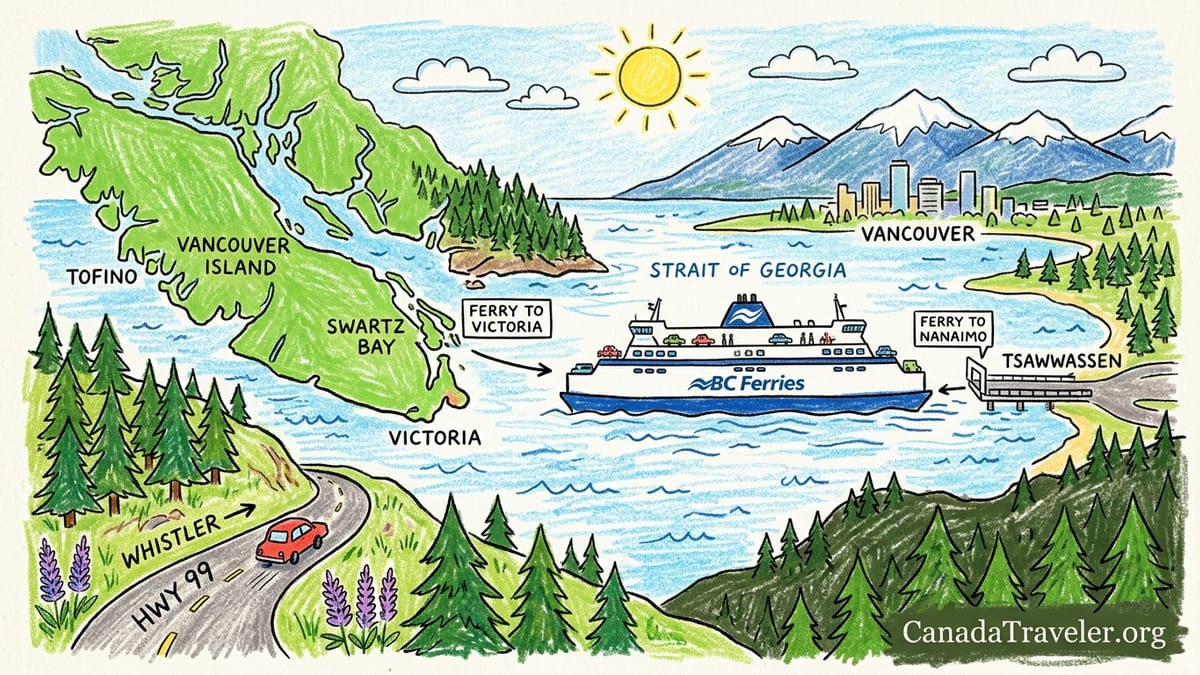
Understanding the Geography and ferries of Coastal British Columbia
Coastal British Columbia is a jigsaw of mainland fjords, large forested islands and smaller Gulf Islands, linked by a mix of highways and ferries. For most visitors the key mainland hub is Vancouver, and the two main island hubs are Victoria at the southern tip of Vancouver Island and Nanaimo midway up the east coast. Road trips between them usually involve at least one major vehicle ferry across the Strait of Georgia or Haro Strait, most often with BC Ferries from Tsawwassen or Horseshoe Bay near Vancouver to Swartz Bay near Victoria or Nanaimo’s terminals.
A typical mid-summer car-and-driver fare on a major BC Ferries route can easily run into the low hundreds of dollars return for a family vehicle, especially when fuel surcharges are high and you pay for passengers as well as the car. On peak weekends, sailings between Vancouver and Vancouver Island often sell out for vehicles unless you book several days or weeks ahead, and same-day “drive-up” customers may queue for multiple sailings. That reality shapes road-trip design: it is not just about distance and driving time, but also about securing reservations at sensible hours and avoiding unnecessary backtracking on the water.
Two practical implications follow. First, each additional round-trip ferry crossing can add both cost and half a day of waiting, boarding and sailing, so itineraries that hop repeatedly between mainland and island usually feel rushed. Second, loop routes that return to the original terminal might be less efficient than one-way routes that use different ports at each end. When you understand where the main terminals sit relative to Vancouver’s neighborhoods and highway network, you can match ferry choices to your arrival and departure flights or trains and avoid stressful transits across the metro area with luggage and jet lag.
Vancouver and the Sea to Sky Highway to Whistler
The Sea to Sky Highway, officially Highway 99 between West Vancouver and Whistler, is roughly 120 kilometers of cliff-hugging pavement that starts at sea level beside Howe Sound and climbs into the Coast Mountains. On a clear summer day, driving in daylight at a conservative pace with a few short stops, most travelers cover the distance in about two to two and a half hours from downtown Vancouver. Rental-car desks at Vancouver International Airport are typically a 30 to 45 minute drive from the start of the highway in good traffic, so a realistic same-day airport-to-Whistler estimate is closer to three hours door to door.
Traffic and conditions can modify that picture considerably. On winter ski weekends, or when major construction is underway, northbound traffic between West Vancouver and Squamish can slow to a crawl, and snowfall or heavy rain increases the need for caution. Local drivers and tourism operators frequently advise first-time visitors not to tackle the highway at night immediately after a long-haul flight, especially if they are not used to mountain roads or are traveling with children. In practice, many travelers now sleep near Vancouver Airport or in downtown Vancouver on arrival day, then pick up a rental car the following morning and drive to Whistler in daylight.
If Whistler is your only mountain stop, it makes sense to pick up a rental car in Vancouver specifically for the Sea to Sky segment. For example, spend three nights in Vancouver without a car, using the SkyTrain and buses, then collect a vehicle from a downtown agency on the morning you depart for Whistler. After two or three nights in Whistler you can return the car in Vancouver and continue car-free to Vancouver Island using a bus-and-ferry connector or a separate rental on the island. Keeping a single rental vehicle for the entire trip is convenient, but parking charges in central Vancouver hotels and the difficulty of one-way car rentals to smaller island locations can make this less attractive for budget-conscious travelers.
Designing Your Core Route: Loop vs One-Way
Most coastal British Columbia road trips built around Vancouver, Whistler, Victoria and Tofino follow one of two basic patterns: a loop that starts and finishes in Vancouver, or a one-way route that begins in Vancouver and ends on Vancouver Island (or the reverse), using open-jaw flights. Both can work, but they feel very different on the ground. A loop is appealing if you have a simple round-trip flight in and out of Vancouver and prefer to keep one rental car for the whole time. A one-way route usually involves an additional one-way car rental fee and a more complex flight plan, but it reduces backtracking and can save a full day of travel.
Consider a common 10 to 12 day loop. Many tour operators and travel agencies promote a circuit that runs Vancouver to Whistler via the Sea to Sky Highway, then back down to Vancouver, across to Vancouver Island via Nanaimo or Victoria, along to Tofino and Ucluelet on the west coast, and finally back to the Vancouver metro area by ferry from Nanaimo or Victoria. On paper this touches all the major highlights. On the ground it means driving the Sea to Sky twice and taking two or even three major ferry crossings, often with tight same-day connections. For many first-time visitors that loop feels overloaded, particularly if they are also trying to add the Sunshine Coast or Port Hardy in the same trip.
A one-way route is often more comfortable if you can book an “open jaw” flight, for example flying into Vancouver and out of Victoria or Nanaimo. In practice you might land in Vancouver, spend a few days car-free, collect a rental vehicle to drive up to Whistler and back, take a ferry from Tsawwassen to Nanaimo, work your way along to Tofino and then finally drop the car in Victoria before flying out. You still cross the water only once with a vehicle, but you avoid repeating the Sea to Sky and you exit the region from the island without doubling back. If your airline options make this difficult, another compromise is to keep Vancouver as your single flight gateway but plan the road trip as two distinct chunks with a car-free day or two between them.
Vancouver Island Segments: Victoria, Nanaimo and Tofino
Vancouver Island is larger than many first-time visitors expect, and distances along its curving two-lane highways add up. The major tourist focus points are Victoria in the south, the mid-island communities around Nanaimo and Parksville on the sheltered east coast, and the surf towns of Tofino and Ucluelet on the exposed west coast. The drive from Nanaimo to Tofino is about three hours in good conditions, much of it on a winding mountain road that passes lakes, river valleys and stands of old-growth forest. While the distance may look modest on a map, most travelers report that the concentration required on the curves makes it feel like a substantial day of driving.
Ferry connections shape how you string these towns together. Ferries from Tsawwassen to Swartz Bay serve the Victoria area, while ferries from Tsawwassen or Horseshoe Bay connect to Nanaimo’s terminals. If you arrive on the island at Swartz Bay and want to reach Tofino, you will either drive three or more hours north to Nanaimo and then continue west, or detour via Port Alberni on Highway 4 from farther south. Many visitors choose to enter via Victoria, spend two or three nights exploring the city and the Saanich Peninsula, then drive the roughly four-hour haul to Tofino via Nanaimo in one day.
Public transport options exist but are not well suited to flexible road trips that include Tofino. Several coach services connect Victoria and Nanaimo to Tofino with scheduled runs, typically taking five to seven hours with stops to change vehicles or ferries. These work for backpackers and solo travelers comfortable with fixed timetables, but families and photographers often prefer the independence of a rental car. On the island you will notice that some small resorts and lodges are several kilometers outside town with limited taxi coverage; having your own vehicle makes it realistic to visit beaches at dawn or drive to trailheads before day-tripper traffic builds.
Ferry Crossings and How They Affect Your Daily Plan
Vehicle ferries in coastal British Columbia run year-round but with seasonal variations in frequency, and summer sailings from Vancouver to Victoria or Nanaimo are often heavily booked. Crossings such as Tsawwassen to Swartz Bay or Horseshoe Bay to Departure Bay typically take about an hour and a half of sailing time; when you add the recommended arrival time for check-in, boarding, disembarkation and the drive between city centers and terminals, the total block of time consumed by a single crossing can easily reach three to four hours. That is effectively half a travel day, so designing your itinerary around no more than one major ferry on any given day makes trips feel more relaxed.
In practical terms, that means avoiding schedules where you check out of a Vancouver hotel, drive to the ferry terminal for a mid-morning sailing, land on Vancouver Island just before noon and then attempt a three-hour mountain drive to Tofino. It is technically possible, and locals do it when necessary, but many visitors underestimate fatigue, traffic delays near terminals and the impact of late-afternoon check-in times at remote lodges. Breaking the journey with an overnight stop in Nanaimo, Parksville or Qualicum Beach turns a punishing day into a manageable two-stage trip. Likewise, on your return to the mainland, resist the temptation to book an evening ferry followed by a long highway drive to an interior destination the same night.
Because ferry capacity is finite, reservation strategy becomes part of road-trip planning. For summer travel between June and early September, it is sensible to reserve the key vehicle sailings as soon as you have fixed your accommodations, especially Friday evenings, Sunday afternoons and holiday periods. Travelers with flexible schedules sometimes plan their entire itinerary around off-peak ferries, choosing midday weekday sailings that are easier to book and pair well with short driving stages on either side. It is increasingly common to see comments from local residents noting multi-sailing waits for unreserved vehicles on long weekends; for a time-limited overseas trip, banking on spontaneous drive-up availability can quickly derail a carefully constructed route.
Sample Durations: Building Realistic Itineraries
For a first visit focused on Vancouver, Whistler, Victoria and Tofino, most travelers are happiest with a minimum of 12 to 14 nights. Anything shorter usually forces rushed one-night stops and days dominated by driving and ferry logistics. A balanced two-week loop might look like this in broad strokes: three nights in Vancouver to adjust to time zones and explore the city without a car; two nights in Whistler reached by a daytime Sea to Sky drive; one extra night in Vancouver to break up the logistics; three nights split between Victoria and the surrounding peninsula; three nights in Tofino or Ucluelet; and a final night near Nanaimo or Victoria before returning to the mainland or catching a flight.
If you have only seven to ten nights, it is usually better to trim destinations than to compress everything. With seven nights you might focus on Vancouver and Vancouver Island only, omitting Whistler and the Sunshine Coast entirely. For instance, spend three nights in Vancouver, then cross to Victoria for two nights, then drive to Tofino for two nights before retracing your route. With ten nights you could add Whistler by staying two nights there and reducing Victoria or Vancouver by a night each. In these shorter trips, think of Tofino as the anchor: reaching it involves a committed full-day journey in each direction, so it only makes sense if you can spare at least two or three nights on the coast.
Longer trips of three weeks or more open up room for optional extensions without crowding the core. At that point you can reasonably add the Sunshine Coast between Vancouver and Vancouver Island, or continue north of Campbell River toward Telegraph Cove or Port Hardy. For example, a 21-night itinerary could include Vancouver and Whistler in the first week, Victoria and the Gulf Islands in the second, and Tofino along with a short north-island segment in the third, with at least one buffer day built in for weather or ferry disruptions. Even then, many seasoned visitors caution against trying to “see all of Vancouver Island” in a single trip, preferring to treat the north and west as separate future journeys.
When to Add the Sunshine Coast or Northern Extensions
The Sunshine Coast, stretching northwest from the Vancouver suburb of Horseshoe Bay to the small community of Lund, offers a quieter alternative to the main Vancouver Island corridor. Reaching it involves a short ferry from Horseshoe Bay to Langdale, followed by a scenic coastal drive and another short ferry across Jervis Inlet between Earls Cove and Saltery Bay. Each of those sailings lasts under an hour, but the loadings and disembarkation still take time, effectively adding another half day of logistics to any route that includes the Sunshine Coast between Vancouver and Vancouver Island.
In practical terms, the Sunshine Coast is best added when you have at least three or four spare nights to devote specifically to it, not as a rushed “drive-through” on the way to Tofino. A realistic mini-route might involve two nights around Gibsons or Sechelt on the lower Sunshine Coast, then one or two nights near Powell River after the Earls Cove to Saltery Bay ferry, with the option to continue to Vancouver Island via the Powell River to Comox ferry. Travelers who try to insert this into a ten-night Vancouver–Whistler–Tofino loop usually end up spending more time waiting for ferries than enjoying beaches, breweries and hiking trails.
Northern extensions on Vancouver Island demand similar restraint. The drive from Nanaimo to Port Hardy, near the island’s northern tip, takes roughly five hours without long stops, and wildlife tours or the Inside Passage ferry from Port Hardy to Prince Rupert are usually early-morning or overnight commitments. It only makes sense to push this far if you can dedicate at least three or four nights to the north island, ideally paired with a separate trip that does not also include Tofino and Victoria. For many travelers, a more manageable compromise is to visit Campbell River or Telegraph Cove as a dedicated short north-island add-on, leaving the long Inside Passage sailings and more remote communities for a future visit when time and budget allow.
Rental Cars: Where You Need One and Where You Do Not
In central Vancouver and downtown Victoria, a rental car is more of a burden than a benefit for most visitors. Both cities have compact, walkable cores with reliable buses and, in Vancouver’s case, rapid transit that connects the airport, downtown and several popular neighborhoods. Hotels in these areas often charge substantial nightly parking fees, and traffic congestion around bridges and tunnels can be frustrating at peak hours. Many frequent visitors now structure their trips so that they are car-free during city stays, only picking up a vehicle on departure day for coastal or mountain segments.
Whistler and Tofino, by contrast, are places where a car significantly increases flexibility. In Whistler, the pedestrian village itself is walkable and served by local buses, but access to trailheads, lakes and viewpoints along the Sea to Sky corridor is much easier by private vehicle. In Tofino and Ucluelet, many beaches and lookouts are spread along a relatively long stretch of highway and side roads, and taxi services are limited outside the small town centers. Rental-car supply on Vancouver Island can also be tight in peak season, and prices may be higher than in Vancouver, so booking well in advance or coordinating with your ferry schedule is essential.
One-way rental arrangements within British Columbia are common but not universal, and they often come with additional fees. For example, dropping a car in Nanaimo or Victoria that you collected at Vancouver International Airport may incur a modest one-way charge that is worth paying to avoid an extra mainland–island ferry crossing. Dropping a car in a smaller town on the north island or along the Sunshine Coast, however, can be difficult or impossible with major rental brands. Before committing to a complex route, travelers should verify that their planned start and end points are supported by at least one agency and that opening hours line up with their ferry or flight times.
What To Skip When Time Is Tight
Because marketing materials and social media feeds emphasize how “close” everything in coastal British Columbia appears, many visitors overfill their itineraries. The most important planning decision is not what to include but what to leave out. With fewer than ten nights, it is usually wise to choose between Whistler and Tofino rather than trying to fit both. Whistler can be visited comfortably as a three-night side trip from Vancouver with no ferry crossings required, while Tofino demands a dedicated three-night stay plus two full travel days to and from Vancouver Island. If you only have a week, pick one anchor destination and explore it deeply instead of racing between both.
The Sunshine Coast is another logical candidate to postpone to a later trip. Its tranquil coves and small communities reward slow exploration rather than rushed drive-throughs. If you are already coordinating ferry reservations for Tsawwassen to Swartz Bay or Nanaimo and planning the mountain highway to Tofino, inserting additional short ferries between Horseshoe Bay and Powell River will add complexity disproportionate to the extra scenery you can realistically enjoy. Similarly, far-north Vancouver Island communities like Port Hardy or Alert Bay deserve more than a brief overnight, and they are best reserved for repeat visitors who have mastered the basics of ferry timing and coastal distances.
When forced to trim within a core Vancouver–Victoria–Tofino route, it is generally better to shorten the number of different bases rather than shave each stay to a single night. For example, reducing Vancouver from three nights to two and Victoria from three to two in order to preserve three nights in Tofino will give a better overall trip than trying to maintain three bases of one or two nights each. Each hotel change costs time and energy, and packing and unpacking around tight ferry check-in windows is where many trips start to feel like chores rather than holidays.
The Takeaway
A successful coastal British Columbia road trip is less about ticking off every highlight and more about understanding the physical realities of the region. Ferries are central to reaching Vancouver Island and the Sunshine Coast, but each crossing eats half a day and requires advance reservations in peak season. Mountain roads like the Sea to Sky Highway and the Nanaimo to Tofino corridor reward unhurried, daylight driving and can feel demanding after long flights or ferry waits. Recognizing these constraints early allows you to make strategic choices about route shape, duration and what to skip.
For most first-time visitors, a focused route that connects Vancouver, Whistler, Victoria and Tofino over 12 to 14 nights offers the best balance of variety and rest. One-way itineraries that minimize repeated ferry crossings, combined with smart use of rental cars only where necessary, tend to feel calmer and more efficient than sprawling loops. Optional add-ons like the Sunshine Coast or north Vancouver Island work best as dedicated extensions when you have enough time to do them justice rather than as hurried detours.
Approach planning with a willingness to leave some iconic spots for a future visit, and build your days around one major move at most. With realistic expectations about distances, ferry logistics and driving conditions, a west coast Canada road trip along the shores and islands of British Columbia will feel like a series of memorable journeys, not a race between viewpoints.
FAQ
Q1. How many days do I need for a Vancouver, Whistler, Victoria and Tofino road trip?
For a comfortable pace, plan at least 12 to 14 nights. That allows three nights in Vancouver, two in Whistler, three around Victoria and the peninsula, and three in Tofino or Ucluelet, plus one buffer night for ferry or weather delays.
Q2. Do I need to reserve BC Ferries in advance if I have a car?
In peak season from roughly June through early September, it is strongly recommended to reserve vehicle sailings on popular routes such as Tsawwassen to Swartz Bay and Horseshoe Bay or Tsawwassen to Nanaimo, especially on weekends and holidays.
Q3. Is it safe to drive the Sea to Sky Highway to Whistler at night?
The Sea to Sky Highway is well maintained but winding, with changing weather and wildlife on the road, so many locals suggest first-time visitors avoid driving it late at night or when jet-lagged.
Q4. Can I visit Tofino as a day trip from Nanaimo or Victoria?
It is technically possible but not recommended. The drive from Nanaimo to Tofino is about three hours each way in good conditions, so a day trip would involve six or more hours of driving and leave little time on the coast.
Q5. Is a rental car necessary on Vancouver Island?
A rental car is not essential for Victoria itself, but it becomes very useful once you leave the city. For Tofino, Ucluelet and smaller coastal communities with dispersed beaches and trailheads, having your own vehicle is highly recommended.
Q6. Should I try to include the Sunshine Coast in a first trip?
Only if you have several extra nights. The Sunshine Coast is beautiful but adds at least two additional ferry crossings and extra driving, which can feel rushed on a short itinerary already covering Whistler and Vancouver Island.
Q7. Is it better to do a loop or a one-way route between Vancouver and Vancouver Island?
Loops are simpler for flights and car rentals, but a one-way route that starts on the mainland and ends on the island (or vice versa) reduces backtracking and can save a full travel day if your flights and rental company allow it.
Q8. When is the best time of year for this coastal British Columbia road trip?
Late spring through early fall, roughly May to September, offers the best combination of daylight, milder weather and full ferry and tour schedules. July and August are the busiest and require the most advance booking.
Q9. Can I get around without a car using buses and tours?
It is possible to link Vancouver, Victoria and Nanaimo using buses and foot-passenger ferries, and there are coach services to Tofino, but schedules are limited. Travelers who want maximum flexibility at beaches and trailheads usually prefer a car.
Q10. What should I cut if I only have one week?
With seven nights, focus on either Whistler or Tofino, not both. For example, combine Vancouver and Whistler for a mountain-and-city trip without ferries, or combine Vancouver, Victoria and perhaps one smaller island hub without trying to reach Tofino.