


The Sea-to-Sky Highway is only about two hours from Vancouver to Whistler on paper, yet in practice it can easily fill a full day or several. This guide treats Highway 99 as a journey rather than a transfer, following the road from Vancouver through Horseshoe Bay, Britannia Beach, Squamish and Whistler to the quieter farmland of Pemberton, with concrete details on stops, parking, viewpoints, traffic patterns and ways to experience the route even without your own vehicle.
Understanding the Sea-to-Sky Corridor
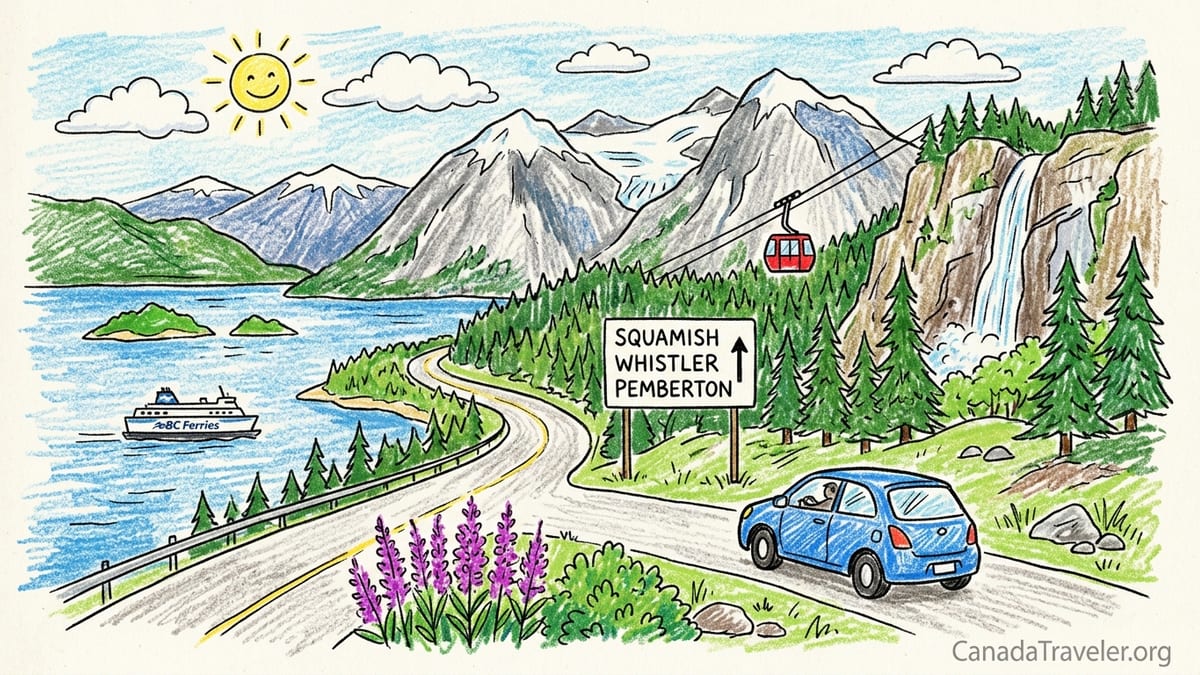
Highway 99 leaves North Vancouver across the Lions Gate Bridge or via the Ironworkers Memorial Bridge and follows the shoreline of Howe Sound to Squamish before climbing through forest and canyon to Whistler and on to Pemberton. The Sea-to-Sky name is typically used for the stretch from Horseshoe Bay to Pemberton, roughly 130 kilometers of paved, two to four lane highway that mixes ocean views, waterfalls, granite cliffs and glaciated peaks. It is fully paved but includes sustained grades, sharp curves and frequent changes in speed limits, so it rewards unhurried, attentive driving rather than rushing between resorts.
On a non-stop run, Vancouver to Whistler generally takes about 1 hour 45 minutes in light traffic and Vancouver to Pemberton about 2 hours 15 minutes. In reality, summer construction, weekend traffic and weather can easily add 30 to 60 minutes or more. Many locals now assume at least 2.5 hours for a daytime Vancouver to Whistler drive that includes a brief coffee or viewpoint stop, and closer to 3 hours on Friday afternoons, Sundays and long weekends when city residents and resort visitors are all on the move.
The corridor is not simply a conduit to Whistler. You pass through independent destinations: Horseshoe Bay with its ferry terminal village feel, the mining history of Britannia Beach, the climbing and kiteboarding hub of Squamish and the agricultural valley around Pemberton. Treating them as optional exits off a ski-transfer route is technically possible, but this misses the reason Highway 99 regularly ranks among Canada’s most memorable drives.
For planning, think of the road in three sections. From Vancouver to Horseshoe Bay is essentially suburban expressway with glimpses of Burrard Inlet. Horseshoe Bay to Squamish is the classic ocean fjord section with roadside viewpoints. Squamish to Whistler and Pemberton is more alpine, with waterfalls, lakes, canyons and multiple short hiking options. How you combine these depends on whether you are simply changing hotels between Vancouver and Whistler, carving out a dedicated sightseeing day, or building the Sea-to-Sky into a multi-day trip.
Vancouver to Horseshoe Bay: Getting Out of the City
Your Sea-to-Sky journey starts in Vancouver proper, but it is worth thinking strategically about how to reach Highway 99. From downtown, most travelers take Georgia Street through Stanley Park to cross the Lions Gate Bridge, then follow Highway 1 west to the Highway 99 junction signed for Squamish and Whistler. In normal conditions this takes around 30 minutes from downtown. In rush hour, especially weekday afternoons between about 3 pm and 6 pm, the bridge and causeway can snarl up and add 20 minutes or more. Leaving before 8 am or after 7 pm often makes the exit far smoother.
If you are staying around East Vancouver or near the airport, it can be faster to cross via the Ironworkers bridge and join Highway 1 there, avoiding downtown entirely. Rental car offices near Canada Place or the central business district often time their vehicle handovers to mid-morning to avoid the worst commuter traffic. If you have flexibility, consider collecting your car around 9:30 or 10:00 am and heading straight out, rather than sitting in gridlock at 8 am.
Horseshoe Bay itself, about 20 minutes beyond the North Vancouver bridgeheads, is where the road becomes interesting. Even if you have no intention of boarding a ferry, the compact village is worth a quick leg-stretch. There are cafes and fish-and-chip counters clustered around the small waterfront park, and on clear days you can watch BC Ferries come and go against a backdrop of forested islands. Street parking is metered and can be tight on sunny weekends, but for a 20-minute coffee stop most travelers find a spot on side streets above the village if the waterfront is full.
From here, Highway 99 officially becomes the Sea-to-Sky Highway. Roadside signs point north to Squamish, Whistler and Pemberton. This is a good moment to reset your expectations: gas stations become less frequent after Horseshoe Bay, especially late at night, and cellular coverage can be patchy in some short stretches of rock cuts and canyons. Topping up fuel in North Vancouver or at Horseshoe Bay and downloading offline maps is a practical first step before continuing north.
Horseshoe Bay to Squamish: Viewpoints, Britannia Beach and Shannon Falls
The roughly 45-minute drive from Horseshoe Bay to Squamish is one of the most dramatic sections of the trip, hugging the shore of Howe Sound with wide views across the water to Bowen and Gambier Islands. A series of signed viewpoints appear on the right-hand (ocean) side as you head north, including spots near Tunnel Point and Porteau Cove. Many are small pullouts with limited capacity. On summer weekends they often fill by late morning, so drivers may need to continue to the next turnout rather than attempting unsafe last-second stops.
About 20 minutes north of Horseshoe Bay, Porteau Cove Provincial Park offers a larger parking area, washrooms and a short walk out along a pier popular with photographers and divers. Parking is free but limited, and in July and August it can be full by midday. Day trippers from Vancouver often treat this as their main oceanfront stop, spending 30 to 60 minutes here before continuing to Squamish. Camping is available by advance reservation only, and day visitors should not park in clearly signed campsite stalls.
Continuing north, the highway pulls away from the shoreline and descends again at Britannia Beach. Historically a copper mining town, it is now known for a modern mining museum set in the old concentrator building, plus a growing cluster of cafes and a brewery-style restaurant. There is a small surface parking lot for museum visitors and short-term street parking for people simply grabbing a coffee en route. Families with children often plan 90 minutes to two hours here to tour the underground mine and interactive exhibits, while other travelers limit themselves to a coffee and washroom break before pressing on to the waterfalls just beyond.
Only a few minutes past Britannia Beach, signs direct you to Shannon Falls Provincial Park and the Sea to Sky Gondola, which sit directly opposite each other on the inland side of the highway. Shannon Falls has a free day-use parking lot that routinely fills on sunny weekends and afternoons. The walk to the viewing platforms is a gentle paved path of about 10 to 15 minutes each way, making this a realistic stop even on a pure transfer day. If the main lot is full, drivers sometimes find space in the overflow areas closer to the gondola, but pay attention to signs about maximum stay times and tow zones, especially in high season.
Squamish and the Sea to Sky Gondola: Short Hikes with Big Views
The Sea to Sky Gondola, just south of Squamish, has quickly become one of the signature stops along the corridor. A standard adult day ticket typically sits in the range of several dozen Canadian dollars, with online prices often slightly lower than buying at the base ticket window on busy dates. The ride takes around 10 minutes one way, rising from near sea level to an upper station with suspension bridges, wooden viewing platforms and a network of forest and ridge trails. Many travelers allow about two to three hours in total here, including queueing, the ride itself and a short loop walk at the top.
Parking for the gondola is in a surface lot at the base, paid through machines or a mobile app, with enforcement in place during opening hours. Day visitors can usually find space early in the morning or later in the afternoon. The pinch point is often between late morning and mid-afternoon on summer Saturdays, when lots can briefly reach capacity. If you are combining the gondola with Shannon Falls, consider parking once, doing the gondola first and then walking the short connecting trail to see the waterfall before returning to your car.
Squamish itself, about 10 minutes beyond the gondola, is worth more than a quick gas stop if you have time. The town has positioned itself as an outdoor capital, with climbing on the Stawamus Chief, kiteboarding in the estuary and mountain biking on the surrounding slopes. For road trippers, the most practical experiences are the short hikes and viewpoints that start within minutes of the highway. The Stawamus Chief provincial park parking area, just off Highway 99, offers access to steep but rewarding trails, although these are quite strenuous and better suited to those with half a day and solid fitness.
For a gentler outing that still breaks up the drive, the estuary trails near downtown Squamish and the waterfront park near the new developments provide flat walking with mountain and ocean views. Street parking in the town center is generally free with occasional time limits, and there are several independent cafes and bakeries where drivers can refuel alongside their vehicles. Many travelers doing a single-day Vancouver to Whistler sightseeing run plan their major meal stop in Squamish to avoid searching for dining in Whistler at peak dinner times.
Squamish to Whistler: Waterfalls, Lakes and Canyon Views
North of Squamish, the highway gradually leaves the coast and climbs along the Squamish River toward Whistler. Driving time without stops is about 45 minutes, but this stretch is dense with potential pullouts and short walks. A signed viewpoint near Tantalus Lookout offers a classic panorama back across the valley to the jagged Tantalus Range. The parking lot is small and located on the left when heading north, so most visitors plan their stop here on the southbound return from Whistler to keep it on the right-hand side.
Farther north, Brandywine Falls Provincial Park is one of the easiest and most rewarding stops on the route. The signed turnoff leads to a paved parking lot that can accommodate standard cars and smaller RVs. From here, a relatively flat gravel path of around 15 to 20 minutes leads to an overlook platform with a clear view of the waterfall plunging into its horseshoe-shaped canyon. The park is day use only and has no entrance fee. It is a very practical stop for those driving with children or older travelers who still want to stretch their legs in nature without committing to a long or steep hike.
Approaching Whistler, several lakes such as Daisy Lake and then Alpha, Nita and Alta Lakes come into view, though formal lakeside access usually requires short detours off the main highway into local road networks. Parking at the more popular Whistler lakes is often resident-controlled in high summer, so visitors planning a swimming or picnic stop should research current regulations and consider arriving earlier in the day. If you are simply using this drive as a transfer between Vancouver and Whistler with one or two stops, it is perfectly realistic to pick either Brandywine Falls or Shannon Falls plus a coffee in Squamish and still arrive in Whistler within four to five hours of leaving the city.
Just south of Whistler village, another stop that has grown popular in recent years is the Whistler Train Wreck, where a short forest trail leads to a series of brightly painted boxcars scattered along a canyon. Parking is available in a small lot near the trailhead off a side road from Highway 99. The walk itself is around 20 to 30 minutes each way on mostly flat terrain with a suspension bridge crossing, making it feasible even on a tight schedule. As with other roadside lots, it can fill quickly on weekends, so early morning or late afternoon visits are often more relaxed.
Whistler to Pemberton: A Quieter Finish to the Road Trip
Many guides stop at Whistler, but continuing 30 minutes north to Pemberton changes the character of the journey. The resort infrastructure thins out as you leave Whistler’s neighborhoods and climb over a low pass before descending into the Pemberton Valley. The mountains remain close on both sides, yet the valley floor opens into working farms and seed potato fields, with hay bales in late summer and autumn colors in September and early October. Drivers used to Whistler’s dense condo complexes often find Pemberton surprisingly small and rural.
A practical stop just south of Pemberton is Nairn Falls Provincial Park, where a short forest trail of about 20 to 30 minutes each way leads to a narrow canyon waterfall. There is a day-use parking area near the entrance and a separate campground area farther in. The walk is moderately uneven with roots and small rocks, so suitable footwear is useful, but it remains realistic for most visitors with average fitness. Many road trippers use this as their final hike of the day before dinner in Pemberton village.
Pemberton itself has a compact main street with a gas station, grocery store, a few restaurants and cafes and small motels. Street parking in the core is generally straightforward compared with Whistler’s structured lots. Some travelers book a night here to enjoy a quieter base with lower accommodation prices than Whistler, especially in peak ski or summer bike seasons. Others simply stop for a late lunch or early dinner before turning around and driving back to Vancouver along the same route in the golden light of late afternoon.
Beyond Pemberton, Highway 99 continues over the Duffey Lake Road toward Lillooet. This section is mountain driving in a more serious sense, with steeper grades, tighter hairpins and more exposure. It rewards experienced drivers who are comfortable with long descents and have time to continue toward the interior of the province. For the purposes of a Sea-to-Sky road trip centered on Vancouver, Squamish, Whistler and Pemberton, most visitors either turn back at Pemberton or spend a night there before heading farther into the interior.
Traffic, Seasonal Driving and Safety on Highway 99
Although the Sea-to-Sky Highway was significantly upgraded before the 2010 Winter Olympics, it remains a mountain highway and demands respect. Weather can change quickly between sea level and Whistler, especially in shoulder seasons. From October 1 to April 30, vehicles traveling on Highway 99 between Horseshoe Bay and Pemberton are required to use winter tires or carry chains. Rental car companies in Vancouver typically label appropriate vehicles and often charge a small premium for winter-ready models, so it is important to specify your travel dates when booking and confirm that your car is equipped.
Summer travel brings a different set of challenges. Construction work is common between May and September, often with single-lane closures and pilot-car convoys through active zones. Weekend traffic is heaviest on Friday afternoons northbound and Sunday afternoons southbound, when travel times between Vancouver and Whistler can stretch significantly beyond the nominal two hours. Leaving Vancouver early in the morning or later in the evening, or traveling midweek where possible, remains one of the most reliable ways to avoid long lines of vehicles.
Wildfire smoke has also become a seasonal factor in some recent summers. While the Sea-to-Sky corridor often escapes the worst smoke that can affect inland regions, visibility and air quality can still be reduced on certain days. Travelers with respiratory sensitivities should monitor local forecasts and consider flexible timing or more indoor-focused stops such as museums and gondola lodges on smoky days instead of strenuous hikes.
Practical safety considerations include using pullouts rather than shoulders for photo stops, obeying variable speed-limit signs in place for weather or traffic conditions, and watching for cyclists on the shoulder, particularly near Squamish where road cycling is popular. Although the drive feels remote in places, emergency services cover the corridor and there are regular brake-check pullouts and chain-up areas on steeper segments. Keeping water, snacks and a basic first-aid kit in the car is a sensible precaution, especially in winter or when traveling with children.
How to Use the Route: Transfer, Full Day or Multi-Day
The Sea-to-Sky can function as a straightforward transfer between Vancouver and Whistler, a full sightseeing day, or the backbone of a multi-day itinerary that includes Squamish and Pemberton as overnight stops. As a pure transfer, many travelers leave Vancouver mid-morning, pause for 20 to 30 minutes at either Shannon Falls or Brandywine Falls and stop for coffee or lunch in Squamish, arriving in Whistler by mid-afternoon. This pattern works well for those with hotel check-in times around 4 pm and evening dinner reservations in the resort.
For a full sightseeing day, spreading the same distance over six to eight hours allows space for a major highlight such as the Sea to Sky Gondola, a one- to two-hour exploration in Squamish, and an additional waterfall or train-wreck hike before reaching Whistler in the early evening. A realistic example would be leaving Vancouver at 8:30 am, riding the gondola from 10 am to 12:30 pm, having lunch and a short walk in Squamish until 2 pm, then visiting Brandywine Falls before arriving in Whistler around 5 pm. This creates a sense that the road itself is the main attraction rather than an obstacle between city and resort.
Multi-day trips can follow several patterns. One common approach is to drive from Vancouver to Squamish on day one, check into a local hotel and spend the afternoon hiking the Chief or riding the gondola, then continue to Whistler on day two with stops at Brandywine Falls and the Train Wreck. Another is to stay in Whistler but devote one full day entirely to exploring south toward Squamish and back, and another to heading north toward Pemberton and Nairn Falls. A third pattern is to use Pemberton as a quieter base for exploring both Joffre Lakes Provincial Park farther north and day trips back to Whistler.
Whichever style you choose, remember that parking policies in Whistler itself are stricter than in the other communities along the route. Many village hotels charge nightly parking fees for underground garages, and day visitors arriving by car typically use paid lots near the village. Building those costs into your budget from the outset avoids surprises. In contrast, parking at most roadside viewpoints, provincial parks and in downtown Squamish and Pemberton remains free or low-cost, although time limits and seasonal regulations do apply in the busiest areas.
Experiencing the Sea-to-Sky Without a Rental Car
Travelers who prefer not to drive can still experience much of the Sea-to-Sky Highway. Several coach companies operate frequent services between downtown Vancouver and Whistler Village, using modern highway buses with luggage bays. Journey times are usually around two to two and a half hours depending on pick-up points and traffic. Tickets are typically priced in the range of several dozen Canadian dollars each way for adults, with discounts for advance online bookings and sometimes for same-day return trips.
While these scheduled buses travel the full highway, they generally do not stop at Shannon Falls, Brandywine Falls or the Sea to Sky Gondola. To incorporate sightseeing, many visitors choose guided day tours that use minibuses and make planned stops at key attractions, such as a viewing stop at Shannon Falls, a ride on the Sea to Sky Gondola and two to three hours of free time in Whistler Village. Prices for these full-day excursions are higher than point-to-point buses but bundle transportation, some admissions and commentary from a guide into a single booking.
Within the corridor, local transit options remain limited outside of Whistler itself, which has its own village bus system. Squamish has a town bus network, but there is no continuous public bus line linking every small stop along Highway 99. For visitors staying primarily in Whistler who want to see more of the road without renting a car, popular workarounds include booking a shuttle that allows a return journey on a different day, or joining activity-specific outings such as rafting, hiking or biking tours that include hotel pick-up and drop-off along scenic sections of the corridor.
Rideshare and car share options are more constrained than in major cities. Traditional app-based ride-hailing operates in the Vancouver region, but availability drops off sharply once you leave the city, and long-distance point-to-point trips to Whistler can be expensive and hard to secure, especially during busy weekends or snowfalls. Planning around confirmed bus tickets or guided tours remains the more reliable method for experiencing the Sea-to-Sky without your own vehicle, particularly for first-time visitors unfamiliar with winter driving or mountain-road etiquette.
The Takeaway
The Sea-to-Sky Highway between Vancouver and Pemberton offers far more than a brisk link between an urban harbor and a famous ski resort. In little more than 100 kilometers it packs in ocean fjord views, waterfalls a short walk from the pavement, gondolas rising above granite cliffs, accessible hikes through coastal rainforest and a transition from busy resort village to quiet agricultural valley. With realistic planning around traffic, parking and seasonal conditions, even a simple transfer can be shaped into a rewarding half-day, while dedicated sightseeing days and multi-night stays in Squamish, Whistler or Pemberton unlock a richer sense of the corridor.
Whether you drive it yourself or join a guided coach, the key is to treat Highway 99 as a destination in its own right rather than an unavoidable stretch of asphalt to be endured. Build extra time into your schedule, choose one or two anchor experiences that match your energy and budget, and be prepared to adjust if weather, construction or crowds intervene. The Sea-to-Sky is a road that invites repeat visits and small variations, revealing new layers of coastal and mountain life each time you follow its curves north from Vancouver.
FAQ
Q1. How long does it take to drive from Vancouver to Whistler without stops?
In light traffic, the drive usually takes around 1 hour 45 minutes from downtown Vancouver to Whistler Village, though many travelers now allow at least 2 hours in practice.
Q2. Can I drive the Sea-to-Sky Highway in winter without special experience?
It is possible, but from October 1 to April 30 your vehicle must have winter-rated tires or chains, and you should be comfortable with mountain driving, changing weather and reduced visibility.
Q3. Are there entrance fees for Shannon Falls and Brandywine Falls?
Both Shannon Falls Provincial Park and Brandywine Falls Provincial Park are day-use areas without entrance fees, though parking is limited and can fill quickly on sunny weekends.
Q4. Is the Sea to Sky Gondola worth the cost on a short trip?
Many travelers find it worthwhile because in two to three hours it delivers big views, short forest walks and suspension bridges that would otherwise require much longer hikes.
Q5. Can I do the Vancouver to Whistler drive as a day trip and still see key sights?
Yes, with an early start you can visit the Sea to Sky Gondola, stop at Shannon Falls or Brandywine Falls, have a meal in Squamish and enjoy a few hours in Whistler before returning.
Q6. Are there gas stations along the Sea-to-Sky Highway?
Yes, there are stations in West Vancouver, Squamish, Whistler and Pemberton, but they are less frequent between communities, so topping up in the city or major towns is sensible.
Q7. What is the best time of day to avoid traffic on Highway 99?
Outside of peak ski and summer weekends, mid-morning and midweek afternoons are often quieter, while Friday northbound and Sunday southbound periods can be significantly slower.
Q8. Can I reach the main viewpoints and waterfalls with limited mobility?
Many viewpoints are directly beside the parking areas, and both Shannon Falls and Brandywine Falls have relatively short, mostly gentle paths, though surfaces are uneven in places.
Q9. Are there good hiking options directly off the highway for half-day stops?
Yes, popular choices include the Stawamus Chief trails near Squamish, the Whistler Train Wreck walk and Nairn Falls near Pemberton, all reachable within minutes of Highway 99.
Q10. What are my options if I do not want to rent a car for this trip?
You can take scheduled coach services between Vancouver and Whistler or join guided day tours that include stops at highlights like Shannon Falls, the Sea to Sky Gondola and Whistler.