


The Canadian Arctic is one of the world’s last great expedition frontiers, where sea ice, shifting weather and Inuit culture shape every journey. Unlike big-ship, port-heavy cruises, most Arctic sailings around Baffin Island, the High Arctic, the Northwest Passage and Greenland-plus-Nunavut are true expeditions of roughly two weeks or more, using small ice-strengthened ships and Zodiac landing craft to reach communities, historical sites and national parks that would otherwise be almost impossible to visit. Choosing the right route and style is essential, because distances are vast, costs are significant and no two itineraries feel the same once you are in the ice.
Understanding Canadian Arctic Expedition Routes
Travel Nunavut describes Arctic cruises as two weeks or longer, often circling Baffin Island or pushing through the High Arctic archipelago, with frequent landings at Inuit communities, ancient Thule sites and remote parks that are hard to reach by any other means. A typical entry-level expedition might be a 12 to 14 day Baffin Island and Greenland voyage, sailing between Iqaluit or a Nunavut community and a Greenland port, while a full Northwest Passage crossing can stretch to 17 to 29 days as ships traverse from western Greenland to Alaska or the reverse. These are not repositioning cruises but purpose-built itineraries designed around wildlife, culture and ice conditions rather than shopping or nightlife.
Four broad route styles dominate the Canadian Arctic: Baffin Island voyages along the wild east coast of Nunavut; High Arctic sailings into Lancaster Sound and the islands of Devon, Ellesmere and Somerset; Northwest Passage expeditions connecting the Atlantic and Pacific via a labyrinth of channels; and Greenland-plus-Nunavut itineraries that combine West Greenland’s fjords and towns with Baffin Island or the central Arctic. Operators such as Adventure Canada, Quark Expeditions, Lindblad Expeditions, HX (formerly Hurtigruten Expeditions) and several European lines now offer these routes on ice-strengthened vessels through at least the 2026 season, with some programs already published as far ahead as 2028.
Because of the short season, departures typically run from late July through September, when sea ice is at its minimum and shore landings are more feasible. A traveler comparing a mid August Baffin Island and Greenland itinerary with a late August Northwest Passage sailing will immediately notice contrasts in duration, cost and remoteness. The Baffin route might deliver more village visits and shorter sea days, while the Northwest Passage could involve longer stretches at sea, rare historical sites like Beechey Island and more variable ice. Understanding how these route types differ is the first step in choosing the right Canadian Arctic expedition.
Baffin Island Voyages: Culture, Cliffs and Accessible Adventure
Many Canadian Arctic cruises focus on Baffin Island, the fifth largest island in the world, known for its soaring granite cliffs, bird colonies and strong Inuit art traditions. Travel Nunavut highlights itineraries that call at communities such as Pangnirtung and Pond Inlet, pass by Sirmilik National Park and sometimes stop at Cape Dorset, famous for its printmakers and carvers. Some sailings start or finish in Iqaluit, Nunavut’s capital, and link across Davis Strait to West Greenland’s fjord towns, creating a loop between two distinct Arctic cultures within roughly two weeks at sea.
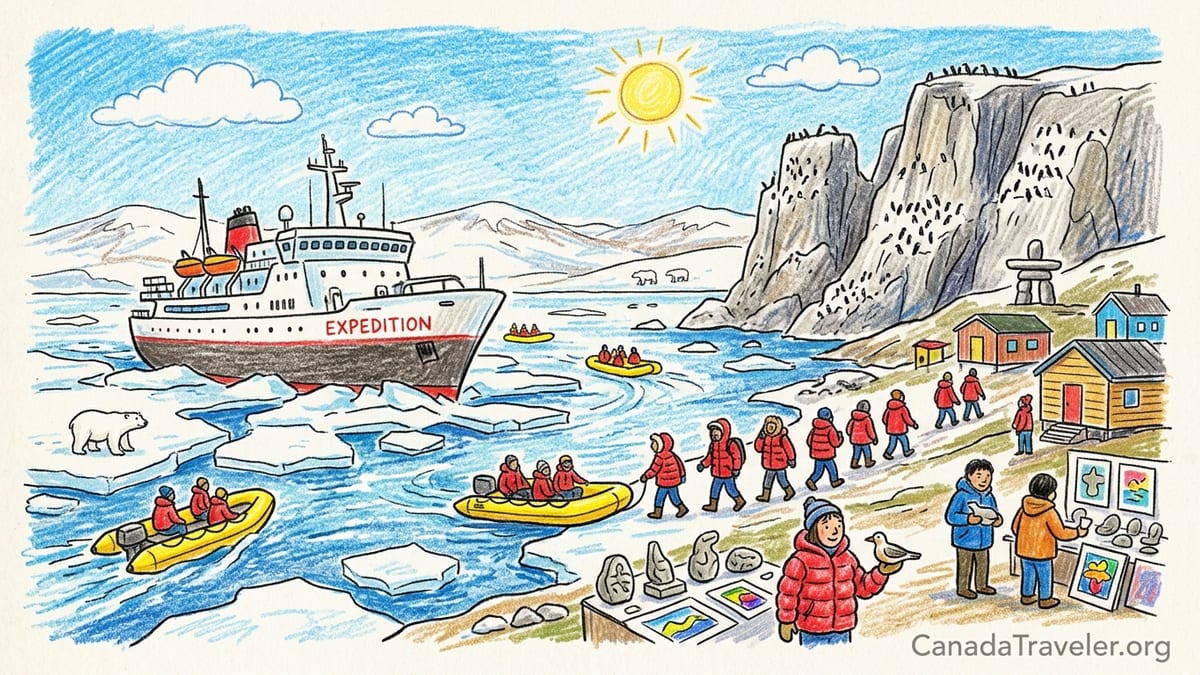
A concrete example is a 14 to 15 day Baffin Island and West Greenland expedition offered by several operators for August 2026, typically embarking in a Greenland port such as Kangerlussuaq or Ilulissat and disembarking in Iqaluit or a smaller Nunavut community. These ships usually carry around 150 to 200 guests and rely heavily on Zodiac operations for shore landings at bird cliffs, glacier fronts and archaeological sites. Expect multiple community visits where local guides, artists and cultural performers come aboard or host travelers on shore, and where passengers may purchase locally made carvings and prints directly from artists in community halls.
Wildlife viewing on Baffin-focused voyages often centers on seabirds, whales and occasional polar bears along the pack ice edge. Passengers might spend a morning cruising in Zodiacs along towering cliffs with hundreds of thousands of nesting murres and kittiwakes, then transition in the afternoon to a visit in a Baffin community to tour the local co operative print shop. Because most Baffin itineraries stay relatively close to shelter and avoid the most complex ice choke points, they are often recommended as a first time Canadian Arctic cruise for travelers who want a strong mix of culture and landscapes without the longer, costlier commitment of a full Northwest Passage.
High Arctic Sailings: Ice, Wildlife and Remote National Parks
High Arctic expeditions push deeper into Canada’s far north, often focusing on Lancaster Sound and the islands of Devon, Somerset and Ellesmere. Classic itineraries described in Nunavut tourism materials include visits to ancient Thule sites on uninhabited islands, stops at Beechey Island to view the graves from Sir John Franklin’s 1845 expedition, and ventures as far north as Tanquary Fiord on Ellesmere Island in very favorable conditions. These sailings might be a stand alone High Arctic route or form part of a longer Northwest Passage or Greenland to High Arctic voyage.
Operators such as Quark Expeditions and Adventure Canada run 12 to 18 day High Arctic programs on ice strengthened ships carrying roughly 130 to 200 guests. A typical August departure might begin with a charter flight from a southern Canadian gateway like Toronto or Edmonton to a Nunavut community such as Resolute or Cambridge Bay, where passengers embark by Zodiac. Once underway, the expedition team looks for opportunities to explore drift ice in search of polar bears, walrus and seals, and to land in national park areas where regulations and wildlife conditions permit. Parks such as Quttinirpaaq on Ellesmere Island and Sirmilik near Pond Inlet are sometimes featured, though access depends entirely on sea ice and weather windows.
Compared with Baffin Island voyages, High Arctic itineraries tend to offer more pack ice and potentially better chances of iconic ice wildlife, but fewer community visits. Landings may be longer and more rugged, with guided hikes over tundra to viewpoints and historical remnants such as old Hudson’s Bay Company posts or abandoned weather stations. These sailings feel more like classic polar expeditions, often attracting travelers who have already visited Antarctica or Svalbard and are specifically seeking Canada’s remote northern archipelago.
Northwest Passage Expeditions: Epic Crossings and Deep Remoteness
The Northwest Passage remains the signature “bucket list” route in the Canadian Arctic, linking Greenland and Alaska through a maze of channels that are navigable for only a brief window each year. Modern itineraries described by operators such as Lindblad Expeditions, HX and various specialist polar cruise companies range from around 17 days for partial passages to nearly a month for full crossings between Nome, Alaska, and West Greenland. Scheduled departures for late July through September 2026 illustrate the scale: one published program runs about 23 days from Greenland’s west coast, across Lancaster Sound and the central channels, to Alaska’s Bering Sea coast.
These expeditions usually begin or end with charter flights to remote Arctic airstrips. For example, one route embarks in Kugluktuk or Cambridge Bay after a charter from Yellowknife, sails east through Victoria Strait and Bellot Strait, and concludes in Greenland with a charter back to a southern gateway. Another style, offered by Lindblad and National Geographic, uses charter flights into Nome or a Greenland hub, then spends more than two weeks weaving through the Canadian Arctic archipelago, with flexible days built in to respond to ice concentrations or wildlife sightings such as bowhead whales and polar bears along Lancaster Sound.
Northwest Passage sailings are almost always priced at the upper end of the Arctic spectrum because of their length, remoteness and logistical complexity. A mid range expedition in 2026 might start around the low to mid teens in US dollars per person in a shared lower deck cabin, with balcony suites often reaching the mid to high five figures. In return, travelers gain the chance to visit rarely seen historical sites like Gjoa Haven, named for Roald Amundsen’s ship, and to stand on shore near Franklin-era relics while expedition historians recount the search for a navigable route between the Atlantic and Pacific. However, travelers should be aware that heavy or mobile ice can prevent ships from completing a full passage in some years, and flexible rerouting is built into every serious Northwest Passage plan.
Greenland Plus Nunavut: Two Countries, One Expedition
Many Canadian Arctic cruises include both Greenland and Nunavut in a single itinerary, blending the colorful towns and fjords of West Greenland with the wild coasts and communities of Baffin Island or the central Canadian Arctic. Travel agencies and operators currently advertise 15 to 18 day voyages that might start in Kangerlussuaq or Ilulissat, work north along Greenland’s coast past Disko Bay and Uummannaq, then cross Baffin Bay to reach Pond Inlet, Devon Island or Lancaster Sound. Some of these routes serve as either the opening or closing segments of a longer Northwest Passage program, while others stand alone as “Greenland and Canadian Arctic” journeys.
On these itineraries, travelers can expect a rich mix of shore experiences. Days in Greenland often focus on cruising through iceberg filled fjords, visiting UNESCO listed icefjord areas and touring towns where colorful wooden houses line the waterfront. Once across to Nunavut, the emphasis shifts toward Inuit culture in smaller communities and tundra landscapes populated by caribou, Arctic foxes and nesting seabirds. Ships still rely on Zodiacs for landings, but port logistics are sometimes simplified by the presence of small docks in Greenlandic towns, which can be a welcome change after several days of pure expedition operations.
Because Greenland plus Nunavut routes do not always require navigating the trickiest choke points of the Northwest Passage, they can offer a strong variety of experiences at a slightly lower price and duration than full passage crossings. For example, one 17 day West Greenland, Arctic Canada and Alaska voyage promoted for August 2026 uses an ice strengthened vessel to combine fjord cruising, hikes on Greenland’s coast, visits in Nunavut communities and extended wildlife watching along the pack ice. For travelers who want both cultures in one trip and are willing to accept some at sea days in exchange for diversity, this hybrid style can be a compelling choice.
Ships, Zodiacs and Expedition Teams: How Onboard Style Shapes Your Trip
Canadian Arctic cruises are almost all small ship by mainstream standards, but there is still a meaningful range in size and style. Classic expedition vessels such as Ocean Adventurer or similar ships used in past seasons typically carry around 120 to 140 guests and emphasize function over luxury, with simple cabins, a single main dining room and plenty of open deck space for viewing. Newer purpose built expedition ships, including those operated by Quark and several luxury brands, tend to carry between 150 and 200 passengers, with a higher percentage of balcony cabins, multiple lounges and amenities such as saunas or small pools while remaining fully ice capable.
Regardless of comfort level, what defines these voyages is their expedition hardware and human expertise. All serious Canadian Arctic operators carry fleets of Zodiac inflatable boats used for shore landings and water level cruising. On a typical day, guests are divided into groups that rotate through two or three activities: a shore hike, a Zodiac cruise near wildlife or glaciers and sometimes a community visit. Expedition teams usually include biologists, geologists, historians and Inuit cultural educators who give daily lectures and lead excursions. For example, a Northwest Passage sailing might feature a historian specializing in Franklin’s journeys, a marine mammal biologist focused on bowhead whales and a local culturalist who joins for the Nunavut segments.
Ship size affects both intimacy and flexibility. Smaller vessels can sometimes load and unload passengers in Zodiacs faster, leading to longer time ashore, and they may be able to use narrower anchorages in sheltered bays. Larger expedition ships offer more onboard choices and often a smoother ride in rougher seas due to their size, but landings can feel more time constrained when two hundred people must cycle through a single landing site in small groups. Travelers comparing options should ask not only about passenger capacity but also the guide to guest ratio and the maximum number of people allowed ashore at once, as these factors directly influence how expeditionary the experience feels.
Cabins, Costs and What Your Budget Really Buys
Canadian Arctic expeditions are high investment trips, and understanding how pricing works will help you match a voyage to your budget. As of the mid 2020s, entry level cabins on a two week Baffin Island or Greenland plus Nunavut itinerary with a mainstream expedition operator often start around the high four figures to low five figures in US dollars per person, based on double occupancy and early booking offers. Balcony cabins and suites can quickly climb several thousand dollars higher. Full Northwest Passage crossings and longer High Arctic routes commonly start in the low to mid teens per person for basic cabins, with top suites priced significantly higher.
Cabin categories usually range from cozy lower deck porthole cabins to mid range window cabins and balcony suites with additional space and amenities. The key is to remember that, on an expedition cruise, you spend much of your prime time outside your cabin: bundled up on deck scanning for wildlife, in Zodiacs or on shore. Travelers willing to choose a more modest cabin can often afford a richer or longer itinerary, such as stepping up from a short Baffin Island loop to a full Greenland plus Nunavut voyage, or from a partial Northwest Passage to a more comprehensive crossing. Conversely, those who value private space and views might prioritize a balcony cabin on a shorter route.
Prices typically include accommodation, meals, daily excursions by Zodiac, onboard lectures and use of expedition gear such as parkas or rubber boots, while excluding international flights, some charter flights to and from the ship, bar drinks and optional extras like kayaking or overnight camping where offered. When comparing options, it is important to factor in charter flight costs to Arctic gateways such as Iqaluit, Resolute, Cambridge Bay, Nome or Greenland ports, as these can add a meaningful amount to the overall trip. Early booking promotions or bundled air can reduce costs slightly, but Canadian Arctic cruising remains a premium experience relative to more accessible regions.
Why Itineraries Are Flexible: Ice, Weather and True Expedition Travel
All Canadian Arctic cruises should be treated as flexible expedition plans rather than fixed port by port itineraries. Sea ice, wind, fog and swell can all force route adjustments on short notice, and reputable operators state clearly that their published day by day schedules are examples only. Recent Northwest Passage and High Arctic itineraries include explicit notes that landings and even embarkation or disembarkation points may change based on sea, ice and weather conditions, and that captains and expedition leaders will alter course if ice concentration blocks a planned channel or wildlife sightings create a better opportunity elsewhere.
In practice, this flexibility can be a highlight rather than a drawback. A ship attempting to transit Bellot Strait might encounter denser ice than satellite imagery suggested, prompting the captain to wait for a tide change or reroute via an alternate channel. On another voyage, a pod of beluga whales or the sighting of a polar bear on ice could lead the expedition team to shift the day’s plan from a community visit to an extended Zodiac cruise. Even embarkation points such as Kugluktuk and Cambridge Bay are sometimes listed as alternates, with the final decision made close to departure based on the latest conditions.
Travelers should approach Canadian Arctic cruises with an expedition mindset, understanding that certain hoped for highlights, such as a specific historical site or community, might not be reachable on their particular sailing. The tradeoff is the chance to experience truly wild conditions where the environment still dictates human movement. When evaluating operators, look for those with transparent communications about flexibility, strong safety records and experienced captains and expedition leaders who have navigated the region repeatedly. Their judgment is ultimately what keeps the voyage both safe and memorable.
Choosing the Right Route for You
Selecting between Baffin Island, High Arctic, Northwest Passage and Greenland plus Nunavut routes comes down to balancing time, budget, comfort and personal priorities. Travelers seeking a first taste of the Canadian Arctic with a strong cultural component and slightly lower costs often gravitate toward Baffin Island or Greenland plus Nunavut itineraries of 12 to 17 days. These routes usually provide several community visits, striking fjord scenery and good chances for wildlife, while flight logistics are somewhat simpler than those for remote High Arctic starting points.
Those who prioritize remote landscapes, extended pack ice and a sense of being at the end of the world may prefer High Arctic sailings, accepting fewer community interactions in exchange for time among polar bear hunting grounds and isolated national parks. Finally, travelers drawn to the idea of a historic crossing, with a higher tolerance for long sea days, logistical complexity and cost, can consider a full Northwest Passage expedition from Greenland to Alaska or vice versa. These trips offer the deepest immersion in Arctic exploration history, but they also carry the greatest risk that ice or weather may force a change of plans.
Regardless of route, the fundamentals of Canadian Arctic expedition cruising remain consistent: small ships, Zodiac based landings, expert expedition teams and an acceptance that nature has the final word. Before booking, it is wise to speak directly with the operator or a polar specialist travel advisor, ask detailed questions about ship capacity, landing procedures, community partnerships and contingency plans, and review recent seasons’ trip reports to understand how itineraries played out in real conditions. With realistic expectations and the right match of route and ship, a Canadian Arctic expedition can be one of the most powerful travel experiences available today.
FAQ
Q1. When is the best time of year to take a Canadian Arctic cruise?
The core season runs from late July through September, when sea ice is at its minimum and expedition ships can reach more communities, fjords and historical sites.
Q2. How long are typical Baffin Island or Greenland plus Nunavut cruises?
Most Baffin Island and Greenland plus Nunavut itineraries run about 12 to 17 days, including embarkation and disembarkation days and several sea days between key regions.
Q3. How long does a full Northwest Passage expedition usually take?
A complete Northwest Passage crossing between West Greenland and Alaska generally takes 17 to nearly 30 days, depending on route complexity and the number of planned landings.
Q4. What kind of ship should I choose for a first time Canadian Arctic expedition?
For a first trip, many travelers choose a mid sized ice strengthened expedition ship carrying 130 to 200 guests, which balances stability, comfort and efficient Zodiac operations.
Q5. How often will I go ashore or into Zodiacs during the cruise?
Weather and ice permitting, most operators aim for one or two main excursions per day, which can include shore landings, Zodiac cruises or community visits, with rest days on longer crossings.
Q6. What wildlife can I realistically expect to see?
Sightings vary by route and season, but travelers commonly see seabirds, seals and whales, with chances for polar bears, walrus and sometimes muskox or caribou in the High Arctic.
Q7. How much does a Canadian Arctic cruise cost?
Approximate entry level pricing for a two week expedition in shared cabins often starts in the high four figures to low five figures in US dollars, with longer Northwest Passage trips costing more.
Q8. Are Arctic expedition cruises physically demanding?
Most cruises offer graded activities, from easy shore walks to longer hikes. You should be comfortable getting in and out of Zodiacs and walking on uneven terrain in cold conditions.
Q9. How fixed are the itineraries and port calls?
Itineraries are flexible by design. Sea ice, wind and wildlife may change the sequence of landings or even which communities and sites are visited on a given departure.
Q10. Do I need special clothing or equipment for a Canadian Arctic cruise?
You will need proper layers, waterproof outerwear and sturdy footwear. Many operators provide heavy parkas and loan rubber boots, but specifics vary by ship and should be confirmed in advance.