


Nunavut is home to most of Canada’s polar bears, yet many travelers still default to Churchill in Manitoba when they start planning. For those willing to go farther into the Canadian Arctic, Baffin Island and other Nunavut destinations offer raw, less crowded and often more flexible ways to see polar bears in their natural habitat, from spring floe-edge camps to late-summer expedition cruises. The trade-off is complexity and risk: this is true polar bear country, where independent travel requires serious precautions and no reputable operator will ever guarantee a sighting.
Why Nunavut, Not Just Churchill, For Polar Bear Viewing
For decades, Churchill has dominated the polar bear travel conversation, thanks to its accessible tundra-buggy tours and relatively straightforward logistics from southern Canada. Nunavut, by contrast, takes more work: you are typically flying through Iqaluit and then on to small Baffin Island communities such as Pond Inlet, Arctic Bay or Qikiqtarjuaq, or joining an expedition ship that threads through Lancaster Sound and Canada’s High Arctic. That extra distance, however, is exactly what appeals to travelers who want fewer vehicles on the horizon and a more wilderness-focused experience.
In Nunavut, polar bears are not concentrated along a short stretch of coast in autumn. They range across vast sea-ice systems, remote islands and national parks, including Auyuittuq on Baffin Island, where Parks Canada notes that polar bears can occur anywhere in the park at any time of year. This means that polar-bear-focused trips here are shaped around the realities of sea ice, Inuit harvesting routes and local safety knowledge, rather than around fixed roadside viewing corridors.
Prices also reflect the remoteness. A one-week floe-edge camp package from a Baffin-based outfitter with flights from Iqaluit, guided activities and full camp support often runs into several thousands of dollars per person, comparable to or higher than a classic Churchill package. Expedition cruises that loop around Baffin Island or transit the eastern entrance to the Northwest Passage can range from mid four figures for the most basic berth to well into five figures for longer, luxury sailings.
Where Churchill revolves around day trips in large vehicles, Nunavut itineraries often weave together snowmobile sled shuttles, small boats, and on-foot time on the ice with Inuit guides. The emphasis is more on reading the landscape, wildlife tracks and sea-ice conditions than on following a known route to predictable bear hotspots.
Baffin Island Floe Edge: The Classic Spring Polar Bear Setting
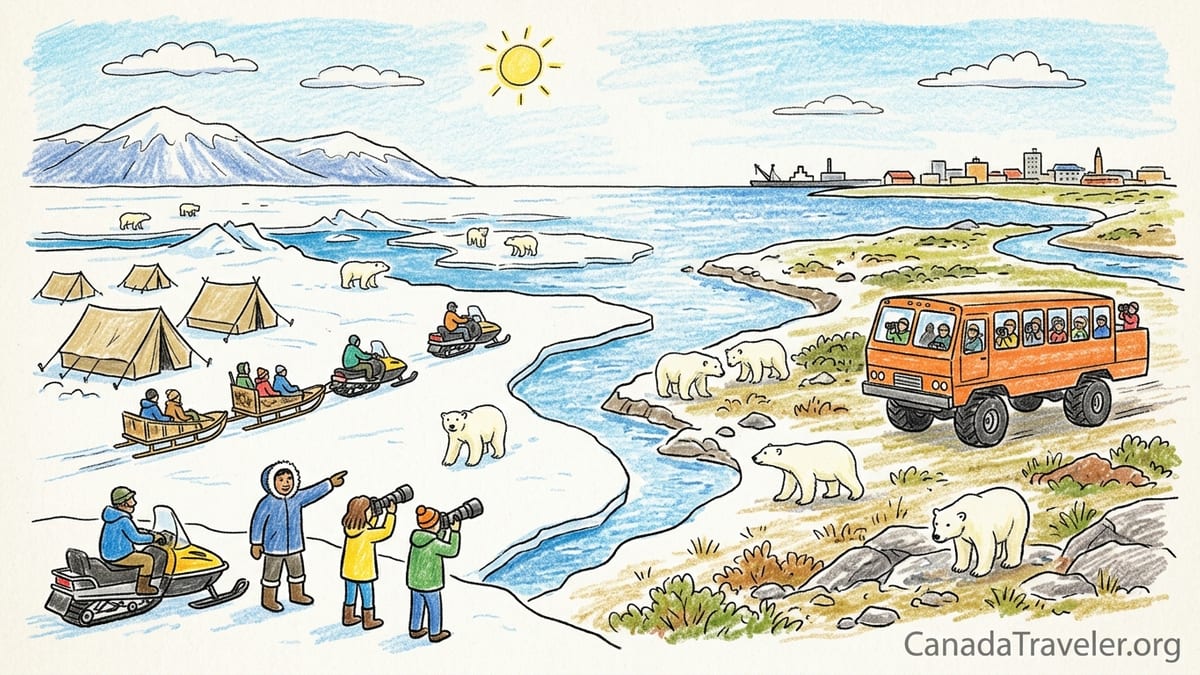
The floe edge, where solid landfast ice meets open Arctic Ocean, is one of the most dynamic wildlife zones on the planet each spring. On the north and east coasts of Baffin Island, outfitters based in communities such as Pond Inlet, Arctic Bay and Qikiqtarjuaq establish temporary tented camps on the sea ice, typically reached by snowmobile and qamutik sled in May and early June. Guests sleep in heated expedition tents, eat in a communal mess tent and spend days traveling between vantage points along the ice edge.
Polar bears use the floe edge to hunt seals and scavenge carcasses, and it is common on these trips for the day’s activities to revolve around scanning pressure ridges and ice pans through spotting scopes while guides check for tracks and fresh bear sign. Narwhal, ringed seals and an astonishing number of seabirds are often present, but on a true polar-bear-focused trip they remain secondary bonuses. Operators will usually be plain that some years the bears patrol a particular stretch of coast heavily, while in others they may stay farther along the ice or be more nocturnal, and sightings can never be promised.
A real-world example is a seven-day floe-edge program from an Arctic Bay or Pond Inlet outfitter, which might include return charter flights from Iqaluit, all meals, shared accommodations in sturdy canvas tents on wooden platforms, and daily excursions by snowmobile, komatik sled and on-foot walks on the sea ice. Travelers are often limited to groups of eight to twelve, which keeps disturbance lower but also raises per-person costs. Photography on these trips frequently happens from 100 to 300 meters away, using long lenses while you remain close to the sled or near the camp vehicles, with local guides setting the minimum distance depending on bear behavior and ice conditions.
Travelers should understand that floe-edge trips are physically and logistically demanding. You may spend long hours in the cold watching distant ice leads, go several days without a close bear encounter, and have itineraries reshuffled by shifting ice, winds or sea fog. Those who arrive expecting a theme-park experience are often surprised by how much of a true expedition this is, even with a full camp support team.
Other Nunavut Polar Bear Experiences: Boat Trips, Parks and Communities
Beyond the famous floe edge, Nunavut offers several other frameworks for seeing polar bears, especially in late summer and early autumn as sea ice retreats. On Baffin Island, small-boat day tours from communities such as Qikiqtarjuaq and Pangnirtung may navigate along coastal fjords and islands where bears roam shorelines or swim between ice floes, particularly near bird cliffs and seal haul-out areas. These trips are highly weather dependent, and local captains ultimately decide whether conditions are safe enough to approach areas where bears are sometimes seen.
National parks and protected areas add another layer. In Auyuittuq National Park on southeastern Baffin Island, visitors hiking the Akshayuk Pass or camping near coastal inlets are reminded that polar bears may be encountered anywhere in the park and at any time of year. Parks Canada provides mandatory safety briefings, recommends travel in groups and strongly advises engaging experienced guides for longer expeditions, especially near the coast where bears are most active. Similar cautions apply in other Nunavut parks and wildlife areas, such as Sirmilik or Qausuittuq, where polar bears are part of the normal wildlife community rather than an occasional highlight.
Some Nunavut hamlets also experience seasonal bear activity around the community itself, especially in late summer and autumn as bears travel along coasts or investigate shoreline dumps and hunting areas. Visitors occasionally see bears from the safety of a vehicle or building without booking a formal tour, but it is critical never to walk the outskirts of town or along beaches without checking with local authorities or outfitters about current bear activity. Many communities have local bear monitors or hunters whose role is to keep people and wildlife separated, and their advice on where not to go is as valuable as any paid excursion.
In all cases, polar bears in Nunavut are part of a working landscape, intertwined with Inuit harvesting, sea-ice travel routes and traditional knowledge. Viewing them ethically means accepting that hunting may be taking place in the same region, that some areas are closed or restricted for conservation or cultural reasons, and that wildlife is not arranged for visitor convenience.
Seasonal Movements: How Sea Ice Shapes Where You See Bears
Planning a polar bear trip in Nunavut is essentially about following the ice. In late winter and spring, many bears are out on the landfast sea ice hunting seals, denning or moving between islands. This is why May and early June are prime months for floe-edge trips on Baffin Island, when the ice is still stable enough for camps yet daylight is long and temperatures are more manageable than in midwinter. At this time, bears may be encountered far from shore, traveling along pressure ridges or near breathing holes, and your guides will position you where those natural hunting opportunities are most concentrated.
As summer advances and the ice melts back, bears are forced to adapt. Around Baffin Island and Lancaster Sound, some stay near remaining ice floes offshore, where they may be seen from expedition ships cruising among drifting ice. Others come ashore, using beaches, headlands and coastal valleys as travel corridors. In places like Auyuittuq, Parks Canada notes that bears are particularly active along the Davis Strait coastline, but can move inland up fiords and even onto glaciers, especially in warm weather when higher, snowier terrain offers cooler refuge. This unpredictability is one reason independent backpacking in these parks is treated as serious polar bear country travel rather than a typical hiking holiday.
By late summer and autumn, bears that have come ashore may appear leaner and more focused on conserving energy, waiting for freeze-up in Hudson Strait, Baffin Bay or the channels around the High Arctic islands. Expedition cruises that transit the eastern entrance to the Northwest Passage in August and September often spot bears on rocky shorelines, on remnant ice shelves or investigating whale carcasses along the coast. Again, no professional company will guarantee a sighting on a specific voyage, but they will usually structure itineraries through known high-use areas such as Lancaster Sound and nearby channels where polar bear density and prey availability are both relatively high.
Winter remains an important time for researchers and local hunters, but the extreme cold, darkness and unstable ice conditions make it a challenging season for tourism. For most travelers, the practical viewing windows are spring floe-edge season and late summer to early autumn cruising or small-boat trips, each with different expectations around temperature, light, chances of seeing narwhal or whales, and how often you can step outside for photography.
Choosing Between Baffin Island Trips and Arctic Expedition Cruises
Travelers focused on polar bears in Nunavut usually end up choosing between two broad styles of trip: land-based or ice-based Baffin Island programs, and ship-based expedition cruises through Nunavut waters. Each has distinct strengths and trade-offs, and both treat polar bears as the main draw while viewing narwhal, muskox, whales and seabirds as important but secondary bonuses.
Baffin Island floe-edge and coastal trips keep you immersed in one region. You might spend a week living on the sea ice within a day’s snowmobile ride of Arctic Bay or Pond Inlet, or stay in simple guesthouses in Qikiqtarjuaq and head out by boat for day tours. The upside is time: you return to the same general area day after day, learning its ridges, ice leads and wildlife corridors, which can increase your overall chances of encounters, even if no single outing is guaranteed. You also interact more closely with local guides, who bring Inuit knowledge about weather, sea ice and animal behavior that goes far beyond what a visiting naturalist can provide.
By contrast, expedition cruises sample a wider geography. A 10 to 14 day voyage might begin in Iqaluit or Resolute, thread through the islands of Nunavut, and spend several days in polar bear habitat around Lancaster Sound, Devon Island or the Baffin coast. Guests view bears from the ship’s decks or from rigid inflatable boats, sometimes stepping ashore at pre-scouted landing sites if bears are not nearby. This approach can combine polar bears with historic sites, remote communities and dramatic glacial scenery, but any individual bear may be seen only briefly as the ship continues along its route.
Pricing and comfort levels vary accordingly. A small-group Baffin Island floe-edge trip typically offers expedition-level comfort in a tented camp without luxury trimmings, whereas higher-end expedition ships might feature private cabins, chefs and lecture programs. On both kinds of trip, polar bears remain wild animals that may or may not appear on a given day. Responsible marketing will usually describe sightings as “likely” or “possible” based on past seasons, not as a guarantee.
For travelers deciding between the two, it can help to ask practical questions: Are you comfortable spending a week in a remote ice camp with no running water, or do you prefer a cabin with a private bathroom? Do you want to focus deeply on one area, or see as much of the Arctic as possible from the ship’s observation decks? Your answers often matter more than advertised sighting statistics, which can swing from season to season as sea ice and prey distribution change.
Safety, Guides and How Polar Bear Travel Differs From Classic Safaris
Polar bear focused travel in Nunavut is more akin to mountaineering or backcountry expedition travel than to a conventional African safari. In most polar bear habitats, you are sharing space with an apex predator that sometimes shows curiosity toward people and infrastructure. Parks Canada and Nunavut authorities emphasize that anyone traveling independently in polar bear country must understand the risks, learn how to interpret tracks and bear behavior, and carry appropriate deterrents where legally permitted. In places like Auyuittuq National Park, visitors are required to read polar bear safety materials and are strongly encouraged to hire licensed local guides, who may be authorized to carry firearms for protection while non-Inuit visitors are not.
On guided trips, local Inuit operators design each day around minimizing risk. On the floe edge, this can mean posting a dedicated bear monitor with binoculars outside camp, keeping food preparation areas tightly managed, and setting clear rules about where guests can walk without an escort. On coastal boat tours, captains maintain a conservative buffer zone between the vessel and any bear. If a bear shows signs of stress, approaches the boat, or tries to enter camp, the priority is to leave or deter the animal, not to stay for better photos.
This is a major difference from many general wildlife safaris, where animals in heavily visited reserves may be habituated to vehicles and guides can approach quite closely without changing behavior. In Nunavut, a polar bear that seems unbothered one moment might decide to investigate the group the next, especially if it is hungry or has learned to associate humans with food. As a result, photography often takes place at longer distances, using 300 to 600 millimeter lenses, and guests are coached to remain quiet and avoid crowding at one side of a boat or sled.
Independent travelers who choose to venture into polar bear country without a guide must take even greater precautions. That includes traveling in groups, securing all food and scented items, planning camp locations away from coastlines and known bear travel routes, and carrying bear deterrents as permitted by federal and territorial regulations. In multiple Nunavut parks and communities, safety recommendations include advance trip registration, satellite communications and detailed emergency plans. This level of preparation is not optional background detail but a fundamental part of what it means to travel responsibly in polar bear habitat.
Photography, Ethics and Secondary Wildlife Highlights
Many visitors to Nunavut arrive with serious camera gear, hoping for iconic images of polar bears on blue ice. In practice, the most respectful and effective photography often happens when you accept distance and imperfection. Shooting from a moving boat on a choppy fjord or from a sled on the sea ice means dealing with wind shake, cold batteries and constantly changing light. Guides will typically advise guests to prioritize their own situational awareness over framing the perfect shot, and may ask everyone to step back or return to vehicles if a bear changes direction or posture.
In recent years, some operators have adjusted their marketing language to emphasize non-intrusive viewing, reflecting a wider concern about habituating bears to human presence. This can mean turning away from a bear that is clearly trying to avoid contact, limiting the time spent with individual animals, or declining to approach mothers with cubs even if the distance seems acceptable. Trip leaders may remind photographers that a distant bear traveling across an untouched snowfield can convey wildness and scale better than a tightly cropped portrait taken at the edge of the animal’s comfort zone.
Secondary wildlife remains an important part of the experience without overshadowing the polar bear focus. At the Baffin floe edge, guests commonly scan for narwhal tusks breaking the surface in loose pods or see ringed and bearded seals hauled out on ice. In Lancaster Sound, expedition ships often encounter beluga, bowhead whales, walrus and concentrations of seabirds on towering cliffs. Inland tundra around some Nunavut parks can host muskox, caribou and Arctic fox, which may appear during shore excursions or community-based hikes, but most polar bear travelers treat these as serendipitous additions rather than primary targets.
For many visitors, the most enduring images are the unscripted ones: a bear’s tracks curving across fresh snow near camp, a distant white shape moving along a fjord at midnight sun, or the sudden silence when a narwhal surfaces briefly and disappears again. These moments underscore the reality that wildlife in Nunavut operates on its own terms, not according to departure schedules.
The Takeaway
Planning a polar bear trip in Nunavut means accepting both the rewards and the uncertainties of true Arctic travel. Compared with Churchill, Baffin Island and other Nunavut regions demand more logistical planning, higher budgets and a greater tolerance for changing ice and weather. In return, they offer access to floe edges, national parks and High Arctic waterways where polar bears are not seasonal curiosities but integral parts of the ecosystem year-round.
Choosing between a Baffin Island floe-edge camp, community-based boat trips or an expedition cruise through Lancaster Sound is less about statistics and more about your appetite for immersion, comfort level and risk tolerance. Whatever you choose, working with experienced Inuit guides, respecting safety protocols and accepting that sightings are never guaranteed are non-negotiable. Polar bear country is not a backdrop for adventure but a living, unpredictable environment, and traveling here on its terms is ultimately what makes Nunavut such a compelling alternative for serious polar bear watchers.
FAQ
Q1. When is the best time of year to see polar bears in Nunavut?
The most practical viewing periods are spring floe-edge season in May and early June, and late summer to early autumn when expedition cruises and boat trips operate in relatively ice-free waters.
Q2. How do Baffin Island floe-edge trips differ from Churchill tundra-buggy tours?
Baffin trips usually involve staying in remote sea-ice camps and traveling by snowmobile and sled with Inuit guides, with longer viewing distances and more expedition-style conditions than road-based vehicle tours in Churchill.
Q3. Can I travel independently in Auyuittuq or other Nunavut parks and still see polar bears?
It is possible but requires advanced preparation, polar bear safety training, group travel and emergency planning. Parks Canada emphasizes that bears can occur anywhere in Auyuittuq at any time of year, so independent travelers must treat it as serious bear country.
Q4. Are polar bear sightings guaranteed on Nunavut trips?
No reputable operator guarantees sightings. They may describe bears as likely or commonly seen based on past seasons, but sea ice, prey availability and weather can change from year to year.
Q5. How close will I get to polar bears on a typical Nunavut tour?
Distances vary, but many responsible guides keep guests 100 to several hundred meters away, using spotting scopes and telephoto lenses to avoid disturbing or attracting the bears.
Q6. What role do local Inuit guides play on these tours?
Inuit guides bring essential knowledge of sea ice, weather, bear behavior and local regulations, and are often authorized to carry deterrents or firearms for protection where visitors are not.
Q7. What kind of budget should I expect for a Nunavut polar bear trip?
Multi-day floe-edge packages and expedition cruises typically run into several thousands of dollars per person, reflecting charter flights, logistics, guides and remote operations.
Q8. Will I also see narwhal, muskox or other Arctic wildlife?
Many travelers do see additional wildlife such as narwhal, seals, whales, muskox or seabirds, but these are treated as secondary benefits and are never guaranteed.
Q9. What safety measures are standard on guided polar bear tours?
Common measures include detailed safety briefings, group travel, camp bear monitors, strict food handling, minimum viewing distances and clear instructions to follow guide directions immediately if a bear appears.
Q10. How is polar bear tourism in Nunavut different from an African safari?
Unlike many African parks with habituated wildlife and predictable game drives, Nunavut trips operate in harsher conditions with less predictable animal movements and a greater emphasis on safety, distance and expedition-style logistics.