


Canada’s Arctic is not a place you simply drive into with a rental SUV and a flexible itinerary. For first-time visitors, especially those drawn to Nunavut and the High Arctic, the most important decision happens before you ever step on a plane: you must choose a specific community, expedition cruise or guided safari, then build all your flights, gear and expectations around that single plan. Think of this as an expedition destination rather than a casual road trip, and the experience becomes far more rewarding, safer and easier to budget for.
What “Canadian Arctic” Really Means
In everyday conversation, people often use “the North” to mean anything from northern British Columbia to Yukon and the Northwest Territories. The Canadian Arctic, and especially Nunavut and the High Arctic, is something more specific. Here you are largely above the tree line, in communities reachable only by air or seasonal ship, with sea ice, polar deserts and permafrost replacing forests and highways. Yellowknife and Whitehorse, for example, sit in the broader Canadian North but are road-accessible service hubs with supermarkets, banks and rental cars. Iqaluit, Pond Inlet or Resolute feel more like remote island outposts than northern small towns.
Nunavut covers a land area bigger than many countries combined, yet its population is roughly that of a small Canadian city, spread across dozens of fly-in communities. There are no intercity roads linking places like Iqaluit, Arctic Bay and Cambridge Bay. If you want to travel between them you board a turboprop on airlines such as Canadian North or Calm Air, and often route through regional hubs. A simple hop that looks close on the map can require one or two plane changes and cost more than a return ticket between Toronto and London.
Within this vast territory, the term “High Arctic” usually refers to islands and communities at extreme northern latitudes, such as Resolute on Cornwallis Island or Grise Fiord on Ellesmere Island, as well as remote national parks and channels along the Northwest Passage. These places have longer periods of midnight sun and winter darkness, colder average temperatures and far more sea ice than sub-Arctic regions like Churchill in Manitoba. For a first visit, you are more likely to access the High Arctic on a small expedition cruise or as part of a tightly organized wildlife safari than by independent travel.
Understanding this distinction matters for planning. A trip to Yukon might involve renting a car in Whitehorse and driving the Klondike Highway on well-graded pavement. A trip to Nunavut usually involves committing to one primary base, such as Iqaluit or Pond Inlet, and then booking guided trips on the land or sea ice with local Inuit outfitters. The logistics, costs and safety considerations are closer to planning a polar expedition than arranging a standard Canadian vacation.
Key Gateways: Baffin Island and Its Communities
For most first-time visitors, Baffin Island is the natural introduction to the Canadian Arctic. It is the largest island in Canada, stretching from the Arctic Circle well into High Arctic latitudes, and is home to Iqaluit, the territorial capital, along with dramatic fjords, mountains and world-class wildlife. Flights from Ottawa and Montreal reach Iqaluit in about three hours on Canadian North or other carriers, often using combi aircraft that carry both cargo and passengers. Recent searches show typical return fares from Ottawa in the range of about 1,200 to 1,500 Canadian dollars, though government fare tables used for tax purposes list “ordinary” economy returns as much higher, underlining how volatile and expensive Arctic air travel can be.
Iqaluit itself is not a wilderness camp, but rather a working capital with a few thousand residents. Visitors find several hotels, from basic motels to business-style properties, with rooms commonly priced from around 300 to 400 Canadian dollars per night and up, especially in peak seasons. There are coffee shops, a handful of restaurants serving everything from burgers to Arctic char, grocery stores with high prices due to air freight, and outfitters who can arrange boat trips, hikes or winter excursions by snowmobile. It is an accessible place to experience Inuit culture, local art galleries and the feel of life on the tundra without immediately plunging into the extreme High Arctic.
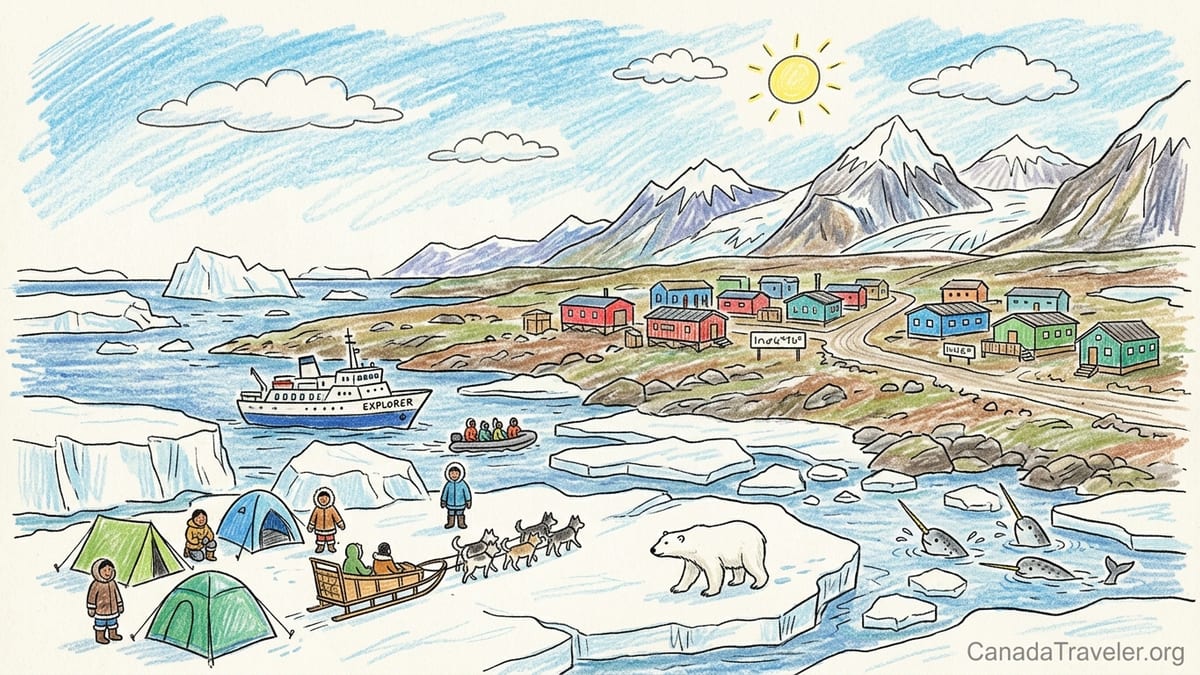
North from Iqaluit, communities such as Pond Inlet and Arctic Bay open the door to more dramatic High Arctic scenery and wildlife. Pond Inlet, on northern Baffin Island, has become known for its access to the spring floe edge, where sea ice meets open water and narwhal, beluga, seals and polar bears can concentrate in late spring and early summer. Local Inuit-owned operators and guides run floe-edge safaris that include camping on the ice, traveling by snowmobile and qamutiik (traditional sled) and standing at the edge of sprawling landfast ice watching for whale tusks breaking the surface. Prices vary but it is realistic to budget several thousand Canadian dollars per person for a multi-day floe-edge safari, not including flights.
Arctic Bay offers deep fjords, cliffs full of nesting seabirds and access to Sirmilik National Park via nearby communities. From here or Pond Inlet, experienced independent travelers sometimes arrange multi-day camping and hiking trips in cooperation with local guides. However, reaching either community typically means flying first to Iqaluit, then onward on smaller aircraft, with each leg costing hundreds to more than a thousand dollars one way. This is why many first-time visitors either base themselves in Iqaluit for day trips or opt to see northern Baffin Island as part of an expedition cruise.
Into the High Arctic: Resolute, Cambridge Bay and the Archipelago
Resolute, on Cornwallis Island, is one of Canada’s northernmost communities and a key High Arctic logistics hub. It has a tiny year-round population, a small cluster of buildings, a short gravel road network and an airport used by scientific teams, military exercises and polar expeditions. Commercial flights are limited and expensive, typically routing through Iqaluit or other regional hubs and sometimes involving charter segments. For many visitors, Resolute is not a standalone destination but the embarkation or disembarkation point for a Northwest Passage expedition or a staging point for specialized trips, such as ski expeditions toward the North Pole.
Farther west, Cambridge Bay on Victoria Island feels comparatively larger and more established, with several hundred residents, a modest selection of hotels and services, and a role as an important stop along the maritime Northwest Passage. Some expedition cruises use Cambridge Bay as a changeover port, transferring guests by charter plane to and from southern Canada. If you join a small-ship voyage visiting Cambridge Bay, the operator will typically include those charter flights in your package price and coordinate luggage limits and timing, removing much of the logistical burden from travelers.
The wider Arctic Archipelago, which includes islands such as Baffin, Devon, Somerset and Ellesmere, is where many classic images of the Canadian Arctic are made: glaciers spilling into ice-choked channels, tabular icebergs drifting past rocky headlands and small clusters of buildings huddled against an immense sky. Few of these islands have permanent communities; instead they are visited seasonally by research stations, Parks Canada staff and expedition ships. For a first-time traveler, seeing Devon Island or the narrow channels of the eastern Northwest Passage almost always means traveling by ship rather than flying into a community and arranging private charters.
Because of the complexity and cost of reaching these High Arctic islands independently, many travel planners encourage first-time visitors to think of the archipelago in terms of itineraries, not individual points on a map. An expedition cruise might advertise “Canadian High Arctic” or “Heart of the Arctic,” with a route including places like Pangnirtung, Baffin Island fjords, Devon Island, Beechey Island and Resolute. The details can shift each season based on sea ice and weather, but the important thing is that you are booking a complete, guided journey that handles charter flights, permits and safety systems on your behalf.
Expedition Cruises, Wildlife Safaris and How to Choose
For many first-time visitors, the most practical way to experience the Canadian High Arctic is to join an expedition cruise. These are not large resort ships with thousands of passengers; instead, they are typically ice-strengthened vessels carrying between 100 and 200 guests, run by specialty companies that focus on polar regions. Operators such as Quark Expeditions and Adventure Canada, along with some premium mainstream lines that have expedition arms, offer itineraries that combine Nunavut communities with Greenland or Atlantic Canada. Sample 12 to 14 day voyages in the region often start around 14,000 US dollars per person in shared cabins, with premium suites significantly more.
On these voyages, your days are structured around Zodiac excursions, shore landings and onboard lectures. One morning you might ride in a small inflatable boat beneath sea cliffs full of nesting kittiwakes and murres, the next hike across tundra guided by Inuit cultural interpreters who explain traditional hunting grounds. Many itineraries include community visits in places like Pond Inlet, Arctic Bay or Cambridge Bay, and some are designed to trace elements of the Franklin expedition or other polar history along the Northwest Passage. While expensive, expedition cruises simplify logistics and spread the cost of charter flights, ice pilots, bear guards and safety equipment across the group.
Wildlife safaris are another powerful draw. In Nunavut, the most famous experiences include spring floe-edge trips from communities like Pond Inlet, where visitors hope to spot narwhal, beluga and polar bears on the sea ice, as well as summer tundra trips in regions where caribou and migratory birds gather. Local Inuit-owned companies in communities across Baffin Island market narwhal viewing, floe-edge camping and guided fishing as part of multi-day packages. Prices vary widely depending on group size and comfort level, but a realistic starting point for a several-day, fully guided floe-edge safari is in the range of several thousand Canadian dollars per person, rising quickly with added comforts such as heated tents and private snowmobiles.
When choosing between a cruise and a land-based safari, consider your priorities. If you want to see as wide a range of landscapes and communities as possible in one trip and prefer to unpack only once, a ship is more practical. If your dream is to spend long days in one place, slowly watching the rhythm of sea ice and wildlife under the midnight sun, and you are comfortable with camping and simpler accommodations, a community-based floe-edge trip may be more rewarding. Either way, you should book with operators that emphasize Inuit leadership, small groups and safety protocols adapted to sea ice and polar bears.
Inuit Communities, Culture and Respectful Travel
Nunavut is homeland to Inuit, and any responsible Arctic journey is, at its core, a visit to Inuit communities. Towns such as Iqaluit, Pond Inlet, Arctic Bay and Cambridge Bay are not tourist constructs but real places where people work, raise families and navigate the challenges of high costs, climate change and shifting sea ice. Visitors will see snowmobiles parked outside homes, kids playing soccer on gravel fields in the midnight sun and hunters preparing qamutiit loaded with fuel drums and camping gear.
Inuit culture is present in language, art and daily life. You may hear Inuktitut spoken in stores, see syllabics on signs and visit co-ops or craft centers where carvers sell sculptures of polar bears, seals and spirits carved from serpentine or whalebone. In Iqaluit, galleries and cultural centers showcase both traditional and contemporary Inuit art, while smaller communities might have local craft shops attached to hamlet offices or co-ops. A soapstone carving or hand-sewn sealskin mitts can cost several hundred dollars, reflecting both the craftsmanship and the cost of materials in remote communities.
Respectful travel means recognizing that you are a guest in someone’s home. Ask permission before photographing people, especially children. Be aware that working dogs tied outside homes are sled dogs, not pets, and should not be approached or petted. Alcohol restrictions vary by community and are often stricter than in southern Canada, reflecting local decisions; research the regulations for your destination and respect them. When in doubt, ask your guide or hotel staff how to behave appropriately in cultural settings, from community feasts to visits to heritage sites.
Inuit participation in tourism is growing, from guides leading hikes and narwhal safaris to Inuit-owned cruise initiatives that seek to shape how visitors see and understand the Arctic. When comparing operators, look for itineraries that spend real time in communities, employ local guides and emphasize cultural exchange rather than treating villages as quick photo stops. This approach not only enriches your experience but also helps ensure tourism revenue benefits local residents.
Flights, Logistics and the Reality of Arctic Travel
Planning logistics is where many first-time Arctic trips either succeed or fall apart. There are no highways connecting Nunavut communities, and the road network within towns is usually limited to a few kilometers of gravel. This means you must think in terms of flights, boats and snowmobiles, and understand that weather can and often does disrupt plans. A strong wind or low visibility in Iqaluit can delay flights domestically and from the south, and a late ice breakup can force expedition cruises to alter routes at short notice.
From southern Canada, the main gateways to Nunavut are Ottawa and Montreal, with scheduled flights to Iqaluit operated by airlines such as Canadian North and, seasonally, other carriers. Recent fare searches suggest that a return ticket from Ottawa to Iqaluit can sometimes be found for around 1,200 to 1,500 Canadian dollars if booked early and during sales, although it is not uncommon to see significantly higher prices at peak times. Within Nunavut, local flights between Iqaluit, Pond Inlet, Arctic Bay or Cambridge Bay can cost hundreds to more than a thousand dollars one way, and in some remote High Arctic communities, government tables listing “lowest ordinary return fares” between hamlets and southern cities can run to several thousand dollars.
Once in a community, you generally get around by taxi or on foot. In Iqaluit, taxis function almost like a shared bus system, with flat per-person fares on standard routes. Car rentals are limited and expensive, and in many smaller communities they may not exist at all. Instead, guided excursions by boat, snowmobile or ATV are organized through local outfitters, who provide both transportation and expertise. Because everything from gasoline to fresh fruit arrives by sealift or air cargo, prices on the ground are high; budgeting generously for food, accommodation and incidentals is wise.
Travel insurance that covers medical evacuation is important. Small community health centers handle routine issues, but serious illness or injury may require medical flights to larger hospitals in southern Canada. Expedition cruise companies generally require proof of evacuation coverage, and even independent travelers should think through what would happen if weather delayed their departure for several days or if they needed to leave a town urgently. Building a buffer of at least one or two nights in a southern city before international flights home can protect against missed connections caused by Arctic weather.
Sea Ice, Midnight Sun and Extreme Weather
Seasons in the Canadian Arctic do not align neatly with southern ideas of spring, summer and autumn. Sea ice, daylight and temperature define the travel calendar more clearly than the month on paper. On much of Baffin Island, for example, the spring thaw around Iqaluit arrives in June, while north coast areas near communities like Pond Inlet stay locked in ice longer. The winter sun can disappear entirely for weeks in High Arctic communities, then in late spring swing into long days where it barely skims below the horizon.
For visitors, this means that April and May can be prime time for snowmobile-based trips across stable sea ice or to the floe edge, with strong but lengthening daylight. Temperatures are still well below freezing and often harsh, but the light is beautiful and wildlife begins to stir around leads and cracks in the ice. June through August are more typical for expedition cruises, when ice conditions allow ships to enter narrow channels and anchor near communities. During this season, temperatures along the coast may hover just above freezing on cool days and climb into the single digits or low teens Celsius on milder afternoons, though wind chill on the water can make it feel much colder.
The midnight sun creates both magic and practical challenges. In communities above the Arctic Circle, summer nights can feel like perpetual afternoon, with children playing soccer at midnight and light streaming around blackout curtains. Travelers who are sensitive to light should pack eye masks or consider accommodation with good window coverings. Photography can be extraordinary, as the sun circles low on the horizon for hours, casting long golden shadows on sea ice and tundra. Conversely, the long winter night can feel intense and is better suited to experienced travelers seeking aurora photography or very specific winter experiences.
Weather in any season can change quickly. Fog rolling in off open water can ground aircraft and shut down local boat excursions. Wind can kick up whitecaps at the floe edge or drive windchill to levels that make bare skin unsafe within minutes. Packing systems, rather than single heavy garments, is essential: base layers of merino or synthetic fabric, mid-layers such as fleece and insulated jackets, and outer shells that are windproof and waterproof. Many expedition cruise companies provide loaner parkas or rubber boots, but independent land-based travelers must ensure they bring or rent gear suitable for conditions that can feel more like winter than summer even in July.
The Takeaway
Thinking of Canada’s Arctic as an expedition destination rather than a casual extension of a Canadian road trip transforms both planning and expectations. Instead of plotting a loop of scenic drives, you choose one community, one cruise itinerary or one wildlife safari as your anchor, then let everything else build around that choice. For many first-time visitors, this anchor might be a week in Iqaluit with day trips onto the tundra, a spring floe-edge camp out of Pond Inlet, or a two-week small-ship voyage threading the eastern Northwest Passage via Resolute and Cambridge Bay.
The rewards for this focused approach are immense. You gain a deeper understanding of Inuit communities, learn how sea ice, weather and wildlife truly shape life in Nunavut, and experience landscapes that feel far removed from even the most remote corners of southern Canada. Yes, flights are expensive, logistics are complex and the weather can rewrite plans overnight. But with realistic expectations, careful budgeting and the guidance of local experts, a first journey into Nunavut and the High Arctic can be one of the most memorable trips you ever undertake.
FAQ
Q1. How far in advance should I book a trip to Nunavut or the High Arctic?
For expedition cruises and floe-edge safaris, booking 9 to 18 months ahead is common, especially for peak dates such as late spring and mid-summer. Flights to Iqaluit and onward to smaller communities can fill quickly during these periods, and early planning allows you to secure limited hotel rooms and experienced local guides.
Q2. What is a realistic budget for a first-time visit?
Budgets vary widely by style, but many first-time visitors who fly from southern Canada to Iqaluit and spend a week with guided activities find that total costs can easily reach several thousand Canadian dollars per person. Small-ship expedition cruises that include charter flights usually start in the low five-figure range in US dollars. Independent travel to remote High Arctic communities can end up being similarly expensive once local flights, accommodations and guiding fees are included.
Q3. Can I drive to any Nunavut communities?
No, there are currently no highways connecting Nunavut communities to the southern Canadian road network. Places like Iqaluit, Pond Inlet, Arctic Bay, Resolute and Cambridge Bay are accessible only by air or, seasonally, by sea. Once in a community, travel is by taxi, on foot or with local outfitters using boats, snowmobiles or ATVs.
Q4. When is the best time to see narwhal and polar bears?
In many areas of northern Baffin Island, late spring at the floe edge is considered the prime time to look for narwhal, beluga and polar bears as sea ice begins to break up. Each year is different, and wildlife is never guaranteed, so working with experienced local Inuit guides or established operators improves your chances. Expedition cruises in June, July and August may also encounter polar bears on ice floes or shorelines, though sightings depend heavily on sea ice conditions.
Q5. Do I need special permits to visit national parks in Nunavut?
Yes, Parks Canada national parks such as Sirmilik and others in Nunavut require advance registration and, in many cases, detailed trip plans for backcountry travel. If you join a guided trip or expedition cruise, the operator usually secures the necessary permits and coordinates safety requirements. Independent travelers should contact Parks Canada well ahead of time to understand permits, fees and mandatory safety measures.
Q6. What kind of clothing should I pack for a summer visit?
Even in July or August, conditions in coastal Nunavut can feel wintry, especially on the water. Pack layered clothing including thermal base layers, fleece or insulated mid-layers, a windproof and waterproof shell, warm hats and gloves, and sturdy waterproof boots. If you are joining a cruise, check whether the company provides parkas or boots; for land-based trips, assume you must bring or rent your own cold-weather gear.
Q7. How reliable are flights, and how should I plan for delays?
Flights to and within Nunavut run regularly, but weather, fog and mechanical issues can trigger delays or cancellations more often than on major southern routes. It is wise to add at least one buffer night in your southern gateway city before any long-haul international flight home. Purchasing travel insurance that covers delays and changes, as well as medical evacuation, helps manage the financial risks of disruptions.
Q8. Are there health or safety concerns unique to the Arctic?
The main concerns are environmental rather than medical. Extreme cold, strong winds and the risk of hypothermia or frostbite require appropriate clothing and caution. Wildlife such as polar bears are powerful and potentially dangerous, so visitors should never travel outside town on their own and should follow the instructions of armed and trained guides. Drinking water in communities is treated, but independent campers must be prepared to purify water on the land.
Q9. Can I see the northern lights on a summer trip?
During the peak of the midnight sun in mid-summer, skies in much of Nunavut and the High Arctic remain bright through the night, making aurora viewing impossible. If seeing the northern lights is a priority, consider traveling in autumn or late winter, when nights are dark and skies can be very clear. Keep in mind that colder temperatures and more challenging conditions come with the better aurora viewing season.
Q10. Is it possible to travel independently, or do I need to join a tour?
It is possible to travel independently to larger communities such as Iqaluit, booking flights and hotels on your own and arranging day trips with local outfitters. However, in remote High Arctic areas, on sea ice or in national parks, traveling with experienced guides or as part of an organized expedition is strongly recommended for safety and logistics. Many first-time visitors choose at least one structured component, such as an expedition cruise or floe-edge safari, even if they also spend time exploring a community on their own.