


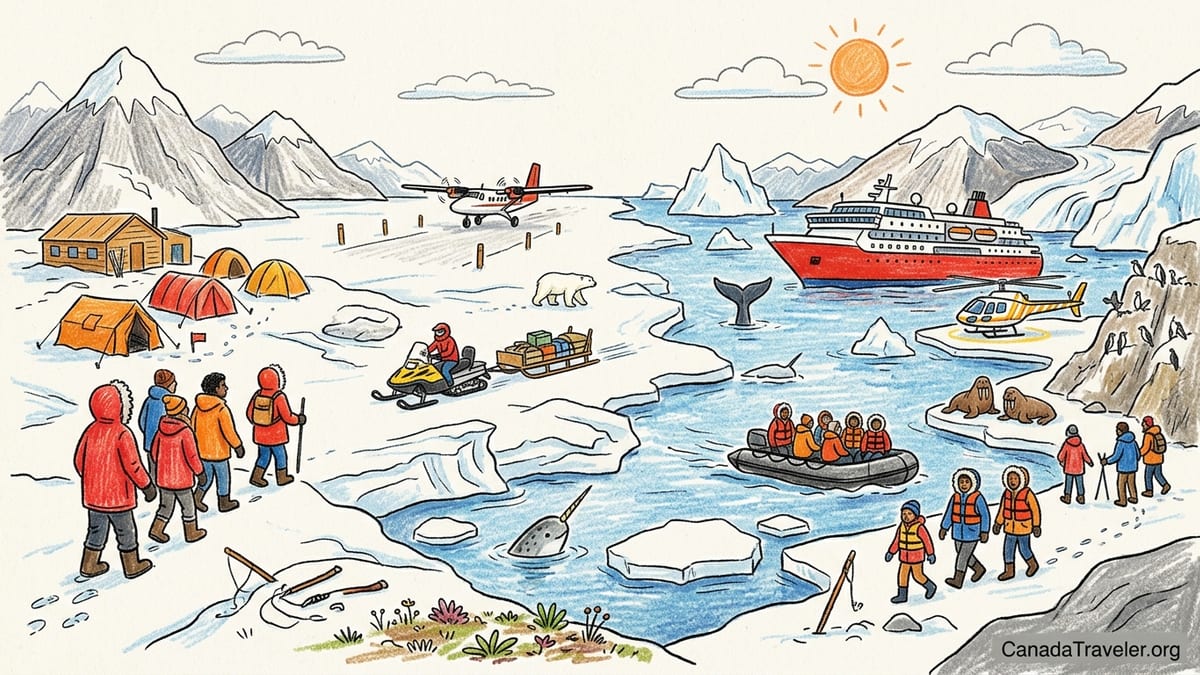
The Canadian Arctic is no longer a blank space on the map reserved for professional explorers. From floe-edge narwhal safaris in Nunavut to small-ship expeditions along Baffin Island’s fjord-cut coast, regular travelers can now step into this polar world safely and comfortably. The challenge is no longer whether you can go, but how you want to experience it: on foot, by snowmobile, in a heated camp on the sea ice or aboard an expedition ship. This guide compares the main styles of Canadian Arctic travel so you can choose the right balance of wildlife, comfort and adventure.
How Travelers Actually Reach the Canadian Arctic
For most visitors, a Canadian Arctic journey begins with a commercial flight from southern Canada to a gateway such as Ottawa, Montreal, Winnipeg or Calgary, then onward on a regional airline into Nunavut communities like Iqaluit, Pond Inlet, Resolute or Qikiqtarjuaq. These flights are rarely included in trip prices. For example, a floe-edge tour based out of Pond Inlet will typically state that the package includes all services from the moment you land in Pond Inlet, but will not include the several-hundred to over one-thousand dollar return airfare from Ottawa or Montreal. Travelers need to budget both for the tour itself and for these positioning flights, which are often the single biggest hidden cost.
Once in Nunavut, logistics are usually bundled. Land-based operators such as Arctic Kingdom and Black Feather commonly include local transfers by snowmobile and qamutik sled, expedition tents or heated camps, meals, local guides and most technical gear like heavy parkas, insulated boots and survival equipment. That means you step off the scheduled flight in your normal winter clothes and are then issued the Arctic-grade layers you need for the sea ice. Expedition cruise companies such as Adventure Canada and Quark Expeditions, by contrast, typically include charter flights between a southern hub and the embarkation port in their cruise fare, but still leave international flights to the traveler. Understanding where your included services begin, whether in Ottawa, Iqaluit or a ship-side pier in the High Arctic, is key to comparing options fairly.
Regardless of trip style, travel times are long and connections are tight. Weather often disrupts regional flights, particularly in April and May during the floe-edge season and in late summer when fog can affect Baffin Island airstrips. Reputable operators build buffer nights into their itineraries or strongly recommend that you arrive a day early in the gateway city. While this adds hotel costs, it significantly reduces the risk of missing a departure that only runs once per season.
Lodge-Based Wildlife Trips: Comfort in Remote Nunavut
Lodge-based wildlife trips in the Canadian Arctic usually combine fixed accommodation with daily excursions to search for bears, whales and Arctic birds. Classic examples include seasonal wildlife lodges in Nunavut and small base camps favored by operators like Arctic Kingdom along the Baffin Island coast. Guests sleep in permanent or semi-permanent structures with proper beds and heating, eat chef-prepared meals and return to the same room each night, which suits travelers who want immersive Arctic nature but value creature comforts and a predictable routine.
What is typically included on these lodge-based safaris is comprehensive once you reach the lodge: accommodation, all meals, guided outings by boat, snowmobile or on foot, use of specialized clothing such as insulated over-boots and sometimes a heavy parka, as well as safety gear like life jackets and survival equipment. Prices can range from the mid four figures to well over ten thousand US dollars per person for a week, depending on the lodge’s remoteness, season and level of comfort. Group sizes tend to be small, often under 12 guests, which allows local Inuit guides and expedition leaders to personalize wildlife viewing and respond quickly to sightings of polar bears, seals or migrating narwhal.
Physically, lodge-based trips are among the more accessible Arctic options. Days can still be active, with several hours of boat time or walking on uneven snow, but participants usually have the option to rest at the lodge instead of joining every outing. This makes lodge-based safaris suitable for travelers with moderate fitness, families with older children, and photography enthusiasts who value comfort for charging equipment and backing up images each night. Weather buffers are still crucial: if high winds or low visibility prevent boats from leaving the shore, your day becomes one of lectures, storytelling and indoor photography practice instead of wildlife encounters.
Floe-Edge Safaris: Life on the Sea Ice
Floe-edge tours are among the most iconic Canadian Arctic experiences. In spring, typically from late April to early June, guides lead small groups across stable landfast sea ice by snowmobile and qamutik sled to the point where solid ice meets open water. This “line of life” concentrates wildlife: guests have real chances to see narwhal surfacing, seals hauled out on the ice, and occasionally polar bears hunting along the edge. Operators such as Black Feather run floe-edge basecamp trips near Pond Inlet where travelers sleep in heated tents on the sea ice, eat hot meals in a communal dining tent and spend days scanning the water from camp or traveling to nearby wildlife hotspots.
Floe-edge safaris are highly inclusive once you arrive in the staging community. Packages commonly cover group transfers by snowmobile, all technical camping equipment, heavy-duty winter clothing layers, sleeping systems, meals and guiding. You may be expected to bring your own base layers and personal items, but high-value gear such as expedition tents and extreme-weather sleeping bags are supplied. In return, prices are at the higher end of Arctic tourism due to the logistics of moving and maintaining a camp on the ice and the ratio of guides to guests. Group sizes are kept deliberately small, often in the range of 6 to 10 travelers with multiple guides, both for safety and to minimize disturbance to wildlife.
These trips are physically and mentally demanding. While no technical skills are required, you will spend hours outside in sub-zero temperatures, walk on uneven, sometimes wind-sculpted sea ice and climb in and out of sleds and snowmobiles several times per day. Simple tasks like using a bathroom tent or managing camera batteries become more effortful in these conditions. Weather buffers are absolutely essential. Operators expect some days when strong winds or shifting ice make travel unsafe, and itineraries are deliberately flexible. Travelers should be comfortable with the idea that a once-in-a-lifetime narwhal encounter might happen on day nine instead of day three, and that conditions may limit opportunities to move camp or explore certain leads in the ice.
Baffin Island Land Expeditions and Guided Hiking
For travelers drawn to big landscapes as much as wildlife, Baffin Island’s mountains and fjords offer serious trekking opportunities. The Akshayuk Pass traverse in Auyuittuq National Park, for instance, is a multi-day backcountry hike through granite peaks and glacier valleys that has become a classic Arctic backpacking route. Specialized outfitters run guided expeditions here, providing tents, cookware, safety equipment and local guides who understand both the terrain and the rapidly changing weather patterns.
Unlike lodge or floe-edge trips, guided hiking expeditions on Baffin Island demand a higher level of physical fitness. Participants often carry 15 to 20 kilogram packs over rough, sometimes boggy or snowy ground, cross glacial streams and contend with wind and cold even in mid-summer. Days can involve six to eight hours of walking. These expeditions generally include guiding, group camping gear, meals on the trail and national park permits, but do not include flights to the start and finish communities or personal gear such as hiking boots, layered clothing and backpacks. Group sizes are typically around 6 to 10 people, large enough for social atmosphere and safety but small enough to move efficiently through the landscape.
Weather buffers on trekking routes are built in as flexible extra days rather than fixed extensions in a town. Guides plan conservative daily distances so that the group can pause for a storm or difficult river crossing without missing an exit flight. However, because small aircraft service Baffin communities, severe storms or fog can still delay your departure. Travelers on land expeditions should avoid tight onward connections and be mentally prepared for itineraries that change on the fly in response to snow conditions or meltwater levels.
Snowmobile Journeys and Dedicated Photography Tours
Snowmobile-based journeys sit somewhere between trekking and lodge stays. In communities across Nunavut, local outfitters offer multi-day snowmobile trips to visit frozen fjords, sea ice camps or remote hunting areas. These itineraries appeal to travelers who want to cover significant distances, experience the rhythm of Arctic travel and spend long days outdoors without carrying heavy backpacks. Guides provide machines, fuel, sleds, survival gear and usually all meals and camping equipment. Guests bring their own warm base layers and personal items, while operators supply heavier Arctic clothing similar to that used on floe-edge trips.
The physical demands of snowmobile journeys are less about cardiovascular fitness and more about endurance and flexibility. Long hours sitting on a moving machine in cold temperatures can be tiring, and you need enough mobility to swing on and off the seat and help with tasks like setting up camp or pushing a sled over rough patches. Group sizes are usually small, often 4 to 8 guests following one or two guides, which supports safety in remote areas. Weather buffers allow for days lost to whiteouts, when visibility drops so low that even experienced Inuit drivers stay put rather than risk traveling over hidden pressure ridges or thin ice.
Many of these snowmobile-based itineraries are tailored for photographers. Operators on Baffin Island and around Pond Inlet, for example, offer northern lights safaris and spring polar bear photography trips where each guest has ample space for gear and the schedule prioritizes early morning and late evening light. Inclusions typically extend to heated shelters or “sleep domes” at base camps, hot meals, and access to guides who understand both animal behavior and the needs of serious photographers. Price points can be comparable to floe-edge safaris when group sizes are limited to four or five photographers, but the trade-off is more control over positioning, patience at sightings and the possibility of returning night after night to a promising iceberg or denning area.
Expedition Cruises: Baffin Island and the High Arctic by Ship
Expedition cruises along Baffin Island and through the Canadian High Arctic allow travelers to experience a vast sweep of coastline in relative comfort. Companies such as Adventure Canada, Quark Expeditions and other polar specialists operate small vessels, often carrying 120 to 200 passengers, that navigate fjords, bays and inlets while offering daily Zodiac excursions and shore landings. Typical itineraries might trace the east coast of Baffin Island and cross to West Greenland, or follow segments of the historic Northwest Passage, visiting communities, bird cliffs and areas with good chances of spotting polar bears and walrus.
Cruise fares are usually comprehensive from the embarkation point onward. They commonly include accommodation in a cabin, all shipboard meals, Zodiac excursions, guided landings, use of rubber boots and a loaner expedition parka, as well as onboard lectures and interpretive programs. Many itineraries also bundle charter flights between a southern Canadian city and the remote port where the ship starts or ends its voyage, simplifying logistics. What they do not include are international flights to the charter departure city, personal clothing layers or optional adventure activities such as kayaking, which carry extra fees and limited spaces.
Physical demands on expedition cruises are lower than on land expeditions or floe-edge safaris. Guests need to be able to step in and out of Zodiacs, climb gangways and walk on uneven shorelines, but can opt out of more strenuous hikes. This makes cruises accessible to a wide age range, including older travelers and multi-generational families. Group sizes on shore excursions are managed by rotating passengers in smaller batches so that landings remain orderly and wildlife disturbance is minimized. Weather buffers are built into the flexible daily plan rather than as extra days; if sea ice closes one fjord, the ship may reroute to another bay or spend more time with onboard programs until conditions improve.
What Each Trip Style Really Includes (and What It Doesn’t)
Across all these Canadian Arctic trip styles, certain inclusions are common from the local starting point. You can generally expect accommodation (whether a cabin, lodge room or tent), meals during the itinerary, guiding, basic safety equipment and local transportation such as boats, snowmobiles or Zodiacs. Expedition cruise lines and higher-end land operators frequently loan or gift heavy parkas and provide insulated boots, which is a meaningful value given the cost of purchasing such items separately. Travelers should still arrive with quality base layers, mid-layers, hats and gloves suitable for sub-zero conditions.
What is rarely included are flights from your home country to the first Canadian city, and often not the scheduled flights onward into Nunavut unless specifically described as charter. Travel insurance, excess baggage fees, alcoholic beverages and tips for guides or ship staff are also typically extra. On land expeditions and guided hiking trips, personal gear like backpacks, hiking boots and sleeping bags may not be provided even when group tents and cooking equipment are included. Photography tours might offer shared use of spotting scopes but expect you to bring camera bodies and lenses.
Because pricing in the Arctic is high, small differences in inclusions can have large impacts on overall cost. For example, a Baffin Island floe-edge safari that includes a charter flight from Iqaluit to a remote camp may appear more expensive upfront than one starting from a town reachable on a regular airline, but once you factor in separate airfare, hotel nights and meals in transit, the totals can be similar. Comparing trips means carefully reading what “from Iqaluit” or “from Pond Inlet” actually covers, and asking operators directly how much additional money most guests spend on travel to the starting point and on extras during the trip.
Matching Trip Style to Traveler: Adventure, Wildlife or Comfort
Choosing between an active land expedition, a wildlife-focused safari and a ship-based journey starts with an honest assessment of your priorities and comfort zone. Travelers who want to cover ground under their own power and are willing to accept basic comforts in exchange for remoteness tend to gravitate toward guided hikes and snowmobile journeys. The reward might be standing in a silent valley beneath Baffin’s granite walls or crossing a vast frozen bay with only your small group in sight. Days are long, you may go several nights without a shower, and there is little separation between you and the environment.
Wildlife-focused safaris, whether at a fixed lodge or on the floe edge, are best suited to travelers who value patient observation and a strong chance of specific animal encounters. If your dream is to watch a polar bear crossing the sea ice or to photograph narwhal tusks at the waterline, these trips offer the most time in the right habitats. They also come with the most weather dependency and the least predictability in timing: animals appear on their own schedule, and guides must constantly balance safety, ethics and guest expectations. The experience can be deeply rewarding but requires flexibility and a tolerance for sitting in the cold scanning the horizon.
Ship-based journeys work well for travelers seeking a broad overview of the Canadian Arctic’s landscapes and cultures with a comfortable home base. You will likely visit more communities, see a greater variety of scenery and enjoy amenities such as private bathrooms, lounge areas and daily talks by historians and naturalists. Wildlife sightings can be excellent, particularly along ice edges and haul-out sites, but are generally briefer than on dedicated safaris because the ship must keep to a schedule. For many first-time polar travelers, an expedition cruise strikes a satisfying balance between adventure and ease, especially if traveling with companions of mixed fitness levels.
The Essential Role of Weather Buffers and Seasonality
Weather and ice control every aspect of travel in the Canadian Arctic, which is why weather buffers are not an optional add-on but an integral part of trip design. Spring floe-edge safaris, for example, rely on stable landfast sea ice and open leads of water for wildlife viewing. An early melt, late freeze or strong winds can alter the timing of these conditions by days or even weeks. Operators schedule their trips within historical windows when conditions are usually favorable, then add extra days in the field or in gateway communities to hedge against transport delays and uncooperative weather.
Expedition cruises face different but equally real constraints. Heavy pack ice along Baffin Island can block planned landings or require the ship to backtrack and seek alternate routes. Dense fog may limit Zodiac operations or make it unsafe to approach certain cliffs and shorelines. To cope, itineraries are advertised as flexible, with daily plans announced only the night before or the same morning. Seasonality also shapes expectations: early summer voyages tend to feature more snow on the ground and active seabird colonies, while late summer and early autumn cruises may have open water, icebergs and better chances of clear skies for northern lights viewing.
For travelers, the practical implication is that Arctic itineraries are always provisional. Booking an extra night in the southern gateway city at the start and end of your trip, avoiding tight onward connections and accepting that you may not visit every named bay or glacier in the brochure are all part of traveling responsibly in this region. The operators most experienced with Nunavut and Baffin Island plans are frank about these uncertainties and design trips to maximize overall experience rather than to tick off a rigid list of stops.
The Takeaway
Experiencing the Canadian Arctic is not about finding a single “best” trip but matching the realities of each style to your interests, fitness and budget. Lodge-based wildlife stays prioritize comfort and structured days with high-quality guiding, ideal for travelers who want Arctic immersion without sacrificing a warm bed. Floe-edge safaris and snowmobile journeys deliver the most intense connection to ice and wildlife, but require mental resilience, flexibility and a readiness for cold, long days. Guided Baffin Island treks satisfy those who see the Arctic as a vast mountain and tundra wilderness to be crossed on foot.
Expedition cruises, meanwhile, open the High Arctic to a wide audience, offering a moving base from which to explore Baffin’s fjords, historic sites and communities. They excel at variety and comfort, even as they remain subject to the same ice and weather that shape life everywhere in Nunavut. No matter which path you choose, understanding what is truly included, how group sizes and physical demands differ, and why weather buffers are essential will help you turn an ambitious dream into a safe, rewarding journey above the Arctic Circle.
FAQ
Q1. When is the best time of year to visit the Canadian Arctic for wildlife?
The best time depends on what you want to see. Spring, roughly late April to early June, is prime for floe-edge trips targeting narwhal, seals and polar bears on sea ice. Mid-summer suits bird cliffs, wildflowers and hiking on Baffin Island, while late summer into early autumn is favored for expedition cruises with more open water, icebergs and potential northern lights.
Q2. How physically fit do I need to be for a floe-edge safari?
You do not need technical skills, but you should be comfortable spending several hours a day outdoors in sub-zero temperatures, walking on uneven sea ice and climbing in and out of sleds or snowmobiles. Moderate overall fitness and good balance are important. Travelers with mobility limitations may find a lodge-based safari or cruise more suitable.
Q3. Are expedition cruises suitable for older travelers?
Yes, many expedition cruises around Baffin Island and the High Arctic are designed to be accessible for older guests. You should be able to manage stairs, step into Zodiacs and walk short distances on uneven ground. Most landings offer options ranging from gentle strolls to more strenuous hikes, allowing each guest to choose their activity level.
Q4. Do these trips usually include flights from my home country?
Typically not. Most packages begin in a Canadian gateway city or a Nunavut community and exclude international flights. Some expedition cruises include charter flights between a southern city and the embarkation port, but you still need to arrange and pay for travel to that city. Always check the “included” and “not included” sections carefully.
Q5. What specialized clothing and equipment are provided on Arctic tours?
Many operators provide heavy parkas, insulated boots, expedition tents, sleeping systems and safety gear such as life jackets and survival kits. You are usually responsible for bringing your own base layers, mid-layers, hats, gloves and personal items. On cruises, loaner boots and a take-home parka are common inclusions, while on land trips more of the camping equipment is supplied.
Q6. How big are the typical group sizes on these tours?
Group sizes vary by style. Floe-edge safaris and snowmobile journeys often run with 4 to 10 guests. Guided hiking expeditions on Baffin Island might have 6 to 10 participants. Lodge-based wildlife trips are frequently under 12 guests. Expedition cruises carry more people overall, but shore excursions are organized in small groups using multiple Zodiacs.
Q7. Why are weather buffers so important in the Canadian Arctic?
Weather and sea ice conditions can delay flights, block routes and make travel temporarily unsafe. Weather buffers, such as extra days in the itinerary or recommended pre-trip hotel nights, help absorb these disruptions so you do not miss critical connections or lose too much time in the field. In the Arctic, building in this flexibility is essential rather than optional.
Q8. How much do Canadian Arctic trips typically cost?
Costs vary widely. Shorter land-based trips or basic guided hikes can start in the low to mid four figures per person, while week-long floe-edge safaris and premium lodge stays often run significantly higher. Expedition cruises around Baffin Island and the High Arctic tend to be priced in the mid to high four figures or more, depending on cabin type and length. Flights to and within Canada are additional.
Q9. Is it possible to visit the Canadian Arctic independently without a tour?
You can fly independently to communities in Nunavut and stay in local hotels or guesthouses, but accessing sea ice, remote fjords or national parks typically requires hiring local guides and arranging specialized transport such as boats or snowmobiles. Because of safety concerns and the cost of equipment, most travelers choose organized tours or guided services for activities outside town limits.
Q10. How far in advance should I book a Canadian Arctic trip?
Many Canadian Arctic trips, especially floe-edge safaris and small-ship expedition cruises, have limited departures and small group sizes. Booking 12 to 18 months in advance is common, particularly for peak seasons and popular cabin categories. Last-minute deals occasionally appear, but are less reliable in such a logistically complex and short season destination.