


Crossing the Canadian Prairies by train is less about getting somewhere fast and more about settling into the rhythm of big skies, grain elevators and long horizons. VIA Rail’s Canadian links Winnipeg, Saskatoon and Edmonton on its Toronto–Vancouver run, giving travelers a rare chance to experience Manitoba and Saskatchewan from a stainless-steel streamliner with dome cars and classic sleeping accommodations. With only a few departures each week and a timetable that often shifts with freight traffic, planning matters. This guide explains how to use the Winnipeg–Saskatoon corridor intelligently, when a train segment makes sense, and why pairing rail with a rental car usually beats trying to do a completely car-free prairie adventure.
Understanding VIA Rail’s Canadian Across the Prairies
VIA Rail’s Canadian is a long-distance train running between Toronto and Vancouver, with Winnipeg, Saskatoon and Edmonton as key prairie stops. The section between Winnipeg and Saskatoon currently appears on the timetable at roughly 13 hours 20 minutes, usually scheduled overnight westbound and partially overnight eastbound. In practice, the Canadian is primarily a scenic, experiential train rather than a fast corridor service, and that mindset will shape how you use it in Manitoba and Saskatchewan.
The route across the Prairies follows Canadian National tracks that carry a heavy volume of freight. That means the Canadian often yields to long freight trains and can arrive several hours behind schedule during busy periods. For a Winnipeg–Saskatoon trip, many travelers report overnight runs that take longer than the published 13 hours, especially in summer when the train is busiest. Treat the timetable as a guideline rather than a promise and avoid tight connections on arrival.
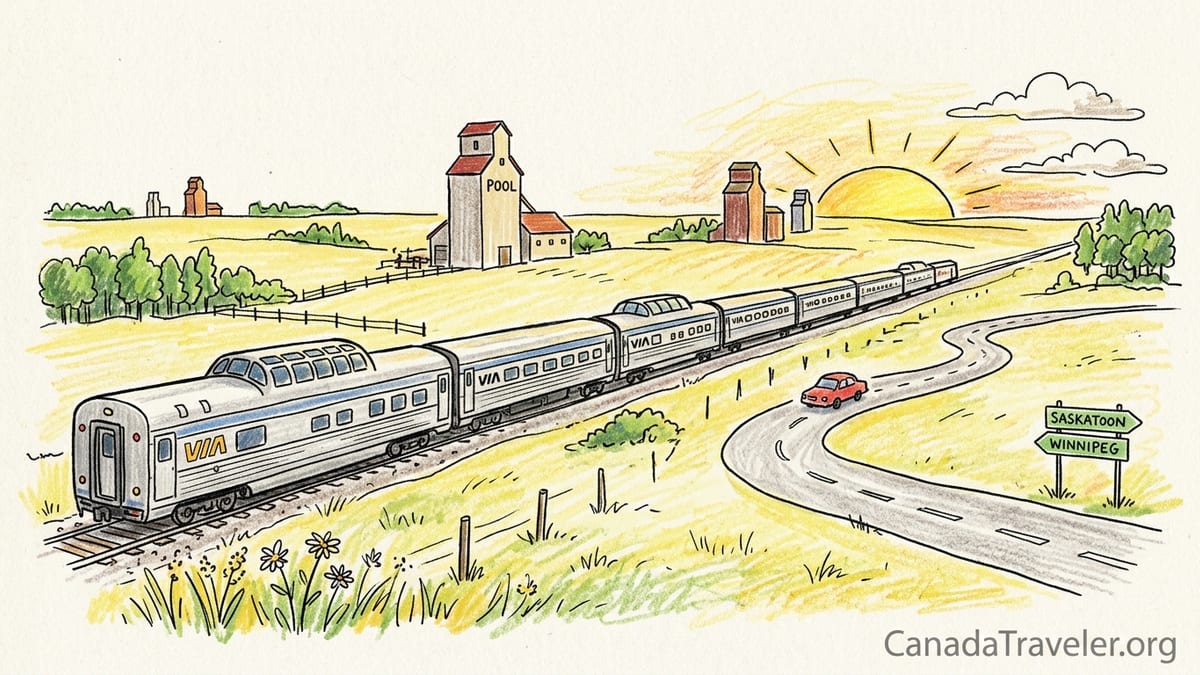
Across the flatlands, the Canadian passes a string of agricultural towns, grain elevators and wetlands, with scenery that feels subtle rather than dramatic. You are unlikely to get the postcard Rockies views on this segment, but you do get a powerful sense of scale, especially from the dome cars. Fields of canola in July, stubble fields in October and endless snowfields in January all offer very different moods of the same landscape.
Because the Canadian serves a mix of long-haul passengers and people traveling between prairie cities, the onboard atmosphere can be a blend of backpackers, retirees on “bucket list” journeys, and local residents moving between communities. Winnipeg and Saskatoon are not just rail stops but practical city gateways, each with airports, major highways and multiple car-rental options, which makes them ideal pivot points for combining train and road travel.
The Winnipeg–Saskatoon–Edmonton Corridor in Practice
On the westbound schedule, the Canadian typically leaves Winnipeg in the evening and is planned to arrive in Saskatoon the following morning, continuing to Edmonton later that day or evening. Eastbound, it reverses this pattern, giving you the option of boarding in Saskatoon in the evening and waking up somewhere in Manitoba the next morning. Actual times vary by season and timetable update, but the key pattern is that this is an overnight-or-mostly-overnight link, not a quick daytime hop.
Frequency is limited. At the time of writing, the Canadian usually runs two departures per week in each direction through Winnipeg, Saskatoon and Edmonton. This is far less than a typical intercity rail corridor, and it has real consequences for planning. If you miss your train in Saskatoon, you may be stuck for three or four days before the next departure, unless you switch to bus or plane. When designing an itinerary, build around the specific days the train runs, rather than trying to fit the train into a fixed daily schedule.
As an example, if you want to travel from Winnipeg to Saskatoon and then continue to Edmonton, you might board an evening departure from Winnipeg on a Thursday, arrive in Saskatoon on Friday morning, spend two or three nights in the city exploring the riverfront and Wanuskewin Heritage Park, and then board the next westbound departure on Sunday or Monday to reach Edmonton. If you try to force a single-night stopover when the train only runs twice a week, you can end up stranded or forced into expensive last-minute flights.
Beyond Edmonton, the Canadian continues to Jasper and the Rockies, so the Winnipeg–Saskatoon–Edmonton segment often forms the middle of a longer cross-country journey. Some travelers fly into Winnipeg, take the train to Edmonton or Jasper, and then pick up a rental car there for the Icefields Parkway to Banff. Others focus on the Prairies themselves, using the Winnipeg–Saskatoon link as an atmospheric overnight leg within a larger Manitoba–Saskatchewan road trip.
Daytime Versus Overnight: What You Actually See
On paper, a 13-hour 20-minute journey between Winnipeg and Saskatoon could be a long day ride with sweeping prairie views. In reality, the train’s schedule and frequent delays mean much of the journey is often spent in darkness, especially in spring and autumn when nights are long. In summer, late sunsets and early sunrises give you more daylight, so you may see broad stretches of Manitoba wetlands, small prairie lakes and the gradual transition into central Saskatchewan farmland from the dome car.
If viewing scenery is a priority, consider traveling westbound in mid-summer. Leaving Winnipeg in the evening, you might still have light for the first couple of hours as the train rolls past small Manitoba communities and grain facilities. At dawn, you could wake up on the Saskatchewan plains, with early sunlight catching the metallic grain elevators and rail yards as you roll toward Saskatoon. The long northern twilight of June and July makes these shoulder hours more rewarding.
Those traveling primarily for transport often appreciate the overnight nature of the run. You board after dinner in Winnipeg, settle into an Economy seat or sleeper cabin, and wake up within a taxi ride of downtown Saskatoon. This can save you the cost of a hotel night, particularly if you choose Sleeper Plus, where your fare includes berths or private cabins and full meals. However, if freight delays push arrival into late morning or early afternoon, you can still end up losing a chunk of your day, which matters if you have tours or meetings scheduled.
Eastbound trips share similar tradeoffs. Board in Saskatoon in the evening and you may reach Winnipeg around breakfast time, with a real possibility of being a few hours behind schedule. For those catching flights from Winnipeg Richardson International Airport, this makes same-day flight connections risky. Many experienced travelers schedule one buffer night in Winnipeg on either end of their prairie train segment, using the time to visit The Forks or the Canadian Museum for Human Rights rather than stressing about missed connections.
Economy Versus Sleeper: Which Class Works on the Prairies
The Canadian offers three broad accommodation types: Economy class reclining seats, Sleeper Plus class with berths or private cabins, and Prestige class luxury cabins on select departures. On prairie segments, most budget-conscious travelers choose between Economy and Sleeper Plus, as Prestige is typically priced like a high-end cruise and makes more sense for those doing the full Toronto–Vancouver run.
Economy seats on the Canadian are more spacious than typical airline economy, with significant recline and legroom, power outlets and access to a shared lounge or Skyline dome car. You can buy meals and snacks at the onboard café or, on some departures, pay separately for dining car meals if space allows. For a single overnight between Winnipeg and Saskatoon, some travelers compare the experience to a long-haul overnight bus, but with more space, better views and the ability to stretch your legs in the dome.
Sleeper Plus includes semi-private upper and lower berths in open sections or private cabins with doors and beds that fold down at night. Fares include meals in the dining car, access to showers and usually priority access to dome and lounge cars. For a Winnipeg–Saskatoon or Saskatoon–Edmonton segment, a single overnight in a lower berth or small cabin can transform the journey from a long night in a reclining seat to something more like a moving boutique hotel, especially if you are continuing onward for several nights toward the Rockies.
Prices vary by season and demand, but it is common to see Economy advance-purchase fares for a Winnipeg–Saskatoon segment in the low hundreds of Canadian dollars, with Sleeper Plus costing several hundred dollars more per person. Travelers often do a value comparison against one hotel night plus restaurant meals. If you would otherwise spend, for example, 180 Canadian dollars on a midrange hotel and 80 dollars on dinner and breakfast for two, a moderate premium for Sleeper Plus that includes bed and meals can feel reasonable, especially when the train ride itself is part of your holiday experience.
Planning Around Limited Departures and Likely Delays
Because the Canadian runs only about twice a week through Winnipeg, Saskatoon and Edmonton, departures shape your entire prairie itinerary. Start planning by checking which days the train actually serves each city in your chosen month, then build hotel reservations, rental car pickups and side trips around those dates. Avoid assuming daily service. Travelers who try to improvise often end up stuck for days in smaller centers or forced into expensive last-minute flights to catch up.
Delays are part of the reality. Freight trains have priority on much of the route, and long-distance VIA Rail services like the Canadian frequently arrive hours late. For a Winnipeg–Saskatoon run, arriving two or three hours behind schedule is not unusual at busy times of year. It is wiser to schedule your first museum visit or guided tour for the afternoon rather than the morning of arrival, and to warn any local hosts that your timing could shift.
One practical strategy is to plan “soft landings” after each rail leg. For instance, if you arrive in Saskatoon in the morning, book a hotel that will store your bags until check-in and plan low-stress activities like walking the Meewasin Valley trail or visiting the Remai Modern art museum rather than time-bound excursions. In Winnipeg, many travelers stay downtown near The Forks or in the Exchange District so that, no matter when the train arrives, they can simply walk or take a short taxi or rideshare to their hotel.
For longer, multi-segment trips, consider using rail for only part of the journey. A traveler might ride the Canadian from Winnipeg to Saskatoon, pick up a rental car to explore rural Saskatchewan, then drop the car in Regina and fly to their next destination. The key is flexibility: with twice-weekly service and a reputation for unhurried timetables, the Canadian rewards those who treat it as an experience around which to build a trip, rather than a precise transportation link to be slotted between close connections.
Combining Rail With Rental Cars in Winnipeg and Saskatoon
Trying to see the Prairies entirely by train and local transit is challenging. Small-town attractions, regional parks and Indigenous cultural sites are often far from rail lines and not well served by buses. A more realistic strategy is to use Winnipeg and Saskatoon as rail-accessible hubs, then add rental cars to reach rural destinations. Both cities have major rental agencies at their airports and, in many cases, downtown locations reachable by short taxi rides from the station.
In Winnipeg, the train station sits near The Forks, south of the Exchange District. Travellers arriving on the Canadian often spend a night or two downtown, then pick up a rental car either from an agency in the central business district or by taking a taxi or rideshare to Winnipeg Richardson International Airport, where national brands like Enterprise, Hertz, Avis and Budget typically maintain fleets. From there, it is straightforward to drive to places such as Riding Mountain National Park, Hecla-Grindstone Provincial Park or small Mennonite communities in southern Manitoba, none of which are easily accessible by rail.
Saskatoon functions in a similar way for Saskatchewan. The VIA station is a few kilometres from downtown, so most passengers use taxis or rideshares into the city. Once in the center, you can rent a car from agencies near the river or at Saskatoon John G. Diefenbaker International Airport. With a vehicle, day trips to Wanuskewin Heritage Park, the lakes north of Prince Albert or the Badlands around Big Muddy become practical. Without a car, reaching these places would require complex combinations of seasonal shuttles, charter tours or very limited intercity buses.
A concrete example: a couple could ride the Canadian overnight from Winnipeg to Saskatoon, spend two nights downtown exploring the riverfront and culinary scene, then pick up a rental car for four days. They might drive north to Prince Albert National Park to hike around Waskesiu Lake, then circle back through small towns like Rosthern and Humboldt before returning the car in Saskatoon and flying onward. The rail segment adds romance and variety to the trip without forcing them to rely on sparse public transit for the rest of their prairie exploration.
Luggage, Comfort and Whether the Train Makes Sense as Transport
VIA Rail allows standard carry-on and checked luggage on the Canadian, similar to airline policies but with more generous weight and size limits in many cases. Economy passengers typically bring one or two pieces into the cabin and can check additional bags for the baggage car, while Sleeper Plus travelers also have access to baggage services and more space in their cabins. For a Winnipeg–Saskatoon segment, many travelers skip checking luggage and keep a medium suitcase and daypack with them, especially if they are continuing directly into a rental car on arrival.
Onboard comfort depends heavily on the class you choose. Overnight in Economy can be manageable if you are used to long-distance buses or red-eye flights, but sleeping in a reclining seat is not for everyone. Earplugs, an eye mask and a travel pillow make a big difference. Sleeper Plus, with beds, showers and dining car meals, turns the journey into part of the holiday rather than a means to an end. Those combining rail with driving often splurge on Sleeper Plus for the overnight segment so they are rested when picking up a car.
As pure transportation between prairie cities, the Canadian is usually slower and less predictable than flying or driving. Driving between Winnipeg and Saskatoon on the Trans-Canada and provincial highways can take around eight to nine hours in good conditions, much shorter than the rail schedule, and flights between the two cities usually take under two hours. The train begins to make sense when you value the experience itself: dome-car views, socializing with other travelers, classic stainless steel rolling stock and the pleasure of watching the Prairies roll past while someone else handles the driving.
A reasonable rule of thumb is to treat the Canadian like a moving hotel and sightseeing platform rather than a commuter service. Use it for one or two strategic overnight segments within a larger trip, budget generously for delays, and avoid planning anything that absolutely depends on the train being on time. If you need to guarantee arrival in Saskatoon for a morning business meeting, fly. If you want to sip coffee in a dome car at sunrise as the Saskatchewan plains wake up, the Canadian is hard to beat.
The Takeaway
Experiencing the Canadian Prairies from VIA Rail’s Canadian between Winnipeg, Saskatoon and Edmonton is about embracing slowness and space. The line runs just a couple of times per week, often overnight, with a scheduled Winnipeg–Saskatoon journey of about 13 hours 20 minutes that can easily stretch longer. If you accept those constraints, the reward is a window into a landscape most travelers simply fly over, from Manitoba’s lakes and wetlands to Saskatchewan’s grain elevators and wide skies.
For most visitors, the smartest approach is to combine a rail segment with rental cars in Winnipeg or Saskatoon rather than trying to remain completely car-free. Use the train as a comfortable, memorable link between major cities, then drive to reach national parks, heritage sites and small-town communities. Consider splurging on Sleeper Plus for overnight legs so you arrive rested and ready to explore, and always allow buffer time in your itinerary to absorb delays.
Ultimately, the Canadian across the Prairies makes the most sense for travelers who value the journey as much as the destination. If your priority is speed or strict punctuality, flying or driving will serve you better. But if the idea of an overnight streamliner crossing the heart of the country appeals, building a Manitoba–Saskatchewan road-and-rail itinerary around VIA Rail’s Canadian can turn a simple transfer into one of the most atmospheric parts of your trip.
FAQ
Q1. How often does VIA Rail’s Canadian run between Winnipeg and Saskatoon?
VIA Rail’s Canadian generally operates about two departures per week in each direction through Winnipeg, Saskatoon and Edmonton, though specific days can vary by season and timetable.
Q2. How long does the Winnipeg to Saskatoon train journey take in reality?
The schedule lists roughly 13 hours 20 minutes, but delays from freight traffic can add several hours, especially in busy seasons, so it is wise not to plan tight connections.
Q3. Is Economy class comfortable enough for an overnight prairie segment?
Economy seats are spacious with good recline and power outlets, but you still sleep in a chair. Many travelers find one overnight manageable with a pillow and eye mask, while others prefer Sleeper Plus for real beds.
Q4. What does Sleeper Plus include on the Winnipeg–Saskatoon route?
Sleeper Plus provides berths or private cabins, bedding, access to showers, meals in the dining car and priority access to dome and lounge cars, turning the train into a moving hotel for the night.
Q5. Can I rely on the train for time-sensitive trips, like catching a same-day flight?
Because delays are common, relying on the Canadian for same-day flight connections is risky. Most travelers plan at least one buffer night in Winnipeg or Saskatoon before important flights or events.
Q6. Is it realistic to explore Manitoba and Saskatchewan completely without a car using only VIA Rail?
In practice it is difficult. Rail service is infrequent and many key parks and rural attractions are far from the tracks, so combining the train with rental cars in Winnipeg or Saskatoon works much better.
Q7. Where can I rent a car after arriving by train in Winnipeg?
Arriving at Winnipeg’s downtown station, you can reach rental counters either at downtown branches or by taking a short taxi or rideshare ride to Winnipeg Richardson International Airport, where several major agencies operate.
Q8. Is the prairie scenery worth doing this section by train?
The scenery is subtle rather than dramatic, but many travelers enjoy watching endless fields, wetlands and small towns roll by from the dome car, especially at sunrise or sunset in summer.
Q9. How far in advance should I book sleeper accommodations?
Sleeper Plus and Prestige cabins can sell out months ahead during peak summer and holiday periods, so booking as early as possible gives you the best chance of securing your preferred date and accommodation type.
Q10. Does it make sense to take only part of the Canadian route instead of the full Toronto–Vancouver journey?
Yes. Many travelers use just one or two segments, such as Winnipeg–Saskatoon or Saskatoon–Edmonton, as part of a broader trip that also includes road travel or flights, gaining the experience without committing to four full days on the train.