

Across the Canadian Prairies, the return of plains bison is one of the great conservation stories of the last century. For travelers, that comeback has created a handful of distinct places where you can reasonably hope to see North America’s largest land animal in landscapes that echo their historic range. From the wide open mixed-grass prairie of Grasslands National Park to the aspen parkland of Prince Albert National Park, the fenced display herd at Riding Mountain and the cultural focus of Wanuskewin near Saskatoon, each destination offers a different way to experience bison on the land.
Free-ranging, Conservation and Managed Herds: What Travelers Should Know
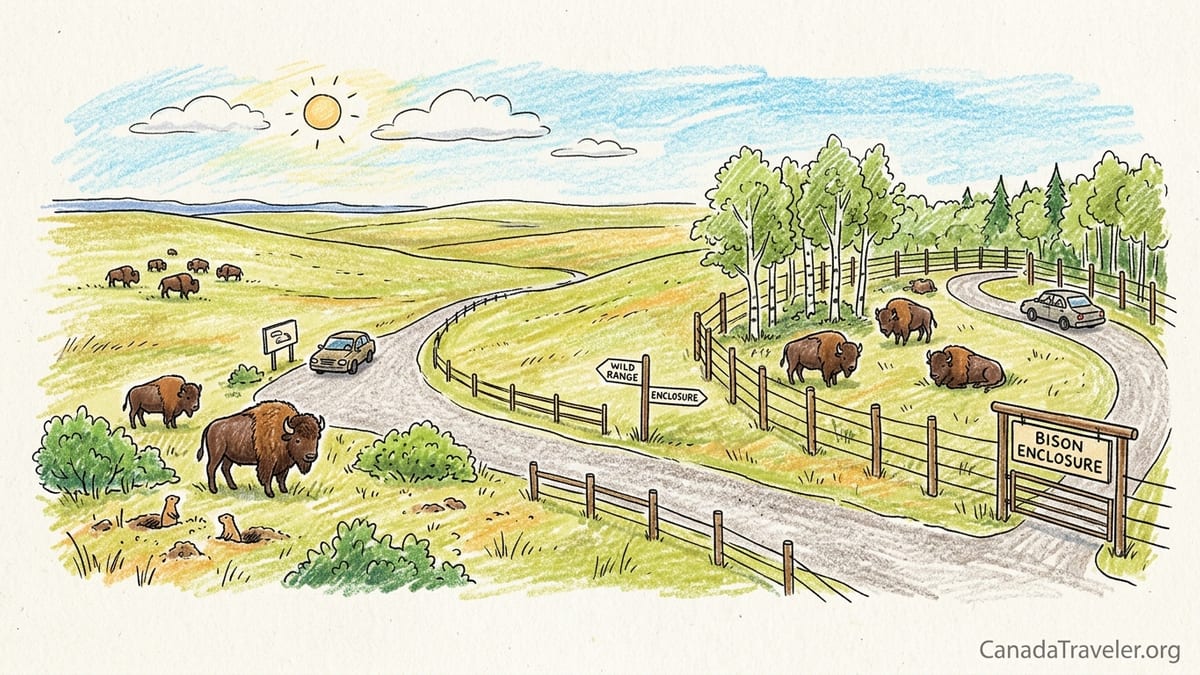
Before choosing where to go, it helps to understand the different types of bison herds you will encounter. In Grasslands National Park in southwest Saskatchewan, plains bison roam freely across a large section of the park’s West Block with no perimeter fence around their range. They are contained only by standard ranch fencing along the park boundary. This is considered a free-ranging conservation herd, restored to native prairie that resembles their historic habitat. You drive gravel roads that cut through their range and may see them grazing on distant hillsides or occasionally right beside the road.
Prince Albert National Park in central Saskatchewan protects the Sturgeon River plains bison herd, which is also free-ranging and wild. Animals move in and out of the southwest corner of the park, crossing unpaved roads and trails used by hikers, horseback riders and local ranchers. Here there is no single viewing paddock or enclosure. Sightings happen on the landscape, particularly in meadow and aspen parkland zones on the park’s west side, where viewing pullouts and signed trailheads make it easier to stop safely.
Riding Mountain National Park in Manitoba offers a different experience. Its Lake Audy Bison Enclosure is a roughly 500 hectare fenced area within the park where a display herd of several dozen plains bison lives year-round. Visitors drive through a gate and follow a looping gravel road inside the enclosure. This is a managed herd: animals are handled in a facility once a year, and numbers are kept at a level that the fenced grassland can support. For travelers, the enclosure design means bison are very likely to be somewhere inside, but their exact location on a given day is not guaranteed.
Near Saskatoon, Wanuskewin is neither a national park nor a wilderness reserve but a cultural and archaeological center in the Opimihaw Creek valley. Its small plains bison herd is intensively managed and fenced, with staff using them to interpret the deep relationship between Northern Plains Indigenous cultures and the animal. You are more likely to view these bison during a guided program, from viewpoints along the trail system, or occasionally from the access road as the herd moves around its pastures.
Grasslands National Park: Wide Horizons and Wild Prairie
If your dream is to watch bison strung out across a vast horizon of native prairie, Grasslands National Park is the standout choice. The West Block, accessible from the town of Val Marie, contains the main free-ranging bison herd. The paved access road turns to gravel past the park gate and continues as the Ecotour Scenic Drive. Pullouts along this loop look over the Frenchman River Valley, and it is common to scan the slopes with binoculars and pick out small groups of bison grazing or resting in the distance. On cool spring evenings in May and June, visitors sometimes find bison only a few hundred metres from their campsite at Frenchman Valley, particularly near the coulees that hold early green grass.
Hiking adds another dimension. Short interpretive walks such as the Eagle Butte or Two Trees trails cross open prairie where fresh bison tracks, dung and wallows are part of the experience even if the animals themselves stay over the next rise. On longer routes, like the 70 Mile Butte area, it is possible to encounter the herd while cresting a ridge. Park staff recommend giving these animals a very wide berth on foot. Turning around to contour well away from a group is not only acceptable but often the safest and least disruptive option.
Timing can make a noticeable difference here. In July and August, midday heat often sends bison to lower, breezier ground or into coulees where they can be hard to see from the road. Early morning and late afternoon, when the light is soft and temperatures drop, are prime viewing windows. Travelers who plan to be out on the Ecotour Drive around 8 a.m. or late in the golden hour often report their best sightings, sometimes of large mixed groups with cows, calves and bulls spread across the same hillside.
Grasslands also offers a strong supporting cast of prairie wildlife. Black-tailed prairie dog colonies line sections of the Ecotour route, and it is common to watch a bison herd grazing slowly past a bustling town of chirping prairie dogs. Pronghorn sometimes appear along Highway 18 on the way in, and ferruginous hawks and golden eagles patrol the valley. If your priority is a feeling of wild prairie and the possibility of seeing bison as part of a larger intact ecosystem, this park delivers that experience better than any other site in this guide.
Prince Albert National Park: Bison in Aspen Parkland
Prince Albert National Park sits at the transition between boreal forest and aspen parkland, and its Sturgeon River plains bison herd is one of the few free-ranging populations in Canada that still share the landscape with native predators such as wolves and black bears. For visitors, that means bison are more spread out than at Grasslands and can be harder to predict, but seeing a small group appear in a meadow backed by mixed forest can feel especially wild. The main access for bison viewing is on the park’s west side, reached by driving gravel roads from the town of Big River or from the southern boundary near the community of Spruce Home.
Parks Canada signage typically directs drivers toward the Valleyview Trail Network and nearby meadows, where pullouts allow you to park safely and scan the landscape. Unlike the Lake Audy enclosure or Wanuskewin’s fenced pastures, there is no gate separating you from the animals here. In late summer, when cows and calves gather in larger groups, visitors sometimes encounter 30 or more animals crossing a side road or grazing in a low-lying hay meadow. Winter visitors who snowshoe or cross-country ski in the same area often notice packed trails and bedding depressions in the snow that show where the herd has recently rested.
Because this herd lives in a mosaic of forest and meadow, your viewing tactics differ slightly from open prairie. The best approach is to treat bison as you might moose or elk in a wooded park: drive slowly, particularly near creek crossings and wet meadows, and watch for dark shapes moving at the edge of the trees. Dawn and dusk are again the most productive times. Travelers who book a cabin or campsite on the park’s west side for two or three nights increase their odds substantially by being in position for those low-light hours rather than day-tripping in from Prince Albert city.
Other wildlife can help set expectations. Elk are common in this part of the park, especially in autumn when bulls bugle in the early morning. If you are seeing fresh elk sign and hearing wolves or coyotes at night, you are in the right general neighborhood for bison as well. However, the herd’s size has fluctuated over the past two decades, and sightings are never guaranteed. For photographers willing to invest time hiking the Valleyview trails and adjacent routes such as Valleyview A and B, the reward can be intimate telephoto images of bison feeding among aspen groves or standing in frost-covered meadows on cold October mornings.
Riding Mountain National Park: Easy Access at Lake Audy
For travelers who value reliable access and straightforward logistics over a completely wild setting, Riding Mountain National Park in western Manitoba is an appealing choice. The Lake Audy Bison Enclosure lies about an hour’s drive from the park’s main Wasagaming townsite. After turning off Highway 10, visitors follow Lake Audy Road, initially paved and then gravel, until they reach a signed entrance with cattle guards and informational panels. Beyond the gate, a narrow gravel loop road winds through rough fescue prairie and light aspen, with several pullouts where you can stop and look for the herd.
The enclosure usually holds a display herd of a few dozen plains bison. They are free to roam within this fenced landscape, which is divided into summer and winter pastures that park staff switch seasonally to manage grazing. On many summer afternoons, visitors driving the loop will see bison within a few hundred metres of the road, sometimes even blocking it. On other days, especially during hot, buggy weather, the animals may retreat to low-lying shade that is not visible from the vehicle track. It is entirely possible to complete a slow loop in an hour and leave without a sighting, although most visitors who time their trip for early evening or a cool, overcast day report success.
The key advantage for families and casual visitors is that you can experience bison here without committing to long drives on remote gravel roads or full-day hikes. A common pattern is to spend the day enjoying Clear Lake’s beaches or the cafés in Wasagaming, then drive out to Lake Audy in late afternoon with a picnic dinner. If bison are near the road, you can watch them safely from your vehicle, then continue to the nearby lakeshore campground or return to town after sunset. Because the access road and enclosure loop are suitable for standard two-wheel-drive vehicles in dry conditions, this is one of the easiest ways in the Prairies to add bison viewing to a broader park holiday that might also include cycling, paddling and elk watching.
Riding Mountain’s surroundings add to the appeal. White-tailed deer are abundant, and black bears are occasionally seen along the Lake Audy Road in spring. Beaver ponds and waterfowl near the lake offer good stops for binocular users. This mix of gentle infrastructure and semi-wild setting makes Lake Audy an especially good option for travelers with young children or those who prefer to stay close to their car while still feeling that they are on a genuine wildlife outing.
Wanuskewin: Bison and Culture Near the City
Wanuskewin, just north of Saskatoon, is the most accessible place in this guide for visitors who are short on time or traveling without a car capable of long gravel-road drives. The heritage park sits on the rim and valley of Opimihaw Creek, overlooking the South Saskatchewan River, and has long been an important gathering and hunting area for Northern Plains Indigenous peoples. Its plains bison herd, reintroduced to the landscape in 2019 using animals sourced in part from Grasslands National Park and other conservation herds, lives in fenced pastures that are integrated into a 7 kilometre trail system.
Visitors typically begin at the interpretive centre, where exhibits explain the cultural, spiritual and practical importance of bison. From there, easy walking trails lead down into the valley. Along the way, viewpoints look over grassland benches and coulees where the bison herd often grazes. Because the animals are managed closely and occupy a smaller area than in the national parks, the chances of seeing them during a half-day visit are relatively high. Staff-led programs, sometimes branded as bison walks or herd-focused tours, further increase those odds by timing outings for parts of the day when the animals are most active.
Wanuskewin is not primarily a wildlife destination. Instead, it is the place where you are most likely to come away with a deeper understanding of how central bison were, and are, to the cultures of Cree, Saulteaux, Dakota and other Indigenous nations. On a typical visit, you might watch a short presentation on bison hunting techniques at a reconstructed buffalo jump, then step outside to see modern bison grazing along the same valley slopes. For many travelers, pairing Wanuskewin with a longer trip to Grasslands or Prince Albert creates a powerful narrative thread that connects cultural story and ecological restoration.
Because the park is only a short drive from Saskatoon’s hotels and airport, it works well as either a first-day introduction or a final stop before flying home. It also suits shoulder-season visits when remote prairie roads might be muddy or when national park campgrounds are closed. Snow-packed trails and crisp air in December or March can make winter visits particularly memorable as long as you dress for the conditions.
Safe Viewing Distances, Roads, Hiking and Realistic Sightings
Across all four destinations, safety around bison is non-negotiable. These animals may look docile, but they can accelerate quickly and are capable of injuring or killing people who approach too closely. In practical terms, that means staying at least 100 metres away on foot in open terrain whenever possible. In Grasslands and Prince Albert, where you may encounter bison while hiking, park staff advise detouring widely around any group and avoiding walking into gullies or dense shrubs where your line of sight is limited. If animals are on or very near a trail, it is safer to backtrack than to try to push through.
From vehicles, a more modest buffer can work as long as you remain inside the car or truck. At Lake Audy, for example, bison sometimes stand right beside the enclosure road. Drivers are expected to stop well back, remain in their vehicles and allow animals to move off on their own schedule. Rolling down a window for photographs is fine, but stepping out for a closer shot or allowing children to sit on the door frame is both unsafe and against park regulations. In Wanuskewin, fences add an extra layer of security, but visitors are still asked not to climb or lean over barriers to get closer photos.
Road conditions and trail types also shape the experience. Grasslands’ Ecotour Scenic Drive is gravel and can develop washboard and potholes; after heavy rain, sections may be temporarily closed. A typical visitor in a rental sedan from Regina or Saskatoon will want to slow down and allow extra time for the loop rather than trying to rush it. Prince Albert’s west-side access roads vary from well-graded gravel to narrower, occasionally muddy tracks. Calling ahead to a park information office can help you decide whether a compact car is sufficient or if you should consider something with higher clearance.
When it comes to realistic expectations, a rule of thumb is that fenced or intensively managed herds offer higher odds of a sighting in a short time. Someone who drives to Wanuskewin for a morning visit or loops through the Lake Audy enclosure at peak season stands a strong chance of seeing bison on a single outing. Free-ranging herds, by contrast, reward time and flexibility. A traveler who dedicates two or three days to Grasslands or the west side of Prince Albert, staying in or near the park and heading out at dawn and dusk, may see bison repeatedly and in more natural behaviors, from wallowing in dust patches to interacting with coyotes and prairie dogs. Those same herds can remain elusive to someone who drives through once at noon and leaves after an hour.
Choosing the Right Destination for Your Prairie Wildlife Trip
Each of these four locations has a distinct personality, and matching that character to your travel style will make your bison experience more satisfying. Grasslands National Park is the choice for travelers who crave big skies, remote drives and a sense of solitude. You are likely to spend long stretches on gravel roads with no other vehicles in sight, scanning vast hillsides where bison look like dark commas on the grass. Camping in Frenchman Valley or Rock Creek campgrounds puts you under exceptionally dark night skies, which can turn bison watching by day into stargazing by night.
Prince Albert National Park suits those who want a blend of lakeside amenities and wilder forays. The main townsite at Waskesiu has lodges, restaurants and rental kayaks, while the west side offers rustic backroads and a realistic chance of seeing truly wild bison that share the landscape with wolves and elk. A sample itinerary might involve spending one day on the main lakes, then devoting another to driving and hiking in the Valleyview area in search of the Sturgeon River herd.
Riding Mountain could be described as the family-friendly middle ground. You can book a cabin or motel around Clear Lake, cycle quiet roads, and finish the day with an evening drive to the Lake Audy Bison Enclosure. The fenced herd and loop road keep logistics simple, and the drive time from Winnipeg is manageable for a weekend trip. Travelers who are new to wildlife viewing or nervous about hiking in areas with large animals often appreciate being able to see bison from the security of a vehicle almost the entire time.
Wanuskewin fits best as an add-on or gateway experience. A business traveler with a free afternoon in Saskatoon can rent a car or taxi out to the heritage park, walk the trails, join a guided program focused on the herd and be back in the city for dinner. Families on a cross-Canada road trip who may not make it to the more remote parks can still give children a meaningful, close-to-the-city bison encounter while also introducing them to Indigenous history, archeology and art. In every case, keeping bison as the central draw while appreciating the broader prairie ecosystem will make your trip feel richer and more connected.
The Takeaway
Bison are once again shaping pieces of the Canadian Prairies, and travelers have a rare chance to see that story unfold on the ground. Grasslands and Prince Albert offer free-ranging herds in landscapes that feel genuinely wild, but reward patience and repeated dawn and dusk outings. Riding Mountain’s Lake Audy enclosure and Wanuskewin’s cultural herd trade some of that wildness for convenience and higher odds of a quick sighting, making them ideal for families, first-time wildlife watchers and time-pressed visitors.
Whichever destination you choose, planning for safe viewing distances, realistic driving times and flexible daily schedules will matter more than chasing any particular photograph or checklist. Bring binoculars, give these powerful animals the space they need, and let the rhythm of prairie light and weather guide your days. The moment when a line of bison crests a ridge at sunset or appears unexpectedly along a quiet gravel road tends to come not to those who hurry, but to travelers who have settled into the pace of the grasslands themselves.
FAQ
Q1. How likely am I to see bison in Grasslands National Park?
On a two or three day visit that includes early morning and evening drives on the Ecotour Scenic Drive, most travelers report at least one clear sighting, often at medium distance.
Q2. Is bison viewing at Prince Albert National Park suitable for first-time visitors?
Yes, but it requires more patience than an enclosure. Staying on the park’s west side and planning multiple slow drives and short hikes greatly improves your chances.
Q3. Can I walk near the bison at the Lake Audy Enclosure in Riding Mountain?
No. Visitors are expected to stay in their vehicles while inside the enclosure. You can stop at pullouts, roll down windows and photograph from the car.
Q4. Do I need a four-wheel-drive vehicle for any of these bison destinations?
In dry summer conditions, most visitors manage with a standard two-wheel-drive car. After heavy rain or in spring thaw, higher clearance can be useful on some gravel roads.
Q5. What is the safest distance to keep from bison while hiking?
Aim for at least 100 metres in open terrain, and more if animals show signs of agitation such as pawing, snorting or intense staring. If in doubt, increase your distance.
Q6. When is the best season to plan a bison-focused trip?
Late spring through early autumn offers the best combination of road access and animal activity. May and June are good for seeing calves, while September light can be excellent for photography.
Q7. Are there guided bison tours in these parks?
Guided offerings change year to year, but Wanuskewin often runs bison-focused walks, and Parks Canada occasionally offers ranger-led drives or talks in Grasslands and Riding Mountain.
Q8. What other wildlife might I see while looking for bison?
In Grasslands, expect prairie dogs and pronghorn; in Prince Albert and Riding Mountain, elk, deer and possibly black bears; at Wanuskewin, songbirds and raptors along the valley.
Q9. Can I visit Wanuskewin and still feel I have had a genuine bison experience?
Yes. Although the herd is managed and the setting is close to the city, seeing bison within a culturally significant valley and learning their history can be very powerful.
Q10. How should I prepare for driving prairie gravel roads to see bison?
Fill your fuel tank beforehand, carry water and snacks, check weather and road conditions with park staff, and drive slowly to reduce dust and avoid wildlife collisions.