

The vast skies of the Canadian Prairies stretch over lands where First Nations and Métis peoples have gathered, traded, resisted and revitalized culture for thousands of years. For travelers, Saskatchewan and Manitoba offer not only historic sites and museums but also living Indigenous places, where guided interpretation, language, food, bison and ceremonies are shaped by Indigenous voices. Planning an itinerary around these experiences turns a standard prairie road trip into a deeper encounter with land, story and contemporary community life.
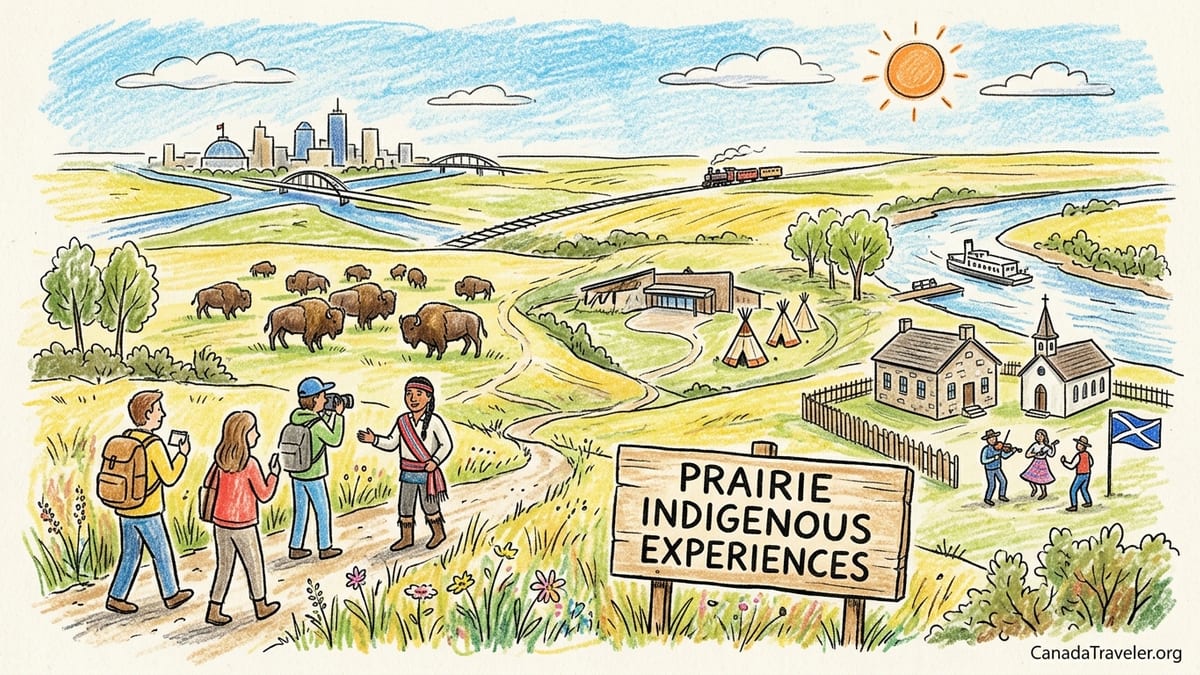
Understanding Indigenous-led Travel in the Prairies
Indigenous travel in the Canadian Prairies is more than ticking off historic sites. It is about choosing experiences where First Nations and Métis people are not just subjects of interpretation but are the interpreters, guides, artists, knowledge keepers and entrepreneurs. In practice, that might mean joining a Cree or Dakota guide on a trail walk at Wanuskewin, taking a Métis-led tour at Batoche, or sitting with an Elder at The Forks in Winnipeg during National Indigenous Peoples Day programming. These experiences foreground living cultures rather than freezing communities in the 19th century.
Many prairie destinations still rely heavily on costumed historical re-enactments that center fur traders and colonial officials. Those can be informative, but travelers increasingly look for spaces where Indigenous perspectives shape what is told and how. At a site like Wanuskewin Heritage Park outside Saskatoon, admission fees help support an Indigenous-led archaeological, cultural and ecological project that includes an active bison herd and ongoing ceremonies. In Winnipeg, The Forks works with Indigenous-led tour operators and community groups to offer language tables, land-based learning and treaty-focused walks that link current issues with 6,000 years of history.
Practical planning begins with understanding the mix of federal Parks Canada sites, Indigenous-run cultural centers and local initiatives. Parks Canada places such as Batoche and Lower Fort Garry now partner with organizations like the Manitoba Métis Federation on programs and access, while independently managed sites like Wanuskewin operate on their own fee structures and event calendars. Checking each site’s current hours, seasonal schedules and special programming before your trip is essential, as offerings can vary significantly between winter and summer.
This guide focuses on four anchor sites: Wanuskewin Heritage Park and Batoche National Historic Site in Saskatchewan, and The Forks and Lower Fort Garry National Historic Site in Manitoba. Along the way, it highlights complementary First Nations and Métis experiences that can be woven into itineraries starting in Saskatoon or Winnipeg, with examples of what you can actually see, taste and do on the ground.
Wanuskewin Heritage Park: Bison, Archaeology and Living Nations
Located just outside Saskatoon, Wanuskewin Heritage Park is an Indigenous-led cultural landscape that layers archaeology, ecology and ceremony. Archaeological digs have identified evidence of occupation stretching back roughly 6,000 years, including bison jumps and campsites used by multiple Northern Plains nations. Today, visitors can walk valley trails that pass tipi rings, ancient drive lanes and the fenced area where plains bison once again graze after their reintroduction in 2019. Seeing bison on land where they historically ran helps many travelers grasp the scale of the grassland ecosystem that supported Indigenous life.
The visitor centre combines gallery exhibits with performance and teaching spaces. A typical visit might include a guided tour focusing on traditional technologies, a talk about petroglyphs that were exposed after bison returned to the valley, and a dance performance that explains the meaning behind men’s traditional, jingle dress or hoop dance regalia. Wanuskewin offers a range of guided and self-guided tours; some are geared to schools, focusing on topics like the role of bison or Indigenous dance, while others welcome independent travelers who want a general introduction to the site. Guided experiences usually run for one to two hours, and many include time outdoors in all but the harshest winter weather.
Food is part of the experience. The on-site restaurant showcases Indigenous-inspired prairie cuisine using ingredients such as bison, wild rice, berries and bannock. A visitor might order bison stew, a wild rice pilaf or a berry-infused dessert while looking out over the Opimihaw Creek valley. The gift shop features art, beadwork and books created by Indigenous artists, which gives travelers a practical way to support local makers beyond the cost of admission. Wanuskewin also hosts seasonal events like winter festivals and special cultural days that bring in additional performers, storytellers and artisans.
As of 2026, general admission is in the mid-teens for adults, with reduced rates for children, students and seniors, plus a flat day-rate for parking. Family passes and memberships that include free parking and discounts in the gift shop and restaurant are popular with locals who return regularly. Advance booking is recommended for guided tours and group programs, especially in summer and around school seasons. For an itinerary, Wanuskewin can easily fill a half day or more from a Saskatoon base: many travelers combine a morning on the trails and in the galleries with lunch on site, then head back into the city for an evening along the South Saskatchewan River.
Batoche National Historic Site and Back to Batoche: Heartland of Métis History
About 90 minutes northeast of Saskatoon, Batoche National Historic Site sits on the banks of the South Saskatchewan River. The community of Batoche was the political and spiritual heart of the Métis resistance in 1885, led by Louis Riel and Gabriel Dumont. Today, the site commemorates both the armed conflict and the enduring Métis community that lived here before and after the battle. Visitors encounter historic buildings like the church of Saint-Antoine-de-Padoue, the rectory and farmsteads, along with interpretive trails that overlook the river and battlefield landscape.
The visitor centre features multimedia presentations about Métis life, the road allowance system, river lot farms and the 1885 Northwest Resistance. Guided tours led by Parks Canada staff often incorporate stories shared by local Métis knowledge keepers, explaining, for example, how fiddle music, jigging and buffalo hunts structured community life. Some programs use sensory experiences like tasting traditional foods, smelling woodsmoke or touching reproduction tools to bring 19th-century Métis households to life. Visitors can also walk self-guided routes along the rifle pits and trenches that show the tactical side of the conflict.
Batoche’s role as a living Métis gathering place is most visible during the annual Back to Batoche festival, typically held in July. For several days, thousands of Métis people and visitors gather for fiddle competitions, jigging contests, traditional foods such as tourtière and bannock burgers, and rodeo events. The festival grounds are adjacent to, but distinct from, the formal Parks Canada historic site, with separate admission and its own rules. While one day you might explore costumed interpretation in the historic village, another day you could sit in the crowd at a jigging competition or watch families camp in tents and RVs decorated with Métis flags and sashes.
Daily admission to the Parks Canada site is modest, with national passes accepted and youth often entering free; fees help maintain trails, buildings and visitor services. During peak summer months, guided tours and some special programs are usually included in admission, but schedules can change year to year, so checking ahead is wise. Outside of festival time, Batoche is quiet and contemplative, and a visit can be comfortably paired with Wanuskewin over two or three days based in Saskatoon or Prince Albert. Travelers interested in Métis history may also look for smaller community museums in nearby towns, or visit river lots and cemeteries where Métis families maintain graves and local histories.
The Forks in Winnipeg: Meeting Place Past and Present
At the junction of the Red and Assiniboine rivers in downtown Winnipeg, The Forks is one of the most accessible Indigenous-linked sites in the Prairies. Archaeological evidence suggests that people have gathered on this ground for more than 6,000 years. Long before fur traders built posts here, the area was a meeting place for Anishinaabe, Cree, Dakota, Nakota, Lakota and later Métis peoples. Today it functions as a mixed-use public space with markets, restaurants, a skate park, museums and seasonal river trails, layered over a National Historic Site with formal interpretive trails and monuments.
For travelers seeking Indigenous-focused experiences, the key is to look beyond the surface of shops and patios. Parks Canada offers self-guided interpretive walks through the national historic site, including a nine-stop tour that highlights Indigenous connections, treaty history and archaeological features. Visitors can stand near the site where Treaty No. 1 was signed in 1871 or spend time in Oodena Celebration Circle, a sunken amphitheatre used for ceremonies and star teachings. The design incorporates stone, earthworks and alignments that invite reflection on the sky and seasons as well as the rivers flowing past.
Several Indigenous-owned or Indigenous-led operators use The Forks as a starting point. A local company might lead a walking tour that explains the Cree name Nestawaya and traces trading routes along the riverbanks, stopping at artworks that reference residential schools or missing and murdered Indigenous women, girls and Two-Spirit people. In summer, community organizations have offered free Indigenous language-learning tables on the grounds, where anyone can drop in to practice basic Ojibwe or Cree phrases after picking up a coffee or ice cream. During National Indigenous Peoples Day every June, The Forks hosts Elders, musicians, dancers and youth for land-based teachings, storytelling circles and craft markets that draw both locals and visitors.
The Forks is free to enter, which makes it a flexible stop on any Winnipeg itinerary. You can arrive on foot from downtown hotels, by bike along the river trails or via public transit. Once on site, most Indigenous-focused programming is either free or low cost, though specialized walking tours or canoe excursions are typically paid experiences. Because events are highly seasonal and often community-driven, it is worth checking the latest calendars for festivals, language tables and guided tours before you travel. Many travelers weave The Forks into multiple days in Winnipeg, returning at different times to experience the site in daylight, at sunset over the rivers and in winter when the Nestaweya River Trail transforms the frozen waterway into a skating and walking route.
Lower Fort Garry and Métis Stories along the Red River
About 30 minutes north of downtown Winnipeg, Lower Fort Garry National Historic Site occupies a bend in the Red River that once served as a key Hudson’s Bay Company administrative and trading post. The stone walls and historic buildings evoke mid-19th-century fur trade society, with costumed interpreters playing the roles of company officials, clerks and laborers. While the original narrative at Lower Fort Garry centered on the colonial side of the story, recent years have seen a stronger focus on treaties, First Nations and Métis experiences and partnerships with Indigenous organizations.
One example is Parks Canada’s collaboration with the Manitoba Métis Federation, under which Métis citizens receive free access to Lower Fort Garry and other selected national historic sites. This recognizes the fort’s role in Métis history and the ongoing presence of Métis communities along the Red River corridor. On site, visitors may encounter interpretation that addresses the signing of Treaty No. 1, the impact of the fur trade on Indigenous communities and the labor of Indigenous women who worked as provisioners, farmers and mediators between cultures. Some tours explicitly invite visitors to reflect on how treaty obligations continue today rather than treating them as events fixed in the 1870s.
Lower Fort Garry offers a blend of guided and self-guided experiences. You might begin in the visitor reception centre, then follow a walking route through the stone fort, warehouse, Big House and surrounding fields, with optional guided programs focusing on topics like the treaty signing ceremony or the daily life of mixed-heritage families. Certain days feature demonstrations of historic skills such as blacksmithing or traditional foodways, though they are framed increasingly in terms of their connections to Indigenous communities rather than as neutral colonial crafts. Admission fees are comparable to other Parks Canada sites, with national passes offering savings for those stringing together multiple places on one trip.
For a Winnipeg-based traveler, Lower Fort Garry can easily pair with The Forks in a single day or weekend. Many visitors spend a morning at the fort, learning about treaty history and fur trade society, then return downtown to explore The Forks’ contemporary Indigenous businesses and events. Driving times are short, but it is essential to check seasonal operating dates: Lower Fort Garry’s full costumed interpretation typically operates in the warmer months, with reduced access or special events in shoulder seasons and winter.
Building a Prairie Route: From Saskatoon to Winnipeg
Designing a route that links Saskatoon and Winnipeg around Indigenous-led and Indigenous-focused experiences is manageable over a week to ten days. One common approach is to start in Saskatoon, spend a full day at Wanuskewin and another at Batoche, then drive east into Manitoba, finishing with several days in Winnipeg anchored by The Forks and Lower Fort Garry. Independent travelers with a rental car or personal vehicle have the most flexibility, as many smaller communities and viewpoints along the way are not well served by public transit.
A sample seven-day itinerary might look like this. Day one and two: stay in Saskatoon, using one day for Wanuskewin and its trails, and another for a drive to Batoche, perhaps with a picnic on the riverbank during a quiet afternoon. Day three and four: travel east along the Yellowhead Highway toward Manitoba, stopping in smaller towns to look for local Indigenous art galleries, community museums or roadside markers that reference treaties and homelands. Day five to seven: base in Winnipeg, alternating between The Forks, Lower Fort Garry and neighborhood visits to Indigenous-run galleries, restaurants and cultural centers.
Throughout, travelers should distinguish between spaces where Indigenous communities are partners with meaningful decision-making power and those that remain largely government or non-Indigenous-run, even if they include some Indigenous content. For instance, Wanuskewin is governed through an Indigenous-led board and advisory circle, with Elders shaping programming and long-term vision. Batoche and Lower Fort Garry are federal sites where Parks Canada increasingly collaborates with Métis and First Nations organizations, but visitors should still listen for whose voices are being foregrounded. In Winnipeg, look for tour companies and shops explicitly owned and operated by Indigenous people, and consider supporting festivals such as Indigenous film or music events when they coincide with your trip.
Budget-wise, this kind of route is relatively accessible compared with many international trips. Individual admissions at sites like Wanuskewin and Parks Canada locations are moderate, with many free or discounted options for youth and in some cases for Indigenous visitors through partnership programs. Travelers can reduce costs by bringing their own snacks or picnics, then choosing one or two meals to invest in Indigenous-inspired dining experiences, whether that is a bison dish at Wanuskewin’s restaurant, a meal at an Indigenous-owned bistro in Winnipeg, or festival food like bannock tacos at Back to Batoche.
Respectful Visiting and Living Cultures
Choosing Indigenous experiences in Saskatchewan and Manitoba is not only about where you go, but how you show up. Many of these sites are active cultural and sometimes ceremonial spaces as well as visitor attractions. At Wanuskewin, for example, the same valley that hosts school groups and international tourists also welcomes ceremonies organized by local First Nations. At Batoche, cemeteries and churchyards remain places of Métis family memory, not simply exhibits. Visitors can show respect by staying on designated paths, asking before photographing people, and listening carefully when guides or signboards explain protocols.
Another crucial distinction is between living cultures and purely historic displays. A costumed interpreter in 19th-century clothing at Lower Fort Garry can be engaging, but the experience becomes more meaningful when it connects to present-day Cree, Anishinaabe or Métis communities rather than leaving them in the past. Conversely, a contemporary jigging competition at Back to Batoche or a language table at The Forks is clearly about cultures that are evolving and flourishing today. Travelers can prioritize experiences that centre contemporary Indigenous voices, such as public talks, art shows, modern music performances or tours led by Indigenous-owned companies.
Supporting Indigenous economies is part of ethical travel. Purchasing beadwork, earrings or prints from Indigenous artists at Wanuskewin’s gift shop, buying books by local Indigenous authors in a Winnipeg bookstore, or choosing a tour with an Indigenous-owned operator at The Forks all direct money into communities that are stewarding culture and land. Tipping guides, paying attention to recommended donation boxes at community events and respecting festival rules at gatherings like Back to Batoche reinforce that these are not merely photo backdrops but living homelands.
Finally, travelers should prepare to engage with difficult histories, including residential schools, dispossession under the Indian Act and the suppression of Métis land rights. At The Forks, treaty-focused tours may address how modern Winnipeg exists because of agreements that were not always honored. At Batoche, interpretation often discusses the aftermath of the 1885 resistance, including land loss and diaspora. Listening with humility, asking thoughtful questions when invited and taking time after your trip to learn more or support Indigenous-led initiatives in your own community can extend the impact of a prairie journey long after you return home.
The Takeaway
Travel across the Canadian Prairies can follow the familiar path of highways, grain elevators and quick city stops, or it can move more slowly through places where Indigenous nations have met, resisted and renewed their cultures for thousands of years. Wanuskewin, Batoche, The Forks and Lower Fort Garry are more than scenic stops: they are entry points into relationships with land, language and community that continue to shape Saskatchewan and Manitoba today.
By prioritizing Indigenous-led and Indigenous-focused experiences, visitors gain a richer understanding of prairie histories and futures. Bison herds grazing again in a Saskatoon valley, Métis fiddles at dusk on the South Saskatchewan River, Elders teaching language at a bustling Winnipeg market and treaty stories told inside stone walls along the Red River all offer windows into living cultures. With a bit of planning, clear respect for local protocols and a willingness to listen, your journey through the heart of the Prairies can become part of a much longer story of connection and return.
FAQ
Q1. Do I need a car to visit Wanuskewin, Batoche, The Forks and Lower Fort Garry?
It is possible to reach The Forks using public transit within Winnipeg, but a car or organized tour is highly recommended for Wanuskewin, Batoche and Lower Fort Garry. These sites are outside city centres, and public transit options are limited or nonexistent, so a rental vehicle provides the most flexibility for a multi-day prairie itinerary.
Q2. How much should I budget for admission to these Indigenous-focused sites?
Admission fees are moderate. Expect adult entry at Wanuskewin to be in the mid-teens in Canadian dollars, with discounts for children, students and seniors. Parks Canada sites like Batoche and Lower Fort Garry charge similar per-day fees, and youth often enter free. The Forks is free to access, although specialized tours and events may have separate costs.
Q3. When is the best time of year to plan an Indigenous-focused prairie trip?
Late spring to early fall offers the widest range of programming, open trails and festivals. Wanuskewin and Batoche have outdoor experiences that are more comfortable in warmer weather, and events like Back to Batoche or National Indigenous Peoples Day activities at The Forks usually happen in summer. Winter travel can still be rewarding, especially in Winnipeg, but some sites operate on reduced hours and with fewer guided tours.
Q4. Are these sites appropriate for children and families?
Yes, all four anchor sites welcome families and offer hands-on activities that work well for children, such as trail walks, interactive exhibits and performances. Wanuskewin’s bison herd and archaeology-themed programming are particularly engaging for kids, while Batoche and Lower Fort Garry often feature costumed interpreters and historic demonstrations that help younger visitors connect with the stories.
Q5. How can I make sure my visit is respectful of Indigenous cultures?
Follow posted guidelines, stay on marked paths, ask permission before taking photos of people and listen carefully to instructions from guides and Elders. Treat ceremonial areas, cemeteries and gathering spaces with the same respect you would give in your own community. Supporting Indigenous-owned businesses and artists, and continuing to learn about the histories you encounter after your trip, are also meaningful ways to show respect.
Q6. Do I need to book guided tours in advance?
Advance booking is strongly recommended for guided tours at Wanuskewin and for specialized experiences at Batoche and Lower Fort Garry, especially during peak summer months and school seasons. Some programs at The Forks, such as language tables or public talks, are drop-in, while others run through tour operators that require reservations. Checking each site’s schedule a few weeks before your trip helps avoid disappointment.
Q7. Are there Indigenous-led food experiences I should seek out?
Yes. Wanuskewin’s on-site restaurant highlights Indigenous-inspired prairie cuisine with dishes featuring bison, wild rice and berries. At festivals like Back to Batoche you can sample Métis comfort foods, while in Winnipeg you can look for Indigenous-owned cafes and restaurants serving bannock-based dishes, game meats and modern takes on traditional recipes.
Q8. How long should I plan to spend at each site?
Plan at least a half day each for Wanuskewin, Batoche, The Forks and Lower Fort Garry to allow time for guided tours, walking trails and unhurried reflection. Many travelers find a full day at Wanuskewin or The Forks rewarding, especially when combining multiple programs, meals and gallery visits. Building in extra time also allows for weather changes and spontaneous conversations with guides or artists.
Q9. Can Indigenous visitors access any special programs or discounts?
Policies vary by site. Some Parks Canada locations, including Lower Fort Garry, offer free access to citizens of specific Indigenous organizations through partnership agreements, and festivals such as Back to Batoche may have community-focused rates. It is best for Indigenous visitors to check current details directly with each site or organization when planning.
Q10. How do these experiences differ from visiting a general history museum?
Many of these sites are located on the exact lands where the histories being discussed took place, and several prioritize interpretation led by Indigenous people themselves. Instead of viewing artifacts behind glass alone, you might walk through a valley used as a bison jump, stand where a treaty was signed, or hear a contemporary Métis fiddler play at a historic river lot. This blend of land, story and living culture sets prairie Indigenous experiences apart from more generic museum visits.