


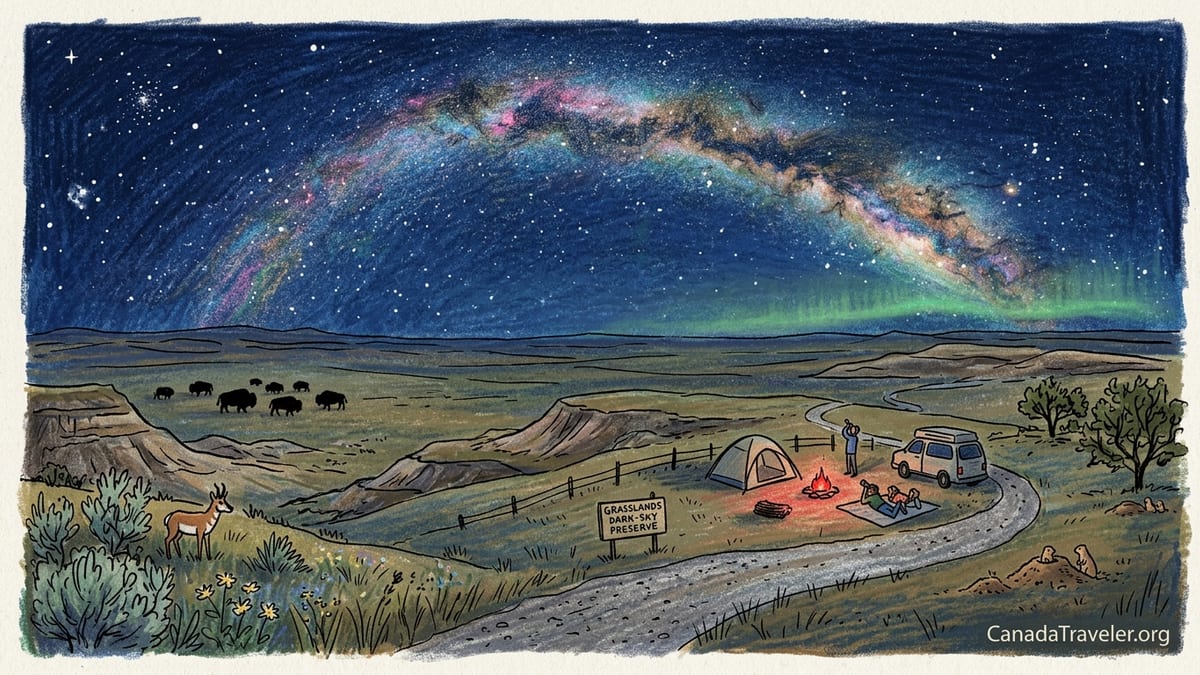
On the Canadian Prairies, the sky is not just scenery. It is the main event. Far from city glare, places like Grasslands National Park in southern Saskatchewan offer some of the darkest, clearest night skies in the country, where the Milky Way looks like spilled milk and even faint constellations leap into focus. For travelers willing to drive a few extra hours down gravel roads and sleep under canvas, the prairies reward with world-class stargazing, powerful encounters with nocturnal wildlife and the rare stillness of a truly dark night.
Why the Canadian Prairies Are a Dark-Sky Goldmine
The Canadian Prairies stretch from Manitoba through Saskatchewan to Alberta, a broad plateau of grassland and farm fields broken by river valleys and badlands. That open geography is exactly what stargazers crave. Trees are low and sparse, horizons are unobstructed in every direction and towns are few, which means minimal light pollution and a sky that feels impossibly wide. On clear nights, you can watch weather fronts sweep in from hundreds of kilometres away and see stars rise and set across a true 360-degree dome.
Saskatchewan in particular has built a reputation for exceptional night skies, thanks to a combination of small population and wide-open spaces. Two of Canada’s official Dark-Sky Preserves sit here, including Grasslands National Park and Cypress Hills Interprovincial Park. Even outside those protected areas, rural skies often feel darker than typical countryside in Europe or the eastern United States, where large urban areas are rarely far away. Travelers who are used to suburban backyard stargazing are often shocked by how many stars appear once they step onto the prairie after sunset.
Another advantage is the prairie climate. Southern Saskatchewan and Alberta are relatively dry compared with coastal regions and central Canada, which translates into a higher number of clear nights during late spring, summer and early autumn. There are no coastal fog banks to worry about, and the land cools quickly after sunset, so transparency can be excellent. You will still have to contend with thunderstorms and passing weather systems, but when conditions align, the view is world-class.
For visitors from the United States, the main prairie dark-sky corridor runs roughly along the Canada–US border from southwestern Manitoba through Saskatchewan into southeastern Alberta and northern Montana. That makes Grasslands and nearby sites quite practical for road trips from cities such as Calgary, Regina or even as a detour from cross-continent drives between the American Midwest and the Rockies.
Grasslands National Park: Canada’s Darkest Dark-Sky Preserve
Grasslands National Park sits in the far south of Saskatchewan near the Montana border, roughly a four-hour drive from Regina and about four and a half from Saskatoon. It was designated an official Dark-Sky Preserve by the Royal Astronomical Society of Canada in 2009 and is widely described by Parks Canada and provincial tourism boards as the darkest dark-sky preserve in the country. With no major towns nearby and very limited artificial lighting inside the park, the night sky here is about as pristine as it gets in southern Canada.
The park is split into two main sections. The West Block, near the village of Val Marie, is more developed and hosts the main visitor centre, front-country campgrounds and a self-drive Ecotour Road through rolling prairie and bison range. The East Block, centred on the Rock Creek Badlands, is wilder and more remote, with dramatic eroded coulees and fewer services. Both blocks provide outstanding dark skies, but many first-time visitors choose the West Block because the infrastructure makes planning simpler, particularly if you are flying into Regina or renting a car.
On a moonless summer night in Grasslands, the sky is bright enough from starlight that your body may cast several overlapping shadows on the ground. Regular visitors talk about clearly seeing their own shadow from the Milky Way itself. Airglow, a faint natural greenish light from the upper atmosphere, is often visible. Under those conditions, familiar constellations such as the Big Dipper become almost hard to pick out against the dense field of background stars, which can be astonishing the first time you experience it.
Despite its remoteness, Grasslands is not completely isolated from basic comforts. The West Block’s Frenchman Valley Campground offers reservable sites, simple washroom facilities and a few oTENTik units, which are semi-permanent canvas-and-wood structures that function like rustic cabins. In East Block, Rock Creek Campground has walk-in tent sites and limited services. The tiny community of Val Marie has a small motel and bed-and-breakfast options, giving less camping-inclined travelers a base within a 15-minute drive of superb dark-sky viewpoints.
Planning for Moon Phases, Milky Way Season and Auroras
Timing is crucial if you want Grasslands and other prairie locations to live up to their dark-sky reputation. The biggest factor is the Moon. For the darkest skies, plan your trip around the new moon or within a few days on either side, when lunar light is minimal. Around full moon, the prairie becomes wonderfully atmospheric in a different way: the land glows silver, the bison and pronghorn are silhouettes against the grass and you can walk without a flashlight, but the Milky Way all but disappears. Check a moon phase calendar for your travel month and try to schedule at least one or two nights when the Moon is below the horizon during prime nighttime hours.
The core of the Milky Way, with its dense star fields and dust lanes, is best seen on the Canadian Prairies between roughly May and September. In May and June, the core rises very late at night or toward dawn, which can mean a chilly wait. July and August offer a better balance, with the Milky Way arching high by midnight and temperatures typically more comfortable, often in the 10 to 18 degree Celsius range overnight. By October, nights are much longer and potentially excellent for astrophotography, but temperatures can drop close to or below freezing, especially on exposed prairie ridges.
The Canadian Prairies also sit within the southern reach of the auroral oval, so northern lights are a real possibility, although not guaranteed on any specific night. In southern Saskatchewan, including Grasslands, you might see a few auroral displays over the northern horizon most months of the year, with stronger storms occasionally pushing overhead. Solar activity runs in approximately 11-year cycles, and during active periods even travelers from the United States can sometimes see bright aurora while camping in the prairies. Because aurora forecasting is a short-term science, check space weather and aurora alerts in the days before your trip, and if the forecast calls for strong geomagnetic activity, try to position yourself with a clear view to the north.
If you cannot align your visit with perfect dark-sky windows, do not abandon the idea. Even a first-quarter moon allows for good stargazing once it sets, and thin cloud bands can make for dramatic long-exposure astrophotography. The key is to understand what kind of night sky you are likely to get on a particular date, adjust your expectations and plan your observing or photography sessions accordingly.
Astrophotography and Night-Sky Viewing in Grasslands
For astrophotographers, Grasslands is the sort of destination that justifies carrying extra gear. The combination of Bortle Class 1 to 2 sky darkness, low humidity and interesting foreground subjects such as eroded buttes, lone trees, fence lines and prairie dog mounds make it a natural outdoor studio. Many visiting photographers bring a full-frame mirrorless or DSLR camera, a sturdy tripod and one or two fast wide-angle lenses in the 14 to 24 millimetre range with apertures of f/2.8 or wider. Typical Milky Way shots might involve exposures of 15 to 25 seconds at ISO 3200 to 6400, but conditions vary, so some on-site experimentation is necessary.
Scouting locations during daylight is extremely helpful. In West Block, popular compositions include the Frenchman River Valley from pullouts along the Ecotour Road, the view near the 70 Mile Butte trailhead and fence lines or old corrals near the campground. In East Block, the Rock Creek Badlands provide dramatic hoodoos and ridges to silhouette against the sky. Because there are few artificial lights, even a single vehicle headlight can ruin a long exposure, so photographers often hike a short distance away from campgrounds to find quieter vantage points.
If you are not focused on photography, you still benefit from these same features. On a clear night, simply lying back on a blanket at a roadside pullout and tracing constellations can be absorbing for hours. Many visitors carry a pair of 8x42 or 10x50 binoculars rather than a telescope. Binoculars are lightweight and versatile, letting you sweep through the rich star fields of the Milky Way in Cygnus or Sagittarius, or pick out the moons of Jupiter and the rings of Saturn without much setup. Phone apps that use your device’s compass to identify constellations can be helpful, but remember to dim your screen or use red-night modes to preserve your night vision.
When photographing or stargazing, red light is your friend. A cheap headlamp with a red LED mode ensures that you can see your gear, but it will not ruin your dark adaptation or disturb nearby observers as much as a bright white beam. Covering a regular flashlight with a few layers of red cellophane is a workable alternative. It is also wise to avoid using camera flash and bright continuous lights around sensitive areas such as prairie dog colonies to reduce stress on wildlife that may already be disoriented by human presence after dark.
Camping, Lodging and Practical Logistics
Although you can technically visit Grasslands National Park on a long day trip, staying overnight is what unlocks its dark-sky potential. Most travelers either camp inside the park or book simple accommodations in nearby prairie towns. At Frenchman Valley Campground in the West Block, you will find drive-in and walk-in tent sites, some with small windbreaks and picnic tables. There are basic washrooms, potable water in peak season and communal fire pits in designated areas, though open fire restrictions can apply during dry spells. Sites can be reserved through Parks Canada’s central system, and it is worth booking well ahead for summer weekends.
If you prefer a soft bed, Val Marie, at the West Block entrance, has a handful of small inns and guesthouses that serve as bases for astronomers and photographers. Rooms are modest but comfortable, with typical late-summer rates often landing somewhere around what you might pay for a budget hotel in a small North American town. These properties sometimes offer early or late check-in flexibility for guests arriving from long drives. From Val Marie, you can be at prime observing locations along the Ecotour Road within 20 to 30 minutes of leaving your room.
In the East Block, Rock Creek Campground is more remote and has fewer amenities. Travelers often bring extra water, a full tank of fuel and backup food, as the nearest full grocery options can be over an hour away. The trade-off is ultra-quiet nights and an even stronger feeling of isolation under the stars. If you are renting a vehicle, a standard car usually suffices in dry conditions, but heavy rain can make some gravel roads muddy and rutted, so keep an eye on weather forecasts and ask park staff about current road conditions before committing to a late-night drive.
Plan your daily schedule around the fact that true astronomical darkness in high summer may not arrive until nearly midnight. Many visitors nap in the late afternoon, cook an early supper, then head out around 10 or 11 p.m. for a first observing session that might run until 2 or 3 a.m. Having warm layers, a thermos of hot drinks and a comfortable camp chair or reclining lounger will make those late hours easier. In shoulder seasons, night arrives earlier, but so does the cold, so a winter-weight sleeping bag and insulated sleeping pad are useful even in September.
Beyond Grasslands: Other Prairie Dark-Sky Destinations
While Grasslands is the anchor for many dark-sky trips, the broader prairie region offers several other excellent night-sky destinations that can be combined into a longer road journey. Cypress Hills Interprovincial Park, straddling the Saskatchewan and Alberta border, is another official Dark-Sky Preserve. Perched on a plateau higher than the surrounding plains, it frequently sits above low-lying haze or thin cloud and offers deep, transparent skies. The mix of open meadows and forested sections gives photographers plenty of foreground variety, and the park regularly hosts astronomy-themed events and star parties.
Farther west, Jasper National Park in Alberta is also a designated Dark-Sky Preserve, though it sits in the foothills and mountains rather than the open prairie. Jasper’s annual dark-sky festival in October draws professional astronomers, speakers and astrophotographers, and the park’s mix of alpine lakes, peaks and dark skies provides different photographic opportunities from the grasslands. For travelers flying into Edmonton or Calgary, a loop that combines Jasper and a prairie dark-sky area such as Cypress Hills or Grasslands can offer a striking contrast between mountain and prairie nightscapes.
In Manitoba, Riding Mountain National Park and surrounding rural areas provide some excellent stargazing, even though they are not yet widely marketed as dark-sky reserves. The park’s rolling hills and lakes give reflections and silhouettes that complement the high, bright Milky Way. Smaller dark-sky friendly communities across the Prairies sometimes host local astronomy club events, so checking regional tourism boards and Royal Astronomical Society of Canada centre pages before your trip can reveal public observing nights that coincide with your itinerary.
Even regular farm country offers surprising night-sky opportunities if you are willing to drive a bit beyond major towns. Many prairie roads see almost no traffic after dark, and small municipal campgrounds or roadside rest areas can be quiet observing spots, provided you respect private property and avoid shining lights toward farmhouses. In all cases, the ethos is the same: seek a place with an unobstructed view in at least one direction, limit white light use and let your eyes slowly adjust to the darkness while the prairie sky reveals itself.
Weather, Light Pollution and Night-Time Wildlife Safety
Prairie weather can be both a gift and a challenge for stargazers. Summer days are often hot and dry, but late afternoon can bring towering thunderclouds that roll across the flatlands with impressive speed. A storm that looks distant at dusk can reach your campsite sooner than expected, so always have a backup plan for shelter and avoid wandering far from your vehicle when forecasts mention severe weather. The good news is that many storm systems pass through quickly, and a dramatic lightning show can be followed by crystal-clear skies once the front moves on.
From a light-pollution perspective, the prairies shine precisely because there is so little development. In much of Grasslands, the nearest significant town lights are well over 100 kilometres away, so the sky brightness is set mostly by natural airglow and starlight. This is markedly different from many suburban dark-sky parks where distant domes of light from nearby cities still brighten the horizon. To preserve that darkness, Parks Canada keeps exterior lighting minimal and encourages visitors to shield or switch off unnecessary lights. When you are in camp, try to use red-light headlamps, keep lanterns dim and avoid pointing lights upward.
Wildlife safety is an important part of any prairie night-sky trip. Grasslands and similar parks are home to plains bison, pronghorn, coyotes, badgers, rattlesnakes and a variety of nocturnal rodents and birds. Encounters with bison are rare at night if you remain near roads and designated areas, but it is wise to give any large animal a very wide berth. Never approach for a photograph, and remember that even seemingly calm animals can move quickly. Rattlesnakes prefer rocky outcrops and warm areas near burrows, so use a headlamp while walking, especially on warm evenings, and listen for any warning rattle before placing hands or feet where you cannot see.
Camping in bear country always requires standard food safety, though in the core mixed-grass prairie of Grasslands black bear encounters are less common than in forested parks. Store all scented items, including toiletries and cooking gear, in your vehicle or designated storage lockers, and avoid leaving food scraps or garbage around your campsite. Coyotes and smaller scavengers will happily raid any accessible food, and unprotected trash bags can quickly blow open in a prairie wind. Respecting wildlife does more than protect you; it keeps animals from associating humans with food and helps maintain the park’s relatively wild character.
The Takeaway
Stargazing in the Canadian Prairies is not just about ticking off constellations or capturing a sharp Milky Way shot. It is about letting an enormous sky recalibrate your sense of scale. In places like Grasslands National Park, where artificial light has been deliberately kept at bay, night returns to something closer to its original form. The experience can be quietly profound, especially for urban travelers who have never seen a truly dark sky.
Planning a successful trip means paying attention to a few key variables: moon phases, seasonal weather patterns, road conditions and wildlife safety. Build your itinerary around at least one or two moonless nights, prepare for cool late-night temperatures even in midsummer, and give yourself flexibility to chase clear skies between Grasslands and other prairie dark-sky locations like Cypress Hills or Jasper. With that groundwork in place, the rest is simple patience: find a spot, turn off the lights, and let your eyes adjust.
Whether you are a serious astrophotographer hauling wide-angle lenses, a family unrolling sleeping bags for a first camping trip or a road-tripper detouring from the Trans-Canada Highway, the prairie sky will meet you halfway. It is a destination in its own right, a living planetarium whose shows change from hour to hour and season to season. Under that canopy of stars, the gravel roads and grassland ridges of the Canadian Prairies become one of North America’s most rewarding night-sky playgrounds.
FAQ
Q1. When is the best time of year to visit Grasslands National Park for stargazing?
The prime season runs from roughly May to September, when nights are comfortably cool rather than bitterly cold and the Milky Way core is visible for much of the night. Shoulder months like April and October can offer longer dark hours and fewer crowds but require warmer clothing and more flexibility for cold snaps or early snow.
Q2. How many nights should I plan for a dark-sky trip in the prairies?
Two to three nights is a good minimum, because weather is unpredictable and you may lose one night to cloud or storms. If you are traveling a long distance, consider four or five nights split between Grasslands and another dark-sky area such as Cypress Hills, which increases your odds of getting at least one or two perfectly clear nights.
Q3. Do I need a telescope to enjoy the night sky in Grasslands?
No, a telescope is optional. The naked-eye view in a Bortle Class 1 or 2 sky is already extraordinary. Many visitors simply bring binoculars, which are cheaper, lighter and easier to use than a telescope. A basic 8x42 or 10x50 pair opens up star clusters, nebulae and the moons of Jupiter without complicated setup.
Q4. Is it safe to walk around at night with wildlife in the area?
It is generally safe if you take basic precautions. Stay on or near roads and marked trails, use a red-light headlamp to see where you are stepping and avoid approaching any animals you spot. Give bison and other large mammals a very wide berth, and be cautious on warm evenings in rocky areas where rattlesnakes may be active.
Q5. What kind of vehicle do I need to visit Grasslands National Park?
In normal dry conditions, a regular car is usually sufficient for main park roads and campgrounds. However, some access roads are gravel, and heavy rain can create muddy or rutted sections. If you are visiting early in the season or after storms, a vehicle with slightly higher clearance can provide extra peace of mind. Always check current road conditions with park staff.
Q6. Can I see the northern lights from Grasslands or other prairie dark-sky sites?
Yes, it is possible though not guaranteed. In southern Saskatchewan and Alberta, aurora often appear as low arcs or curtains along the northern horizon during periods of moderate solar activity. During strong geomagnetic storms, the lights can reach directly overhead. Monitoring short-term aurora forecasts before and during your trip will help you know when to stay up late.
Q7. How cold does it get at night in summer on the prairies?
Summer daytime temperatures can be hot, but nights often cool into the 10 to 18 degree Celsius range. In June and September, it is not unusual for nighttime temperatures to drop toward single digits, especially in exposed areas. Bring more warm layers than you think you need, including a hat, gloves and a windproof jacket.
Q8. Are there guided stargazing programs or events in Grasslands?
During peak season, Parks Canada and local astronomy groups sometimes offer guided night-sky programs, ranging from laser-guided constellation tours to telescope viewing sessions. Schedules change from year to year, so check current programming information before your visit or ask at the visitor centre when you arrive.
Q9. What should I pack specifically for night-sky photography?
In addition to your camera and lenses, pack a sturdy tripod, extra memory cards, fully charged batteries, a remote shutter release or interval timer and a headlamp with red light. Hand warmers, lens cloths and a simple dew shield or lens hood help manage condensation on cool nights. A folding chair or blanket makes waiting between exposures much more comfortable.
Q10. Can I rely on my phone for navigation and star-finding in remote prairie areas?
Your phone can be very helpful, but you should not rely on it exclusively. Download offline maps ahead of time and carry a physical map of the park, because cellular coverage can be patchy away from main roads and towns. For star-finding, astronomy apps are useful, but remember to dim your screen or use a red filter so you do not lose your night vision.