


The spine of the Canadian Rockies between Calgary and Jasper is one of the most rewarding first-time road trips in North America. With a week, you can link Calgary, Banff, Lake Louise, the Icefields Parkway and Jasper without spending every day trapped in the car, and still have room to taste Yoho National Park or Kananaskis Country on the side. This guide lays out a realistic route, explains where it makes sense to sleep, and shows why the Icefields Parkway deserves to be treated as a full-day highlight rather than a simple transfer.
How Long You Really Need in the Canadian Rockies
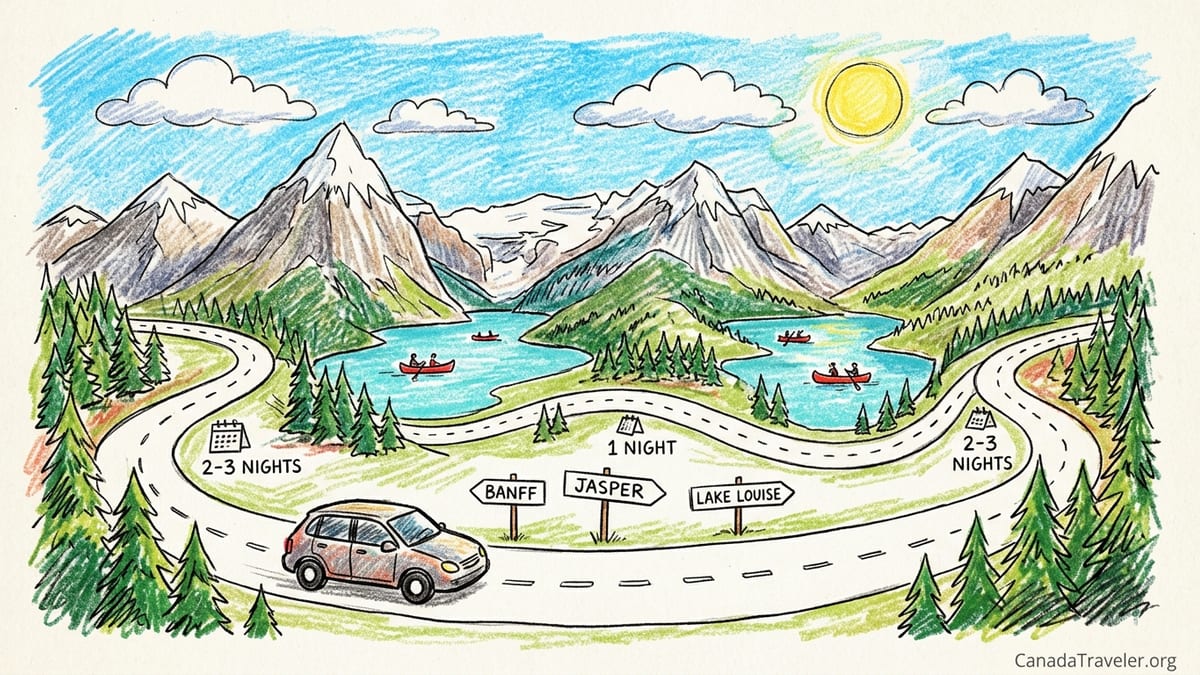
Most current Canadian Rockies trip planning advice clusters around seven days for a first visit. That is enough time to fly into Calgary, spend a couple of nights around Banff, one near Lake Louise, drive the full length of the Icefields Parkway with generous stops, and still enjoy two or three nights in Jasper before flying home. Travelers regularly post one-week sample plans that look like this: arrive in Calgary, drive straight to Banff, day trip to Lake Louise and Moraine Lake on a Parks Canada shuttle, then continue north to Jasper and loop back.
Less than five days almost always means hard choices. You might manage Calgary, one base near Banff or Canmore, a quick look at Lake Louise, and a partial run up the Icefields Parkway before turning around. In practice, that can translate to long driving days where you glance at Peyto Lake from a crowded lookout and rush past Athabasca Falls because you are racing sunlight back to your hotel.
On the other hand, once you push beyond a week, extra nights slot naturally into this same corridor. Ten days lets you add a full Yoho day from Lake Louise and a relaxed Kananaskis overnight near the end of the trip, or simply linger longer in Jasper’s Maligne Lake area without sacrificing rest days. The core rhythm remains similar; you are just unhurried enough to sit beside the lakes instead of photographing them and leaving immediately.
For this guide, the example route assumes about seven days on the ground. Shorter and longer options are folded into each section, so you can trim or stretch without redesigning everything from scratch.
Start in Calgary: Arrival, Jet Lag and First Night
Calgary International Airport is the main gateway for the Rockies, with frequent nonstops from major U.S. hubs like Denver, Dallas and Chicago. For most itineraries focused on Banff, Lake Louise and Jasper, it makes the simplest starting point. Rental car fleets here are substantial in summer, but prices rise quickly around July and August. Booking several months ahead can mean paying the equivalent of around 70 to 100 Canadian dollars per day for a compact car instead of facing bare shelves or only premium SUVs.
Whether to sleep in Calgary the first night is a real decision, not a formality. If you land in the evening after a long-haul flight, take an airport hotel or a downtown room and drive into the mountains the next morning. That turns the 90-minute run to Banff into a pleasant first look at the foothills instead of a white-knuckle jet lag drive. Families with small children often prefer this, using Calgary’s compact downtown or the zoo for a leg-stretch.
If you land before midday, it is realistic to collect your car and go straight to the Rockies. The Trans-Canada Highway is divided and well signed, and many visitors report leaving Calgary around noon and checking into a Banff hotel by mid-afternoon, even with a grocery stop in Canmore. Banff parking can be tight, so consider a hotel that includes parking or plan to use public lots on the edge of town and walk.
Short on time, you can also treat Calgary purely as a transit point. An early flight home from Calgary after a final night in Banff or Canmore still works; you simply leave the mountains at dawn and drive east. For a more relaxed finale, though, one final Calgary night lets you drop the car early, explore restaurants in neighborhoods like Kensington or Inglewood, and head to the airport by taxi the next day.
Banff as Your First Base
For a first trip, two or three nights in or near Banff works well. Banff has the most varied accommodations in the region, from hostels and midrange chain hotels to historic properties with mountain views. Staying here instead of commuting from Calgary every day saves three hours of round-trip driving and puts trailheads and lakes within easy striking distance. Many established itineraries treat Banff as the main hub, with one day on local hikes and viewpoints and another aimed toward Lake Minnewanka or Johnston Canyon.
Plan at least one full day without long drives. A typical example could be riding the Banff gondola up Sulphur Mountain in the morning, walking the boardwalks at the summit, and then soaking in the Banff Upper Hot Springs at day’s end. In summer, travelers often build in time to wander Banff Avenue, where gear shops, bakeries and casual restaurants cluster within a 10-minute walk. Allow room in your schedule for real breaks; a coffee overlooking the Bow River can be as memorable as another rushed hike.
If you prefer quieter evenings, Canmore, just outside the park gate, can stand in for Banff while keeping drive times reasonable. A Canmore condo with a kitchen suits families staying four or five nights. From there, day trips into Banff National Park remain straightforward: roughly 25 minutes to downtown Banff, just under an hour to Lake Louise in light traffic.
With only five total days, many travelers reduce Banff to two nights and use the third night in Lake Louise to cut down backtracking. With more than a week, adding an extra Banff or Canmore night makes sense if you want one big alpine hike such as the Plain of Six Glaciers or Sentinel Pass, since that can absorb most of a day.
Lake Louise as a Launchpad, Plus Yoho or Moraine Lake
Lake Louise is a better place to sleep than it sometimes looks on a map. Moving your base from Banff to Lake Louise for one or two nights cuts the drive to Jasper by about 45 minutes and lets you visit famous lakes early or late in the day, when day-trippers are still on the road. Accommodation here is more limited and usually more expensive, but it pays off in time saved. Even a single overnight can let you walk the lakeshore after dinner, when many tour buses have already left.
Parking around Lake Louise and Moraine Lake is heavily controlled in peak season. Many visitors now use advance-booked shuttles from hubs like the Lake Louise Ski Resort park-and-ride instead of driving to the lakes themselves. A concrete example: rather than circling for parking at 7 a.m., you might park once at the ski hill, ride a timed shuttle to Moraine Lake for sunrise, then connect onward to Lake Louise later in the morning. Build these logistics into your itinerary; a “quick stop” at Moraine Lake can easily stretch into half a day when shuttles and lines are included.
Lake Louise also anchors side trips to Yoho National Park, just across the provincial border in British Columbia. Many one-week road trips thread in Yoho as a single full-day detour: leave early from Lake Louise, drive the short distance over Kicking Horse Pass, visit Emerald Lake and Natural Bridge, and return by late afternoon. In shoulder season, when Moraine Lake roads may be closed, Yoho becomes an especially appealing alternative, offering canyon walks, waterfalls and canoe rentals without adding major driving days.
For travelers with only six or seven nights, folding Yoho into a Lake Louise day is often the most realistic way to see it without sacrificing Jasper time. With ten days or more, some visitors choose a night in Field, the small community inside Yoho, to enjoy evening quiet and early morning trail access before moving on toward Jasper.
The Icefields Parkway: Give It a Full Day
The Icefields Parkway, running roughly 230 kilometers between Lake Louise and Jasper, often appears on maps as a simple line that might be driven in about three and a half hours. In reality, it is one of the world’s most scenic mountain roads and deserves most of a day. Parks Canada itself describes it as a corridor of lakes, glaciers and short walks rather than a highway to rush along. A common first-timer mistake is to schedule a Lake Louise check-out at 10 a.m. and a Jasper dinner reservation at 6 p.m., leaving little time for unplanned stops.
A satisfying day on the Parkway might look like this. Leave Lake Louise by around 8 a.m. and head north, stopping first at Bow Lake to stretch your legs along the shoreline. Continue to the Peyto Lake area, where a short uphill walk brings you to views over its turquoise water. Later in the morning you reach the Columbia Icefield, where some travelers book a combined glacier vehicle tour and skywalk experience, while others prefer to explore the interpretive center and short trails. Each of those options can easily fill two or three hours.
After the Icefield, the character of the drive changes as you follow the headwaters of the Sunwapta and Athabasca rivers toward Jasper. Pullouts at Sunwapta Falls and Athabasca Falls deserve unhurried stops; both have short paths with railings and affordably dramatic canyon views even for non-hikers. Many people find themselves rolling into Jasper early evening, pleasantly tired but not drained, having spent eight or nine hours between the two towns with generous pauses.
There are a few modest services along the route, including gas and simple food near the Saskatchewan River Crossing and at the Columbia Icefield area, but they are spaced far apart and can be costly. Fill your tank before leaving Lake Louise or Banff, carry water and snacks, and accept that this is a day designed for views and short walks rather than restaurant-hopping. If you must fit the Parkway into a half day, consider prioritizing a handful of stops and skipping the long tours, but understand you are compressing one of the Rockies’ essential experiences.
Jasper: Slower Pace at the Far End of the Road
Jasper often feels more laid back than Banff, with fewer large hotels and a town core that travelers describe as less polished but more relaxed. Two or three nights here gives you enough time to explore without rushing back down the Parkway. Many classic seven-day itineraries allocate three nights to Banff and Lake Louise combined, one full day driving the Icefields, and the remaining three nights in Jasper to soak up the quieter vibe before flying home.
From a practical standpoint, basing in Jasper makes day trips to places like Maligne Canyon, Medicine Lake and Maligne Lake straightforward. For example, one day could be devoted almost entirely to Maligne Lake: drive out in the morning, walk parts of the shoreline, and, if budget allows, take a boat tour to the famous Spirit Island viewpoint. Another day could focus on shorter hikes or viewpoints near town, followed by an evening visit to Miette Hot Springs for a soak.
Accommodation in Jasper ranges from simple motels along Connaught Drive to cabins and lodges set slightly outside town. During July and August, budget options book early, and same-day searchers may find only higher-end rooms left. If you value kitchen access, look for “home accommodation” listings where residents rent out suites within their homes. These can offer more space at a price comparable to a standard hotel room.
Travelers who cut Jasper to save time often regret it. While the views along the Icefields Parkway are spectacular, Jasper’s network of lakes, falls and meadows rewards slower mornings and evenings. Even a single extra night here, turning a rush-through into a true base, can shift the tone of the whole trip.
One-Way vs Loop: When to Fly Out of Edmonton
Most first-timers fly in and out of Calgary, creating a simple loop: Calgary to Banff, on to Lake Louise, up the Icefields Parkway to Jasper, then all the way back down to Banff and into Calgary. That last day can be long, sometimes six or more hours including breaks, especially if you stop again at viewpoints you missed on the way north. For some visitors, re-driving the Parkway in the opposite direction is a bonus. For others, it feels like backtracking.
You can reduce that backtracking by flying home from Edmonton instead of returning to Calgary. Jasper is roughly four hours from Edmonton by the Yellowhead Highway in normal conditions, and the scenery, while less dramatic than the Parkway, still reveals foothills and open prairie. In practice, this means your itinerary becomes a straight line: Calgary to Banff, Lake Louise, Icefields Parkway, Jasper, then east to Edmonton for your departing flight.
There are tradeoffs. Rental car companies sometimes charge a one-way drop fee for picking up in Calgary and dropping in Edmonton, though in recent summers the surcharge between these two Alberta cities has often been modest compared with cross-province one-ways. Flight options may also differ: some U.S. cities have more frequent or cheaper connections from Calgary than from Edmonton, which could outweigh the convenience of the one-way drive.
If your total trip is only six nights, sticking with Calgary round-trip may be simplest, especially if you appreciate the chance to revisit a few Icefields stops in different light on your way back. Once you reach eight or nine nights, or if you strongly dislike repeating routes, the Calgary-in, Edmonton-out structure becomes more compelling, saving half a day of driving without sacrificing experiences in the mountains.
Where Kananaskis Fits, and How to Stretch or Shrink the Plan
Kananaskis Country lies south of the main Trans-Canada corridor and offers a quieter set of valleys, lakes and trailheads compared with Banff’s central areas. It fits naturally either at the beginning or end of a Rockies itinerary, using Canmore or Kananaskis Village as a base. Some travelers finish a loop here specifically to unwind after busier days around Lake Louise and Jasper, booking a night that centers on a spa session or an easy lakeside walk instead of another major drive.
For a compact one-week example, a realistic route might look like this: arrive Calgary and sleep in Banff or Canmore, spend a full day around Banff, then move to Lake Louise for one night that includes Moraine Lake or a Yoho detour. Next, drive the Icefields Parkway all day to Jasper for two or three nights, then return south for a final night in Canmore or Kananaskis before proceeding to Calgary and flying home. This keeps most individual drives under four hours, aside from the Icefields day, and avoids constantly changing hotels.
If you have only five nights, consider dropping Kananaskis and possibly trimming Jasper to two nights. The skeleton might become one night Banff or Canmore, one night Lake Louise, one full Icefields day, and two nights Jasper before either driving straight back to Calgary or detouring only briefly into Kananaskis on the return. The tradeoff is less flexibility for bad weather days, so try to keep at least one “floating” half day that can slide between activities as clouds dictate.
With ten or more nights, the same spine supports richer variations. You might add a dedicated Yoho night in Field, a second full Lake Louise day to tackle a longer alpine hike, or an extra Kananaskis stop focused on wildlife viewing and quieter trails. The key is to resist the temptation to bolt on distant destinations such as Revelstoke or Waterton unless you add enough time to account for the extra hours behind the wheel.
The Takeaway
A satisfying first journey through the Canadian Rockies hinges less on how many postcard stops you tick off and more on how you pace the corridor between Calgary and Jasper. Treat Calgary as your practical gateway, Banff as a flexible first base, Lake Louise as a launchpad for lakes and Yoho, the Icefields Parkway as a full-day highlight, and Jasper as your slower finale. Then, if time and energy allow, wrap the trip with a night in Kananaskis or a one-way departure through Edmonton to reduce backtracking.
Within that structure, there is room for all kinds of styles and budgets, from camping and self-catered condos to once-in-a-lifetime lakefront hotels. What matters most is building in unscheduled hours beside the water and on short trails, rather than compressing the region into a frantic series of scenic drive-bys. With realistic drives, well-chosen bases and at least one day devoted entirely to the Icefields Parkway, a week here can feel both rich and remarkably relaxed.
FAQ
Q1. Do I need a rental car for this Canadian Rockies itinerary?
It is possible to piece together buses and shuttles, but a rental car gives you far more flexibility, especially for the Icefields Parkway and early-morning lake visits.
Q2. How many nights should I spend in Banff versus Jasper?
For a week, a common split is three nights between Banff and Lake Louise and three nights in Jasper, with one full day devoted to driving the Icefields Parkway between them.
Q3. Is it better to stay in Banff or Canmore?
Banff puts you closer to many classic sights but can feel busier and pricier, while Canmore is slightly farther out with a quieter feel and more condo-style lodging.
Q4. When should I drive the Icefields Parkway?
Plan to leave Lake Louise or Jasper early and give the entire daylight period to the drive so you can stop freely at lakes, falls and viewpoints without rushing.
Q5. Can I visit Yoho National Park on a one-week trip?
Yes, most travelers fold Yoho into a single full day from Lake Louise, visiting Emerald Lake and nearby viewpoints before returning to their base in the evening.
Q6. Where does Kananaskis fit into a Rockies road trip?
Kananaskis works well at the start or end of your itinerary, usually using Canmore or Kananaskis Village as a base for a quieter night and easier walks.
Q7. Should I fly home from Calgary or Edmonton?
Calgary works well for a simple loop, but flying out of Edmonton from Jasper can reduce backtracking if you prefer not to repeat the Icefields Parkway drive.
Q8. How far in advance should I book accommodation?
In July and August, aim to book key nights in Banff, Lake Louise and Jasper several months ahead, especially if you want specific room types or lake views.
Q9. Do I need to worry about park passes and shuttles?
You will need a Parks Canada pass for national park access, and in peak season many visitors also reserve official shuttles for places like Lake Louise and Moraine Lake.
Q10. Is one week enough for the Canadian Rockies?
One week is enough for a satisfying first visit if you focus on Calgary, Banff, Lake Louise, the Icefields Parkway and Jasper, and avoid adding distant side trips.