


Ask ten travelers whether to spend limited vacation time in the Canadian Rockies or on Vancouver Island and you will likely hear ten confident, contradictory answers. Both regions deliver the essence of Western Canada, yet they feel like different countries: one a cathedral of mountains, glaciers and turquoise lakes, the other a misty coastline of surf beaches, rainforests and whales. With only one major trip to work with, choosing between them becomes a commercial decision as much as an emotional one: where will your time, money and long-haul flight deliver the bigger payoff for the experience you want?
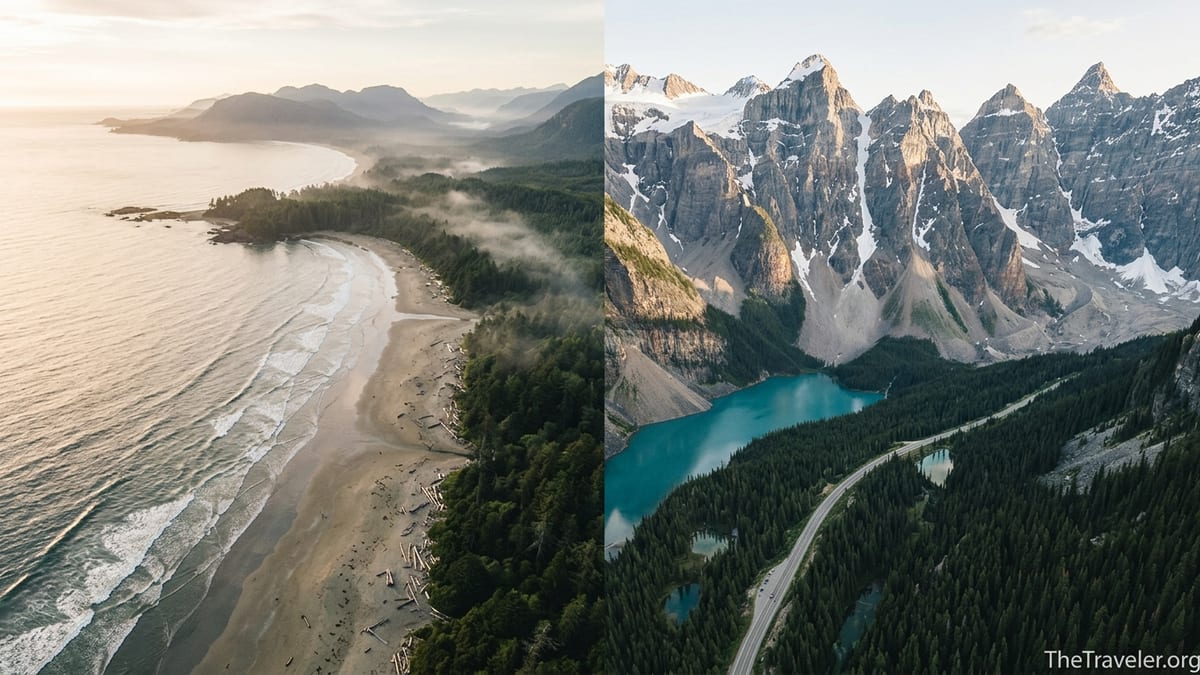
Mountains vs Coast: Two Very Different Western Canada Icons
The Canadian Rockies are the classic Western Canada postcard. Think Banff and Lake Louise in Banff National Park, the Icefields Parkway connecting to Jasper, and Yoho’s vertical peaks just over the British Columbia border. Distances here are measured in valleys and passes, not in bays or islands. You are looking at towering limestone and shale peaks, often snow-streaked even in July, wrapped around glacier-fed lakes like Moraine Lake and Peyto Lake. Roadside viewpoints feel like amphitheatres built for mountain scenery.
Vancouver Island, by contrast, is a long, mountainous island set off the British Columbia coast, yet the experience is more about ocean than summits. The capital city of Victoria faces the Salish Sea; surfers gather around Tofino and Ucluelet on the storm-battered west coast; small communities such as Campbell River and Telegraph Cove look out onto channels where whales and coastal bears roam. There are highlands and even alpine plateaus on the island, but they are framed by driftwood beaches, fishing harbours and fog banks rolling in from the Pacific.
In practice, this means your visual memories will be different. A Rockies trip is likely to be full of switchback drives, chairlifts, turquoise lakes and big, wide U-shaped valleys, with evenings spent in compact mountain towns like Banff or Jasper. A Vancouver Island journey is more about slow coastal highways, long sandy arcs such as Chesterman Beach near Tofino, moss-draped cedars in places like Cathedral Grove, and boats heading out to look for humpbacks, sea lions or black bears flipping rocks at low tide.
For many long-haul visitors, especially first-timers, the Rockies still define Western Canada. If your mental image is the “alpine Canada” seen on calendars and movie backdrops, this is where that picture becomes real. If your dream is closer to wild Pacific beaches, surfing, whales and old-growth forest, Vancouver Island is the more accurate fit.
Weather, Seasons and Trip Length
Seasonality is one of the biggest practical differences between these destinations. The Canadian Rockies have a short, intense peak season for hiking and sightseeing, roughly from late June through September. Outside those months many higher trails remain snowbound, some lakes stay frozen into May, and mountain passes along routes like the Icefields Parkway can see fresh snow well into shoulder seasons. Summer crowds and hotel prices in Banff, Lake Louise and Jasper rise accordingly, especially around Canadian and US holiday periods.
Vancouver Island, influenced by the Pacific, is far milder and more flexible in timing. Victoria can feel surprisingly spring-like in March and April compared with the rest of Canada, with flowers out while the Rockies still deal with snowbanks. The west coast around Tofino is famous both for summer beach weather and for dramatic storm-watching in late autumn and winter. That means you can plan an April or October trip to Vancouver Island and still comfortably hike low-elevation trails, walk beaches and join whale-watching tours, while a Rockies hiking-focused holiday at the same time would be compromised or require winter gear.
Trip length also plays differently in each region. A five to seven day Rockies trip based out of Calgary can comfortably include Banff, Lake Louise and at least part of Jasper or Yoho, especially if you focus on day hikes and scenic drives. The classic loop from Calgary to Banff, up the Icefields Parkway to Jasper and back can be done in a week without feeling frantic, provided you are willing to spend multiple nights in one base and day-trip from there.
Vancouver Island is more stretched out. It is entirely possible to fill a full week and barely see half of it. Many visitors split their time between Victoria and the Pacific Rim region near Tofino and Ucluelet, with a driving day via Nanaimo and the forested interior in between. Add in side trips to places like Parksville and Qualicum Beach, or up to Campbell River for wildlife tours, and you quickly reach ten to fourteen days. You can visit for four or five days and just focus on Victoria plus one additional hub, but you will be skimming the surface of what the island offers.
Wildlife and Nature Highlights
Both regions are rich in wildlife, but the types of encounters differ. In the Canadian Rockies, you are most likely to see elk, deer and mountain goats, with good chances of black bears and occasional grizzlies along roads such as the Bow Valley Parkway or the Icefields Parkway. Bighorn sheep and even moose appear in marshy areas and high passes. National park authorities remind visitors that these are true wild animals living in protected habitat, so wildlife viewing is usually a matter of patient roadside scanning rather than guaranteed tours.
Vancouver Island’s wildlife draws are more coastal and marine. Orcas, humpback whales and gray whales transit the surrounding waters, especially from spring through early autumn. Towns like Victoria, Tofino, Ucluelet, Campbell River and Telegraph Cove support a network of whale-watching and wildlife operators who run half-day or full-day trips to view whales, sea lions, porpoises and sea birds. Black bears are commonly seen foraging along remote shorelines at low tide on guided boat tours, particularly around Clayoquot Sound and the inlets north of Campbell River.
If your dream encounter is a grizzly bear in a wild mountain valley, the Rockies or the central and northern mainland coast reached from them are the better match, although specialized grizzly-viewing tours often depart from places accessible via the island as well. If you want to watch a pod of orcas surfacing with the forested coast as a backdrop, or hear the exhale of a humpback at close range, Vancouver Island is the more reliable bet. In both cases, plan to invest in at least one or two guided experiences rather than relying solely on chance sightings from highways and busy viewpoints.
It is worth remembering that responsible viewing practices are a major part of both destinations. In the Rockies you will see strict rules about keeping distance from elk and bears, especially during calving or berry seasons. Around Vancouver Island, good operators emphasize slow approaches, engine-off drifting and avoiding crowding wildlife, and the most reputable companies highlight their adherence to local regulations and conservation codes in their briefings.
Hiking, Beaches and Active Adventures
For hikers, the Canadian Rockies feel like a vast natural theme park, particularly in summer. Classic day hikes around Lake Louise, Moraine Lake, Yoho’s Emerald Lake, the Sunshine Meadows near Banff, and Jasper’s Maligne Lake or Valley of the Five Lakes provide alpine meadows, larch forests and big summit vistas. Elevation gains can be significant, and popular routes often have steep, rocky sections or lingering snow patches in early season, but the rewards are high. Backpackers gravitate to multi-day trails such as the Skyline near Jasper or the Rockwall in Kootenay National Park, which require careful booking and backcountry permits.
Vancouver Island’s hiking portfolio is more varied in terrain and less dominated by high altitude. The Juan de Fuca Marine Trail and sections of the longer West Coast Trail offer rugged coastal backpacking with beaches, headlands and suspension bridges. Shorter day hikes near Tofino combine forest boardwalks with coastal views, while Cathedral Grove on the route between Parksville and Port Alberni places you among towering old-growth Douglas fir and cedar within minutes of the parking lot. Near Comox and Campbell River, trails climb into subalpine meadows and small lakes, giving a mountain feel without the extreme elevation of the Rockies.
Beaches are where Vancouver Island clearly outshines the interior. Long Beach in Pacific Rim National Park Reserve stretches for kilometres, attracting surfers and beachcombers in equal measure. Closer to Nanaimo, Parksville and Qualicum Beach offer warm, shallow waters in summer that are popular with families. Smaller coves and pebbly inlets fringe the Gulf Islands, reachable by short ferries from the mainland or the island itself. In the Rockies, lakeshores like those at Lake Minnewanka or Two Jack Lake near Banff provide picnic spots, paddleboarding and short shoreline walks, but they do not offer the expansive sand-and-surf experience of the Pacific coast.
Beyond hiking and beach time, both regions are strong for active travelers. In the Rockies you can book guided glacier walks on the Columbia Icefield, whitewater raft the Kicking Horse or Kananaskis rivers, ride gondolas up Sulphur Mountain above Banff or Whistlers Mountain above Jasper, and spend days road cycling or mountain biking. Vancouver Island counters with sea kayaking in sheltered bays, surfing lessons in Tofino, stand-up paddleboarding in calm inlets, plus cycling routes such as the Galloping Goose Trail near Victoria. Your decision comes down to whether you want your adventures framed by alpine or ocean horizons.
Accommodation, Costs and Road Trips
Accommodation style is a practical way to differentiate these trips. In the Canadian Rockies, especially in and around Banff and Jasper, choices range from simple motels and hostels to upscale mountain hotels and historic lodges. Banff Avenue is lined with mid-range properties, while Lake Louise hosts a mix of one premium lakeside property, a handful of smaller hotels and cabins, and a significant campground network. In peak summer you should expect to book many months in advance for the most sought-after spots, and prices rise quickly on weekends and holidays.
On Vancouver Island, lodging runs from urban hotels in Victoria’s Inner Harbour district to relaxed beachfront resorts near Tofino and Ucluelet, marina-side motels in Campbell River, intimate bed-and-breakfasts, and extensive provincial park campgrounds. A family might, for example, split a week between a centrally located hotel in Victoria and a self-catering cabin near Tofino, grocery shopping in small coastal supermarkets and eating at casual seafood places in between. Availability outside July and August is generally better than in the Rockies, and shoulder seasons can offer more competitive rates.
Road-trip logistics also differ. A typical Rockies itinerary for international visitors starts and ends in Calgary, with a rental car picked up at the airport. Distances between hubs are short by North American standards: Calgary to Banff is around 90 minutes, Banff to Lake Louise roughly 45 minutes, and Lake Louise to Jasper along the Icefields Parkway can be comfortably driven in half a day with multiple scenic stops. Fuel, park passes and occasional shuttle buses to popular lakes form the main extras beyond accommodation and food.
Reaching Vancouver Island almost always involves a ferry or a short flight. Many visitors connect through Vancouver, then drive to ferry terminals such as Tsawwassen or Horseshoe Bay to cross to Victoria or Nanaimo. The crossing itself becomes a scenic experience, with coastal mountains and forested islands slipping by. Once on the island, the main driving spine up to Nanaimo and beyond is straightforward, but side roads to surf towns or isolated coves can be narrow, winding and slower than they appear on a map. If you are comparing costs, factor in ferry fares for vehicle and passengers and the extra travel time on either side of the sailing.
Best Choices for Families and Couples
Families often weigh accessibility, ease of days out and variety of activities suitable for different ages. The Canadian Rockies score well for simple logistics: short drives between Banff, Lake Louise and surrounding sights, established picnic areas, family-friendly gondolas and lake-side walks, and the ability to see dramatic scenery without committing young children to long hikes. Gondola rides, lakeside canoe rentals, wildlife drives at dusk and well-developed visitor centres keep days flexible, though costs can add up for larger groups.
Vancouver Island can be equally family friendly, especially if you base yourselves in one or two hubs. A week split between Victoria and Parksville, for example, offers a mix of kid-friendly museums, inner-harbour floatplanes and street performers in the provincial capital, plus shallow sandy beaches and mini-golf or waterparks up-island. In the Pacific Rim area, families with older children gravitate to surf lessons, tide-pooling on rocky shelves at low tide and short rainforest boardwalk trails. Long driving days and ferries require more planning with small children but can also be broken up with playgrounds and beach stops en route.
For couples, the choice is more about mood. Mountain towns like Banff and Jasper lend themselves to evenings in cozy restaurants and hot pools after long hikes, with sunrise lake visits and scenic drives during the day. Romantic splurges might include a lakeside stay near Lake Louise or a heritage lodge in Yoho, coupled with activities such as horseback riding or a private sunrise photography session. On the island, the atmosphere leans toward west-coast casual: beach bonfires where permitted, oceanfront hot tubs at small inns, storm watching from a room overlooking Cox Bay in winter, or leisurely wine tastings at small vineyards on the Saanich Peninsula or Cowichan Valley.
If your idea of a couple’s escape is spa treatments, fine dining and balcony views of mountains and glaciers, the Rockies fit the bill. If it is strolling hand-in-hand along empty beaches at sunset, listening to surf and gulls, then Vancouver Island makes the stronger case. Both regions support elopements and destination weddings, but the aesthetic of the photos will be dramatically different: alpine lakes vs driftwood and surf.
Which Should You Prioritize for a Classic Western Canada Trip?
When pressed to choose just one region for a first Western Canada experience, many repeat visitors lean toward the Canadian Rockies, particularly for travelers coming from overseas or from regions that do not already have high mountains. The scenery packs an immediate punch, and the density of world-famous viewpoints in a relatively small area between Banff and Jasper means every day feels like a highlight reel. With a week and a rental car you can build an itinerary where each drive delivers new peaks, lakes and wildlife, and your photos will unmistakably say “Canada” to anyone who sees them.
Vancouver Island, however, tends to surprise people with how much time it deserves. Those who rush through Victoria in a day on their way to somewhere else often leave feeling they barely sampled the island. Travelers who give it ten days or more, looping through Victoria, Tofino, Ucluelet, perhaps Campbell River or the Gulf Islands, usually describe the experience as slower, more layered and in some ways more relaxing than a peak-season Rockies dash. If you already spend time in mountain environments at home, or if whales, surfing and rainforests are your main draw, prioritizing the island can make perfect sense.
For those with two or more weeks, combining both is ideal. One common pattern is to fly into Calgary, spend six to eight days exploring Banff, Lake Louise, the Icefields Parkway and Jasper, then drive or fly west, connecting through Vancouver to spend another week on Vancouver Island. Commercially packaged itineraries often follow a similar pattern, pairing a Rockies segment with a Vancouver and Victoria add-on or a Pacific Rim extension, because the experiences complement rather than duplicate each other.
If you must choose, frame the decision around your non-negotiables. If the must-see list includes Lake Louise, Moraine Lake, alpine hikes and big mountain passes, the Canadian Rockies should come first. If it includes orcas, long surf beaches, old-growth rainforest and a generally milder climate, Vancouver Island should jump ahead. Both regions repay repeat visits, but only one can be your first impression of Western Canada.
The Takeaway
Viewed purely as a commercial decision about how to spend limited time and travel budget, the Canadian Rockies deliver the most concentrated hit of “iconic Canada” in a short window, especially from June to September. Easy access from Calgary, dense clusters of headline sights and a straightforward network of roads make it simple to build an itinerary where every day feels like a postcard. For many visitors, particularly on a once-in-a-lifetime long-haul trip, this is the region that best matches their expectations of Western Canada.
Vancouver Island, by contrast, is less about box-ticking and more about mood. It stretches out over a longer timeframe, encourages slower travel, and rewards those who linger in small coastal communities, walk the same beach at different tides and revisit rainforest trails in changing light. Its strengths lie in season flexibility, wildlife encounters on the water, beaches and a laid-back Pacific culture that contrasts with the more structured feel of busy mountain national parks.
In the end, neither choice is wrong. The better Western Canada experience is the one that aligns with your priorities. If you want concentrated alpine drama and a route that neatly fits into a one-week or ten-day schedule, start with the Rockies. If you want a gentler climate, ocean horizons, whales and surf, or if you have the time to give the island the ten to fourteen days it deserves, Vancouver Island may well become the place you cannot stop talking about once you get home.
FAQ
Q1. Is it easier to reach the Canadian Rockies or Vancouver Island from overseas?
For most visitors it is slightly easier to reach the Canadian Rockies, as many international flights connect through Calgary and you can be in Banff by rental car in around 90 minutes. Reaching Vancouver Island typically involves flying into Vancouver, then taking a connecting flight or ferry to Victoria or Nanaimo, which adds extra steps and travel time.
Q2. Which destination is better if I only have one week?
If you have just one week, the Canadian Rockies often provide a more efficient itinerary. You can focus on Banff, Lake Louise and possibly part of Jasper without spending long days in transit, and you will see many of the area’s headline sights in a compact loop.
Q3. When is the best time of year to visit the Canadian Rockies?
The most popular period for hiking and general sightseeing in the Canadian Rockies is from late June through September, when most high-elevation trails are snow-free and lakes are fully thawed. Earlier or later trips can still be rewarding but may involve lingering snow, cold nights and limited trail access.
Q4. When is the best time to visit Vancouver Island?
Vancouver Island is flexible almost year-round. Summer from June to September is ideal for beaches and camping, spring and autumn offer good hiking and wildlife viewing with fewer crowds, and winter on the west coast around Tofino attracts visitors for storm watching rather than sunbathing.
Q5. Which place has better wildlife viewing?
It depends on what you want to see. The Canadian Rockies are stronger for roadside sightings of elk, deer, mountain goats and potentially bears, especially in national parks. Vancouver Island excels for marine wildlife such as orcas, humpback whales, gray whales, sea lions and coastal bears viewed from boats.
Q6. Are both destinations suitable for young children?
Yes. In the Rockies, families can enjoy short lake walks, gondola rides and wildlife drives without long hikes. On Vancouver Island, shallow sandy beaches, easy forest boardwalks and relaxed coastal towns work well for children, though you will need to plan around ferry crossings and potentially longer driving days.
Q7. Which region is more budget friendly?
Costs vary widely, but peak-summer accommodation in Banff, Lake Louise and Jasper can be especially high due to limited supply and strong demand. Vancouver Island can also be expensive in July and August, particularly around Tofino, but shoulder seasons often bring more competitive rates. Ferry fares should be factored into island budgets, while park passes and popular attractions add to Rockies costs.
Q8. Can I combine the Canadian Rockies and Vancouver Island in one trip?
Yes, although you will want at least two weeks to do both justice. A common pattern is to start in Calgary for the Rockies, then travel west by car or plane, connect through Vancouver and finish with several days on Vancouver Island before flying home.
Q9. Which destination is better for non-hikers?
Both work well for non-hikers. The Rockies offer easily accessed viewpoints, scenic drives, gondolas and short lakeside strolls, while Vancouver Island provides harbour walks, easy beach access and gentle forest trails. If you prefer more urban and cultural activities alongside nature, Victoria on Vancouver Island offers museums, gardens and dining within a compact walkable city.
Q10. If I have mountains at home, should I still choose the Rockies?
That depends on how different your local mountains are from the Canadian Rockies and on your interests. Travelers from Alpine regions sometimes find Vancouver Island more distinct because of its Pacific coastline, rainforests and marine wildlife. Others still prioritize the Rockies for their unique combination of turquoise lakes, broad valleys and North American wildlife. Consider which landscape feels more special and less familiar to you personally.