


Western Canada’s classic Rockies route from Vancouver to Banff, Lake Louise, the Icefields Parkway and Jasper is one of the world’s great journeys. Whether you have one week, 10 days or a full two weeks, careful planning is essential. Distances are long, accommodations book out months ahead in peak season, and you will need to choose between a flexible rental car road trip, a premium rail journey such as Rocky Mountaineer, or a mix of both.
Key Planning Decisions: Season, Direction and Park Passes
The most popular time to travel between Vancouver, Banff and Jasper is late June through early September, when all mountain roads and trails are usually snow free and services are fully open. This is also the busiest and most expensive period, especially in July and August when hotel rates in Banff, Lake Louise and Jasper often climb well above the Alberta resort average, which has recently hovered around the high 200s in Canadian dollars per night for standard properties, with flagship hotels such as the Fairmont Banff Springs or Fairmont Chateau Lake Louise often exceeding 700 Canadian dollars per night in summer. Shoulder seasons in May, early June and late September can be quieter and a little more affordable, though some activities, such as lake canoe rentals or higher-elevation hikes, may still be limited by lingering snow or ice.
Direction also matters. Many travelers fly into Vancouver, drive or take the train east to the Rockies and then fly home from Calgary, which avoids backtracking and one very long driving day. Others choose a loop, returning to Vancouver via the Okanagan Valley or southern British Columbia. If you prefer rail, Rocky Mountaineer operates daylight-only luxury trains between Vancouver and Banff or Lake Louise on its First Passage to the West route, and between Vancouver and Jasper on its Journey Through the Clouds route, typically from mid April to early October. These trains run only a few days per week in each direction, so your dates will need to align with the schedule.
All visitors to Banff and Jasper national parks aged 18 and over must hold a valid Parks Canada pass for the duration of their stay. In 2026, entry fees are temporarily waived between June 19 and September 7, and camping and some accommodation managed by Parks Canada receives a discount during that period, but a pass is still required outside those dates and parking or municipal fees in places like the town of Banff may still apply. For most international visitors staying more than a few days in the parks, a multi-day or annual Discovery Pass offers better value than buying individual day passes on arrival.
Finally, consider road conditions. The Vancouver to Banff corridor uses major highways such as Highway 1 and Highway 5, which are paved and maintained year-round, but winter conditions can be severe from October through April, with snow, ice and occasional closures due to avalanches or accidents. If you plan a spring or autumn itinerary, allow extra driving time, check road advisories each morning, and book vehicles equipped with appropriate tires. Summer brings relatively straightforward driving, but also construction delays and heavy traffic near popular viewpoints.
Rental Car versus Rail: How to Travel Between Vancouver and the Rockies
For most travelers, a rental car remains the most flexible and cost-effective way to link Vancouver with Banff, Lake Louise, the Icefields Parkway and Jasper. A compact car hired in Vancouver for 7 to 10 days in summer often starts around 70 to 120 Canadian dollars per day before taxes and one-way drop fees. Major agencies such as Enterprise, Hertz, Budget and Avis all operate downtown and airport locations. If you plan to start in Vancouver and finish in Calgary, expect an additional one-way charge that can range from a modest flat fee to several hundred dollars, so compare quotes carefully. Families and groups often find that splitting a standard SUV or minivan, which can cost 130 to 200 Canadian dollars per day in peak season, still works out cheaper than multiple rail tickets plus transfers.
Rail is an entirely different experience. Rocky Mountaineer’s two-day First Passage to the West service between Vancouver and Banff or Lake Louise is a premium, daylight-only journey with hotel overnights in Kamloops. For the 2026 season, entry-level SilverLeaf Service fares from Vancouver to Banff are typically advertised from just over 2,000 Canadian dollars per person, with GoldLeaf Service starting above 3,000 Canadian dollars per person, depending on date and availability. The Journey Through the Clouds route between Vancouver and Jasper is priced in a similar range. These fares include meals, drinks and commentary on board, but you will still need to arrange separate accommodation and transport once you arrive in the Rockies.
A hybrid approach can work well for travelers who want the comfort of rail for the long stretch through British Columbia, but still want driving freedom inside the national parks. One common pattern is to travel eastbound from Vancouver to Banff on Rocky Mountaineer, spend several nights in Banff and Lake Louise, then rent a car in Banff or Calgary to drive the Icefields Parkway to Jasper and on to Edmonton or back to Calgary. Another is to rent a car in Jasper after arriving by rail and drive the parkway south to Lake Louise and Banff, returning the car in Calgary and flying out. This reduces long-distance driving while still preserving flexibility for roadside stops at Peyto Lake, Mistaya Canyon, Sunwapta Falls and other viewpoints that are difficult to enjoy fully by bus tour.
Budget-conscious travelers sometimes consider VIA Rail’s Canadian, which runs from Vancouver to Jasper with basic sleeper and economy options. This is an overnight train rather than a daylight sightseeing service, so you will see only portions of the route in daylight, but base fares can be considerably lower than Rocky Mountaineer, especially if booked well in advance on a sale. Once in Jasper, you can rent a car locally or join guided tours to Banff and Lake Louise. However, VIA Rail schedules and capacity can change from year to year, and delays are possible because freight trains have priority, so build in a buffer day if you are connecting to flights.
Seven-Day Itinerary: Vancouver to Rockies Highlights on a Tight Schedule
A week is the bare minimum to travel from Vancouver to the Rockies and back without feeling rushed. Many visitors on a 7-day schedule choose either a one-way trip from Vancouver to Calgary or a loop that focuses on one of Banff or Jasper rather than both. The example below assumes a one-way direction from Vancouver to Calgary by rental car, which usually offers the best balance of driving time and sightseeing.
On Day 1, arrive in Vancouver and spend the afternoon exploring Stanley Park, Granville Island or the seawall before an early night. Stay downtown or around Coal Harbour for easy access to attractions and the highway the next morning. Mid-range hotels such as the Blue Horizon Hotel on Robson Street or the Century Plaza Hotel & Spa often price in the 250 to 400 Canadian dollar range in summer, while budget-conscious travelers might look at chain properties around Richmond near Vancouver International Airport.
Day 2 is a long driving day from Vancouver to Kamloops or Salmon Arm, roughly 4.5 to 6 hours of actual driving depending on the route. Many travelers head east on Highway 1 through Hope and the Fraser Canyon, stopping to stretch their legs at viewpoints such as Hell’s Gate or the old Alexandra Bridge. Kamloops offers a wide range of chain hotels, making it a practical overnight stop. Alternatively, staying in Salmon Arm or Sicamous puts you closer to the Rockies for the following day.
On Day 3, drive from Kamloops or Salmon Arm to Banff. Leaving early allows time for a detour into Yoho National Park to see Emerald Lake or Takakkaw Falls before continuing to Lake Louise and on to Banff town. Overnight in Banff, choosing between downtown hotels such as the Moose Hotel & Suites or budget-friendly lodges along Banff Avenue. Day 4 is for exploring Banff: ride the Banff Gondola up Sulphur Mountain, stroll the Bow River trail, visit the Cave and Basin site, or drive out to Lake Minnewanka and Two Jack Lake. Spend a second night in Banff.
With only seven days, you will not be able to do full justice to both Banff and Jasper, so use Day 5 to visit Lake Louise and Moraine Lake, then return to Banff or move to Lake Louise village for the night. If staying at the Fairmont Chateau Lake Louise or the nearby Lake Louise Inn, reserve well in advance, as both properties are in high demand in July and August. On Day 6, drive from Banff or Lake Louise to Calgary, stopping in Canmore for a final short hike or café stop. Overnight at an airport hotel such as the Calgary Airport Marriott or a central property near the Bow River. Day 7 is for last-minute shopping and your flight home. Travelers determined to include Jasper in seven days can do so by sacrificing time in Vancouver and Banff, but this usually results in two or more days of eight-hour drives, which many find tiring.
Ten-Day Itinerary: Vancouver, Banff, Lake Louise, Icefields Parkway and Jasper
With 10 days, you can comfortably include both Banff and Jasper while still starting in Vancouver. A typical self-drive route is Vancouver to Kamloops or Revelstoke, then on to Banff, Lake Louise, Jasper and finally Calgary. This gives you time to savor the Icefields Parkway, which many seasoned travelers regard as the single most beautiful section of the trip.
On Day 1, explore Vancouver as in the shorter itinerary, perhaps taking a few hours for Capilano Suspension Bridge or the Grouse Mountain Skyride if you want a quick introduction to British Columbia’s forested mountains. Stay centrally so you can depart early the next morning. Day 2 is the Vancouver to Revelstoke leg, about 6.5 to 7.5 hours of driving via Highway 1 through Glacier National Park. Revelstoke is a compact mountain town with characterful independent hotels and motels, such as the Regent Hotel or the Stoke Hotel, often pricing between 200 and 350 Canadian dollars in high season.
Day 3 takes you from Revelstoke to Banff, roughly three hours of driving if done directly, but many travelers add stops in Glacier and Yoho national parks. Short walks to the Hemlock Grove Boardwalk near Rogers Pass or the meeting of the Kicking Horse and Yoho rivers break up the journey. Arrive in Banff for a two-night stay. Spend Days 4 and 5 exploring Banff and the surrounding area, including the Banff Gondola, Johnston Canyon, Vermilion Lakes and, if you enjoy hot pools, the Upper Hot Springs, which typically require timed entry reservations in peak periods.
On Day 6, shift your base to Lake Louise. It is only about 45 minutes’ drive from Banff, but staying here allows you to enjoy sunrise or sunset on the lake, which is difficult to do on a day trip given parking restrictions and shuttle schedules. Because Moraine Lake access is by shuttle or commercial transport only, check the latest Parks Canada arrangements and consider booking a shuttle from the Lake Louise Ski Resort park-and-ride. Overnight in Lake Louise village or at a nearby lodge in the Bow Valley Parkway corridor.
Day 7 is the Icefields Parkway from Lake Louise to Jasper. While the distance on the odometer is only about 230 kilometers, most visitors spend at least 6 to 8 hours on this day, stopping at Bow Lake, Peyto Lake, Mistaya Canyon, the Columbia Icefield Centre, Sunwapta Falls and Athabasca Falls. Some opt for the Columbia Icefield Skywalk or a guided glacier experience, which should be booked ahead, especially in July and August. Arrive in Jasper for a three-night stay, using Days 8 and 9 to explore Maligne Lake, Maligne Canyon, Pyramid Lake and the quiet trails off the main highway. Jasper accommodations range from full-service hotels such as the Forest Park Hotel to cabin-style properties like Jasper Inn & Suites and a wide network of licensed private home accommodations.
On Day 10, drive from Jasper to Edmonton or Calgary to end your trip. The Jasper to Edmonton drive is usually around four to five hours, using Highway 16 to reach the city. If you return to Calgary, you can retrace the Icefields Parkway, which looks different in reverse, though this will lengthen your drive. Air connections out of both cities are frequent, but if you are flying internationally from Vancouver, consider an inexpensive domestic flight back to Vancouver rather than driving all the way west again in limited time.
Fourteen-Day Itinerary: A Deeper Loop with Side Trips
With two full weeks, you can slow down and add rewarding side trips without sacrificing time in the key destinations. A popular 14-day loop starts and ends in Vancouver, traveling east via the Okanagan Valley or Revelstoke, looping through Banff, Lake Louise and Jasper, and then returning to the coast via either the Yellowhead Highway and Whistler or the southern lake country.
One example begins with two nights in Vancouver to adjust to time zones and explore the city. From there, drive to Kelowna in the Okanagan Valley for wine tasting and lake views, staying at a mid-range lakeside hotel or one of the region’s many vineyard inns. On Day 4, continue to Revelstoke for an overnight in the mountains. Days 5 and 6 are for Banff, as outlined earlier, with time to ride the Banff Gondola, stroll Banff Avenue and try short hikes such as Tunnel Mountain, which rewards an hour or two of effort with broad views over the Bow Valley.
Day 7 is a Lake Louise and Moraine Lake day, staying overnight in Lake Louise or along the Bow Valley Parkway. On Day 8, drive the Icefields Parkway to Jasper, then use Days 9 and 10 as flexible days in Jasper. You might book a Maligne Lake cruise to Spirit Island, hire bikes to explore the backroads near Pyramid Lake, or simply build a buffer day in case of weather disruptions or wildfire-related closures, which have affected portions of the region in recent summers.
From Jasper, a 14-day itinerary allows you to return to Vancouver by a more northerly route via Prince George and then down to the coast. Many Canadian travelers use this route when creating loops, staying in simple motels in towns such as Valemount or Clearwater, then finishing with a night or two in Whistler before returning to Vancouver. Others choose to exit the Rockies via the Icefields Parkway back to Lake Louise and Banff, then travel west through Yoho and Glacier national parks to Golden and Revelstoke before dropping into the Shuswap or Okanagan regions for lake time. Whichever return route you choose, spread the driving over at least three days and aim to keep individual driving days under six hours of wheel time.
If your budget permits, you can also integrate a segment of Rocky Mountaineer into a 14-day plan. One scenario is to spend the first week self-driving from Vancouver through the Okanagan and the Rockies, ending in Jasper, then board the Journey Through the Clouds route back to Vancouver in daylight comfort. Another is to start your trip with the First Passage to the West train to Banff, enjoy a week in the mountains with a rental car and local touring, and then self-drive back to Vancouver via the southern interior. This kind of mixed itinerary is popular with multi-generational families who want at least part of the journey to be car free and fully hosted.
Where to Stay Each Night: Practical Overnight Bases
Overnight stops can make or break this itinerary, particularly in July and August when availability is tight. As a rule of thumb, book Rockies accommodations as early as you reasonably can, especially in Lake Louise and Jasper, where the number of rooms is limited. In some recent summers, visitors browsing booking sites in May for July dates have found only a handful of hotels left under 600 Canadian dollars per night around Lake Louise, compared with a wider range of options in Banff town and Canmore.
On a 7-day one-way trip, a simple pattern is Vancouver, Kamloops or Salmon Arm, Banff (two nights), Lake Louise or Banff, Calgary (one or two nights). For a 10-day version including Jasper, add Revelstoke or Salmon Arm at the start and Jasper (two or three nights) in the middle, then end in Edmonton or Calgary. On a 14-day loop, further bases such as Kelowna, Whistler or the Shuswap region between Kamloops and Revelstoke are worthwhile additions, offering lakeside downtime after mountain hiking.
Within the parks, you will face a choice between hotel-style properties, cabins, campgrounds and private home accommodations. In Banff, hotels like the Rimrock Resort Hotel, Moose Hotel & Suites and Banff Caribou Lodge cover the premium and mid-range categories, while hostels such as the HI Banff Alpine Centre appeal to budget travelers. Lake Louise options are more limited and skew upscale, with the Fairmont Chateau Lake Louise and Deer Lodge right near the lake, and more affordable hotels such as the Lake Louise Inn and Mountaineer Lodge in the village. Jasper has fewer large hotels but a wide spread of motel-style lodgings and licensed home accommodations, where locals rent basement suites or carriage houses with kitchenettes.
Campers should note that frontcountry campgrounds in Banff and Jasper, such as Tunnel Mountain, Two Jack and Whistlers, operate on a mix of reservable and first-come, first-served sites, with reservations opening months in advance and popular weekends selling out quickly. RV travelers driving from Vancouver often aim for full-service campgrounds in Revelstoke, Golden or the Shuswap for their first night, then book several nights at a single campground near Banff or Jasper to reduce set-up time. When planning, always cross-check official park websites close to your travel dates for up-to-date information on fire bans, wildlife advisories and any temporary closures.
Driving the Icefields Parkway and Local Logistics
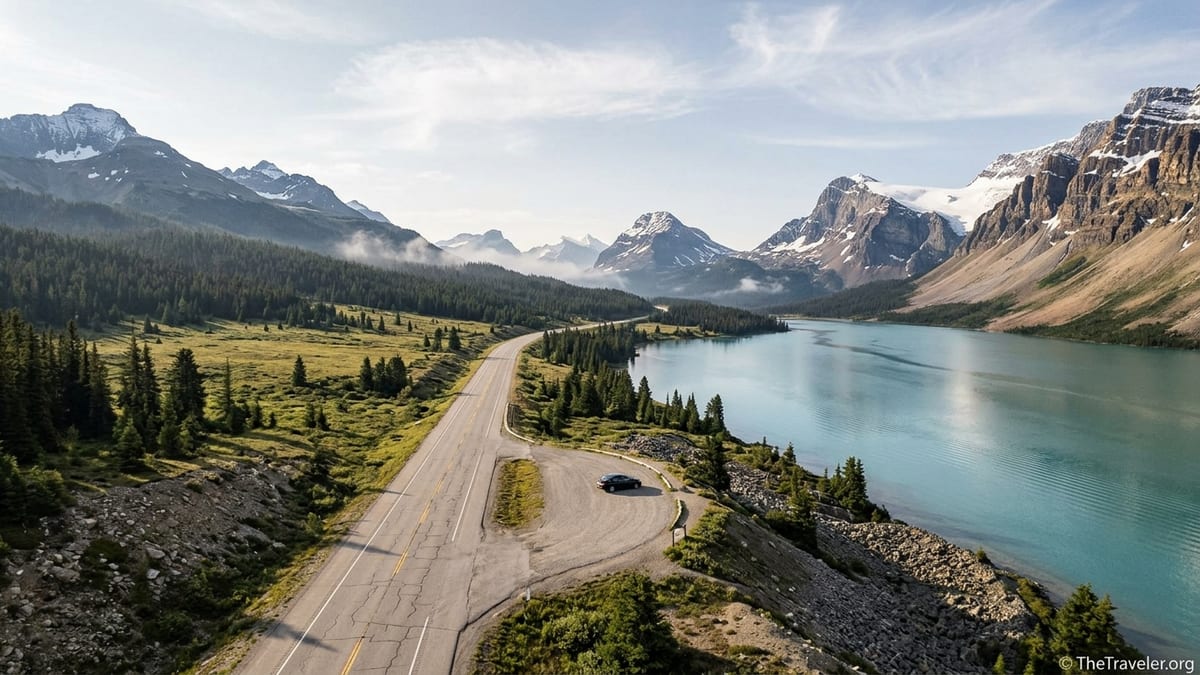
The Icefields Parkway between Lake Louise and Jasper is the scenic heart of this itinerary and deserves unhurried time. Even if navigation apps suggest a three-hour drive, most travelers find that a full day is appropriate, especially if the weather cooperates. Typical stops include Bow Lake for reflections of the Wapta Icefield, a short walk to the Peyto Lake viewpoint, a break at the Saskatchewan River Crossing service area, photo stops at viewpoints such as Weeping Wall, and longer visits around the Columbia Icefield area. Commercial Columbia Icefield tours and the glass-floored Skywalk fill quickly in peak season, so pre-booking at preferred times is wise.
Fuel and food services along the parkway are limited. Saskatchewan River Crossing offers the only fuel station between Lake Louise and Jasper, and prices can be higher than in town, so many drivers top up in Lake Louise or Jasper before setting out. Bring water, snacks and layers of clothing even on sunny days; wind at higher elevations can be chilly, and mountain weather can change quickly. Wildlife encounters are common. Mountain goats, bighorn sheep and occasionally bears may be seen near the roadside. Maintain a safe distance, remain in your vehicle when possible and obey any instructions from wardens or temporary traffic controllers at wildlife jams.
Parking at marquee sights like Lake Louise, Moraine Lake and some Banff town viewpoints is tightly managed. In recent seasons, private vehicles have not been allowed up the Moraine Lake road during peak months, with visitors required to use Parks Canada shuttles, commercial tours or registered taxis. Lake Louise lakeshore parking lots often fill early in the morning. To adapt, many travelers either book shuttles in advance, visit at dawn or after 6 p.m., or choose alternative hikes and lakes such as Herbert Lake, Lake Minnewanka or Johnson Lake on busy weekends. When comparing rental car and rail-based trips, factor in these local transportation logistics, as guests relying on public transport or tours may find it easier to access certain places without worrying about parking.
Finally, keep an eye on regional conditions. Wildfire seasons in western Canada can affect air quality and trail or road access, particularly in late July and August. Provincial and federal agencies publish up-to-date advisories and maps showing active fires and smoke. An itinerary with some built-in flexibility, such as an extra night in Jasper or a buffer night in Revelstoke, can help you pivot if a particular valley or campground becomes temporarily inaccessible. Travel insurance that covers trip interruption and changes can also be useful when planning a longer, more expensive journey involving nonrefundable rail segments or prepaid hotel packages.
FAQ
Q1. Is seven days really enough for Vancouver, Banff, Lake Louise and Jasper? For most travelers, seven days is only enough for Vancouver plus Banff and Lake Louise, or for a fast one-way trip that includes Jasper with long driving days. If you want to enjoy all four areas at a relaxed pace, 10 to 14 days is more realistic.
Q2. What is the best month to drive the Icefields Parkway? Late June through mid September typically offers the best combination of open facilities, snow free trails at moderate elevations and longer daylight. May and October can still be beautiful but may bring lingering snow, icy sections and some seasonal closures.
Q3. How far in advance should I book hotels in Banff, Lake Louise and Jasper? In peak season, it is wise to start checking availability four to six months ahead, especially for Lake Louise and Jasper, where room numbers are limited. Last-minute deals do appear, but in busy periods remaining options can be very expensive or far from key sights.
Q4. Is Rocky Mountaineer worth the cost compared with renting a car? Rocky Mountaineer is a premium, hosted experience with inclusive meals, commentary and large viewing windows, and many travelers feel it is a once-in-a-lifetime splurge. However, a rental car will almost always be cheaper and offers more flexibility for spontaneous stops, so the choice comes down to budget and travel style.
Q5. Do I need a four-wheel-drive or SUV for this itinerary? For most summer itineraries a standard two-wheel-drive car is sufficient, as the main highways and the Icefields Parkway are paved and well maintained. An SUV can offer additional ground clearance and comfort, but it is not essential unless you plan winter travel or unpaved side roads where allowed.
Q6. Can I do this route in winter? It is possible to travel between Vancouver, Banff and Jasper in winter, but conditions can include snow, ice and reduced visibility, and you must be comfortable with winter driving. Many first-time visitors prefer to visit between late spring and early autumn, when roads are easier and more activities are available.
Q7. How expensive is food along the route? Food costs vary, but travelers commonly budget similar to major North American cities, with casual restaurant dinners often in the 25 to 40 Canadian dollar range per person before drinks. Mountain resort prices can be slightly higher than in Vancouver, especially for sit down meals near major landmarks.
Q8. Are there good options for travelers without a car once in the Rockies? Yes. In Banff and Jasper, local shuttle buses, tour operators and hotel-run shuttles serve popular sights such as Lake Louise, Moraine Lake, Maligne Lake and the Banff Gondola. Many visitors combine intercity rail or coach travel with locally guided day tours instead of renting a vehicle.
Q9. How do one-way rental car fees work between Vancouver and Calgary? Most major rental companies charge an additional fee to drop a car in a different province, and this can range from modest to several hundred dollars depending on vehicle type, demand and season. When comparing quotes online, ensure that the one-way fee is included in the total estimate before you book.
Q10. Is it safe to see wildlife from the roadside? It is common to see animals such as elk, deer and bears near highways, but you should never approach or feed them. Stay inside your vehicle when possible, keep a generous distance and move on promptly so as not to contribute to traffic jams or stress the animals.