


Ontario’s provincial parks are some of Canada’s most rewarding places to camp, paddle, hike, and spend a beach day. They are also famously confusing to plan, because Ontario Parks uses three different systems that look similar online but behave very differently in real life: frontcountry camping reservations, backcountry permits, and advance day-use vehicle permits. If you have ever wondered why a campground is sold out months ahead, why a canoe route needs a “permit” instead of a “site,” or why you still need to book entry even if you already bought a seasonal pass, this is the guide that makes it all click.
Ontario Parks In One Sentence: Three Systems, Three Different Promises
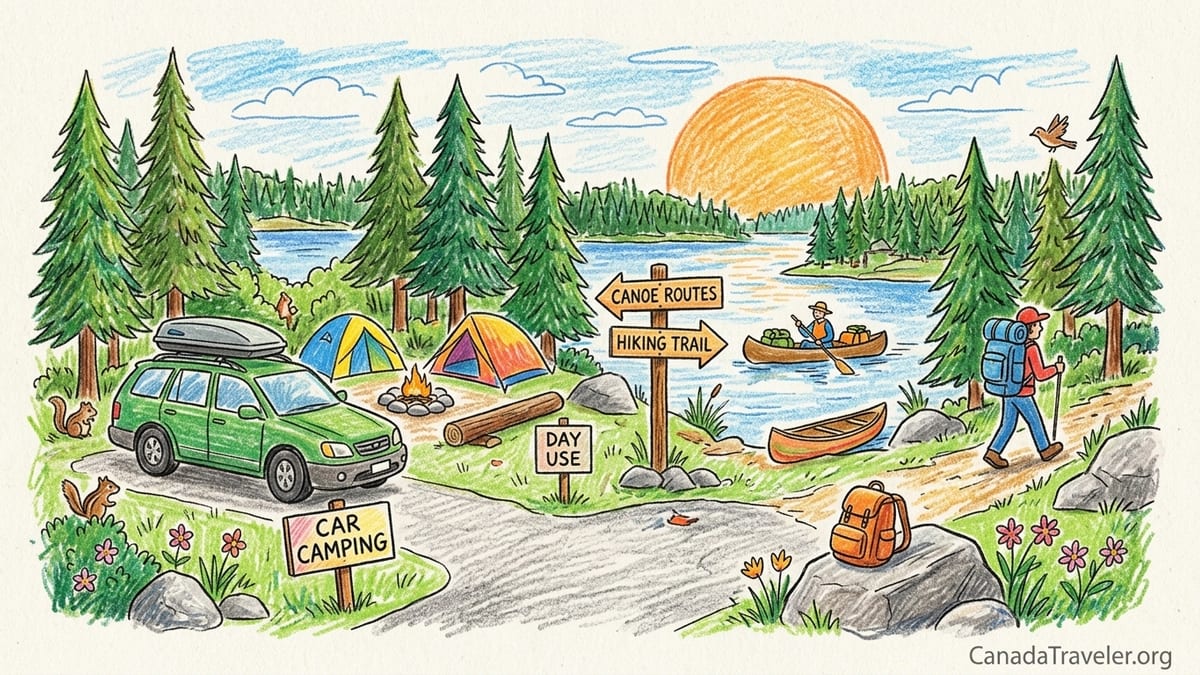
Ontario Parks planning becomes much easier when you treat each visit as one of three categories. First is car camping (also called frontcountry camping): you reserve a specific campsite number in a developed campground, drive right to it, and your booking includes one vehicle at your site. Second is backcountry: you reserve an interior itinerary that is tied to an access point and a zone, lake, or specific backcountry campsite depending on the park and activity; the “permit” is your proof you are allowed to travel and camp in the interior. Third is day use: you are not sleeping overnight, and what you need is a daily vehicle permit for entry, which may be first-come, first-served at some parks or may require an advance reservation at others on busy dates.
The reason travelers get tripped up is that all three can be purchased through the same Ontario Parks reservation service, but the rules around timing, refunds, check-in, and what you actually get at the gate are different. A car-camping reservation gives you a campsite for a night. A backcountry permit gives you legal occupancy for an interior route and campsite(s). An advance day-use vehicle permit gives you a guaranteed entry spot for your vehicle and passengers on a specific date, typically valid during posted day-use hours.
Before you choose a park, decide what you are truly trying to do. “Sandbanks for beaches” might be a day trip, a car-camping weekend, or a roofed stay nearby plus a day-use visit. “Algonquin for canoeing” might mean a Highway 60 corridor campground with a day paddle, or a true backcountry loop that requires an interior permit and trip plan. The system you pick determines what sells out, what can be changed, and what you need to show staff when you arrive.
Car Camping Reservations: The Five-Month Window That Drives Everything
For most travelers, the core Ontario Parks skill is understanding the five-month car-camping reservation window. Ontario Parks generally allows car-camping sites to be reserved up to five months before your arrival date, and that timing rule is enforced even when you try to “build your stay” by moving campsites through a trip. In practical terms, if you are trying to book a Friday to Monday weekend and only the Friday is within five months, the system can stop you from booking the whole weekend until each night falls inside the window.
Popular summer parks can fill quickly, and that is not just the headline beach parks. Sandbanks (Prince Edward County) can sell out far in advance for summer weekends. Pinery (near Grand Bend on Lake Huron) and Killbear (Georgian Bay) are also high-demand. Those are exactly the parks where your strategy should be to book the trip you can get, then refine it later if rules and fees make sense for your situation. Ontario Parks requires full payment at booking, and changes or cancellations can involve fees and timing restrictions, so treat early booking as a commitment rather than a “hold.”
Also understand what your campsite reservation includes. Parking for one vehicle is typically included with a campsite permit, and additional vehicles require additional permits and may have to park in a separate area away from the site. If you are meeting friends who are not sharing your campsite, they should not assume they can drive in and park at your site just because you “have a reservation.” In busy parks, that assumption can turn into a stressful gatehouse conversation on a Friday afternoon.
Arrival and departure timing matters more than people expect. Ontario Parks commonly lists check-in for camping after 2:00 p.m. and check-out before 2:00 p.m. That means on a summer Friday, arriving at 1:30 p.m. can be too early to be admitted to your campsite, while arriving at 5:30 p.m. can mean long lines at the entrance. If you are aiming for a smooth arrival, plan for the “arrival surge” that hits many parks on Fridays and long weekends and have a backup plan for dinner, bathroom stops, and cell service along the final approach.
Backcountry Permits: Algonquin And Killarney Are Not “Just Camping”
Backcountry trips confuse even experienced campers because Ontario Parks backcountry is about managing impact and safety in places where there is no gatehouse at your campsite. You are not simply booking a night; you are booking an interior camping permit that authorizes you to camp in specific areas and travel a specific itinerary. In many parks, you must obtain an interior camping permit prior to entering the backcountry, and you are expected to carry proof of purchase digitally or on paper in case a warden asks.
Algonquin is the classic example for canoeing and interior routes. The backcountry reservation process is still done through the Ontario Parks reservation service, but the way you search matters. Algonquin backcountry is organized around access points and interior destinations, and your confirmation functions as your permit. In real-world planning terms, that means you should start by deciding your access point (for example, Canoe Lake or Opeongo if your route requires them), then build a realistic first day distance that matches your group’s experience and daylight. A “perfect” route that only works if you get on the water at 9:00 a.m. is not perfect if you are driving up from the Greater Toronto Area after work.
Killarney is a different style of backcountry planning because it is famous both for interior lakes and for the La Cloche Silhouette Trail. Killarney’s overnight hiking trail uses campsite-specific reservations, and interior camping permits are required for backcountry camping. The key practical takeaway: if you want to hike La Cloche, you are not just picking a date; you are picking specific campsites that create your daily hiking distances. That is closer to planning hut-to-hut style travel than it is to casually “finding a spot.” For paddling Killarney’s interior lakes, your route planning is similarly structured, and you need to match your permit to your intended interior nights.
Backcountry rules also affect flexibility. Ontario Parks has maximum-stay rules for backcountry that vary by park and location, and some popular areas have tighter limits. If you are dreaming of “base camping” on a scenic lake for a week, confirm whether that lake or trail segment has special limits before you commit to the route. The safest approach is to plan a modest itinerary that keeps your group moving while still allowing a rest afternoon, rather than betting your whole weekend on getting a single high-demand lake for multiple consecutive nights.
Advance Day-Use Vehicle Permits: What They Cover And Why They Sell Out
Ontario Parks day-use rules have changed how many people do beaches and popular hikes, and this is now one of the biggest sources of confusion. A daily vehicle permit is entry for one vehicle and its passengers for day use at an operating provincial park, typically valid during posted day-use hours (many parks list day-use hours in the range of 8:00 a.m. to 10:00 p.m., but it can vary by park). For some parks, you can still buy a day-use permit on arrival on a first-come, first-served basis. For many other parks, Ontario Parks now offers advance daily vehicle permits, which you can purchase up to five days before your visit, starting at 7:00 a.m. Eastern, and buying in advance guarantees your spot.
Sandbanks is the clearest real-world example because it is both a beach magnet and one of Ontario’s busiest parks. On peak summer weekends, showing up without an advance day-use vehicle permit can mean you are turned away when the park reaches capacity. The practical planning move is to decide early whether your Sandbanks trip is an overnight stay (camping or roofed accommodation) or a day trip. If it is a day trip, treat the five-day permit release like a timed ticket: set an alarm for 7:00 a.m. Eastern five days before and book the moment it opens if you are targeting a Saturday.
It is also important to understand what an advance daily vehicle permit is not. It is not transferable to a different park, it is typically non-refundable and cannot be changed to a different date or park once purchased, and it is not a “park-wide reservation” that guarantees a specific beach parking lot, picnic table, or trailhead space inside the park. What it guarantees is entry for your vehicle and passengers. Once you are in, you still need to make smart on-the-ground choices like arriving early for the best beach lots, packing lunch to avoid leaving and re-entering, and knowing where dogs are allowed.
One more detail that surprises seasonal pass holders: a seasonal vehicle permit alone does not guarantee entry at parks using the advance day-use system on busy dates. Seasonal permit holders are still expected to secure a day-use spot in advance at no extra charge using the seasonal permit’s serial number. In other words, the seasonal pass is a payment product, while the advance daily vehicle permit is a capacity management tool. Think of it as paying for the right to enter, but still needing a timed slot when the park expects to hit its daily cap.
Operating Seasons, Roofed Accommodations, And Choosing The Right Overnight Style
Ontario Parks does not operate every service in every season, and the “open” status of a park can mean different things. Many parks have specific operating dates for camping and for roofed accommodations, while day use may be available more broadly depending on the park. Northern parks such as Lake Superior Provincial Park are a good example: the campground and full summer services typically operate seasonally, while day-use access can be available year-round for certain areas depending on conditions. If you are planning a shoulder-season road trip to Sleeping Giant or Lake Superior, verify the operating dates for the campground, comfort stations, and any park store services before you commit to a route that assumes showers and water taps will be on.
Roofed accommodations are a powerful workaround when tent sites are sold out, but they are not a single category. Ontario Parks offers options that range from yurts to cabins and cottages in certain parks. Roofed stays come with their own rules: Ontario Parks notes that a security deposit may be required upon arrival for some roofed accommodations, that smoking and vaping are prohibited in roofed units, and that cooking in yurts is not permitted. In practice, that means you should plan for an outdoor cooking setup where allowed, and you should read the unit’s specific “what to bring” notes as carefully as you would read an airline baggage policy.
Car camping versus backcountry is also about your daily rhythm. Car camping is ideal if you want beach time at Sandbanks, family-friendly biking at Pinery, or day hikes with an easy return to a fire pit and a cooler. Backcountry is ideal if you want the classic canoe travel feel in Algonquin or multi-day hiking on routes like Killarney’s La Cloche, where the point is the interior experience itself. If you are a first-timer trying to do a “little backcountry,” consider an easier overnight hiking option in a park that offers established backcountry trails with clear campsite reservations, rather than improvising a complex canoe loop on your first interior trip.
Finally, be realistic about travel time in Ontario. The drive to Sleeping Giant or Lake Superior is a true northern road trip. Those parks are perfect when you want a bigger landscape and fewer crowds than southern beach parks, but they reward longer stays. A one-night dash north can be done, but it often turns into a rushed experience with late arrivals and early departures. If your calendar only allows a two-night weekend, a closer park plus a well-planned day-use permit can be a better experience than spending half your time behind the wheel.
Rules You Actually Feel On The Ground: Pets, Fire Bans, Bears, And Check-In
Pets are allowed in Ontario Parks, but not everywhere you might assume. Ontario Parks generally welcomes dogs on campsites, park roads, and most hiking trails, while restricting dogs from many main swimming beaches except in designated dog beaches or pet exercise areas. The practical planning tip is to pick the park experience that matches your dog plan: a park with a clearly designated dog beach can turn a stressful weekend into an easy one, while a beach-heavy park without dog-friendly sand can mean your group is constantly splitting up or returning to camp early. If your trip is built around Sandbanks style beach time, confirm in advance where dogs can and cannot go so you do not drive hours only to discover your ideal beach area is pet-free.
Fire restrictions are another rule that changes your weekend fast. Ontario can declare Restricted Fire Zones and municipalities can also implement their own burn bans, and provincial parks can have specific restrictions during high-risk periods. Ontario Parks also publishes guidance on what equipment is allowed during a fire ban, and the details matter: a fire ban can mean no wood campfires and sometimes restrictions on charcoal or other cooking methods depending on the order. The practical move is to pack a backup cooking plan that does not rely on a wood fire, plus headlamps or lanterns so you are not depending on a campfire for light.
Bear-aware food storage is not just for deep wilderness travel. In parks where wildlife is active, poor food storage can lead to nuisance animals and ruined trips. Treat the campground like a place where scents matter: store food in your vehicle if permitted, keep coolers closed, and do not leave garbage out. For backcountry, plan for secure storage methods appropriate to the park and route. The key traveler mindset is to avoid “just this once” behavior on the first night when everyone is tired. That is the night most groups get sloppy and the night animals are most likely to be rewarded by easy access.
Finally, arrival and check-in is where rules meet reality. Ontario Parks has leaned into tools like preregistration for camping at some parks and encourages campers to plan for congestion at entrances at peak times. Whether you are arriving for a campsite after 2:00 p.m. or entering for day use with an advance vehicle permit, have your proof of purchase ready on your phone and also consider saving a screenshot in case reception is weak. In busy parks, that simple step can be the difference between a smooth entry and holding up the line while your email loads.
Planning A Summer Weekend When Your Park Is Sold Out: A Step-By-Step Rescue Plan
Here is a realistic scenario that plays out every summer: it is a Tuesday in July, you try to book Sandbanks or Pinery for the coming weekend, and everything is sold out. The wrong move is to give up or to keep refreshing one park page until you run out of time. The right move is to pivot your plan in a structured way, because Ontario Parks has multiple inventory types and your best weekend might be a mix of one overnight choice plus a guaranteed day-use permit elsewhere.
Step one is to decide what you will not compromise on. If your group’s non-negotiable is “a beach day with guaranteed entry,” keep the beach experience but change the sleeping plan. That can mean staying in a nearby town and booking an advance day-use vehicle permit for Sandbanks instead of camping inside the park. Treat the day-use permit as the anchor of the trip, then build lodging around it. The reverse can also work: keep the overnight camping by choosing a less famous but well-run campground in the same region, and drive to the headline park early with a day-use permit on one of your days.
Step two is to broaden the park search in a way that matches your activities, not your wish list. If you wanted Pinery mainly for Lake Huron swimming and biking, look for other Lake Huron shoreline parks and campgrounds with similar amenities, then plan a day trip to Pinery only if you can secure an advance day-use permit. If you wanted Killarney mainly for hiking, consider whether you actually needed a backcountry itinerary, or whether a car-camping base plus a day hike gives you the experience you want. If you wanted Algonquin mainly for canoeing, check whether a frontcountry campground in the Highway 60 corridor plus a day paddle fits your group better than a fully booked interior route.
Step three is to use inventory flexibility intelligently. Many travelers only search “camping,” miss roofed accommodations, then declare the park sold out. If your group can handle a rustic cabin or yurt style stay, search roofed accommodations in the same date range and be willing to adjust by one night. Another real-world pivot is to switch from a Friday arrival to a Thursday arrival, which can open up availability and also makes the weekend itself feel less crowded at the gatehouse and on beaches.
Step four is to build a Plan B that still feels like a win. For example, if Sandbanks camping is sold out, you can still have a Prince Edward County weekend by staying off-site, locking in an advance day-use vehicle permit for your beach day, and spending your second day on a winery, cycling, or town-focused itinerary that does not require park entry. If Killarney’s La Cloche campsites are booked, you can still plan a northern Ontario hiking weekend by using a different park or a frontcountry base and focusing on day hikes and paddles that do not require the same fixed backcountry campsite sequence. If your northern dream was Sleeping Giant or Lake Superior but the campground dates do not line up, shift the northern experience to a shoulder-season scenic road trip with day-use stops and confirm which areas are operating before you go.
The Takeaway
Ontario Parks is not hard to plan once you stop treating every visit as the same product. Car camping is about booking a specific site within a five-month window and timing your arrival around check-in and gatehouse congestion. Backcountry is about permits and itineraries, where Algonquin and Killarney require you to think in access points and reserved interior sites rather than “first come.” Advance day-use vehicle permits are about capacity and guaranteed entry, released up to five days in advance at participating parks and especially valuable for peak summer beach and hiking days.
If you take one planning habit into your next trip, make it this: decide whether your trip’s anchor is the sleep (campsite or roofed unit) or the day experience (beach or hike), then book the system that protects that anchor. When your first-choice park is sold out, you can still build an excellent weekend by mixing a different overnight base with an advance day-use permit, or by shifting your arrival day and accommodation type. That approach turns Ontario Parks from a frustrating “sold out” wall into a set of tools you can use.
FAQ
Q1. How far in advance can I reserve an Ontario Parks car-camping campsite?
Ontario Parks generally allows car-camping reservations up to five months before your arrival date, and that window is enforced when you build multi-night stays.
Q2. What is the difference between a camping reservation and a backcountry permit?
A car-camping reservation assigns you a specific campsite in a developed campground, while a backcountry permit authorizes an interior itinerary and camping on designated backcountry sites or zones.
Q3. How far in advance can I book an advance day-use vehicle permit?
At participating parks, advance daily vehicle permits can be purchased up to five days before your visit, with availability typically opening at 7:00 a.m. Eastern.
Q4. What does a daily vehicle permit cover?
It covers entry for one vehicle and its passengers for day use at the specific park and date purchased, generally during posted day-use hours for that park.
Q5. If I have a seasonal vehicle permit, do I still need an advance day-use permit?
At parks using the advance day-use system, a seasonal permit alone does not guarantee entry on busy dates; seasonal permit holders are expected to secure a day-use spot in advance at no extra charge.
Q6. What time can I check in for camping at Ontario Parks?
Ontario Parks commonly lists camping check-in as after 2:00 p.m., with check-out before 2:00 p.m., though you should confirm details for your specific booking and park.
Q7. Can I bring my dog to an Ontario provincial park?
Dogs are generally welcome on campsites, park roads, and most trails, but many swimming beaches are pet-free except for designated dog beaches or pet exercise areas.
Q8. What should I do if my preferred park is sold out for a summer weekend?
Anchor the trip around what matters most, then pivot by changing accommodation type (including roofed options), adjusting arrival day, choosing a nearby base park, and using an advance day-use permit to guarantee entry for a day trip.
Q9. How does backcountry booking work for Algonquin canoe trips?
You reserve through the Ontario Parks reservation system by selecting backcountry paddling and building an itinerary tied to an access point and interior destinations; your confirmation serves as your permit.
Q10. Are fire bans handled the same way everywhere in Ontario Parks?
No. Fire restrictions can vary by region, municipality, and park, and the type of equipment allowed can change under different restriction levels, so you should confirm current restrictions before your trip.