

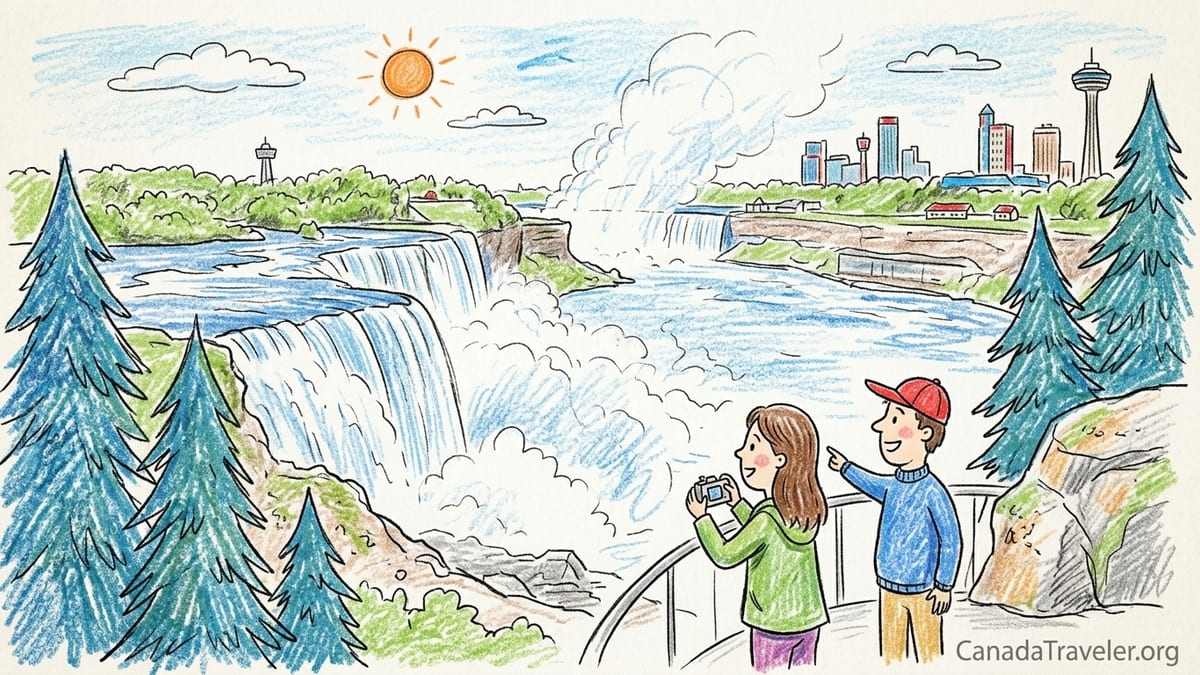
Niagara Falls is one of those places that feels impossible to live up to its own reputation, too famous to still be surprising. And yet, the first time I walked up to the brink of the Canadian Horseshoe Falls, it did the rare thing: it genuinely impressed me. The roar wasn’t a soundtrack, it was a physical presence. The mist hit my face like cold weather. And the color of the water, that shifting green as it accelerated toward the edge, made it clear that the falls aren’t just a view. They are motion, force, and geography doing what it has done for thousands of years.
What The Falls Get Right Immediately: Scale, Sound, And That First Look
From the Canadian side, the Horseshoe Falls are not a distant postcard. They are right there, close enough that you can watch the river change character in real time, from smooth current to a fast, glassy surge and then a sudden drop into a churning basin. Even if you think you have seen Niagara in photos and videos, the real thing is wider, louder, and more immersive than any screen can translate.
I expected beauty, but I didn’t expect how sensory it would feel. The sound is the first shock. It is constant, not dramatic. The mist is the second. And the third is how quickly your brain stops treating it like “an attraction” and starts treating it like weather. People nearby were yelling, laughing, pointing, trying to narrate it to themselves. I found I didn’t want to talk at all. I just wanted to stand there and absorb it.
One thing that surprised me in a good way is that simply viewing the falls is not gated behind a ticket. Niagara Falls itself is always available for viewing, even though the attractions around it have their own hours and admissions. That matters, because it means the best part of Niagara is still fundamentally free: the landscape.