


I thought I was booking a simple summer escape: a few quiet days in Muskoka, a lake, a dock, and that famous “nothing-to-do” Canadian bliss people talk about with a kind of reverence. What I actually booked was a crash course in the real meaning of cottage country, the version that Destination Ontario romanticizes so well with misty morning canoeing, lake cruises, forest hikes, resort comforts, golf afternoons, and fireside evenings. All of that exists, but so do the less glamorous truths: sticker shock, strict check-out chores, surprise supply runs, patchy cell service, and mosquitoes that can turn a sunset drink into a full-body dance. My first Ontario lake getaway taught me Muskoka isn’t just a destination. It’s a rhythm. And if you don’t like the pace, the quiet can feel less like peace and more like boredom.
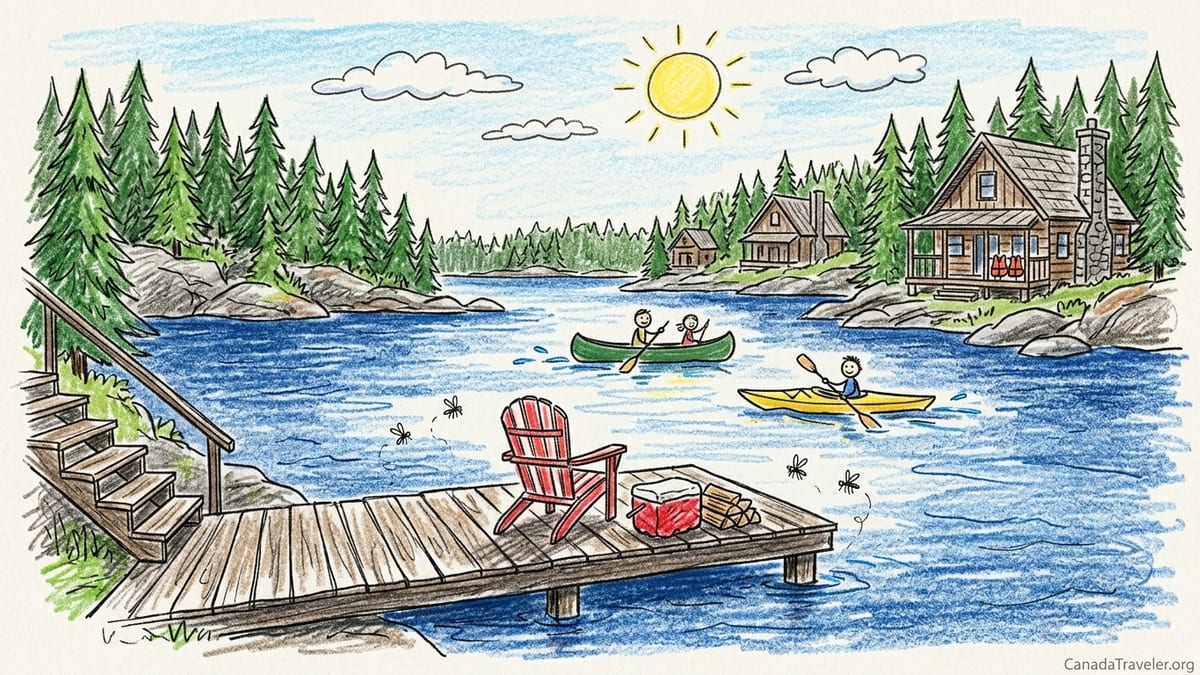
What “Cottage Country” Actually Means In Muskoka
Muskoka is one of those place names that functions like shorthand. Say it in Toronto and people picture pine trees, granite shoreline, and a dock with two Muskoka chairs facing water that looks brushed on. Destination Ontario explicitly frames Muskoka as Ontario’s cottage country, and that matters because it sets expectations: this is not a city break with attractions stacked back-to-back. It’s a nature-first holiday culture where your accommodation is the activity.
The idea of cottage country, especially in Ontario, isn’t only about a pretty lake. It’s about leaving your everyday pattern behind and adopting another one that’s slower and more domestic: making coffee in someone else’s kitchen, packing a cooler, timing errands around town hours, and learning what “lake time” does to your sense of urgency. Muskoka is built for that lifestyle, with communities like Gravenhurst, Bracebridge, Huntsville, and Port Carling acting like small-town service hubs for thousands of seasonal lake properties.
There is plenty to do if you want it. Destination Ontario points travelers toward lake cruises on the Muskoka lakes, forest hikes, and activities like golf and evenings around a fire. What surprised me is how optional everything feels. Unlike Toronto or Niagara Falls, where you can fill an itinerary just by stepping outside, Muskoka asks you to decide what kind of stillness you’re comfortable with.
What I Booked: A Private Cottage On Lake Rosseau, And The Reality Check
I chose a private cottage stay rather than a hotel because I wanted the quintessential cottage country experience: a place with its own dock, kitchen, and enough space to sit and watch the lake change color all day. I booked a lakefront cottage rental on Lake Rosseau in Muskoka, near the community of Rosseau. Lake Rosseau is part of the famous Muskoka lakes system, and staying there immediately made the trip feel like “the real thing,” not a generic lake weekend.
Here’s what mattered in the booking details. The listing specifically stated that a kayak and a canoe were included, along with life jackets, and it also flagged an important truth about waterfront access: there were a lot of stairs to get to the water. That one sentence changed how I packed and what I expected from the day-to-day, because a “quick swim” becomes a small workout when the dock is down a stairway. The listing also made it clear there was no power boat included, but there were slips if you brought your own or rented locally.
Price and minimum stay were the next wake-up call. In peak summer, many Muskoka cottages lean toward week-long stays, often Saturday-to-Saturday, and summer pricing can be the kind of number you hesitate to say out loud. Even when a place offers shorter off-season stays, the most in-demand weeks tend to lock you into a full week. For travelers used to city hotels, that minimum-stay structure is one of cottage country’s biggest hurdles, because it pushes you into a longer commitment with fewer “outside” distractions.
Then came the fine print that separates a fantasy from a functioning trip: linens and cleaning. Some Muskoka rentals bake linen and cleaning fees into the price, some charge separately, and some expect you to bring your own linens. Even if the place looks like a dream on camera, you should verify what’s actually provided before you arrive. Cottage country is not a single standard. It’s hundreds of individual owners with different rules, and the experience changes dramatically depending on how “hands-on” the rental expects you to be.
The Practical Stuff Nobody Puts In The Photos
Road access and arrivals are where cottage travel starts feeling different. A Muskoka cottage can be close to town in kilometers but still feel remote, especially if the last stretch is along narrow roads where you slow down for curves, deer, and the occasional oncoming pickup that takes up most of the lane. If you arrive after dark, it can feel like you’re driving into a black-and-pine tunnel. It’s beautiful, but it’s not effortless. I learned to arrive with daylight to spare, groceries already bought, and a screenshot of directions saved offline.
Connectivity is another make-or-break. Some cottages have strong Wi-Fi and consistent mobile signal, while others barely let you load a map. That matters for more than Instagram. It changes how you coordinate groceries, boat rentals, restaurant reservations, and even weather radar. If you’re traveling with work expectations, verify the Wi-Fi situation with the same seriousness you’d verify the number of bedrooms. Some resorts and cottage resorts make connectivity part of the package, while private cottages can vary wildly.
Mosquitoes were exactly as intense as everyone warned, but the timing surprised me. The worst moments were often the calm ones: sunset on the dock, reading outside, standing still while grilling. Movement helps, breezes help, and a smoky fire helps. But there were evenings when the dream of a long, slow patio dinner simply didn’t match reality. Cottage country comfort is less about pretending the bugs don’t exist and more about planning around them, including screens, bug spray, and a willingness to retreat indoors without feeling like the trip is “ruined.”
Finally, solitude. Photos sell seclusion, but “private” can mean different things. On a big lake like Rosseau, you may still see boat traffic and hear distant engines on weekends. I learned to look beyond the hero shots and ask questions: How close are the neighbors? Is the shoreline shared? Is the dock exclusive? Can you actually sit outside without feeling watched? The cottage delivered quiet, but it wasn’t wilderness isolation. It was cottage country, which is often a tapestry of private shorelines stitched together around one body of water.
The Daily Rhythm: Misty Mornings, Dock Time, And That Famous Nothing-To-Do Feeling
The first morning made me understand why people become a little poetic about Muskoka. The lake can be glassy, and the air can feel cool even in summer, the kind of calm that makes coffee taste better. This is where the “misty morning canoeing” image clicks into place. With a canoe included, I could actually do the postcard thing: paddle slowly along the shoreline, hear loons, and feel like time had thickened.
Days fell into a pattern that would sound boring in a city but felt correct on the lake. Swim. Sun-dry on the dock. Read a few chapters. Make lunch. Paddle again. Watch boats pass. It’s a loop. The “activity” is often just being outside near water, and the point is to stop trying to optimize your time. I brought too many ambitions at first, then gradually let them go.
There were small-town interludes that felt like a classic cottage-country ritual: driving into a nearby community for ice cream, a bakery stop, or a hardware run for something you didn’t know you needed. Cottage travel turns you into a frequent visitor of local grocery stores, small marinas, and general stores. That’s part of the charm, but it’s also part of the cost, because every “quick run” takes time and fuel.
Evenings were the emotional center of the trip. If the bugs were manageable, the dock became the best seat in the world. If not, the fire pit became a kind of gathering point, with that fireside-evening feeling Destination Ontario leans into. The biggest surprise was how quickly I stopped needing planned entertainment. The lake itself became the show, especially once the light softened and the day’s noise drained out of my head.
Doing More Than Dock Life: Cruises, Hikes, And A Taste Of The Resort Version Of Muskoka
To understand Muskoka beyond one dock, I leaned into the region’s classic add-ons. Destination Ontario points travelers to lake cruises, and Muskoka’s steamship culture is one of the most recognizable ways to experience the big water without needing to rent your own boat. In 2026, Muskoka Steamships marketed a Grand Muskoka Overnight Voyage that sails from Muskoka Wharf in Gravenhurst through the Port Carling lock to Lake Rosseau, docking at Windermere House, with set 2026 dates and per-person pricing that underscores just how premium this region can be.
Forest hikes helped balance the stillness with movement. Muskoka isn’t just lake frontage, it’s Canadian Shield rock, thick pine, and trail systems that let you swap dock sitting for sweat and views. If you’re the kind of traveler who needs at least one “we did something” moment each day, a morning hike is one of the easiest ways to get it without turning the trip into a checklist.
I also came to understand why some travelers choose a Muskoka resort or lodge over a private rental. Resorts and cottage resorts can wrap the cottage-country feeling in a more structured experience: on-site dining, organized watercraft access, and fewer logistical headaches. You still get canoeing, swimming, and fireside evenings, but you don’t always have to manage linens, garbage schedules, and checkout cleaning the same way. That trade-off is a big part of choosing how to do Muskoka.
Golf is another classic Muskoka layer that fits the destination’s pace. It’s outdoors, scenic, and time-consuming in a way that feels aligned with long summer days. Even if you don’t play, you notice how the region caters to it, especially around the Muskoka lakes and Lake of Bays area. It’s part of why the destination can feel both rustic and upscale at the same time.
How Cottage Travel Differs From Toronto Or Niagara, And Why Some Travelers Won’t Enjoy It
Toronto rewards you for being restless. You can spend a day museum-hopping, restaurant-hunting, shopping, and catching a show, all without a car. Niagara Falls is similarly dense with purpose-built attractions, viewpoints, tours, and entertainment. Muskoka is the opposite. The whole premise is that it’s okay, even desirable, to have empty hours.
That difference can be jarring if you’re wired for constant stimulation. At a cottage, you’re not “out” in the same way. You’re home in a borrowed place. You cook more. You clean more. You carry things from the car. You plan your meals. You decide whether it’s worth driving 20 to 40 minutes for groceries because you forgot coffee filters. A city traveler might interpret that as inconvenience. Cottage people interpret it as part of the ritual.
Bad weather reveals the truth of your booking. In Toronto, a rainy day means you pivot to indoor attractions. In cottage country, a rainy day can mean you are inside with board games, books, and whatever streaming the Wi-Fi allows. If your cottage is cozy, that can be perfect. If it’s cramped, dim, or poorly heated on a cold shoulder-season day, it can feel like you paid a premium to be bored indoors.
The other major difference is the way time is spent. In Niagara, you can measure the trip in attractions. In Muskoka, you measure it in rhythms: morning coffee, midday swim, afternoon nap, evening fire. If you need your vacation to look productive, cottage country might frustrate you. If you need your vacation to quiet your brain, it might be exactly what you’re looking for.
The Frustrations: Summer Sticker Shock, Chore Lists, And The Not-So-Relaxing Logistics
The most universal cottage-country frustration is price, especially in summer. Muskoka has name recognition, proximity to Toronto, and limited shoreline supply, and it all shows up in rates. Week-long minimum stays can make a trip feel financially heavy, especially for smaller groups. If you’re splitting with another couple or a family group, the math improves, but solo travelers and pairs can feel priced out quickly.
Cleaning requirements were another reality check. Many private rentals operate on tight changeovers, and owners often ask guests to complete a list: dishes done, garbage sorted, surfaces wiped, sometimes bedding handled according to house rules. None of it is unreasonable, but it changes how “relaxing” departure day feels. It’s not the hotel experience of dropping a key card and leaving.
Groceries and supplies take more effort than expected. Even when you’re relatively close to towns like Bracebridge or Huntsville, you’re still driving, parking, and hauling bags. If the cottage is down a slope or has stairs, that hauling becomes part of the workout. I learned to treat the first grocery run like provisioning a small expedition: coffee, snacks, easy dinners, extra condiments, and more ice than you think you’ll need.
And yes, bugs. Mosquitoes and other biting insects are part of Ontario summer life, and the intensity can vary based on rainfall, wind, and time of day. If you’re sensitive to bites, you need a strategy, not just hope. Screens, long sleeves for dusk, and a willingness to move your “outdoor time” earlier in the day can preserve the magic without turning the trip into a battle.
The Takeaway
Muskoka cottage country is for travelers who want to live somewhere, not just visit. It’s for people who like mornings that start slowly, who don’t mind cooking, and who can enjoy long stretches of quiet without needing an attraction every hour. It’s also ideal for groups and families, because the cottage itself becomes a shared space where the best moments are often unplanned: a spontaneous swim, a dock-side conversation, a sunset that keeps everyone outside a little longer.
It may not be for travelers who need constant entertainment, who dislike driving, or who want a vacation with minimal responsibility. If your definition of relaxation is being served, a Muskoka resort or lodge might suit you better than a private rental. Resorts can still deliver that classic Muskoka feeling, misty mornings, water access, fireside evenings, but with fewer logistical burdens and more on-site options when the weather turns.
Would I do it again? Yes, but with clearer priorities. If the goal is maximum cottage-country immersion, I would still choose a private cottage, but I would confirm linens, firewood, and connectivity in writing, and I would budget more realistically for peak-season rates. If the goal is a lower-stress first-time experience, I would consider a cottage resort where canoes and docks are managed and where a rainy day comes with a lounge, dining room, or spa. And if the goal is simply lake time on a tighter budget, I would look at cheaper lake regions outside Muskoka’s marquee lakes, where you can still get a dock, a swim, and a fire, but with less brand-name premium.
Cottage country is not a checklist trip. It’s a lifestyle sample. Muskoka taught me that the best part is not what you do. It’s what you stop doing.
FAQ
Q1. What is “cottage country” in Ontario, and why is Muskoka the classic example?
Cottage country refers to lake regions where people rent or own seasonal cottages and spend days swimming, paddling, boating, hiking, and doing very little on purpose. Muskoka is widely framed as Ontario’s cottage country because the region’s identity is built around that lake-cottage rhythm.
Q2. Is it better to book a private cottage or a Muskoka resort for a first trip?
A private cottage is more immersive and self-directed, but it comes with chores, logistics, and variable amenities. A resort or lodge can be easier for first-timers because dining, activities, and staffing reduce the amount you have to manage.
Q3. Do Muskoka cottage rentals usually require a minimum stay?
Many do, especially in peak summer when week-long stays are common. Some rentals allow shorter stays in shoulder seasons, but the most popular dates often come with strict minimums.
Q4. Are canoes or kayaks typically included with a cottage rental?
Sometimes, but not always. Some listings include a canoe or kayaks and life jackets, while others charge extra or require you to rent from a marina or outfitter. You should confirm exactly what is included before booking.
Q5. Will I have cell signal and Wi-Fi at a Muskoka cottage?
It depends heavily on the exact location and property setup. Some cottages have strong Wi-Fi and usable mobile reception, while others can be patchy. If you need reliable connectivity, ask the host for specifics before committing.
Q6. How far are groceries in Muskoka cottage areas?
Groceries can be close in distance but still take time because you may be driving on slower roads. It’s common to drive into towns like Bracebridge, Huntsville, Gravenhurst, or Port Carling for major shopping, depending on where you are staying.
Q7. Are mosquitoes really that bad in Muskoka?
They can be, especially at dusk and after rainy periods. Breeze and smoke from a fire can help, but most travelers are happiest when they pack repellent, use screened spaces, and plan outdoor evenings strategically.
Q8. What do people actually do all day at a cottage?
The cottage routine often revolves around swimming, paddling, reading, napping, grilling, sitting on the dock, and taking short trips to nearby towns for supplies or treats. The “nothing to do” feeling is often the point.
Q9. How is Muskoka different from visiting Toronto or Niagara Falls?
Toronto and Niagara offer dense, attraction-based itineraries. Muskoka is accommodation-centered and slower, with more time spent at your own dock or beach and fewer built-in entertainment options when the weather is poor.
Q10. If Muskoka feels too expensive, where else should I look for a lake getaway?
If Muskoka’s peak-season pricing is out of reach, consider other Ontario lake regions that still offer cottage rentals and classic lake life but with less name-recognition premium. A good approach is to search by lake rather than by brand-name destination and compare what is included in the rate.