


On paper, my Québec fall foliage road trip was perfectly timed. I booked months ahead for what guides and locals quietly call the “golden window” between late September and mid-October. I cross-referenced averages, read forum threads and refreshed Bonjour Québec’s live colour map obsessively. Yet when I finally flew into Montréal on October 3 and drove north toward the Laurentides, I discovered what that glowing map could not show: chasing peak colours in Québec is as much stress and luck as it is science.
Planning Around a Map That Refuses to Behave
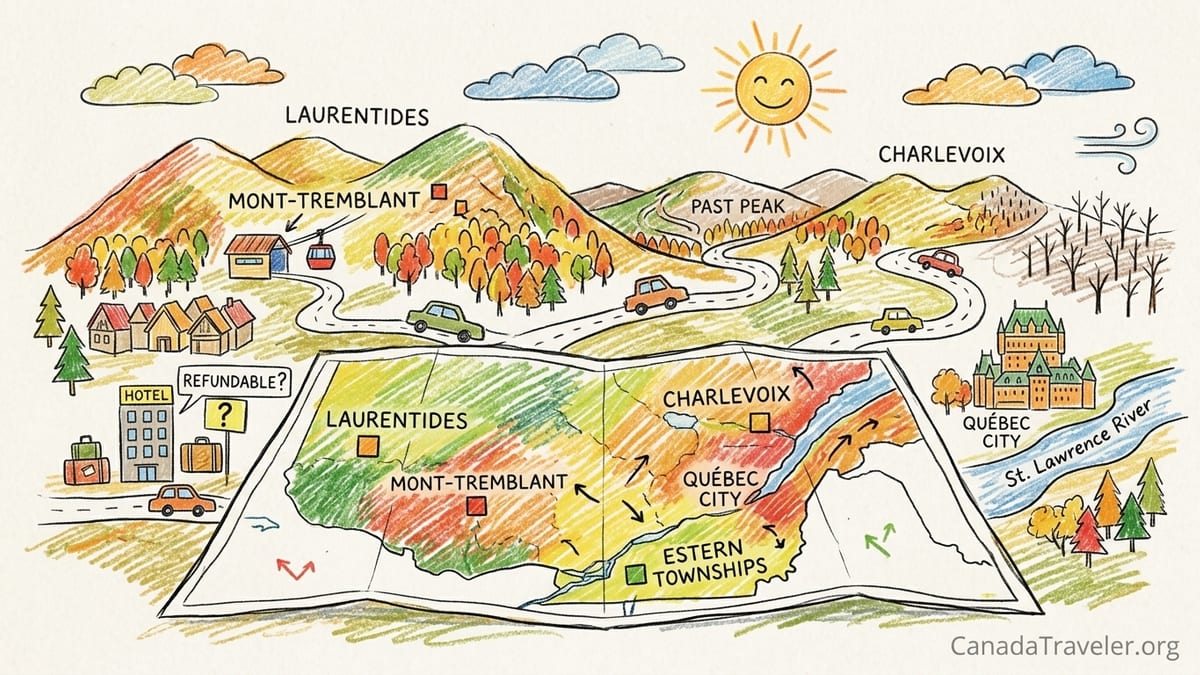
The backbone of my trip was Bonjour Québec’s interactive fall-colour map, which tracks more than 60 parks and regions from “not started” to “peak” and “end of season.” It typically runs from mid-September to late October, updating weekly as reports come in from tourism offices and park staff. In early August I watched old screenshots and media coverage from past years, trying to decode patterns: Laurentides peaking around the first week of October, Eastern Townships a few days later, Charlevoix somewhere in between. It all looked satisfyingly predictable on the screen.
Reality in 2026 was messier. A warm spell in late September pushed the forecast back in some areas, while an early cold snap at higher elevations seemed to accelerate others. When I checked the map on September 25, large sections of the Laurentides around Mont-Tremblant were already marked as “near peak.” A week later, as I landed on October 3, new updates showed some pockets already in “final glimmers” while lower valleys on the same map tile still hovered at “mid-point.” It was a visual reminder that the map is a helpful snapshot, not a guarantee.
I built my route anyway: October 3–6 in the Laurentides, October 6–9 in the Eastern Townships, October 9–12 around Charlevoix and Québec City. On spreadsheets and glossy tourism photos this looked ideal. I expected peak or near-peak leaves in at least two of the three regions. What I did not fully grasp was how much microclimates, elevation and a single windy night could scuttle those expectations, and how little flexibility I had left after locking in hotels, car rental and restaurant reservations months in advance.
By the time I picked up my rental car at Montréal-Trudeau, I was no longer asking whether I would see peak colours, but where along my rigid schedule they might still be hiding.
Laurentides: Stunning Colours, Surprising Crowds and Patchy Peaks
I hit the Laurentides first, driving from Montréal to Mont-Tremblant on the afternoon of October 3. Bonjour Québec’s map that morning showed much of the region at “near peak,” with some higher ridges flagged as “excellent” for colour. On the ground, the drive up Autoroute 15 told a more inconsistent story. Around Saint-Jérôme the hills were still largely green, with only occasional bursts of orange. By Sainte-Agathe-des-Monts, splashes of red sugar maples finally appeared, while the slopes near Saint-Faustin-Lac-Carré had entire bands of hillside already rust and brown from early leaf drop.
Accommodation prices reflected the map’s optimism, not the patchiness I saw from the highway. For a basic queen room in Mont-Tremblant’s pedestrian village on Saturday, October 3, I paid just under 420 Canadian dollars including taxes and resort fees. Cheaper motels in Saint-Jovite, fifteen minutes down the road, were listed around 220 to 260 dollars for the same night when I checked a week prior. When I asked a front-desk clerk why mid-range rooms were flirting with luxury pricing, she shrugged and pointed to the calendar: peak colours, marathon weekend, and the Thanksgiving long weekend just a week away. The foliage might be uneven, but demand was not.
The next morning, October 4, I joined the line for the Mont-Tremblant gondola shortly after 9 a.m. The Bonjour Québec map had the immediate area still marked “near peak,” and Instagram backed that up with recent posts of scarlet ridges. At ground level the trees around the village were indeed fiery, but the experience was undercut by crunch factors I had underestimated. The main parking lots by the village were already close to full by 9:30 a.m., with attendants directing latecomers to overflow gravel lots where people jockeyed for spots and double-parked. The gondola line snaked back and forth across the plaza, easily 30 to 40 minutes just to board, as bus tours unloaded groups of forty at a time.
The summit payoff was gorgeous yet far from perfect. The western slopes showed classic quilted reds and oranges, but the lower valleys to the north had clearly blown past peak. Whole stands of maple were already bare, the colour replaced by a gray tangle of branches. I had expected a panoramic, uniform blaze; instead, I got a lesson in how quickly a gusty two-day wind can move a whole hillside from “near peak” to “final glimmers.” The map still said almost-peak, but my photos show something closer to early decline.
Eastern Townships: When “Next Week” on the Map Becomes “Too Late”
On October 6 I drove south from Mont-Tremblant to the Eastern Townships, crossing back through Montréal’s ring roads and into rolling farmland. I based myself near Magog, with plans to hike in Parc national du Mont-Orford and wander winery country near Dunham and Frelighsburg. Bonjour Québec’s colour map that week showed the Townships slightly behind the Laurentides, hovering between “mid-point” and “near peak,” and some local tourism sites suggested that Thanksgiving weekend often lines up with the best colour in this region.
The first hint that I was late rather than early came on Route 112 east of Bromont. Vineyards that should have been framed by saturated reds were already dulled out, the dominant tones more bronze and faded gold. By the time I reached the viewpoints along Chemin de la Montagne near Sutton on October 7, the high ridges were heavily thinned, branches exposed where maples had shed a week earlier than expected after a stretch of strong wind and rain. Down in the valleys, oaks hung on stubbornly green, creating a slightly confused palette of bare gray ridgelines above swathes of summer foliage below.
Mont-Orford itself was the clearest example of how the map’s broad categories can miss local nuance. The park’s status that day was “near peak,” but the popular viewpoints near the top of the gondola told a different tale. Some north-facing slopes still held strong oranges and reds, especially where sugar maples were sheltered, yet entire south-facing hillsides visible from the summit lookouts were past prime, mottled brown and repeatedly hammered by wind. On sections of the Sentier Mont-Chauve, I hiked through corridors of mostly bare trunks even as glossy brochures at the visitor centre promised tunnel-like arches of colour.
Prices in the Townships felt closer to what I expected for shoulder season, but even here the popularity of fall weekends shows. A small lakeside inn near Magog quoted me about 280 dollars a night for October 6 and 7 when booked in July, with the same room dipping under 200 dollars on midweek dates in late October once colour season winds down. At restaurants in Magog and Sutton, every Friday and Saturday dinner slot between 6 and 8 p.m. had been pre-booked days in advance. One bistro I tried could only offer a 5 p.m. or 9 p.m. seating on Thanksgiving Sunday, and several cafés posted signs asking customers not to linger because of high demand.
Charlevoix and Québec City: Still Green Where I Expected Fireworks
The final leg of my loop, from October 9 to 12, took me along the north shore of the St. Lawrence River toward Charlevoix and Québec City. Here the timing flipped. While the Laurentides had been uneven but mostly at or just past peak, parts of Charlevoix remained surprisingly green. Bonjour Québec’s map that week showed the region steadily advancing toward “near peak,” with some higher terrain near Le Massif de Charlevoix edging ahead. I planned my days around those hopeful patches of orange on the screen.
On October 10 I drove the famed stretch of Route 362 between Baie-Saint-Paul and La Malbaie, which in photos often resembles a postcard collage of cobalt river and flaming hills. The views were still impressive, but the dominant tone was yellow-green, not red. Lower slopes along the river remained mostly green, with only the odd maple going bright crimson. The higher hills behind Baie-Saint-Paul had more colour, yet even there oranges dominated, and the tapestry effect I had hoped for felt muted. My notebook entry from that afternoon simply reads: “Beautiful drive, but this would be spectacular one week later.”
The biggest surprise came at Parc national des Grands-Jardins, inland from Saint-Urbain, on October 11. The park’s boreal plateau sits at higher elevation and often changes earlier than the coast, and the map described it as “mid-point.” I found a landscape in transition that did not fit neat categories. On the lower approach road, birches were already yellow and dropping. Up on the popular Mont du Lac des Cygnes trail, many of the shrubs and low maples had already let go of their leaves after the same September wind event that had battered the Laurentides. The tundra-like summit felt almost wintry despite a dusting of lingering colour along distant slopes.
Québec City itself, where I spent the night of October 11, was closer to the beginning of the show than the end. On the Plains of Abraham and along the ramparts of Old Québec, only about half the trees had changed, and the dominant shade was a soft yellow-green. Île d’Orléans the next morning was more advanced, with orchards and roadside maples turning amber, but nowhere close to the “peak foliage” that tourism photography suggests for early October. Here my carefully staggered itinerary backfired: by the time I reached the city, the season had clearly not caught up to my reservations.
The Hidden Stress of Fixed Dates and Flexible Leaves
Looking back, the most stressful part of the trip was not a traffic jam or a missed reservation, but the mental tension between fixed travel logistics and fluid natural timing. By late June I had already booked flights into Montréal for October 3 and out of Québec City on October 12 to keep prices reasonable. A compact rental car for ten days cost about 720 dollars before fuel. Most of my accommodation was either partially or fully prepaid, and several properties required nonrefundable first nights for that particular holiday period.
As October approached and long-range forecasts hinted at unusual warmth, I felt my carefully built plan begin to wobble. Moving the trip earlier by even five days would have meant hundreds of dollars in airline change fees and starting over on accommodation just as peak season prices climbed. Sliding it later risked losing deposits for the first half of the loop and running into bare trees in the Laurentides and Eastern Townships. In practice, my dates were locked in long before anyone could say with confidence when the leaves would peak.
On the ground, this rigidity turned everyday decisions into low-grade stressors. Checking the colour map each evening became less about inspiration and more about confirmation of what I had already missed or might still catch. When Charlevoix looked a little behind, I debated in my hotel room whether to cancel a nonrefundable whale-watching tour and try for a last-minute extra night in the Laurentides, where pockets still showed “excellent.” The lack of flexible, penalty-free options meant I stuck with my original plan, even as it drifted away from the best colour zones.
The emotional whiplash was real. On October 4, standing in a gorgeously lit, nearly perfect section of forest near Mont-Tremblant, I felt pure awe at the saturated reds arching overhead. The next day, hiking under half-bare canopies in the Eastern Townships while hostel guests scrolled through their feeds and raved about colours they had seen the previous weekend in the same park, I felt like I had misplayed some intricate game. The irony is that, by any reasonable measure, the trip still delivered magnificent scenery. It just did not deliver the neat, all-regions-at-peak tableau that pre-trip research quietly makes you expect.
Traffic, Parking and Restaurant Reality at Peak Demand
The other source of stress was human, not botanical. Weekends in colour season bring a density of people, cars and reserved tables that many first-time visitors underestimate. On Saturday, October 4, the main access road into the Mont-Tremblant resort area slowed to a crawl by late morning. Drivers circled public lots, hoping to catch departing cars, while lineups formed at pay stations. In the village, queues snaked from coffee counters and washrooms, and the gondola boarding area never really emptied between 10 a.m. and 3 p.m.
It was much the same in popular national parks. At Parc national du Mont-Orford on Tuesday, October 7, I arrived just after opening time on a weekday and still found the main parking area for the Mont-Chauve trail nearly half full. Staff at the gate explained that on peak weekends in October, they often turn cars away and rely on advance daily quotas that can sell out in the days before, especially for Thanksgiving. Sépaq, the provincial parks network, encourages visitors to buy daily access online in advance during the busy season, and in 2026 some parks have moved to timed entry on the busiest trails.
Restaurants mirrored this compression. In Baie-Saint-Paul on Friday, October 9, I walked into three well-known bistros between 5 and 6 p.m. only to be told they were fully booked through the night. One server laughed kindly and asked if I had tried reserving a week earlier. I ended up with a late seating at a smaller brasserie off the main street, which was excellent but not the farmhouse-style experience I had envisioned. In the Eastern Townships, smaller villages like Sutton and Frelighsburg saw midday lineups out the door at popular bakeries and cafés. The food was worth the wait, but spontaneity was not.
All of this is manageable with planning, but it adds another layer of logistics to a trip that is already complicated by the chase for colour. When you are timing mountain gondolas around morning light and checking weather radar for passing showers, budgeting an extra half-hour for parking or building in restaurant lead times can feel like one variable too many. Yet ignoring those human patterns is how an otherwise beautiful day ends with hangry hiking partners and sunset stuck in a car queue instead of on a viewpoint.
A Smarter Strategy for Next Time
By the time I boarded my flight home from Québec City on October 12, I had stopped obsessing over whether I had “hit peak” and started thinking about how I would plan differently. The biggest adjustment would be to aim for flexibility over perfection. Instead of anchoring a fall foliage trip to a single, tightly scripted ten-day loop, I would break it into smaller, more adaptable segments that can be shuffled as the season unfolds.
On a future trip, that might look like booking two or three nights in Montréal or Québec City as flexible base camps in early October, then watching the Bonjour Québec map and short-term weather forecasts. If the Laurentides lights up first, I could rent a car for a midweek dash to Mont-Tremblant, Saint-Sauveur or Saint-Donat, returning the car in the city afterward. If the Eastern Townships linger later, I could pivot south instead, focusing on Magog, Sutton and the cider route near Frelighsburg. Charlevoix, with its broader window of mid-September to mid-October at different elevations, could be layered in once colours either upstream or downstream along the St. Lawrence look promising.
Midweek travel is another clear win. The difference between a Saturday and a Tuesday at popular spots such as Mont-Tremblant’s gondola or the viewpoints in Parc national de la Jacques-Cartier is dramatic. Parking is easier, lines are shorter, and dinner reservations are possible on the same day rather than a week in advance. Prices sometimes reflect that pattern as well, with Sunday-to-Thursday rates in resort towns dropping significantly compared with Friday and Saturday nights during the colour window.
The final piece is to design a trip that remains satisfying even if the leaves underperform. Québec in October offers far more than foliage: trail networks that are enjoyable in any shade, Nordic spas where mist and steam matter more than canopy colour, food circuits focused on cider, cheese and farm-to-table meals, historic districts in Montréal and Québec City that feel atmospheric in gray drizzle as much as in golden light. Building days around a mix of hiking, thermal baths, markets and village wandering means that a hillside of half-green, half-bare trees becomes background texture rather than the entire point.
The Takeaway
My ten days chasing fall colours in Québec delivered everything the brochures promise and everything they gloss over. I saw fiery maples arching over Laurentian trails, orchards in the Eastern Townships glowing in late-afternoon sun, and the St. Lawrence framed by golden hills near Charlevoix. I also saw bare ridgelines a week earlier than expected, valleys still stubbornly green, and crowds that turned supposedly tranquil viewpoints into impromptu festivals of selfie sticks and bus tour name tags.
The core lesson was simple. Peak foliage in Québec is not a fixed date on the calendar but a moving target shaped by altitude, microclimates and fickle autumn weather. Bonjour Québec’s live map is an excellent tool, but it is a map of probabilities, not promises. Lock in nonrefundable hotels and rigid daily plans too early and you trade flexibility for the illusion of control, then feel every shift in the forecast as a personal loss.
There is a better way. Travel midweek when possible, lean on refundable or at least changeable accommodation, and treat Montréal and Québec City as flexible hubs rather than mere bookends. Check the live map in the days before each leg, not just months in advance, and be willing to flip the order of regions if colour progression demands it. Most of all, frame the trip around the broader pleasures of Québec in autumn: long lunches in village bistros, quiet trails after the first frost, hot pools under cold skies. When the leaves align perfectly, it will feel like a bonus rather than a fragile goal you have to hit exactly.
FAQ
Q1. When is the best time to see fall colours in Québec?
The most reliable window is from the last week of September through about the third week of October, but exact peak dates vary each year by region and elevation.
Q2. How accurate is the Bonjour Québec fall-colour map?
It is a useful, frequently updated guide that shows broad regional trends, but microclimates, altitude and wind can make conditions better or worse than the map suggests in specific valleys or on individual hillsides.
Q3. Which regions usually change colour first in Québec?
Higher and more northern areas such as parts of the Laurentides and Charlevoix often turn first, while lower valleys, cities and some areas of the Eastern Townships typically peak a little later.
Q4. How far in advance should I book accommodation for a Québec fall trip?
For popular weekends between late September and mid-October, booking three to six months ahead is common, especially in Mont-Tremblant, Magog, Sutton, Baie-Saint-Paul and around Thanksgiving.
Q5. Are weekends really that busy during peak foliage?
Yes. Expect heavier traffic on main highways, full parking lots at national parks and resort areas by midmorning, longer waits at gondolas and more competition for restaurant tables on Fridays, Saturdays and holiday Mondays.
Q6. Can I still enjoy a fall trip if I miss peak colours?
Absolutely. Hiking, village markets, cider houses, Nordic spas and historic districts in Montréal and Québec City all remain rewarding, even if the foliage is a bit early, late or patchy.
Q7. Is it better to base in one place or do a big loop?
If your dates are inflexible, using Montréal or Québec City as a base and making shorter side trips allows you to chase the best colours with less risk than locking in a rigid, multi-region loop.
Q8. How can I reduce stress while chasing fall colours?
Travel midweek when you can, book refundable rooms, reserve key restaurant meals and park entries ahead of time, and treat the colour map as a guide rather than a scorecard to hit perfectly.
Q9. Do I need a car to see Québec’s fall foliage?
A car gives the most flexibility for reaching parks and rural areas such as the Laurentides, Eastern Townships and Charlevoix, although limited foliage excursions are available from Montréal and Québec City by tour or public transport.
Q10. What should I pack for an October foliage trip in Québec?
Pack layers for temperatures that can swing from near freezing to mild, waterproof outerwear, sturdy hiking shoes, hat and gloves for chilly mornings, and a daypack for food, water and extra clothing on the trail.