


Few wildlife experiences in North America feel as accessible, dramatic and distinctly local as watching whales in Québec. Along the St. Lawrence River and Gulf, especially around Tadoussac and the Côte-Nord, cold, nutrient-rich waters attract up to 13 whale species in summer, including humpbacks, fin whales, minke whales and the iconic white beluga. With an official 940-kilometre Whale Route, multiple marine parks and an infrastructure built around ethical viewing, Québec is one of the easiest places on the continent to combine road-tripping with world-class cetacean encounters.
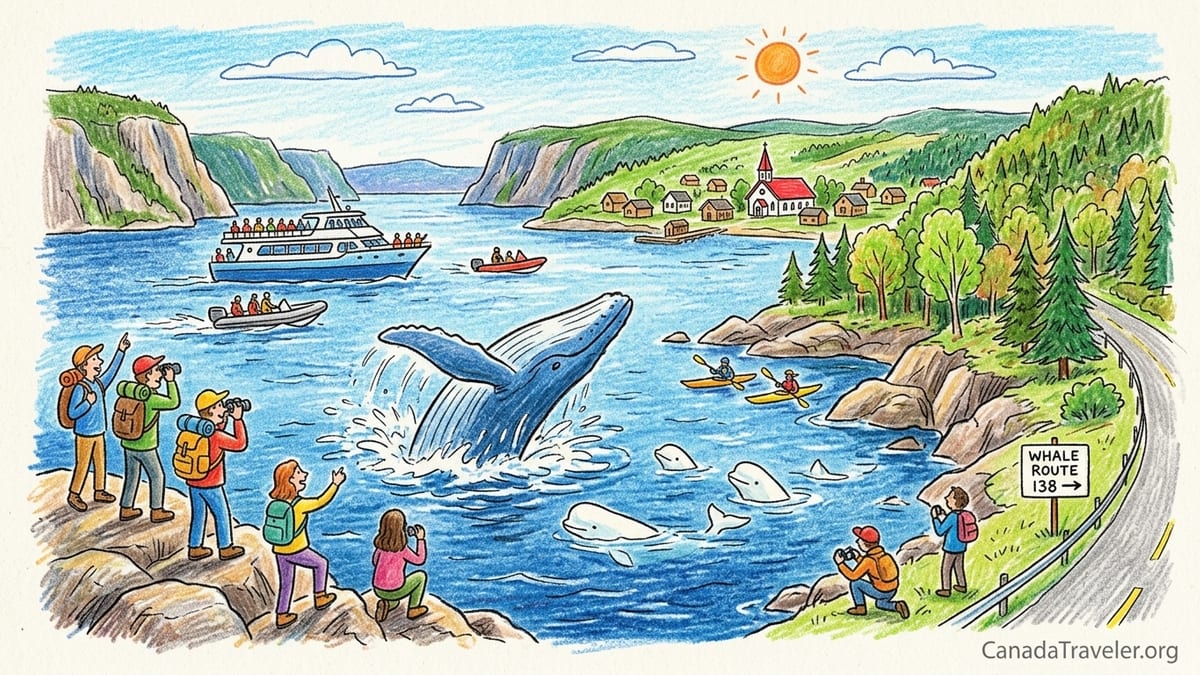
Why Whales Love the St. Lawrence
Québec’s reputation for whale watching starts with its geography. The Saguenay–St. Lawrence Marine Park sits where the deep Saguenay Fjord meets the colder, saltier waters of the lower St. Lawrence estuary. This junction acts like a funnel and a mixing zone, bringing up nutrients from the deep Laurentian Channel and concentrating plankton and fish. For whales, this is a rich buffet. For visitors, it means a relatively compact area where several species, from small harbour porpoises to enormous blue whales, may be seen over the course of a single season.
As the St. Lawrence widens into a maritime estuary and then the Gulf, it behaves less like a river and more like an inland sea. Strong tides, complex currents and the steep underwater topography along the north shore keep food sources near the surface. Between Tadoussac and points far east along the Côte-Nord, whales come close to shore to feed. That is why travelers regularly report seeing blows and dorsal fins while standing on headlands like Cap-de-Bon-Désir or the granite rocks in Les Bergeronnes.
The official Whale Route marketed by Bonjour Québec runs for roughly 940 kilometres along Route 138 on the north shore of the St. Lawrence, from Tadoussac toward the far eastern village of Kegaska and on to Blanc-Sablon via discontinuous segments. Along this road, interpretation centres, viewpoints and cruise operators are spaced out through small communities such as Les Escoumins, Les Bergeronnes, Longue-Rive, Baie-Comeau and Havre-Saint-Pierre. Every summer, provincial tourism authorities highlight that about 13 whale species visit these waters, though any given trip will usually focus on a handful of the more frequently seen ones.
Timing matters. Organized boat and Zodiac excursions typically operate from roughly May to October, with peak diversity and numbers for many migratory species between June and September. Belugas, by contrast, are present year-round in parts of the estuary but are more readily seen from shore in summer, particularly around the mouth of the Saguenay, Baie-Sainte-Marguerite and some upper estuary viewpoints. Regardless of month, sightings are never guaranteed, and conditions such as fog, wind and sea state can influence both safety and what you see.
Tadoussac and the Core Whale-Watching Area
Tadoussac is the symbolic gateway to whale watching in Québec and the western anchor of the Whale Route. Set where the Saguenay River empties into the St. Lawrence, the village combines a protected bay, historic trading post and easy access to deep water. From here and nearby Baie-Sainte-Catherine on the opposite shore, large cruise boats and Zodiacs fan out toward feeding grounds within the Saguenay–St. Lawrence Marine Park. Many visitors base themselves in Tadoussac for one to three nights to combine a whale excursion with hikes, beach walks and visits to interpretation centres.
Within the village, the Marine Mammal Interpretation Centre introduces travelers to local species through skeletons, sound recordings and exhibits which explain why this area is so critical for endangered populations like the St. Lawrence beluga and some blue whales. Walking trails lead from near the centre toward headlands at the mouth of the Saguenay, where locals and travelers alike often stand with binoculars scanning for blows, especially at high tide. When you hear people say they saw whales “from the village,” this is usually where they walked.
The broader core area extends east to Les Bergeronnes and Les Escoumins and inland up the Saguenay Fjord. Cap-de-Bon-Désir, part of the Saguenay–St. Lawrence Marine Park, is a rocky headland with an interpretation centre and marked viewpoints where whales sometimes pass surprisingly close to the shore. A little farther inland, Baie-Sainte-Marguerite, reached by road along the Saguenay or by trail within Parc national du Fjord-du-Saguenay, is well known as an important habitat for belugas; there is a belvedere designed for land-based viewing with interpretive information about the species’ fragile status.
Choosing where to focus within this core zone depends on how you prefer to watch whales. Tadoussac and Baie-Sainte-Catherine are the main departure points for large sightseeing boats and Zodiacs, while Les Bergeronnes, Les Escoumins and Cap-de-Bon-Désir are particularly strong for shore-based viewing and small-scale sea kayaking. Many travelers combine both: for example, taking a half-day Zodiac tour from Tadoussac, then driving 40 to 60 minutes northeast along Route 138 to spend an afternoon on the rocks at Cap-de-Bon-Désir or camping at a waterfront site in Les Bergeronnes.
Large Sightseeing Boats: Comfort and Family-Friendly Viewing
Large sightseeing vessels are the most accessible way to experience whale watching along the St. Lawrence, especially if you are prone to motion sickness or traveling with young children. Operators based around Tadoussac and Baie-Sainte-Catherine run ships that can carry several hundred passengers, with indoor heated lounges, outdoor decks on multiple levels and onboard commentary in French and English. Cruises typically last about three hours and follow established routes within the Saguenay–St. Lawrence Marine Park where whales are frequently observed.
These larger boats have several advantages. They are generally more stable in choppy conditions than small Zodiacs, which can help if you are unsure about your sea legs. Many offer restrooms, snack bars and sheltered seating, which can make a big difference in the cool wind off the St. Lawrence, even in July and August. Families often find it easier to manage strollers and the needs of toddlers on these vessels, although you should confirm in advance whether strollers can be brought on deck.
There are still trade-offs. Because of their size, large boats must maintain greater distances and are less nimble in responding to whale movements within park regulations. On busy days, they can feel crowded at railings when whales surface nearby. If you are sensitive to engine noise or prefer a more intimate atmosphere, this may not be your ideal choice. Motion sickness is still possible if the wind comes up, so it is wise to eat lightly beforehand and consider bringing sea-sickness medication if you are prone to nausea.
From a planning perspective, large boat excursions are the simplest to book and usually operate the longest season, sometimes from early May to late October, with more frequent departures in summer school holidays. When reserving, check practical details such as parking availability in Tadoussac or Baie-Sainte-Catherine, boarding times around the ferry schedule if you are crossing the Saguenay, and language options for onboard commentary. Many companies offer discounted rates for children and occasional family packages, but specific prices and promotions vary year by year.
Zodiac Excursions: Close to the Water and High on Thrills
Zodiac tours are the signature experience for many travelers on Québec’s north shore. These rigid-hulled inflatable boats sit low on the water, carry a smaller number of passengers and feel fast and agile as they move through the estuary. Departures operate from Tadoussac, Baie-Sainte-Catherine, Les Bergeronnes, Les Escoumins and other Côte-Nord communities within or near the Saguenay–St. Lawrence Marine Park. Typical outings last two to three hours, with guides and captains in radio contact to share information about whale locations while respecting marine park regulations on approach distances and time spent near animals.
The main appeal of a Zodiac is the immersive sensation of being close to the elements. Passengers are issued warm flotation suits or waterproof gear, and you feel the spray, wind and motion of the sea more directly than on a large ship. When a minke whale surfaces nearby, or a humpback’s tail flukes in the distance, the experience can feel intense and personal. Photographers appreciate the boat’s maneuverability, though you need a secure strap for cameras and a willingness to keep gear protected from water.
Because of their speed and size, Zodiacs are generally not recommended for everyone. Most operators impose minimum age limits, often around five or six years, and may also have restrictions related to pregnancy, back problems or mobility issues. The ride can be bouncy, especially if afternoon winds pick up, and passengers are seated on individual jockey-style seats or benches where they must hold on during fast sections. If you are very prone to motion sickness, choose an early morning departure when seas are typically calmer and sit near the stern where movement may feel less extreme.
Clothing is critical on Zodiac trips. Even on a sunny August day, air temperatures on the water can feel 5 to 10 degrees cooler than on land once wind chill is factored in. Dress in layers with a moisture-wicking base, a warm mid-layer such as fleece or a light down jacket, and wool or synthetic socks. Most companies supply flotation suits, but it is still advisable to bring a hat, gloves in shoulder seasons and a buff or scarf to shield your neck and face. Waterproof cases for phones and a dry bag for spare clothing can make the difference between an exhilarating adventure and an uncomfortably damp memory.
Kayaking With Whales: Quiet Encounters on Human Power
Sea kayaking along the Côte-Nord offers a slower, quieter way to share the St. Lawrence with marine mammals. Outfitters based in Les Bergeronnes, Les Escoumins, Tadoussac and nearby communities offer guided outings that range from short introductory tours close to shore to multi-hour or multi-day trips that visit sheltered coves and exposed headlands. Some operate directly within or adjacent to the Saguenay–St. Lawrence Marine Park, while others paddle in coastal zones just outside its formal boundaries but still within the migratory paths of whales, porpoises and seals.
Regulations for kayaking around whales are strict, and guides undergo specific training on approach distances, right-of-way rules and how to minimize acoustic disturbance. In practice, this means you do not paddle toward whales or attempt to “chase” them. Instead, groups maintain a generous buffer and allow animals to choose whether to approach. Often the most memorable moments come when a minke or porpoise surfaces unexpectedly off to the side, or when a group pauses paddling to listen to exhalations and seabirds against the background of the river’s low swell.
Kayaking requires a higher baseline of physical fitness and comfort on the water than boat-based trips. Many outfitters set minimum age limits, which might range from about 12 years for tandem kayaks on calmer routes to higher ages for longer or more exposed itineraries. Participants usually need to be able to swim, follow guide instructions and tolerate several hours in a seated position. Guides provide immersion gear, such as neoprene wetsuits or drysuits, along with spray skirts and safety equipment, but you should still wear quick-drying base layers and avoid cotton.
If you are considering a kayaking trip specifically to see whales, build in extra time along the Côte-Nord rather than relying on a single outing. Because paddling routes prioritize safety and manageable conditions, guides may adjust itineraries or even cancel on short notice if wind and waves are not suitable. Having one or two backup days in your schedule greatly improves your chances of both getting out on the water and enjoying the experience without pressure. Combining a kayaking excursion with a separate Zodiac or large-boat cruise can also balance the intimacy of human-powered travel with the broader range of a motorized vessel.
Watching Whales From Shore Along the Côte-Nord
One of the most distinctive aspects of whale watching in Québec is how often you can see marine mammals without boarding a boat. Along the Côte-Nord, especially from Tadoussac to at least Les Escoumins and beyond, the deep channel of the St. Lawrence runs close to shore. This allows whales to feed within sight of headlands, pebble beaches and low cliffs. For travelers prone to sea sickness, those with limited mobility or anyone who simply prefers to linger at their own pace, land-based viewing can be deeply rewarding.
Several locations stand out. Within the Saguenay–St. Lawrence Marine Park, Cap-de-Bon-Désir features a lighthouse, interpretation building and marked viewpoints on rocky slabs that slope gently toward the water. Naturalist staff are often present in season to answer questions and help visitors identify species. Les Bergeronnes, a short drive away, has waterfront campgrounds and unofficial viewing spots where dedicated watchers spend hours scanning the horizon. Baie-Sainte-Marguerite, within Parc national du Fjord-du-Saguenay, offers a beluga observation site set high above the fjord, with interpretive information about this endangered population and a trail system that lets you combine wildlife watching with hiking.
Beyond the core marine park, the official Whale Route continues northeast along Route 138 past Longue-Rive, Portneuf-sur-Mer, Baie-Comeau, Sept-Îles and the Mingan Archipelago region. In many of these communities, municipal rest stops, lookouts and seaside promenades provide views over the St. Lawrence where whales and porpoises may appear, especially in late summer. While services and interpretation may be more basic than in the Tadoussac area, the trade-off is quieter surroundings and the chance to watch blows against the evening light almost alone.
For shore-based viewing, binoculars are almost essential. A compact pair with 8x or 10x magnification allows you to distinguish species at a distance, notice behaviors such as tail-slapping or lunge-feeding and follow animals as they move along the coast. Photographers should temper expectations: from land, even with a telephoto lens, your images will focus more on atmosphere and context than frame-filling close-ups. Many travelers find that putting the camera down and simply following whales with the naked eye, perhaps from a seaside picnic table in Les Escoumins or the rocks near Tadoussac’s dunes, is one of the most relaxing ways to engage with the river.
Ethical Viewing, Safety and What to Pack
Québec’s whale watching sector operates within a framework of regulations designed to protect marine mammals and their habitat. Within the Saguenay–St. Lawrence Marine Park, federal and provincial authorities jointly manage vessel behavior, minimum approach distances and time limits around animals. While specific distances can change as rules are updated, the overarching principle is consistent: do not disturb whales, and allow them the space and quiet they need to feed, rest and travel. This applies equally to large ships, Zodiacs, kayaks and individuals watching from shore.
From the traveler’s perspective, ethical whale watching starts with choosing responsible operators, following crew instructions and resisting any temptation to pressure guides into risky maneuvers. On land, it means staying within marked viewing areas, keeping noise levels reasonable and never attempting to climb down unstable cliffs or launch unregulated drones. Low-flying aircraft and drones are restricted over the marine park, both for safety and to minimize stress on wildlife, so aerial photography is generally not an option. It is also vital to remember that touching or feeding marine mammals is illegal; respectful distance protects both animals and people.
Preparation and clothing influence not only comfort but also safety. The St. Lawrence’s waters remain cold throughout the year, and wind can rise quickly. Even on a bright July afternoon in Tadoussac, temperatures on the water can feel closer to late autumn than high summer. Pack layers that include a warm sweater or fleece, a windproof and waterproof outer shell, a hat that covers your ears and gloves in shoulder seasons. Footwear should be closed-toe with good grip; avoid sandals for boat and Zodiac tours, as decks can be wet and slippery.
Beyond clothing, a small kit can enhance your trip. Binoculars and a camera with a zoom lens help you appreciate distant activity, while a soft pouch or dry bag keeps them protected from spray. Sunglasses with a strap, sunscreen and lip balm are surprisingly important, as the glare from water can be intense even on hazy days. If you are prone to seasickness, speak with a health professional before your trip about appropriate remedies and consider scheduling outings earlier in the day. Regardless of how meticulously you plan, always keep in mind that sightings are never guaranteed; approaching the experience with curiosity rather than a checklist makes it easier to appreciate seabirds, seals and the play of light on the river as part of the same ecosystem.
Planning Your Route: Tadoussac versus Going Farther East
For many visitors, the key planning question is how much time to allocate to Tadoussac and nearby villages compared with continuing farther along the Côte-Nord. If you have only two or three days available from Québec City or Montréal, focusing on Tadoussac, Baie-Sainte-Catherine and perhaps a short extension to Les Bergeronnes or Cap-de-Bon-Désir is often the most practical. This cluster offers the densest choice of excursions, interpretation centres and accommodations, along with relatively short driving distances between experiences.
A sample short stay might look like this: drive from Québec City to Tadoussac, check into a local inn or campground, then stroll to the village waterfront and Marine Mammal Interpretation Centre. On day two, join a morning large-boat or Zodiac cruise, followed by an afternoon drive to Cap-de-Bon-Désir for shore-based viewing. If you have a third day, consider hiking around Baie-Sainte-Marguerite or exploring the dunes and beach at Tadoussac before returning west. This itinerary keeps your driving manageable while giving several distinct perspectives on the marine environment.
If you have a week or more, continuing along the Whale Route adds depth and variety. East of Tadoussac, Route 138 runs through small communities strung out along the coast, with frequent vantage points over the river. Les Escoumins and Forestville are practical intermediate bases with their own excursion providers and waterfront campgrounds. Around Baie-Comeau, the St. Lawrence widens and the sense of being beside an inland sea increases, while still offering occasional whale sightings from lookouts and ferries. Farther east, the Mingan Archipelago region is notable for both marine mammals and distinctive limestone islands, which can be visited on boat tours and kayaking trips focused on seabirds, geology and occasionally whales.
Driving conditions and distances deserve respect. The road from Québec City to Tadoussac takes roughly three hours in good conditions, not counting the short ferry crossing over the Saguenay River. Continuing from Tadoussac to Baie-Comeau adds several more hours, with frequent opportunities to stop at viewpoints. Services such as fuel, groceries and restaurants become more widely spaced as you move east of Baie-Comeau, and cell coverage can be patchy in rural stretches. Planning ahead for accommodations, especially in July and August, is important, as options in small villages can book up quickly during peak whale season.
Choosing the Right Experience for Different Travelers
Different modes of whale watching suit different types of travelers, and one of Québec’s strengths is that the same region offers options across the spectrum. Families with young children and people who prioritize comfort often lean toward large sightseeing boats departing from Tadoussac or Baie-Sainte-Catherine. These allow you to move around, take breaks indoors and share the excitement with onboard naturalists who can answer questions. Pairing a boat trip with an easy walk to a village viewpoint or the dunes at Tadoussac rounds out the experience without overtaxing attention spans.
Adventurous couples, photographers and solo travelers often prefer Zodiacs for their nimbleness and the visceral sensation of being close to the water. Spending one night in Tadoussac for a Zodiac excursion, then another in Les Bergeronnes or Les Escoumins for land-based watching or kayaking, creates a satisfying two- or three-day loop that balances activity and downtime. If you are sensitive to crowds, consider choosing the first departure of the day or sailing from smaller communities where boat capacities may be lower.
Travelers with limited mobility or those who simply dislike boats can still design an entire trip around shore-based viewing. Booking a waterfront cabin near Les Escoumins, a campsite overlooking the St. Lawrence at Les Bergeronnes or a guesthouse in Tadoussac within walking distance of the headlands allows you to watch for whales at multiple points throughout the day. Combining these stays with a visit to Baie-Sainte-Marguerite’s beluga lookout, accessible via a forest trail with rest stops, adds an educational dimension focused on conservation.
For those drawn to extended road trips, the full Whale Route is an appealing framework. Ten days is often cited as a comfortable duration to travel from Tadoussac toward the far eastern reaches of the Côte-Nord, stopping in small villages, hiking coastal trails, visiting interpretation centres and joining occasional excursions. Even if your schedule does not allow you to drive its entire 940 kilometres, the concept of following the route eastward encourages you to slow down, tune into the rhythms of tide and light and appreciate that whales are part of a much broader coastal landscape and culture.
The Takeaway
Whale watching in Québec is more than a single boat trip out of Tadoussac. It is a province-level experience woven along hundreds of kilometres of coastline, anchored by the nutrient-rich waters of the Saguenay–St. Lawrence Marine Park and extended by the official Whale Route that runs deep into the Côte-Nord. Within this framework, travelers can choose between large, comfortable cruise ships, nimble Zodiacs, quietly powerful kayaks and patient hours on sea-swept headlands, often within the span of a single journey.
At its heart, planning a successful whale-focused trip here means matching your preferred style of travel to the right places and pacing. If you want the simplest option, a two- or three-day stay in Tadoussac with one organized cruise and some shore walks will deliver a strong introduction. If you are willing to drive farther, a multi-day exploration toward Baie-Comeau and beyond layers on quieter vistas, more varied encounters and a sense of being immersed in one of North America’s great maritime landscapes. In every case, going in with realistic expectations, warm clothing and a spirit of curiosity will serve you better than any guarantee about sightings.
Ultimately, the best whale watching in Québec may be the moment that surprises you. It might be a humpback’s tail lifting against the sunset from a Zodiac off Tadoussac, a sudden beluga surfacing pale and luminous below a cliff at Baie-Sainte-Marguerite, or a distant fin backlit as you sip coffee beside a campground in Les Escoumins. The province’s coastal infrastructure simply stacks the odds in your favor and invites you to stay long enough to let the river reveal what it will.
For practical choices: for the easiest whale trip, base yourself in Tadoussac and book a large-boat cruise, adding an optional Zodiac if conditions look good. For the best land-based viewing, aim for Cap-de-Bon-Désir, Les Bergeronnes, Baie-Sainte-Marguerite and waterfront lookouts along Route 138. For the best multi-day whale road trip, follow the Whale Route eastward for at least a week, building in time for both excursions and unhurried shore watching. Families may prioritize stable boats, short drives and interpretation centres, while travelers willing to venture farther east will be rewarded with quieter villages, expansive horizons and a deepening appreciation of how central whales are to Québec’s coastal identity.
FAQ
Q1. When is the best time of year to see whales in Québec’s St. Lawrence region?
Peak whale watching generally runs from June to September, when many migratory species are present and most cruise, Zodiac and kayaking operators are fully active. Some excursions start as early as May and continue into October, with belugas present year-round in parts of the estuary, but shoulder-season departures may be less frequent and weather more variable.
Q2. Are whale sightings guaranteed on cruises or Zodiacs?
No operator can guarantee whale sightings, because marine mammals move freely and conditions change daily. The Saguenay–St. Lawrence Marine Park and the broader Côte-Nord are rich feeding areas where whales are seen often in season, yet fog, wind, sea state and animal behavior all affect what you may see on any given outing.
Q3. What is the difference between large sightseeing boats and Zodiac tours?
Large sightseeing boats offer more stability, indoor seating, restrooms and space to move around, making them well suited to families, older travelers and those concerned about motion. Zodiacs are smaller, faster and sit closer to the water, providing a more immersive and sometimes more thrilling experience, but with greater exposure to wind, spray and motion.
Q4. Is whale watching suitable for young children and people prone to seasickness?
Many families choose large boats from Tadoussac or Baie-Sainte-Catherine because they are more stable and provide indoor spaces where children can rest. If you are prone to seasickness, shorter cruises, early-morning departures and seating near the center of the vessel can help; extremely sensitive travelers may prefer land-based viewing from places like Cap-de-Bon-Désir or Baie-Sainte-Marguerite.
Q5. What should I wear for a whale watching trip in summer?
Even in July and August, conditions on the St. Lawrence can feel cold and windy, so dress in layers with a warm sweater or fleece, a windproof and waterproof outer shell, long pants and closed-toe shoes with good grip. Bring a hat, gloves in shoulder seasons and consider a buff or scarf; Zodiac operators usually provide flotation suits, but you still need warm clothing underneath.
Q6. Do I need binoculars or special camera gear?
Binoculars greatly enhance both boat and shore-based viewing, helping you spot blows and identify species at a distance. For photography, a camera with a moderate zoom lens is useful, but conditions on the water can be wet and bumpy, so secure straps and weather protection are important; many travelers find that a smartphone and binoculars are enough to enjoy the experience.
Q7. How long should I stay in Tadoussac if whale watching is my main goal?
Two to three nights in Tadoussac works well for many visitors focused on whales. This allows time for at least one organized excursion, a backup window if weather is poor or departures are canceled, and opportunities for shore walks, visits to interpretation centres and possibly a side trip to nearby viewpoints such as Cap-de-Bon-Désir.
Q8. Is it worth driving farther along the Côte-Nord beyond Tadoussac?
Driving east along Route 138 opens up quieter villages, additional viewpoints and different perspectives on the St. Lawrence, with occasional whale sightings from shore and local excursions. If you have a week or more, extending your trip toward communities like Les Escoumins, Baie-Comeau or the Mingan Archipelago region can deepen the experience and make the Whale Route feel like a true journey.
Q9. Are there accessibility-friendly options for whale watching?
Some large sightseeing boats have accessible boarding ramps, indoor seating and washrooms designed for travelers with reduced mobility, though the level of accessibility varies by vessel and operator. Shore-based sites such as certain lookouts within the Saguenay–St. Lawrence Marine Park and some village promenades along the Côte-Nord offer relatively level paths and designated parking, so it is important to check specific details with each site or company before you go.
Q10. How can I make sure my whale watching is ethical and respectful of wildlife?
Choose operators that emphasize compliance with Saguenay–St. Lawrence Marine Park regulations, listen to crew instructions about staying seated or silent near whales and avoid pressuring guides for closer approaches. On land, remain on marked paths, respect viewing distances, keep noise low and never attempt to launch drones or approach animals directly; treating whales as wild, autonomous beings rather than attractions is central to responsible travel in this region.