


I thought I was booking a day of classic luxury pampering. Instead, on a freezing February afternoon in Quebec City, I found myself padding along an icy boardwalk in a damp robe, heart pounding, trying to decide if I was really going to lower my entire body into a plunge pool barely above freezing. This was my first full Nordic spa thermal circuit at Strøm spa nordique in Old Quebec, and it turned out to be far more ritual, repetition and quiet endurance than bubble bath indulgence. Here is exactly what it was like.
Choosing a Quebec Nordic Spa and Setting Expectations
I was in Quebec City in mid-February 2026, when the St. Lawrence River is lined with chunky ice and the cobbled streets of Old Quebec feel like a European film set. The city has a deep Nordic spa culture, with more than a hundred spas across the province offering thermal circuits in forests, by rivers and lakes, or right in the city. For this first full immersion, I chose Strøm spa nordique Vieux-Québec, which sits directly on the river at the base of the cliffs below the walled Upper Town.
I booked my thermal experience online the night before. As of early 2026, a basic weekday “thermal experience” day access at the Old Quebec Strøm location is generally in the range of 110 to 140 Canadian dollars per adult, depending on time of day and whether there are promotions or upgraded packages that include extras like a juice or access to a flotation bath. The key point is that this is a flat fee for several hours of access to the hot pools, saunas, steam rooms, cold plunges and relaxation areas. Massages, facials and meals are all add-ons.
My mental image, shaped by hotel spas and glossy brochures, leaned toward plush loungers, background music and a bit of social buzz around a central pool. What I actually walked into was closer to a quiet wellness temple. The tone was calm, voices were low, and everyone seemed to know a sequence of movements that I had only half read about: hot, cold, rest, repeat.
Before arriving, I had skimmed guides to Nordic spa etiquette and the thermal circuit. They all described the same structure: about 10 to 15 minutes in heat, a brief cold plunge or shower, then 10 to 20 minutes of quiet rest. Three to five hours was consistently mentioned as a good window to complete several cycles without rushing. I arrived at Strøm just after noon with a 4 p.m. dinner reservation in the city, hoping that would be enough time to understand why locals book entire winter days at these places.
Arrival, Lockers, Robes and the Practical Details
Inside Strøm’s reception, the mood was more design gallery than hotel spa. Concrete, blond wood and picture windows framed the snowy banks of the St. Lawrence. Check-in was quick. I signed a standard waiver, paid my balance, and the receptionist handed me a wristband that doubled as my locker key. At this location, robe, towel and locker use were included in the day access price I had booked, which helped the value equation, since some Nordic spas in Quebec charge extra for robe rental.
In the changing room, each guest had a full-height locker. Mine was already assigned; I tapped the wristband to lock and unlock it. Inside, I stowed my winter gear and street clothes and changed into a swimsuit. Strøm’s written rules asked guests to wear sandals and bring a reusable water bottle. If you forget flip-flops or a bottle, you can buy or rent them at reception, but most people appeared to have brought their own. The spa-provided robe was thick, white and hotel-quality, and the towel was large enough to wrap up completely between pools.
There was a clear sign stating that phones and cameras were not allowed beyond reception, except in a small designated area. Staff were present in the locker hallway and reinforced the rule kindly but firmly. This is common across Quebec’s Nordic spas: the circuit is meant to be screen-free. Knowing my phone had to stay in the locker sharpened the sense that I was stepping into a different kind of day, one measured by how my body felt rather than by notifications.
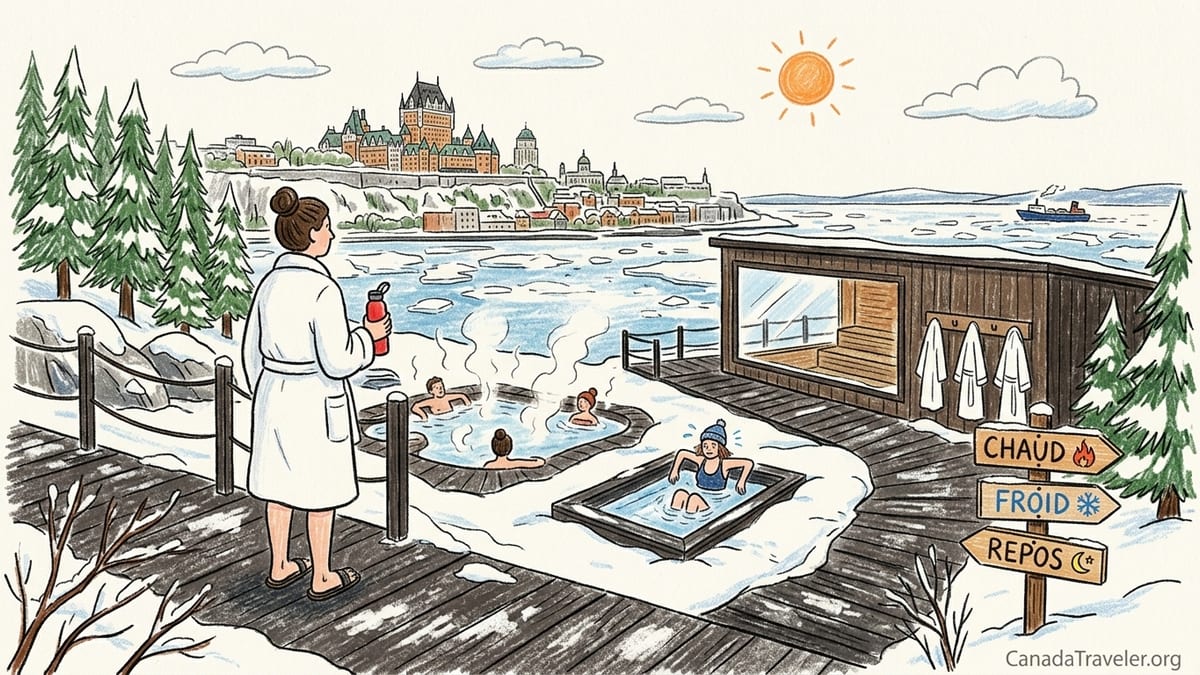
From the changing area, a short indoor corridor led to a glass door and the outdoor deck. There was a hook wall for hanging robes right beside the door, plus shelving for sandals. The deck outside was shoveled, but in mid-February the air temperature hovered well below freezing. Steam from the hot pools rose into the pale winter light, and I could see patches of snow clinging to the dark wood of the boardwalk. It looked equal parts inviting and intimidating.
The Hot Phase: Saunas, Steam and First Impressions
I started my first thermal circuit in one of the large dry saunas. Strøm’s riverfront site has a main panoramic sauna with tiered wooden benches facing a wide window that looks straight across the St. Lawrence. When I pushed open the door, a wall of heat rolled over me. The room was close to silent, apart from the soft hiss of a heater and the creak of wood as people shifted.
I found a place on the middle bench. Within a few minutes, my skin prickled and sweat began to bead along my hairline. Texts about sauna use recommend around 10 to 15 minutes per session if you are in good health and well hydrated, and that felt about right here. Anything beyond that, especially for a first-timer, would have been more about stubbornness than relaxation. The view helped. Ships moved slowly in the river ice, and the city’s upper fortifications sat above, sharp against the clear sky.
Next, I tried a steam room. Compared with the dry heat of the sauna, the steam felt enveloping and almost heavy. The air smelled faintly of eucalyptus. Strøm provides wall-mounted hourglass timers, but I mostly went by feel. Around the eight-minute mark I felt my heart rate rise and my breathing deepen. This was the point the etiquette articles had warned me about: it is important not to go to the limit of what you can bear in the hot phase, because the cold shock comes immediately afterward.
Those first two hot rooms were when the “luxury spa” expectations started to fall away. There was no background music, no chatter, no spa attendant circulating with infused water trays. This was heat as a deliberate stressor, taken seriously but calmly, in a space where your main job was simply to sit and notice what your body did.
The Cold Plunge and Walking Through Quebec Winter in a Bathrobe
Stepping from the sauna into the open winter air was the moment the experience became intensely physical. Even wrapped in a thick robe, the shift from 80-plus degrees Celsius indoors to Quebec’s February chill was drastic. The steam coming off my skin turned to mist in the air. My feet registered the cold of the wooden boards through my sandals, and the skin of my face tightened almost instantly.
Strøm has several options for the cold phase: traditional plunge pools, a waterfall-style cold shower and access points to colder outdoor pools. I chose a small plunge basin directly beside the hot pool. It was roughly chest deep on me, with a ladder for entry. A sign suggested a 10 to 15 second immersion after the hot phase. That sounded short on paper, but staring at the wafting steam and bracing white edge of the pool, it felt like a commitment.
I eased myself down the ladder. The cold hit like an electric jolt at my ankles, then shins, then thighs. By the time the water reached my waist, every instinct screamed at me to climb straight back out. A few people moved purposefully around me, dipping, gasping quietly, then stepping back up and wrapping themselves in robes with practiced motions. Taking a cue from them, I exhaled hard, lowered myself to shoulder depth, counted to twelve and then came up, heart hammering and skin tingling as if it had been lightly slapped all over.
The strangest part of the cold phase was not the plunge itself but the minute immediately after. Standing back on the freezing deck, with air temperatures far below zero, I expected to start shivering. Instead, I felt almost warm. The blood rush from the hot phase and the shock of the cold seemed to flood my body with heat from the inside out. Droplets of water on my arms crystallized into tiny beads before I slipped into my robe. That paradox, of being warm while surrounded by snow and ice, is part of why many Quebecers insist winter is the best season for a Nordic spa.
The Rest Phase and the Question of Silence
After the first hot-and-cold combination, I moved into the rest phase. Nordic spas in Quebec take this part seriously. Strøm’s Old Quebec location offers several distinct relaxation areas: indoor rooms with fireplaces and loungers, quiet indoor nooks with dim lighting, and outdoor Adirondack-style chairs arranged near fire pits. Each is signposted as either silent or whisper-only.
I chose an indoor relaxation lounge with floor-to-ceiling windows. Guests reclined on padded loungers under soft blankets, some with eyes closed, others reading in silence. A low-key staff presence helped keep things orderly. On two occasions during my visit, I saw an attendant gently signal to guests whose conversation had slipped above a whisper, and they quieted immediately. The result was not absolute silence, but a hush closer to a library than a social club.
During my first 15-minute rest, I noticed a surge of warmth spreading through my hands and feet that had been chilly when I first arrived. My heart rate slowed. The initial light-headedness from the sauna faded and was replaced by what I can only describe as a clean tiredness, like after a brisk winter walk. This was the phase that most resembled my idea of a spa in the traditional sense. I could stretch, sip water, and simply look at the changing river light.
On later circuits, I experimented with outdoor rest areas. Sitting by a fire pit in a robe while snowflakes drifted down was atmospheric and uniquely Quebec, but after 10 minutes the cold began to creep in, especially at the ankles and wrists. For true rest, I gravitated back indoors. By the third cycle, I could feel a pattern: heat, shock, then an almost meditative stillness that made 15 minutes pass in what felt like five.
Food, Drink and How Many Hours Before It Felt Repetitive
Quebec’s larger Nordic spas have leaned into the full-day destination model, and Strøm is no exception. There is a restaurant and café area separated from the wet zones, where guests wear robes and sandals but sit at proper tables. The menu during my visit featured salads, tartines, soups and a few heartier dishes like risotto and fish, plus local craft beers, Quebec ciders and a short wine list. As with most Nordic spas, alcohol is available but clearly framed as something to enjoy in moderation, not the focus of the day.
Prices were comparable to a mid-range restaurant in Quebec City. A light main such as a warm grain bowl or fish dish hovered around 25 to 35 Canadian dollars, and non-alcoholic drinks like herbal iced teas or juices were in the 6 to 9 dollar range. I opted for a simple lunch of soup and bread between my second and third circuits, and a large carafe of water. Eating lightly turned out to be the right call. Going straight from a heavy meal back into 80-degree heat would have been uncomfortable.
I stayed at Strøm for just under four hours, completing four full hot-cold-rest cycles and a shorter fifth one that was mainly a soak in a warm outdoor pool followed by a long indoor rest. Around the three-hour mark, the essential novelty of the sequence began to fade. I had tried each sauna and steam option, sampled different cold pools and rotated through several rest areas. The circuit did not become unpleasant, but the experience shifted from discovery to repetition.
In that sense, the guides that suggest planning three to five hours for a Nordic spa day feel accurate. Less than three hours would have felt rushed, especially with a break for lunch. Staying much beyond five, unless you are combining the circuit with a massage or treatment, might feel repetitive for some visitors. The ritual nature of the thermal cycle is the point, but it is also what sets an internal limit on how long the experience feels fresh.
Luxury Expectations vs Minimalist Ritual
Coming from a background of hotel spas and urban day spas, I arrived at Strøm expecting “luxury” to mean constant sensory layering: scented hallways, soft playlists, staff checking in frequently, perhaps small amenities appearing without asking. What I found was a form of luxury that was more about subtraction than addition.
The design at Strøm is high-end, with carefully chosen materials and dramatic river views, but the thermal circuit itself is minimalist. There are no jets timed to pulse on your shoulders, no colored lights dancing through the water, no chatter of conversation to fill the space. Music, when present, is extremely subtle or absent altogether in the hot and rest zones. The ritual is the luxury: you pay for a carefully composed progression of temperatures and textures that you repeat until your body shifts into a different gear.
This took some mental adjustment. My first reaction, somewhere in the second circuit, was a flicker of “Is this it?” Sitting quietly in a sauna or on a lounger, with the instruction to simply notice my breathing and not speak, felt a bit austere. Over time, that stripped-back quality grew on me. Without a phone, without talking and without external entertainment, I had little choice but to track the changing way my body responded: the rush of the first plunge, the calmer second one, the easier breathing in the sauna by the third round.
If your idea of a spa is indulgent variety, this kind of Nordic circuit can feel repetitive or even boring. If you think of it instead as a structured, almost meditative practice, more like a yoga class than a pool party, the minimalist approach begins to make sense. For me, the shift in expectation halfway through the day was what allowed the experience to feel genuinely restorative rather than simply underwhelming.
What I Would Pay Extra For and What I Would Skip Next Time
Most Quebec Nordic spas, including Strøm, offer optional upgrades: massages, body treatments, access to special baths or relaxation experiences, or bundled “thermal plus dining” packages. After one full day on the basic thermal experience, I left with a clearer sense of what I would pay extra for on a return visit and what I would happily skip.
If I were returning in deep winter, I would consider adding a massage scheduled about two hours into my visit, after two full circuits. By that point my muscles felt loose and warm from the heat and cold contrasts, and a focused treatment would likely have had maximum impact. At Strøm, sixty-minute massages typically run in the 140 to 170 Canadian dollar range before tax and tip, which is a significant add-on but could turn the day into a more complete mind-body reset.
I would also pay a small premium for packages that include an extra robe or easy robe exchange. Walking from hot pool to cold plunge to relaxation room in freezing air, your robe can quickly become damp. Strøm’s comfort-level packages at Old Quebec sometimes include a robe exchange and a drink, and that combination started to look appealing as my robe grew progressively heavier through the afternoon. Dry warmth between circuits is one of those quietly important comforts that you only appreciate after a few hours outdoors.
On the other hand, I would probably skip any elaborate meal packages next time. While the food at Strøm was solid, the rhythms of the thermal circuit did not lend themselves to a long, multi-course lunch. A light snack and plenty of water suited the day better. I would also skip upgrades that add more sensory elements, like sound baths or lumino-meditation rooms, unless I were specifically in the mood to experiment. For me, the core value of the Nordic spa is the simple hot-cold-rest loop. Adding too many layers risks turning what is essentially a clean ritual into another form of busyness.
Urban Nordic Spa vs Nature Retreat: Bota Bota, Strøm and Beyond
Spending a winter afternoon at Strøm on the St. Lawrence made me appreciate the particular charm of an urban Nordic spa. The view of Quebec City’s cliffs and historic skyline, the slow movement of river ice and the faint sounds of the city in the distance created a sense of being removed from everyday life without actually leaving town. It was easy to walk back up into Old Quebec afterward for dinner, cheeks still flushed from the cold plunges.
At the same time, I could see the appeal of other styles. Earlier in my Quebec trip, I had visited Montreal and walked past Bota Bota, the floating spa moored in the Old Port. There, the thermal circuit unfolds on multiple decks of a converted river ferry, with one side facing historic warehouses and the other looking out to the wider river. As of 2026, its water circuit day access is in roughly the same price tier as Strøm, with a strong recommendation to reserve ahead on weekends. Bota Bota felt even more urban and vertical in design, with city views woven into almost every corner of the ship.
On the more remote end of the spectrum are nature-focused spas just outside Quebec City, such as Siberia Station Spa in Lac-Beauport. Locals describe these as immersive forest experiences, with pools and saunas scattered among tall pines and beside streams, about a 20-minute drive from the city. Prices for day access typically fall within the same general bracket as urban spas, but the setting is entirely different. In photographs and local accounts, guests step from saunas directly onto snow, with fewer built structures in sight.
Having now tried an urban riverfront spa, I found myself imagining a next trip that combines both: a day at Strøm or Bota Bota to enjoy the contrast between hot water and cityscape, and a second day at a forest spa for deeper quiet. If forced to choose just one next time, I would probably opt for a slightly more remote, nature-forward spa in winter. While I loved Strøm’s design and convenience, the moments that stayed with me most strongly were those where trees and snow, rather than architecture, filled my field of vision.
The Takeaway
Walking back into Old Quebec in the blue light of late afternoon, with the St. Lawrence behind me and the faint sensation of warmth still moving through my limbs, I realized that my first full Nordic spa day had been both less immediately glamorous and more quietly affecting than I had expected. There were no dramatic transformations, just a slow peeling away of tension in 90-minute increments of heat, cold and rest.
Who is most likely to love this kind of Quebec Nordic spa experience? Travelers who enjoy ritual, who are comfortable with silence, and who are curious about how structured exposure to heat and cold can change how they feel over the arc of several hours. Solo travelers and couples seem to thrive in these spaces. It is one of the rare activities where doing nothing is not only allowed but encouraged, and where being offline feels socially reinforced rather than like a personal experiment.
Who might find it boring or uncomfortable? Anyone who equates “spa” with socializing, conversation, cocktails by the pool and a constantly changing menu of distractions may find a Nordic circuit too stark. The repetition can feel tedious if you fight it, and the silence rules, while not absolute, are taken seriously enough that groups looking for a chatty afternoon will likely feel constrained. People who are very sensitive to cold or who dislike the idea of icy water, even for seconds, may also struggle to relax into the cycle.
As for me, I would return to Strøm in a heartbeat, but I would frame it clearly in my mind as a form of active rest rather than indulgent pampering. Next time in Quebec, I would plan one day at an urban spa like Strøm or Bota Bota, then set aside another for a forest spa outside the city, using the same hot-cold-rest pattern in a more natural setting. The Nordic spa may not match the plush fantasy of a luxury spa day, but in the depth of a Quebec winter, its minimalist ritual feels precisely attuned to the landscape outside the steam-fogged glass.
FAQ
Q1. How much does a Nordic spa day in Quebec typically cost?
For a full day of access to the thermal circuit at a major Quebec Nordic spa such as Strøm in Old Quebec or Bota Bota in Montreal, you can expect to pay somewhere in the range of about 80 to 150 Canadian dollars per adult, depending on the day of the week, time of day and whether you choose basic access or a package with extras like drinks, meals or special baths.
Q2. How long should I plan to stay at a Nordic spa?
Most regular visitors recommend planning three to five hours for a Nordic spa visit so you can complete several full cycles of hot, cold and rest without rushing, have time for a light meal or snack, and still leave before the experience begins to feel repetitive.
Q3. Do I need to book my Nordic spa visit in advance?
Advance reservations are strongly recommended, especially on weekends and holidays. Many Quebec Nordic spas allow walk-ins on quieter weekdays, but they limit capacity, so booking ahead online is the safest way to secure a spot and choose your arrival time.
Q4. What should I bring with me to a Quebec Nordic spa?
At a minimum you should bring a swimsuit, sandals, and a refillable water bottle. Many spas include a robe, towel and locker with entry, but some charge extra for robe rental, so it is worth checking the specific policy of the spa you plan to visit.
Q5. Are phones really banned at Nordic spas?
Most Quebec Nordic spas either fully ban phones in the thermal circuit or limit them to small designated areas. Staff do enforce these rules, and guests are expected to keep devices in their lockers so that the hot, cold and rest zones remain quiet, screen-free spaces.
Q6. What does the hot-cold-rest sequence actually feel like?
The hot phase brings deep warmth and heavy sweating, followed by an intense, brief shock in the cold plunge, and then a wave of calm, loose warmth during the rest phase. Over several cycles many people notice that the cold becomes less intimidating and the rest periods feel more deeply relaxing.
Q7. Is winter really the best time to visit a Quebec Nordic spa?
Winter is an especially atmospheric time to visit because the contrast between hot pools and freezing air is at its strongest, and walking through snow in a robe between saunas and cold plunges adds a memorable, almost otherworldly element to the ritual.
Q8. Can I talk with friends during the thermal circuit?
Conversation is usually limited to quiet whispers, and many areas are designated silent. Small amounts of low-voiced chatting are tolerated in some pools and rest zones, but guests who talk loudly or constantly will almost certainly be reminded to lower their voices by staff.
Q9. Are food and drinks available during a Nordic spa visit?
Yes, larger Nordic spas in Quebec typically have a restaurant or café where you can eat in your robe between circuits, offering light dishes, snacks and drinks. Alcohol is often available but is expected to be consumed in moderation and not taken into the hot or cold installations.
Q10. Should I choose an urban spa like Bota Bota or Strøm, or a more remote nature spa?
Urban spas such as Bota Bota in Montreal and Strøm in Old Quebec offer dramatic city or river views and easy access from hotels and restaurants, while more remote nature spas outside Quebec City immerse you in forest and snow. The choice comes down to whether you prefer the contrast of hot water and cityscape or the deeper quiet of a wooded setting, but both follow the same hot-cold-rest ritual.