


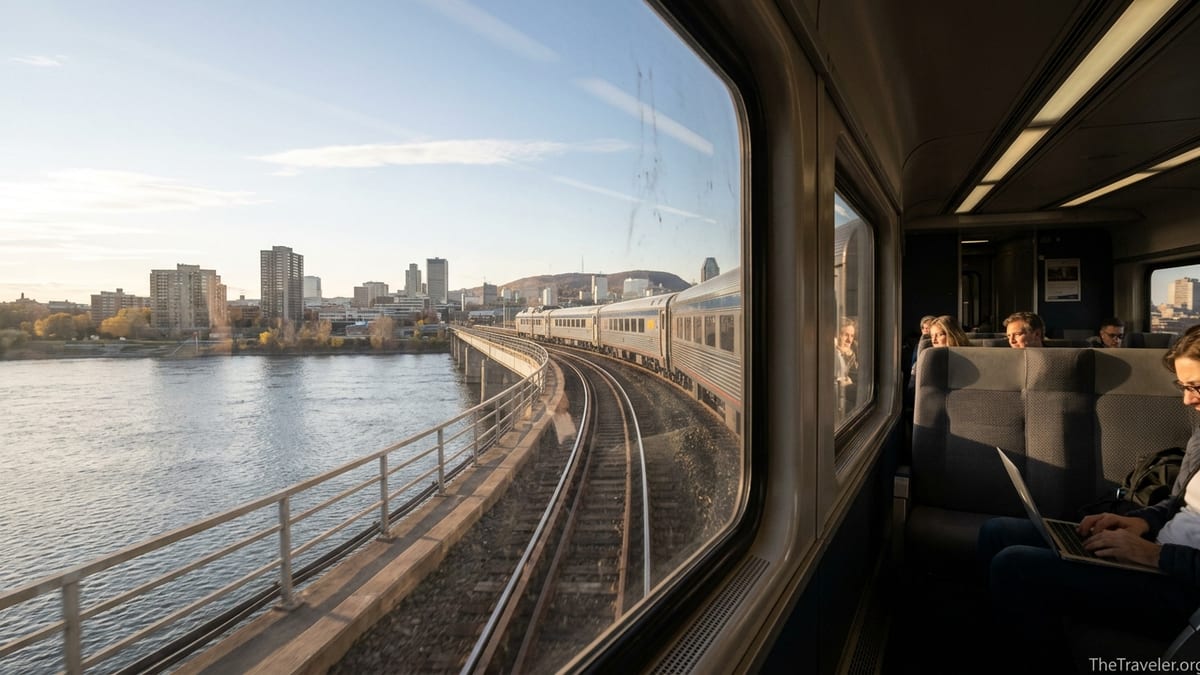
Riding the train through Eastern Canada is one of the most relaxed ways to link Toronto, Ottawa, Montreal and Quebec City. Instead of battling highway traffic or airport security, you can settle into a wide seat, watch the St. Lawrence and Ottawa River valleys roll by, and arrive downtown without needing a rental car. This guide walks through how the Corridor routes work, how to book, what to expect in Economy versus Business, how luggage is handled, and when rail stops being the most practical option as you push farther east toward the Maritimes.
How the Eastern Canada Corridor Works
Intercity passenger trains in Eastern Canada are operated by VIA Rail Canada, a federal Crown corporation that runs the busy Quebec City to Windsor Corridor and longer distance routes like The Ocean between Montreal and Halifax. For most travelers focusing on Toronto, Ottawa, Montreal and Quebec City, the Corridor service is the backbone of the trip, with multiple daily departures and straightforward booking. Trains on these routes are usually modern, with air conditioning, power outlets and Wi-Fi available in both Economy and Business cars.
Toronto is the main western gateway for this itinerary, with trains radiating to Ottawa and Montreal and then continuing along the St. Lawrence River to Quebec City. Ottawa sits roughly four hours from Toronto by train and about two hours from Montreal. Quebec City is generally reached by changing trains in Montreal, though some departures run through without a change, especially at peak times. As of 2026, schedules on the Corridor are frequent, but exact times and trip lengths vary a little depending on the train and time of day, so it is important to check current timetables as you plan.
In practice, the Corridor feels similar to a European intercity network rather than a high speed line. Trains do not reach the very high speeds found on French TGVs or Japanese bullet trains, but journey times are competitive with driving once you factor in traffic and breaks, and they almost always deliver you to a central station. For example, Toronto Union Station, Ottawa Station, Montreal Central Station and Quebec City’s Gare du Palais are all linked to transit and ride shares, which makes arriving by rail especially convenient if you prefer not to rent a car.
Because this is one of VIA Rail’s busiest regions, you will also find more modern rolling stock on these routes than you might on some longer distance lines. Newer train sets are being introduced across the Corridor with upgraded seating, lighting and accessibility. While you may still find a mix of older and newer cars during this transition period, from a traveler’s perspective the overall experience is noticeably more comfortable than many intercity bus options and often more relaxed than flying.
Key Routes: Toronto, Ottawa, Montreal and Quebec City
The most common rail loop through Eastern Canada connects Toronto, Ottawa, Montreal and Quebec City in some combination. From Toronto to Ottawa, typical journey times are around four to four and a half hours, with several trains daily. Many travelers choose a morning departure from Toronto Union Station to arrive in Ottawa around midday, leaving time to check into a hotel and walk along the Rideau Canal before dinner. The reverse route from Ottawa back to Toronto runs just as frequently, which makes it easy to shape a flexible itinerary.
Between Ottawa and Montreal, trains generally take about two hours. This leg is short enough that you can easily do it in the morning and still have a full afternoon to explore Old Montreal or the Plateau. Some trains on this route continue through to Quebec City, meaning you can stay in your seat in Ottawa and arrive in Quebec City later the same day, while others require a change at Montreal’s Central Station. Connections in Montreal are usually straightforward, with clear signage and staff on hand if you are unsure where to go.
The line between Montreal and Quebec City follows the St. Lawrence corridor and takes roughly three to three and a half hours, depending on the specific train. Many visitors schedule this leg midmorning so they reach Quebec City in time for a late lunch near Place Royale or Terrasse Dufferin. Because Quebec City’s station is close to the historic centre but not right on top of the upper-town sights, some travelers book accommodations within walking distance of the funicular or use a short taxi or ride share from the station to reach their hotel, especially if they are carrying luggage.
From Toronto to Montreal, there are two main approaches by rail. You can travel directly between the two in about five hours, or you can route via Ottawa, splitting the journey into a four hour trip followed by a two hour hop. Direct Toronto to Montreal services are appealing if you want to maximize time in the big cities, while the via-Ottawa option works well for travelers who want to see the capital without adding a separate side trip. In both cases, trains are frequent enough that you can choose morning, midday or late afternoon departures to match your sightseeing plans.
Booking Tickets and Understanding Fares
VIA Rail sells tickets directly through its own website and mobile app, as well as through some third party travel agencies and rail specialists. For most independent travelers planning a Toronto to Quebec City itinerary, booking directly is the simplest and often the most economical. When you search for a route like Toronto to Montreal or Ottawa to Quebec City, you will usually see a range of departure times, each with several fare types in both Economy and Business. The lowest prices are generally found if you book several weeks in advance and travel outside the busiest holiday periods.
Typical one way Economy fares on Corridor routes can vary widely depending on demand and how early you book. For instance, it is common to see advance Economy tickets between Toronto and Ottawa, or Toronto and Montreal, that are significantly cheaper than last minute bookings for the same train. On popular Friday evening or Sunday afternoon departures, especially at the start or end of long weekends, prices can rise quickly as the train fills. Flexible fares that allow changes or refunds are usually more expensive than nonrefundable options, so it is worth deciding in advance how firmly set your dates are.
Business class fares on the Corridor are higher but include additional services such as lounge access at major stations, a hot meal and drinks on many departures, as well as larger seats and priority boarding. On some midweek trains, the price gap between the cheapest available Economy ticket and a discounted Business seat can be relatively modest, especially if Economy has only higher, flexible fares remaining. On other days and times, Business can be considerably more expensive. Checking several departure times on the same day often reveals better value options if your schedule is flexible.
The booking engine clearly shows whether a particular ticket includes extras such as meal service, change flexibility or additional loyalty benefits. If you are planning multiple journeys, consider creating a VIA Rail profile so your passenger details and preferences are saved and so you can track points if a loyalty program is important to you. When traveling in a group, booking all passengers on the same reservation simplifies seat assignments and makes it easier to sit together, although you can often choose or adjust specific seats during or after booking if the train still has open seating inventory.
Economy vs Business: Choosing the Right Class
On the Quebec City to Windsor Corridor, VIA Rail offers two main classes: Economy and Business. Economy is the baseline product and is already more comfortable than many long distance buses, with assigned seating, access to Wi-Fi, power outlets at or near the seat, and the ability to purchase snacks and drinks from an onboard cart or service counter. Seats in Economy are typically arranged in a 2 by 2 configuration with decent legroom and reclining backs, making even a five hour Toronto to Montreal trip manageable for most travelers.
Business class, previously branded as VIA 1, is positioned as a premium experience for those who value extra space, included meals and a quieter environment. Business passengers usually have access to station lounges in key hubs like Toronto and Montreal, where you can wait with complimentary drinks and a more relaxed atmosphere before boarding. Onboard, Business cars offer wider seats with more legroom, often in a 2 by 1 or similar layout on some newer equipment, along with at seat meal and bar service included in the ticket price on many daytime trains. For example, lunchtime departures between Toronto and Montreal commonly feature a hot meal served with wine or soft drinks.
Whether Business is worth the upgrade depends on your budget and travel style. For a short two hour hop between Ottawa and Montreal, many travelers decide that Economy is perfectly adequate and that the extra cost of Business is hard to justify, especially if they plan to spend most of the trip working quietly with headphones. On longer legs, such as Toronto to Quebec City via Montreal, a Business ticket can be attractive if you value a hot meal, quieter surroundings and more space to spread out with a laptop. Travelers with back issues or those arriving off an overnight flight into Toronto often appreciate the extra comfort.
It is also worth thinking about timing. On early morning trains, Business can provide a peaceful environment to catch up on sleep or emails, while evening departures may feel more social as passengers enjoy drinks and conversation over a multi course meal. Some regular Corridor travelers report that the onboard experience can vary slightly from trip to trip depending on staff and load, but in general Business remains a noticeable step up from Economy. If your schedule is fixed and you see a Business fare that is only moderately higher than a flexible Economy ticket, upgrading for at least one of your longer segments can make your rail journey feel like part of the vacation, not just a way to get from A to B.
Luggage, Seating and Onboard Practicalities
VIA Rail’s baggage rules on Corridor trains are relatively straightforward and comparable to airlines, though usually a bit more forgiving. Economy and Business passengers are typically allowed a combination of carry on items and, in some cases, checked bags within set size and weight limits. Since baggage car service has been scaled back on many Corridor trains, most travelers rely primarily on carry on luggage that they can store in overhead racks or at the end of the car. A common practical approach is to travel with a medium sized rolling suitcase and a personal item like a backpack, keeping valuables and documents with you at your seat.
Seats are assigned when you book or during check in, with the exact process varying slightly depending on the age of the train set and how VIA is managing reservations at the time of travel. In general, families and couples who book together are seated together, and there is usually a chance at booking or later via the app to choose a window or aisle. If sitting on a particular side of the train matters to you for scenery, staff at the station or on the platform can sometimes advise which direction the train will be facing and whether that will give you better views of the lakes, rivers or city skyline along your route.
Onboard amenities include washrooms in every car and Wi-Fi throughout the Corridor trains, though speeds can fluctuate, especially in more rural stretches. Power outlets are widely available, so it is easy to keep phones and laptops charged while you work or stream. Food options in Economy typically consist of a rolling cart or a small service area serving light snacks, sandwiches and beverages for purchase. In Business, service is more structured, with a bar cart and hot meals on many departures. For example, a midmorning Toronto to Ottawa Business service might start with a beverage service shortly after departure, followed by a hot breakfast and coffee refills as the train passes through eastern Ontario.
As on most intercity trains, common sense travel habits go a long way to ensuring a smooth trip. Label your bags clearly, keep passports and wallets on your person even when you go to the washroom, and avoid blocking aisles or doorways with large suitcases. If you are traveling with skis, bikes or bulky equipment, it is essential to check current rules, as not all Corridor trains are equipped to handle oversized items and options may be limited to specific departures or require advance arrangements.
Train vs Driving: Making the Right Call
Choosing between train and car in Eastern Canada often comes down to your priorities. If you value flexibility, want to explore small towns and rural areas, or are traveling with a larger family where splitting the cost of a rental and fuel makes sense, driving can be appealing. Distances are manageable: for example, Ottawa is roughly a four hour drive from Toronto and about two hours from Montreal, according to regional tourism authorities, and Quebec City sits a further few hours northeast along the St. Lawrence from Montreal. Highways are generally in good condition, though winter driving between November and March can involve snow and ice.
For many city to city trips, however, the train is competitive or better once you factor in downtown arrival, parking costs and driver fatigue. A five hour rail journey from Toronto to Montreal allows you to work, read or relax instead of concentrating on highway traffic around Kingston and other busy stretches. You also avoid parking charges that can add significantly to the cost of a night or two in central Toronto or Montreal. For solo travelers or couples, especially those comfortable using urban transit and walking, rail often compares favorably in total cost to a rental car plus fuel and parking.
Environmental impact is another consideration. Intercity trains generally have a lower carbon footprint per passenger than driving alone, particularly on busy routes where trains run full or nearly full. If you are trying to keep your trip relatively low impact, choosing rail for the main Toronto to Ottawa to Montreal to Quebec City legs and then renting a car only for short rural side trips can be a sensible compromise. Many travelers, for instance, arrive in Quebec City by train, spend a couple of nights car free in the old city, then rent a car for a day or two to explore Île d’Orléans or Montmorency Falls before returning the vehicle and continuing by rail or air.
There are also less tangible benefits. If you are visiting from abroad, riding the train can feel like part of the cultural experience, offering a window onto everyday Canadian life that you do not always get behind the wheel. Onboard conversations with fellow passengers, glimpses of small stations and farm towns, and the simple rhythm of watching the countryside slide past can be a pleasant counterpoint to the museums and restaurants at your destination. For many visitors, combining one or two long rail legs with shorter drives or local transit provides the best balance between efficiency and a sense of journey.
Beyond Quebec City: When Rail Becomes Less Practical
East of Quebec City, frequent Corridor style service gives way to more limited options. VIA Rail’s primary route into Atlantic Canada is The Ocean, an overnight train between Montreal and Halifax that operates several times a week. This train is more of a classic long distance service, with sleeper accommodations in Sleeper Plus class and seated accommodation in Economy. For travelers starting in Toronto, reaching Halifax by rail usually means taking a Corridor train to Montreal, spending part of the day there, then boarding The Ocean in the evening for the overnight journey to the Maritimes.
The Ocean is a scenic and atmospheric way to reach Atlantic Canada if you have time in your itinerary. However, its limited frequency and overnight schedule make it less flexible than simply renting a car in Quebec City or Montreal and driving east, or taking a short flight from Montreal or Quebec City to Halifax. For example, if your main goal is to spend several days exploring Nova Scotia’s South Shore or Cape Breton, you may find that a direct flight from Toronto or Montreal combined with a local rental car gives you more time on the ground and more control over your schedule than relying on the train.
Within the provinces east of Quebec, regular intercity rail options are sparse. There is no dense web of trains linking places like Fredericton, Charlottetown or Saint John with Quebec City in the same way that Toronto, Ottawa, Montreal and Quebec City are connected. Buses, regional flights and driving become the primary means of getting around. As a result, rail travel is most practical as far as Quebec City, and then again only if you are specifically interested in the experience of The Ocean for the stretch between Montreal and Halifax. For anything more intricate, particularly itineraries that involve multiple small towns, self driving or guided tours fill the gaps.
Many travelers choose a hybrid approach. They ride the train between Toronto, Ottawa, Montreal and Quebec City to keep the city to city legs relaxed and low stress, then either fly or rent a car from Quebec City or Montreal to continue east. For instance, a couple might spend a week traveling by rail from Toronto to Quebec City, then fly to Halifax for several days of coastal touring by car before returning home by air. Understanding where the rail network is strongest helps you allocate your time and budget to the modes of transport that make the most sense on each segment.
The Takeaway
Traveling through Eastern Canada by train offers a comfortable, low stress way to link some of the country’s most interesting cities. The Corridor routes between Toronto, Ottawa, Montreal and Quebec City are frequent and reliable, with modern trains, straightforward booking and a choice between solid Economy seats and upgraded Business class with meals and lounge access. For many itineraries, especially those focused on city breaks and cultural sights, rail compares very favorably to driving in both cost and convenience.
At the same time, it helps to recognize the limits of the network once you push beyond Quebec City toward the Atlantic provinces. The Ocean from Montreal to Halifax can be a memorable overnight journey, but its schedule and coverage mean that buses, flights and rental cars still play a major role in exploring smaller communities and coastal regions. By using trains where they are strongest and switching to other modes where necessary, you can build a trip that feels both relaxed and efficient.
With a bit of advance planning on tickets, a clear sense of the differences between Economy and Business, and realistic expectations about luggage and onboard services, you can treat the rail segments of your trip as part of the adventure rather than a chore. Watch the city skylines give way to river valleys, work or read at a full sized table instead of juggling items in a car seat, and step off the train directly into the heart of some of Eastern Canada’s most compelling destinations.
FAQ
Q1. How far in advance should I book VIA Rail tickets for the Toronto to Quebec City corridor?
For the best prices and choice of departure times, it is sensible to book several weeks in advance, especially for peak periods such as summer weekends and major holidays. Last minute seats are often available but may cost more and be limited to less convenient departure times.
Q2. Is Business class on VIA Rail worth the extra cost on these routes?
Business class is often worth it on longer legs like Toronto to Montreal or Toronto to Quebec City, where the wider seats, included meals, lounge access in major stations and quieter environment add noticeable value. On shorter segments such as Ottawa to Montreal, many travelers find that Economy offers enough comfort that the upgrade is less compelling unless prices are close.
Q3. Can I travel with large luggage on Corridor trains?
You can bring suitcases on Corridor trains, but baggage car service is limited and most passengers rely on carry on sized bags that can fit in overhead racks or at the ends of the cars. If you plan to travel with very large or heavy items, it is important to check current baggage rules and consider traveling lighter to avoid inconvenience.
Q4. Do Corridor trains have Wi-Fi and power outlets?
Yes, trains in the Quebec City to Windsor Corridor are generally equipped with Wi-Fi and power outlets in both Economy and Business. Wi-Fi speeds can vary by segment and usage, so downloading key files or entertainment before boarding is a good precaution if you need a reliable connection.
Q5. How do train travel times compare with driving between these cities?
Rail journey times are broadly similar to driving once you factor in traffic and rest stops. For example, Toronto to Ottawa or Montreal by train usually takes about as long as driving those routes, but the train delivers you downtown, avoids parking hassles and allows you to relax instead of focusing on the road.
Q6. Is it easy to connect from the train stations to city centers?
Major stations such as Toronto Union Station, Montreal Central Station and Quebec City’s Gare du Palais are located centrally or close to downtown, with easy access to public transit, taxis and ride shares. Ottawa’s main station sits a short transit or taxi ride from the core, and connections are straightforward for most travelers.
Q7. Can I continue by train beyond Quebec City into Atlantic Canada?
Yes, but options are more limited. The primary route east is The Ocean, an overnight train between Montreal and Halifax that runs several times a week. There is no dense network of daytime trains beyond Quebec City, so many travelers use a combination of rail, flights and rental cars to explore the Atlantic provinces.
Q8. Are there food options in Economy, or do I need to bring my own?
Economy passengers can usually buy light snacks, sandwiches and drinks from an onboard cart or service area, but the selection is modest. Many travelers bring their own food and refillable water bottles for more choice, especially on longer journeys, while relying on the train offerings for coffee or additional snacks.
Q9. Do I need a car at my destination if I arrive by train?
In Toronto, Ottawa, Montreal and Quebec City, you can comfortably explore central areas on foot, by public transit and with occasional taxis or ride shares, so a car is not essential for city focused stays. You are more likely to want a rental car if you plan day trips to rural areas, national parks or coastal drives beyond what local tours or transit can easily reach.
Q10. Is winter train travel in Eastern Canada reliable?
Trains in this region are used to operating in winter conditions and often continue running when driving can be more stressful due to snow and ice. Weather related delays are possible during storms, but rail generally remains a dependable option, and many travelers prefer it to highway driving between late fall and early spring.