

Planning a trip to Canada often starts with one big decision: east or west. On one side, Toronto, Montreal and Quebec City offer dense culture, historic districts, food scenes and easy rail connections. On the other, Vancouver and the Canadian Rockies promise snow-capped peaks, turquoise lakes, wildlife and legendary road trips. Both regions can fill an unforgettable itinerary, but they deliver very different kinds of vacation. This guide compares the two sides of Canada on cities, scenery, road trips, wildlife, weather, costs and overall vibe to help you decide which is better for your next trip.
Eastern Canada vs Western Canada at a Glance
For most international visitors, “Eastern Canada” on a first trip means a loop built around Toronto, Montreal and Quebec City, sometimes with a side trip to Niagara Falls or Ottawa. These cities are close together by North American standards, with fast trains and multiple daily flights linking them. You can breakfast in Toronto’s Financial District and have dinner on a terrace in Old Montreal the same day.
“Western Canada” usually means a combination of Vancouver and the Canadian Rockies, especially Banff, Lake Louise and Jasper. Distances are larger, but the payoff is dramatic mountain landscapes, glacier-fed lakes and high chances of seeing wildlife like elk or black bears from the highway. Many travelers fly into Vancouver, then drive or take a bus tour through the Rockies via Kamloops or Kelowna.
In simple terms, choose the east if you want European-style old towns, museums, food and nightlife in walkable cities, and the west if your priority is mountains, hiking, lakes and scenic drives. Families often split the difference: a week in Toronto and Montreal focused on urban attractions, or a week in Vancouver and Banff with gondola rides and easy lakeside walks rather than serious backcountry adventures.
Season matters as much as geography. Montreal and Quebec City in February feel like a snow globe with ice sculptures and the famous Quebec Winter Carnival, while Vancouver in the same month is often rainy but mild, with cherry trees starting to bud. In July, Toronto can be hot and busy with festivals, while the Rockies are prime for hiking with most trails snow free but peaks still capped in white.
Cities: Culture, Food and Nightlife
Toronto is Canada’s biggest city and feels the most like a classic North American metropolis, with a skyline of glass towers, big-league sports, and major museums like the Royal Ontario Museum and the Art Gallery of Ontario. Neighborhoods such as Kensington Market and Queen Street West offer independent boutiques, street art and multi-ethnic food. A typical mid-range downtown hotel, such as a modern chain near Union Station, often runs in the region of 260 to 320 Canadian dollars per night outside peak event dates, reflecting Canada’s record-high hotel rates in 2025.
Montreal delivers a more European mood, mixing French language and café culture with festivals and nightlife. Old Montreal’s cobblestone streets, the Notre-Dame Basilica and the Old Port give the city a historic core that feels very different from Toronto. Nearby, the Plateau and Mile End districts are known for bagel bakeries open late into the night, crowded terraces, and bars where a glass of wine or beer often costs noticeably less than in downtown Toronto. Travelers who care about food culture, neighborhood exploring and a party atmosphere often gravitate to Montreal as their favorite Canadian city.
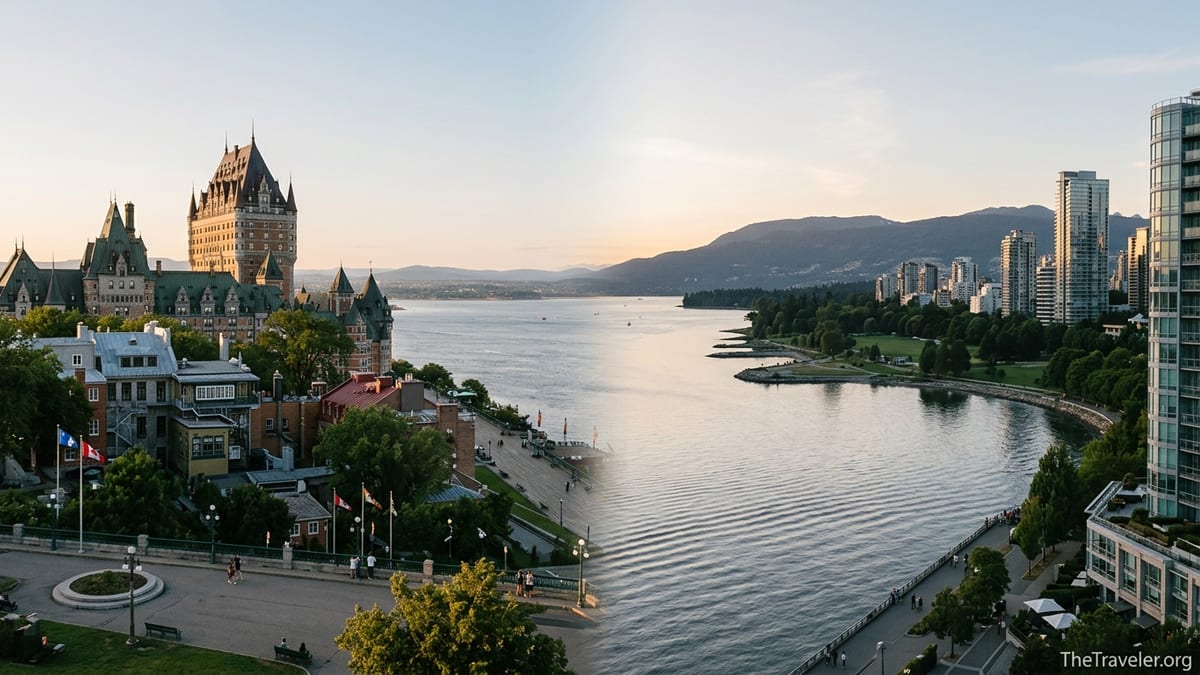
Quebec City feels smaller and more intensely historic than either. The walled Old Quebec, the Chateau Frontenac hotel towering over the St. Lawrence River, and narrow lanes filled with bistros make it feel closer to a compact French hill town than a North American city. In winter, the streets around the Upper Town and the Plains of Abraham host the Quebec Winter Carnival, typically in early to mid February, with ice palaces, snow sculptures and night parades in temperatures that can dip well below freezing. Boutique hotels in Old Quebec can cost less than comparable historic properties in Western Canada’s resort towns, but demand spikes around festival dates and summer weekends.
Vancouver sits apart from all of these. It is a coastal city framed by mountains and ocean, with Stanley Park’s seawall, nearby beaches and easy access to the North Shore mountains for hiking or skiing. Food is heavily influenced by Pacific Rim and East Asian cuisines, and you can eat well in everything from modest ramen shops on Robson Street to seafood restaurants overlooking Coal Harbour. Hotel prices reflect high demand: industry data shows Vancouver has some of Canada’s highest average daily hotel rates, often around the high 200s Canadian dollars per night for centrally located properties, and considerably more during summer or special events.
Mountains, Lakes and Iconic Landscapes
If your mental image of Canada is turquoise lakes and jagged peaks, Western Canada will line up closely with that picture. Banff and Jasper National Parks are the classic entry point. Lake Louise’s bright blue water and Moraine Lake’s craggy backdrop are among the most photographed places in the country. In summer, short walks like the Lake Agnes Tea House trail or the Johnston Canyon catwalks let relatively casual hikers get deep into mountain scenery without technical gear.
The Icefields Parkway between Lake Louise and Jasper is one of the world’s great mountain drives, with glaciers spilling down to the roadside and frequent pullouts where you can see turquoise lakes below. Organized tours from Banff or Jasper often include time on the Columbia Icefield, while independent travelers frequently stop for half-day hikes to viewpoints like Parker Ridge. In winter, much of the parkway remains open but feels more like an expedition, with icy roads, short daylight and a greater need to plan fuel and services carefully.
Eastern Canada has beautiful landscapes, but its mountains are older and lower. Near Montreal, the Laurentians provide forested hills, ski resorts such as Mont Tremblant, and lakeside cottage country rather than dramatic alpine terrain. Quebec City’s nearby Charlevoix region adds fjord-like cliffs around the Saguenay and scenic river views, but it still lacks the rugged vertical relief of the Rockies. For visitors whose dream is to look out over vast mountain ranges, the west wins almost every time.
That said, the east scores higher on certain types of scenery. The St. Lawrence River around Quebec City can be breathtaking during the fall foliage season, with hillside neighborhoods blazing red and orange. East of Quebec City, small villages like Baie-Saint-Paul combine river views and creative scenes with local food and craft shops. Travelers who are more interested in a mix of gentle landscapes and culture, rather than high-adrenaline adventure, often find this countryside ideal.
Road Trips and Getting Around
In Eastern Canada, many first-time visitors do not need a car at all. Toronto, Montreal and Quebec City are linked by frequent flights and intercity trains, with typical rail travel times of around five hours between Toronto and Montreal and about three hours between Montreal and Quebec City. Within the cities, public transit and walkable historic cores make it easy to rely on subways, buses and ride-hailing. A classic trip might look like three nights in Toronto with a day tour to Niagara Falls, three nights in Montreal, and two nights in Quebec City, all connected by train and short taxi rides.
Renting a car in the east becomes more appealing if you want to add side trips, such as the Laurentians, Prince Edward County’s wineries near Lake Ontario, or the Eastern Townships south of Montreal. Driving between Toronto and Montreal is roughly a five to six hour highway run along the 401, not particularly scenic but straightforward. Parking in downtown Toronto and Montreal can be expensive, so some travelers pick up their rental car only on the days they actually intend to leave the city.
In Western Canada, a car is close to essential outside the larger cities. Vancouver’s downtown core and nearby neighborhoods like Kitsilano are walkable and well served by the SkyTrain and buses, but reaching the Rockies involves either a long drive or a packaged coach tour. The drive from Vancouver to Banff via the Trans-Canada Highway is roughly nine to ten hours of actual road time, not counting stops. Many travelers break it in Kamloops or Revelstoke to avoid long days behind the wheel.
Once you are based in Banff or Jasper, a car or local shuttle is usually needed to reach lakes, trailheads and viewpoints. National park passes are required for all vehicles entering or staying in these parks. Organized tours exist to places like Moraine Lake and the Icefields Parkway and can be a good option in peak season, when parking lots at famous lakes are often full early in the morning. For independent travelers, building in extra time for early starts or shoulder-season visits can reduce crowds.
Weather and Best Seasons
Weather is one of the biggest differences between east and west. Eastern cities like Montreal and Quebec City have classic continental climates, with hot, often humid summers and cold, snowy winters. In January and February, daytime temperatures in Quebec City frequently sit well below freezing, with cold snaps that can plunge toward minus 20 degrees Celsius or lower. That deep winter cold is part of the experience, especially if you plan to visit the Quebec Winter Carnival, which usually runs for about 10 days in early to mid February and dresses the old town in snow sculptures and ice bars.
Summers in Toronto and Montreal can feel surprisingly hot. July daytime highs are often in the mid to high twenties Celsius, with humidity making it feel warmer. Outdoor events like the Montreal International Jazz Festival, Toronto Caribbean Carnival and open-air food markets take advantage of the season. If you enjoy restaurant patios, riverfront walks and long evenings, late June through early September is often the top time to visit, though it is also when hotel prices and crowds peak.
On the Pacific coast, Vancouver’s climate is much milder. Winters are generally cool and wet rather than deeply cold, with frequent rain and occasional light snow at sea level. This makes Vancouver a pleasant city break almost year-round, but it also means low clouds and drizzle can obscure mountain views for days at a time. In contrast, the Rockies further inland have much colder, snowier winters with bright blue skies. January in Banff can bring crisp, dry cold that is ideal for skiing and snowboarding, as long as you are prepared with proper clothing.
Summer in the Rockies, typically late June through early September, is prime hiking season, though snow can linger on some higher trails into July. Wildfire season has become a factor in recent years, with smoke occasionally reducing visibility in July or August. Travelers who want good chances of clear hiking conditions without intense heat often target late June in the east for city trips, or early September in the west for mountains, when trails are mostly open but families have gone home for the school year.
Wildlife, Outdoor Activities and Experiences
Wildlife is where Western Canada clearly stands out. In and around Banff and Jasper, it is common to see elk grazing near town, bighorn sheep along the highway, and black bears feeding on roadside vegetation in late spring and early summer. Parks staff strongly encourage visitors to keep their distance, stay inside vehicles when animals are close, and carry bear spray on backcountry hikes. Simple experiences like driving at dusk along the Bow Valley Parkway can easily turn into impromptu wildlife-viewing evenings.
Outdoor activities in the west lean heavily to hiking, skiing and water-based adventure. In summer, even casual visitors often take the Banff Gondola up Sulphur Mountain for 360-degree views, rent canoes on Lake Louise, or book half-day rafting trips on nearby rivers. In winter, ski resorts like Sunshine Village, Lake Louise Ski Resort and Whistler Blackcomb near Vancouver attract visitors from around the world. Many hotels in Banff, Jasper and Whistler run shuttle buses to lifts and provide secure ski storage, making them convenient bases for multi-day stays.
In Eastern Canada, wildlife tends to be less visible in the city-focused itineraries, though you may still see squirrels, raccoons and the occasional fox in urban parks. To increase your chances of larger animals, you would need to add nature-focused side trips, such as whale watching on the St. Lawrence River, black bear viewing in parts of Quebec’s interior, or hikes in provincial parks north of Montreal or Toronto. These experiences are rewarding, but they take more planning and travel than simply stepping out of a hotel in Banff and driving ten minutes.
On the other hand, the east excels at cultural experiences. Spending an evening at a small venue listening to jazz in Montreal, joining a food tour through Toronto’s diverse neighborhoods, or walking Quebec City’s fortified walls at sunset are all quintessential eastern Canada moments. Travelers interested in art, history and language often find several days vanish quickly in museums, galleries and historic sites without ever leaving the city limits.
Hotels, Costs and Practical Budgeting
Canada’s hotel prices reached record highs in 2025, and both east and west feel that reality. Vancouver currently ranks among the most expensive Canadian hotel markets, with average daily rates for all hotels often approaching or exceeding the mid 200s Canadian dollars per night, and popular downtown properties or boutique hotels in peak season charging far more. Banff and Lake Louise also command premium rates, particularly in July and August, when rooms at well-located hotels can cost several hundred dollars per night and book out months in advance.
Eastern Canadian cities are not cheap, but they generally offer more mid-range and budget options within or near the center. In Toronto and Montreal, you can often find decent chain hotels or well-rated independent properties in less touristy neighborhoods for less than a comparable room in summer Banff. Quebec City’s Old Town, with its historic buildings, sees special-occasion splurges: a night at the landmark Chateau Frontenac or a top-end boutique hotel can rival or exceed prices for luxury stays in the Rockies.
Beyond hotel rooms, daily costs add up differently in each region. A day of sightseeing in Toronto or Montreal might focus on museum entry fees, transit passes and meals in restaurants or cafés. A visitor might spend moderately on a pass to a major museum, grab a casual lunch for a modest price, and splurge on a multi-course dinner paired with local wines or cocktails. In Western Canada, many key attractions involve paid gondola rides, lake canoe rentals, national park pass fees and guided tours, which can quickly push a daily budget higher even if you picnic or self-cater some meals.
Car rental can also be a major budget line, especially in the west. Summer rentals from Vancouver or Calgary airports, with one-way drop fees into the other city, often cost significantly more than a few intercity train tickets in the east. Travelers trying to manage costs sometimes choose to base themselves in one mountain town for longer stays, using local shuttle buses and walking trails rather than moving every night. In the east, staying in one neighborhood and exploring primarily on foot or by public transit keeps transport spending lower.
Which Side of Canada Should You Choose?
If you have never been to Canada before and have about a week to ten days, the choice between east and west often comes down to your trip style. For culture lovers who want historic streets, galleries, festivals and a sense of European flair, the combination of Montreal and Quebec City is hard to beat, with Toronto added for big-city variety and easy access to Niagara Falls. You can move between cities quickly without driving, lean on restaurants and cafés, and structure your days around walking tours, museums and evening performances.
For travelers whose dream is wide-open landscapes and crisp, pine-scented air, the west is usually the better fit. Pairing Vancouver with Banff and Lake Louise gives you both a cosmopolitan seaside city and classic Rocky Mountain scenery. This side of the country is especially rewarding for photographers, hikers, skiers and families who enjoy active vacations. Keep in mind, though, that it usually demands a higher budget for hotels, car rental and tours, and it rewards planning well ahead for peak-season visits.
Seasonal preferences add another layer. If you are drawn to winter festivals, ice hotels and snowy streets lit by lanterns, a February trip to Quebec City and Montreal surrounding the Quebec Winter Carnival can be magical, as long as you are comfortable with serious cold. If you prefer milder winters with the option to ski in the mountains by day and dine in a relatively temperate city by night, splitting time between Vancouver and Whistler might suit you better.
Ultimately, there is no single “better” side of Canada. Many frequent visitors start in the east for an easier, city-focused introduction, then return another year for a more ambitious mountain road trip in the west. If you must choose, let your core priority guide you. For city energy, history and food, head east. For mountains, lakes and wildlife, go west.
FAQ
Q1. Is Western Canada more expensive to visit than Eastern Canada?
Western Canada is often more expensive overall, mainly because of higher hotel rates in Vancouver and the Rockies and the need for a rental car and park-related activities.
Q2. Can I visit Toronto, Montreal and Quebec City without renting a car?
Yes. Fast intercity trains and frequent flights link these cities, and their central districts are walkable and well served by public transit and taxis.
Q3. How many days do I need for Vancouver and the Canadian Rockies?
For a relaxed trip, plan at least 9 to 12 days, splitting time between Vancouver and one or two bases in the Rockies such as Banff, Lake Louise or Jasper.
Q4. When is the best time to visit Quebec City for winter experiences?
January and February are ideal for deep winter, with the Quebec Winter Carnival typically held over about 10 days in early to mid February when snow and ice sculptures are at their best.
Q5. Is driving in the Canadian Rockies difficult for first-time visitors?
In summer the main highways are straightforward, though you should watch for wildlife and changing weather. In winter, snow and ice require careful driving and sometimes winter tires.
Q6. Which side of Canada is better for families with young children?
Both can work well. The east suits stroller-friendly city exploring and indoor attractions, while the west offers gondolas, easy lakeside walks and wildlife viewing that many children love.
Q7. Do I need a national park pass to visit Banff and Jasper?
Yes. All visitors traveling through or staying in Banff and Jasper National Parks need a valid park pass, which can be bought online or at park entry points and visitor centers.
Q8. Is English enough to get by in Montreal and Quebec City?
Yes. While French is the main language in Quebec, people working in tourism and hospitality generally speak good English, especially in central neighborhoods popular with visitors.
Q9. Which region is better if I rely on public transport?
Eastern Canada is easier without a car because Toronto, Montreal and Quebec City have extensive public transit and rail links, whereas the Rockies are much more car dependent.
Q10. If I can only visit once, should I choose eastern or western Canada?
If you love cities, history and food, choose the east. If your priority is mountains, lakes and wildlife, choose the west and plan around Vancouver and the Rockies.