


Between the surfy beach towns of southern Lake Huron and the pink-granite islands of Georgian Bay lies one of Ontario’s most rewarding road trips. Linking Grand Bend and Saugeen Shores with the Bruce Peninsula, Tobermory, Manitoulin Island, Killarney-area scenery and the North Channel, this route combines sand beaches, lighthouses, cliff‑top hikes and island culture in a way that works both as a sweeping loop from Toronto and as a series of shorter escapes. The key is understanding where to slow down, how the Chi‑Cheemaun ferry shapes your route, and how Ontario Parks’ Georgian Bay–Lake Huron touring corridor ties it all together.
Understanding the Georgian Bay – Lake Huron Coastal Route
Ontario Parks and regional tourism partners now promote a Georgian Bay–Lake Huron touring route that essentially forms a wide loop around the eastern side of Lake Huron and Georgian Bay. In practice, the core driving arc for most travelers runs from southern Lake Huron beach towns such as Grand Bend north through Huron County and Saugeen Shores, across the Bruce Peninsula to Tobermory, then by ferry to Manitoulin Island and on toward the Killarney and North Channel region before curving back toward the Greater Toronto Area. You can join this arc at many points, but drivers coming from Toronto most often access it via Highway 401 and 402 toward Grand Bend, or via Highway 400 and 26 toward the southern Georgian Bay towns around Collingwood and Wasaga Beach.
This route is not a single signed highway so much as a linked string of lakefront communities, provincial parks and viewpoints. Official materials highlight long beaches at Wasaga Beach, Sauble Beach and Pinery, the rugged shores of Bruce Peninsula National Park and Fathom Five National Marine Park near Tobermory, and the quieter coastal stretches on Manitoulin and along the North Channel. Rather than chasing every viewpoint, it is more satisfying to pick two or three “anchor” areas and give yourself at least two or three nights in each.
From a practical standpoint, the coastal route works well in either direction, but many travelers prefer to climb gradually from the busier southern beaches to the wilder feel of Tobermory, Manitoulin and Killarney, then loop back toward Toronto through Sudbury and Parry Sound. Driving distances are manageable: Toronto to Grand Bend is roughly three to three and a half hours in light traffic, Tobermory to Sudbury via the Chi‑Cheemaun and Highway 6 is about four and a half to five hours of combined ferry and road time, and Sudbury back to Toronto via Highway 400 is about four hours without heavy congestion.
Seasonality matters. Most services in these lake towns and on Manitoulin operate from roughly late May through Thanksgiving weekend in October, with July and August the most crowded and expensive. Shoulder seasons in June and September can deliver warm water at Lake Huron beaches, fewer lineups at popular hikes like the Grotto and Flowerpot Island, and easier last‑minute bookings, though you will want a flexible plan in case weather pushes you off the water for a day.
Southern Lake Huron: Beach Towns and Western Sunsets
For a classic sand‑and‑sun start, many itineraries begin on Ontario’s “West Coast,” the ribbon of Lake Huron shoreline south of the Bruce Peninsula. Grand Bend is the liveliest option, with a broad Blue Flag beach backed by a boardwalk, lifeguard stands in summer and a dense strip of motels, ice‑cream stands and patios within a few minutes’ walk. Families might choose a simple roadside motel or cottage resort a block or two off the main strip to reduce nighttime noise, while couples often opt for small inns or newer boutique motels that have opened nearby. In peak July and August, minimums of two or three nights are common on weekends.
North of Grand Bend, smaller communities such as Bayfield, Goderich, Kincardine and Port Elgin string together like beads. Bayfield’s main street is lined with independent restaurants and shops, with stairways down to Lake Huron beaches at the edge of town. Goderich has a trio of beaches below its octagonal downtown square, each with change rooms and playground equipment, and Kincardine is known for its lighthouse and summer Scottish‑themed events. These towns make excellent one‑night pauses if you are breaking up the drive toward the Bruce, or longer stays if your priority is Lake Huron sunsets and casual cycling on relatively flat rural roads.
As you approach the base of the Bruce Peninsula, Saugeen Shores and Sauble Beach come into play. Saugeen Shores covers Port Elgin and Southampton; both offer wide sandy waterfronts, paved multi‑use trails, and a quieter, more year‑round town feel than the pure resort atmosphere of Grand Bend. Families who want playgrounds, grocery stores and a choice of mid‑range hotels often gravitate to Port Elgin, while Southampton draws repeat visitors for its heritage‑style inns and the view of Chantry Island lighthouse offshore at sunset. Accommodation here ranges from basic motels in the 150 to 250 Canadian dollar per night range in high season to larger cottages that can run significantly more for week‑long rentals.
Sauble Beach, just north of Southampton, is one of the longest freshwater beaches in the province, with shallow, warm water that appeals to younger kids and novice swimmers. The town’s strip has a distinctly summer‑vacation flavour, with mini‑golf, fry trucks and surf shops renting paddleboards and beach gear. Because weekend traffic from the Greater Toronto Area can back up along the final approach, it is worth planning to arrive on a weekday afternoon if your schedule allows, and to book any waterfront motel or cottage several months ahead for July and August.
Bruce Peninsula and Tobermory: Cliffs, Coves and Lighthouses
From Wiarton north, the Bruce Peninsula narrows into a spine of limestone cliffs and forest, with Lake Huron on one side and Georgian Bay on the other. Even though the distance from Sauble Beach to Tobermory is only about 90 minutes without stops, you could easily spend several days along this stretch. Base yourself for at least two or three nights either near Lion’s Head, which offers quieter accommodations and dramatic Georgian Bay views, or in Tobermory itself for direct access to national park facilities and the ferry.
Bruce Peninsula National Park is the big draw for many visitors, especially its Grotto, a turquoise cove carved into the limestone shoreline. Access is strictly controlled by timed parking reservations at Cyprus Lake during peak season, and these often sell out days in advance, particularly on weekends. Travelers should build a spare day into their itinerary in case storms or wind make swimming unsafe, or to explore alternative hikes such as the Halfway Log Dump shoreline or inland trails around Cyprus Lake. Pack sturdy footwear, as the rock is uneven and can be slippery when wet.
Tobermory, at the peninsula’s northern tip, combines a working harbour with holiday amenities. Glass‑bottom boat tours depart regularly in season to Fathom Five National Marine Park, where shallow shipwrecks lie beneath clear Georgian Bay water and Flowerpot Island’s famous rock pillars rise offshore. If you are traveling with children, a half‑day cruise that includes a brief stop on Flowerpot Island balances sightseeing with time back on shore for ice cream and fish‑and‑chips along the waterfront. Those with scuba certification can book dives on some of Canada’s best‑known wrecks through local operators, but should allow extra days in town in case wind delays boat departures.
Lighthouses add character all along this section. Big Tub Lighthouse guards the entrance to Tobermory’s harbour and is easily reached by car or a short walk, while smaller lights dot points near Lion’s Head and along the Lake Huron side near Kincardine and Goderich. An enjoyable day for lighthouse enthusiasts might start with a sunrise walk in Southampton to view Chantry Island from shore, continue north to explore Lion’s Head Harbour and its modest pier light, and finish with golden‑hour photos at Big Tub before dinner in Tobermory. Spreading these stops over a couple of days keeps the driving relaxed and lets you time your visits around the best natural light.
Manitoulin Island and the Chi‑Cheemaun Ferry Connection
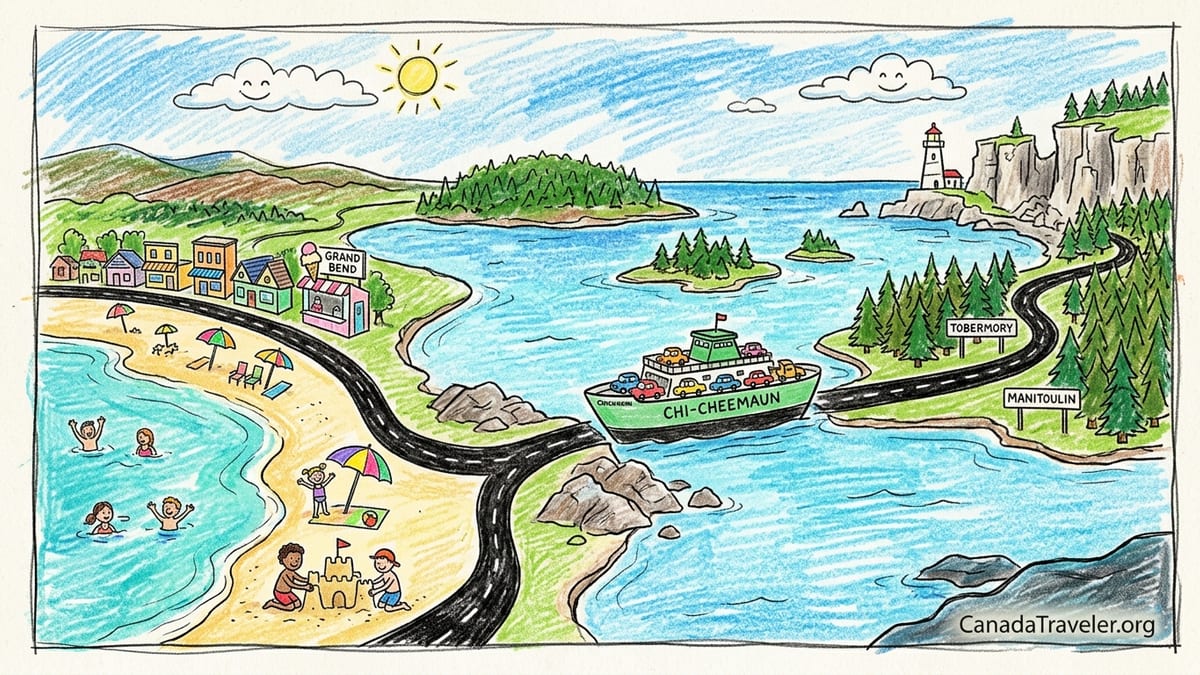
The Chi‑Cheemaun ferry between Tobermory and South Baymouth on Manitoulin Island is the linchpin that transforms a simple out‑and‑back drive up the Bruce Peninsula into a satisfying loop. In 2026, the ferry typically runs from early May through mid‑October, with multiple sailings most days in July and August and a reduced schedule in May, June, September and October. Crossing time is about one hour and 45 minutes, but check‑in requirements mean you should plan to be at the terminal 60 to 90 minutes before departure, especially with a vehicle. Advance reservations are strongly recommended for cars and essentially essential for RVs or vehicles with trailers in peak season.
For routing, travelers starting in Toronto and heading clockwise might drive up the Lake Huron coast and Bruce Peninsula, overnight in Tobermory, then catch a mid‑morning sailing to Manitoulin, continuing on to Little Current or Kagawong the same day. Those going counter‑clockwise could reach Manitoulin via Sudbury and Highway 6, spend several days exploring the island, then sail south to Tobermory as a more dramatic entry point to the Bruce. In shoulder seasons, when the ferry may run just two or three times per day, your entire day’s driving rhythm will revolve around your sailing time, so it is wise to build in at least one buffer night either side of the crossing.
Manitoulin Island itself warrants a minimum of two or three full days. It is the world’s largest freshwater island, with a network of small communities, inland lakes and cultural sites that reward slow travel. Hikers gravitate to the Cup and Saucer Trail for its views over the island’s forested interior, while shoreline wanderers head for Providence Bay’s long sandy beach or Misery Bay Provincial Park, where flat limestone pavement meets Lake Huron. In summer, basic motel rooms on Manitoulin commonly start around the mid‑hundreds per night, with lakefront cabins and cottages at a premium; booking early is especially important for popular periods such as long weekends.
The island is also a place to engage with Indigenous culture, including Anishinaabe communities that have lived here for generations. Depending on timing, you may find powwows, artisan markets or guided cultural experiences advertised through local tourism offices. Even a simple stop at a community‑run craft shop can add context to the landscapes you are driving through. Because distances between communities can be longer than they appear on the map, travelers should keep fuel topped up, carry snacks and water for hikes, and plan their days around the few full‑service grocery stores on the island, which are concentrated in larger centres such as Little Current and Mindemoya.
The North Channel, Killarney and Georgian Bay Scenery
From Manitoulin, Highway 6 leads north over a series of causeways and swing bridges to the North Channel and the Sudbury region. This stretch marks a transition from broad Lake Huron beaches to the pink granite, pine‑studded islands that many people associate with Georgian Bay. Boaters have long prized the North Channel as one of the world’s great freshwater cruising grounds, but road travelers can still access many viewpoints, marinas and short walks without owning a boat. Smaller communities such as Espanola and McKerrow make logical fuel and coffee stops as you turn east toward the Killarney area.
The Killarney region, including Killarney Provincial Park and the village of Killarney on Georgian Bay, showcases some of Ontario’s most photographed landscapes. Even if you are not undertaking multi‑day canoe trips, you can sample the scenery via day hikes such as the Chikanishing Trail, which winds over smooth rock to bayside overlooks, or shorter walks to lookouts near George Lake. The park’s campgrounds and backcountry sites are highly sought after in summer; road‑trippers who prefer a real bed often base themselves in Sudbury or along Highway 69 and make a long day trip into the park, or book a night or two at a lodge or motel in Killarney village itself.
Continuing east and south along Highway 69 and then Highway 400, the landscape alternates between Canadian Shield outcrops and glimpses of Georgian Bay. Around Parry Sound and the 30,000 Islands, sightseeing cruises depart from town docks to weave through narrow channels and around wooded islands, offering a very different perspective from the beach‑lined shores of southern Lake Huron. A typical one‑ to three‑hour cruise is easy to fit into a travel day between Sudbury and Toronto, breaking the roughly four‑hour drive into more digestible segments. This is also cottage country, so traffic can be heavy on summer Fridays and Sundays; aim for midweek travel when possible.
Depending on time, some itineraries dip back to the shoreline around Wasaga Beach, Awenda Provincial Park or the towns of Midland and Penetanguishene before returning to Toronto. Wasaga Beach is famous for its long arc of sand along the Nottawasaga Bay, though summer weekends can be crowded and parking fills quickly by midday. Awenda, by contrast, offers quieter Georgian Bay beaches with more of a provincial park feel, reached by forested roads from Highway 400. Either can serve as a final night’s stop if you want one last swim in Georgian Bay before heading home.
Loop Options From Toronto and Suggested Stays
From Toronto, there are two main ways to turn this coastal route into a loop: a Lake Huron first approach and a Georgian Bay first approach. In the Lake Huron first version, you drive southwest toward Grand Bend, then work your way up Huron County and Saugeen Shores, continue up the Bruce Peninsula to Tobermory, cross to Manitoulin on the Chi‑Cheemaun, then head north to Sudbury and back to Toronto via Highway 400. This version emphasizes sand beaches and west‑facing sunsets early in the trip, with wilder rock and island scenery later on.
In the Georgian Bay first version, you drive north on Highway 400 toward Parry Sound, possibly stopping in Collingwood or Wasaga Beach, then continue to Sudbury and down Highway 6 to Manitoulin Island. After several days there, you sail on the Chi‑Cheemaun to Tobermory, explore the Bruce Peninsula and then drive down through Saugeen Shores and the Lake Huron beach towns before cutting back inland to the Greater Toronto Area. This direction often works well when ferry availability is better for southbound sailings on your chosen dates, or if you want to avoid some of the heavy Friday traffic toward Grand Bend and instead do your Georgian Bay driving earlier in the trip.
Whichever loop you choose, the most comfortable itineraries build in at least three multi‑night bases. For a 9‑ or 10‑day trip, one common pattern is three nights around Grand Bend or Saugeen Shores, three nights on the Bruce Peninsula (splitting between Lion’s Head and Tobermory if you enjoy changing scenery), and three nights on Manitoulin or in the Killarney area. Travelers with more time might add two nights around Parry Sound or southern Georgian Bay. Constant one‑night hops can work for very ambitious drivers, but you will spend more time packing and unpacking than on beaches or trails.
Budget considerations will shape where you linger. Beach towns like Grand Bend and Sauble see their highest prices in mid‑summer, particularly for waterfront properties, while more inland centres such as Goderich or Sudbury may offer comparatively better value on chain hotels with larger room inventories. Camping in provincial parks can significantly reduce nightly costs, but most parks along this route use online reservation systems that open months ahead and book quickly, particularly weekends at Pinery, Bruce Peninsula and Killarney. If you are mixing camping and hotels, many travelers find it comfortable to alternate a few nights in a tent with a night or two in a motel to reset and do laundry.
Practical Planning: Seasons, Driving Conditions and Booking Tips
Weather on Lake Huron and Georgian Bay is variable, so packing layers is essential even in July and August. A typical summer day can swing from cool, breezy mornings on exposed headlands to hot, calm afternoons on south‑facing beaches. Water temperatures on southern Lake Huron beaches are often swimmable by late June and can feel surprisingly warm by August, while Georgian Bay and the North Channel tend to stay cooler. In May, early June and late September, you will want a light jacket and perhaps a hat and gloves for evening lighthouse walks, even if daytime hiking is comfortably mild.
Driving conditions are generally straightforward, with well‑paved highways and clear signage, but coastal traffic can be slow in peak times. The approach to Sauble Beach and to Grand Bend can back up on sunny Saturdays, and Highway 6 through the Bruce Peninsula is often a procession of vehicles heading for the ferry during holiday weekends. To ease the strain, aim for early morning departures, keep fuel tanks at least half full in more remote stretches, and watch carefully for deer, especially around dawn and dusk in forested sections south of Tobermory and near Killarney.
On the booking front, the Chi‑Cheemaun ferry is the one element that usually cannot be left to chance at busy times. It is sensible to choose your sailing dates and times first, reserve them, then build accommodation around those fixed points. If you are traveling with an RV or towing a trailer, pay close attention to vehicle length and height categories when booking, as fares and availability differ. For campgrounds and national park day‑use at high‑demand spots like the Grotto, note that reservation windows can open several months before your trip; marking key release dates on a calendar improves your chances of securing preferred times.
Food and services are widely available along the route, but not always at the moment you might crave them. Stocking a cooler with groceries from larger centres such as London, Owen Sound, Sudbury or Little Current will give you flexibility to picnic at lighthouses, trailheads or quiet beaches without relying entirely on seasonal snack bars. Many lakeside communities have at least one independent coffee shop that doubles as a local hub; stopping in not only refuels you but often yields up‑to‑the‑minute advice on lesser‑known swimming spots, roadworks or wildlife sightings that do not make it into printed guides.
The Takeaway
A Georgian Bay and Lake Huron road trip is less about ticking off a list of towns and more about following the shoreline’s changing moods. On one day, you may be walking barefoot along Sauble’s shallow sandbars at sunset; on another, you might be scrambling over pink granite near Killarney with white pines leaning against the sky. The Chi‑Cheemaun ferry welds these experiences into a coherent loop, saving hours of backtracking and turning the journey itself into a highlight as you watch the Bruce Peninsula recede and Manitoulin’s low hills appear ahead.
For travelers from Toronto, the beauty of this region lies in its flexibility. You can sample a long weekend in Saugeen Shores, a five‑day circuit combining Tobermory and Manitoulin, or a full 10‑day loop that sweeps around the bay and back. By understanding ferry schedules, reserving key park access in advance and choosing a few strategic bases instead of constantly moving on, you give yourself room to slow down: to linger over a second coffee on a cottage deck, to wait an extra twenty minutes for the sky to turn orange over Lake Huron, or to take a detour down a side road that ends at a quiet, unnamed cove.
In the end, what ties southern Lake Huron, the Bruce Peninsula, Manitoulin and the Georgian Bay and North Channel region together is not just geography but a shared sense of freshwater vastness. Whether you stand on Grand Bend’s busy main beach or at a silent lookout above the North Channel, it feels like looking out to sea, even though the water around you is all inland. Planning carefully yet leaving space for unplanned stops allows you to experience that feeling in many different forms, turning a simple Ontario drive into a memorable coastal journey.
FAQ
Q1. How many days do I need for a full Georgian Bay and Lake Huron loop from Toronto?
Most travelers find 9 to 12 days comfortable for a loop that includes southern Lake Huron, the Bruce Peninsula, Manitoulin Island and the Georgian Bay or North Channel area, with at least two or three nights in each main region.
Q2. Do I need to reserve the Chi‑Cheemaun ferry in advance?
Advance reservations are strongly advised from late June through early September and on long weekends, especially if you are bringing a vehicle or RV. Outside peak periods, you may occasionally find space as a drive‑up passenger, but relying on this can disrupt your overall itinerary.
Q3. Which direction is better for the loop, clockwise or counter‑clockwise from Toronto?
Both directions work. Clockwise routes usually start with Lake Huron beach towns, then continue to the Bruce Peninsula, Manitoulin and back via Sudbury, while counter‑clockwise routes reach Georgian Bay and Manitoulin first and finish with Lake Huron beaches. Many people choose based on which ferry sailings they can book.
Q4. When is the best time of year to drive this route?
Late June to mid‑September offers the warmest water and the fullest range of services. July and August have the longest hours and liveliest towns but also the most crowds, while June and September can be ideal for hiking and quieter beaches if you pack layers.
Q5. Can I do this trip in an RV or campervan?
Yes, the entire route is suitable for RVs, though you will need to reserve appropriate ferry spaces and campsites in advance. Some downtown areas and beach parking lots have size restrictions, so it helps to research where you will park before arriving at busy towns like Grand Bend or Tobermory.
Q6. Is it realistic to visit the Grotto, Flowerpot Island and Manitoulin on a single weekend?
Trying to fit all three into one weekend from Toronto is usually rushed. A long weekend might allow for Tobermory and either the Grotto or Flowerpot Island, but adding Manitoulin typically requires at least an extra two or three days to avoid spending most of your time in transit.
Q7. Are there options for travelers who prefer hotels over camping?
Yes, every region on this route has motels, inns or small hotels, from chain properties in larger centres like Goderich, Owen Sound and Sudbury to independent waterfront motels in places such as Sauble Beach, Tobermory and Little Current. Booking ahead is important in the height of summer.
Q8. How far in advance should I book accommodations and campsites?
For July and August, it is wise to secure key bookings several months ahead, especially for provincial park campgrounds, Manitoulin motels, and popular beach towns. Shoulder season trips may allow more flexibility, but weekends and holidays still fill quickly.
Q9. Is swimming safe along Lake Huron and Georgian Bay?
Most established beaches have designated swimming areas and, in many cases, seasonal lifeguards and posted safety information. Conditions can change quickly, especially on windy days, so always heed local flags and notices and avoid cliff jumping or swimming outside marked areas.
Q10. Can I do part of this route as a shorter trip from Toronto?
Absolutely. Popular shorter options include a three‑ or four‑day getaway to Saugeen Shores and Sauble Beach, a long weekend focused on Tobermory and Bruce Peninsula National Park, or a five‑day circuit linking Tobermory and Manitoulin using the Chi‑Cheemaun without continuing around the full Georgian Bay loop.