


For many wildlife travelers, seeing a wild narwhal ranks as one of the most elusive goals on earth. Nunavut in northern Canada is one of the few places where dedicated visitors have a realistic chance, but narwhal viewing is never simple or guaranteed. It depends on highly specific timing, precise locations along the sea-ice edge, Inuit guiding expertise and a willingness to accept Arctic weather delays. This guide compares key narwhal areas around Lancaster Sound, including Pond Inlet, Arctic Bay and Naujaat, and explains the trade-offs between floe-edge camps, shore-based scanning, boat trips and expedition cruises so you can choose the style that best matches your priorities.
Why Narwhal Tours Are Different From General Arctic Trips
Narwhal-focused travel is built around a single species that is shy, ice-loving and strongly tied to seasonal sea-ice conditions. That makes it very different from a general Arctic wildlife cruise, where operators can move the ship to seek out bowhead whales one day, polar bears the next and seabird cliffs the day after. With narwhals, timing and geography are far less flexible. Travel Nunavut notes that Lancaster Sound, Pond Inlet, Arctic Bay and Naujaat are among the few accessible places where travelers have a realistic chance of encounter, and even there, sightings are never guaranteed.
Most narwhal itineraries are scheduled to coincide with two main windows. The first is the spring floe edge, roughly late April through early June, when narwhals move along the edge of the land-fast sea ice awaiting access to their summering areas. The second is a shorter summer period, usually in late June and July, when some whales frequent open-water areas near certain communities and sounds. By contrast, general Arctic excursions, such as mid-summer expedition cruises through Baffin Bay or broader wildlife safaris in Nunavut, can operate from June to September without needing such narrow timing.
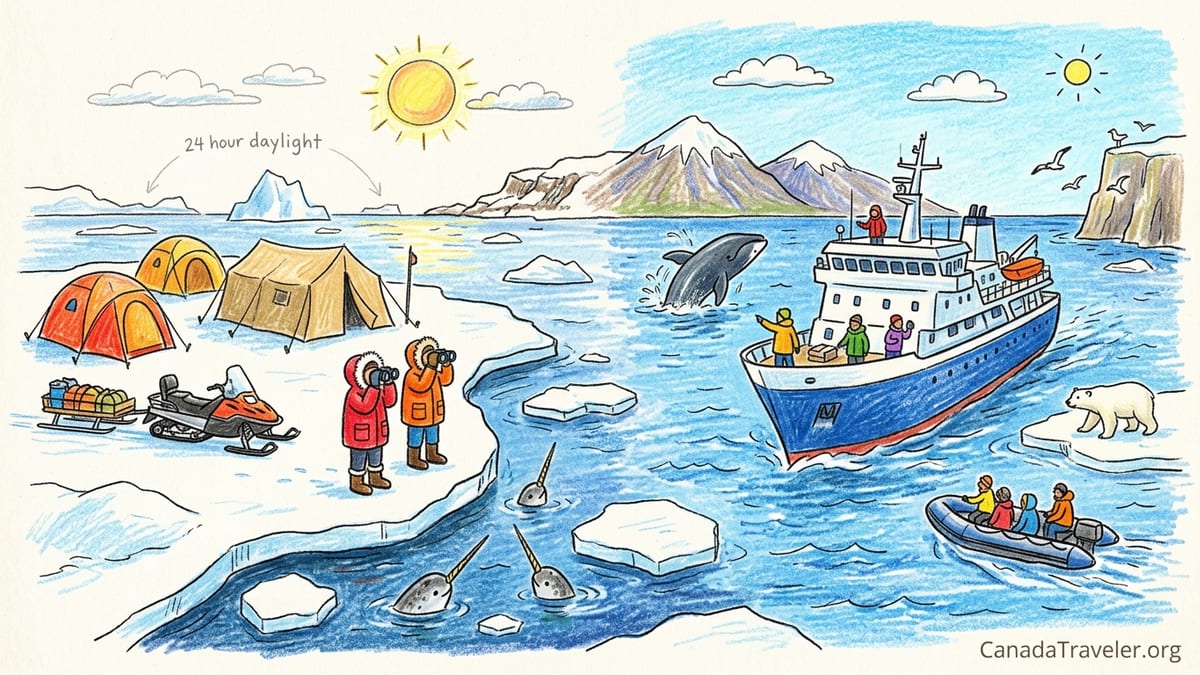
Because narwhals are associated with ice and are sensitive to disturbance and noise, the most productive viewing often happens at the floe edge, reached by snowmobile and qamutik sled from communities like Pond Inlet, Arctic Bay or Naujaat. This is a much more specialized and physically demanding experience than standing on a cruise-ship deck in Greenland or sailing the Northwest Passage. It involves long days in extreme cold, camping on sea ice, and accepting that some days may be spent simply waiting quietly, scanning the water and listening for the exhale of whales that may or may not appear.
Another difference is cost concentration. A dedicated narwhal floe-edge safari near Pond Inlet with an operator such as Arctic Kingdom or a specialist birding company can easily run into the multiple thousands of dollars per person for 7 to 10 days, including charter flights from Ottawa or Iqaluit, heavy cold-weather gear, and full ice-camp logistics. A traveler who boards a broader Arctic cruise may pay a similar overall price, but their wildlife expectations are spread across many species and experiences rather than focused almost entirely on the chance of seeing narwhals at close range.
Spring Floe Edge vs Summer Boat-Based Opportunities
The most productive narwhal encounters usually happen at the spring floe edge, where land-fast sea ice meets open water. Between about late April and early June, narwhal pods travel along this boundary to access rich feeding grounds and their summering areas in Lancaster Sound and related inlets. Several Nunavut outfitters run floe-edge trips from communities like Pond Inlet, Arctic Bay and Naujaat during this season, transporting guests by snowmobile and qamutik to sea-ice camps located a few hours away from town. Days are then spent either at camp or right at the ice edge, watching for narwhal surfacing between drifting pans of ice.
Because the sea ice is still intact in spring, travelers can safely camp on stable ice under the midnight sun and use the frozen surface as a platform for photography. Companies operating in Admiralty Inlet near Arctic Bay, for example, describe setting up heated tents, communal domes and safety perimeters so guests can stay within walking or snowmobile distance of the best wildlife leads. The reward can be extraordinary moments when groups of narwhals approach the floe edge to breathe, sometimes close enough for guests to hear their blows and see the spiral tusks of males breaking the surface.
Summer narwhal viewing, generally late June into July, relies more on boat-based observation once the sea ice has broken up. In some years, travellers staying in Pond Inlet or Arctic Bay can arrange day trips out by boat to channels and headlands where narwhals transit or feed. Lancaster Sound, Eclipse Sound and nearby inlets often hold significant numbers of narwhals during sea-ice retreat and advance, but their distribution can change due to ice conditions, weather and shipping disturbance. In Naujaat, operators offering floe-edge trips often transition to open-water excursions later in the season, combining narwhal searching with chances of bowhead whales, belugas and polar bears along the coastline.
For many visitors, choosing between spring and summer is a matter of priorities. The spring floe edge offers a higher chance of concentrated narwhal activity and a quintessential Arctic environment of snow, ice and 24-hour daylight. The trade-off is colder temperatures, more complicated gear requirements and an acceptance of travel by snowmobile over sea ice. Summer boat-based opportunities can feel more familiar to those used to whale watching elsewhere, with comparatively milder temperatures and the possibility of combining narwhal hopes with hiking, bird cliffs and village visits. However, narwhal sightings in summer can be more scattered and farther from shore, and the visibility of the tusk at a distance is often brief.
Key Narwhal Areas: Pond Inlet and Lancaster Sound
Pond Inlet, known locally as Mittimatalik, sits near the eastern entrance to Lancaster Sound at the northern tip of Baffin Island. The surrounding waters, including Eclipse Sound and nearby inlets such as Milne Inlet, support one of the largest known summer concentrations of narwhals in the world. Conservation and scientific organizations have described Lancaster Sound and the surrounding Tallurutiup Imanga National Marine Conservation Area as a major migration corridor for narwhal, beluga and bowhead whales as ice retreats in late spring and returns in autumn.
For travelers, the practical implication is that Pond Inlet serves as a primary gateway for narwhal-focused expeditions. Operators run floe-edge safaris that typically last between 7 and 10 days door-to-door, with roughly 5 nights on the ice and 2 or more nights in hotels in Pond Inlet and sometimes Iqaluit. Sample itineraries often include charter flights from Ottawa to Iqaluit, onward flights to Pond Inlet, snowmobile shuttles to the floe edge, and days of guided scouting for narwhals and polar bears under the midnight sun. Pricing for these premium trips can begin around the low five figures in Canadian dollars once charter flights and taxes are included, though exact numbers vary by year, operator and cabin type.
Beyond floe-edge camps, Pond Inlet also sees expedition cruise traffic in summer. Large and small-ship operators occasionally anchor off town, arranging Zodiac excursions into Eclipse Sound and shore landings on Bylot Island. While passengers on these cruises do sometimes see narwhals, their chances depend heavily on timing, ice conditions and routing decisions made for the broader voyage. An August Northwest Passage itinerary, for instance, may pass quickly through core narwhal habitat at a time when animals are less concentrated near shore, making encounters far from guaranteed.
When comparing land-based Pond Inlet floe-edge trips with ship-based itineraries that mention narwhals, it helps to read the fine print. Dedicated narwhal safaris are usually explicitly scheduled for the late May to early June window and feature floe-edge camps as the centerpiece. General Arctic expeditions that list narwhals among a long roster of possible wildlife should be viewed more as a pleasant bonus if they occur, rather than a primary justification for the trip.
Arctic Bay, Naujaat and Other Floe-Edge Options
Arctic Bay sits on Admiralty Inlet, a deep inlet off Lancaster Sound with a sizeable narwhal population. The geography of the area funnels wildlife toward the floe edge, creating conditions that can be excellent for multi-species viewing in spring. Local outfitters based in Arctic Bay run floe-edge tours that combine narwhal watching with the possibility of polar bears, walrus and seals. Some programs use a base camp on the land-fast ice, while others offer hotel-based packages where guests snowmobile out to the floe edge by day and return to heated rooms at night.
Travelers considering Arctic Bay often weigh it against Pond Inlet. Pond Inlet has more established high-end narwhal operators and a long history of wildlife safaris built around international clients, whereas Arctic Bay can offer a more intimate setting with smaller local outfitters. Boat-based adventures out of Arctic Bay later in summer generally focus on the dramatic coastal scenery of Admiralty Inlet and the chance encounters with narwhals and other marine mammals in open water. Standard packages for visiting the Arctic Ocean from Arctic Bay might run 4 to 10 days, with prices that depend on group size and included flights.
Naujaat, on the western shore of Hudson Bay, is another community highlighted by territorial tourism sources as accessible for narwhal access. Operators here run floe-edge experiences between roughly April and July, where walrus, seals, bowhead and beluga whales gather where open sea meets ice, and narwhals may also pass through. Typical packages include several nights in the Naujaat hotel and multiple days of guided snowmobile and sled trips to the floe edge. Traveling to Naujaat generally involves flights via regional hubs like Rankin Inlet and can require an extra planning layer compared with more commonly visited Baffin Island communities.
Other areas mentioned in narwhal research and management plans, such as the routes past Resolute or along eastern Baffin Island near Clyde River and Qikiqtarjuaq, tend to be more logistically complex for casual travelers. Some expedition cruises use Resolute as a staging point for voyages into Lancaster Sound, and small-ship itineraries that explore the Tallurutiup Imanga region sometimes list narwhals among potential sightings. However, for most independent travelers seeking a land-based narwhal experience, Pond Inlet, Arctic Bay and Naujaat remain the most practical starting points.
Trip Styles: Shore-Based, Sea-Ice Camps, Boats and Expedition Cruises
Travelers whose top priority is seeing narwhals usually choose between four main trip styles, each with its own trade-offs: shore-based viewing, sea-ice camps at the floe edge, day trips by boat and multi-day expedition cruises. Shore-based viewing is the simplest in concept but the most limited in reach. In some Nunavut communities, especially during certain weeks in summer, it may be possible to spot distant narwhals from headlands or beaches as they surface offshore. Local residents in places like Pond Inlet or Arctic Bay sometimes see narwhals from town or nearby viewpoints, but for visiting travelers, relying solely on shore-based scanning greatly reduces the odds of a meaningful sighting.
Sea-ice floe-edge camps represent the most immersive and targeted approach. On these trips, guests sleep in heated expedition-style tents on stable sea ice only a few kilometres from the floe edge itself. Daily excursions bring them to the edge, where they sit on camp chairs or stand behind safety lines looking out over the open water leads. An example itinerary might see visitors departing Ottawa, overnighting in Iqaluit, flying to Pond Inlet, then transferring by snowmobile to a camp where they spend five nights with full-time guides and support staff. Meals are served in communal domes, and safety teams watch constantly for polar bears. This style maximizes time in prime narwhal habitat but demands a degree of physical resilience and acceptance of cold, wind and primitive conditions.
Boat-based day trips, more common in late June and July, are familiar to anyone who has done whale watching elsewhere. Guests stay in simple hotels or guesthouses in communities like Pond Inlet or Arctic Bay and join local guides on sturdy open boats or small cabin vessels to search nearby waters. These outings might last anywhere from three hours to a full day. They allow flexibility: if conditions are poor one day, it may be possible to try again the next, and itineraries can combine wildlife with glaciers, bird cliffs and cultural visits. However, seas can be choppy, and narwhals may be present but elusive, surfacing briefly at a distance. Photography from a moving boat in variable weather is more challenging than from a stable ice platform.
Expedition cruises, finally, appeal to travelers who want a broad Arctic overview: multiple communities, iceberg-filled fjords, seabird cliffs and the possibility of various whale species. Several international operators route itineraries through Lancaster Sound or along eastern Baffin Island, with landings at Pond Inlet, Arctic Bay or Resolute in some seasons. These trips might last 10 to 14 nights, and cabins can range from basic to luxury. While marketing materials often mention narwhals among potential wildlife highlights, these sightings are opportunistic rather than guaranteed. The ship must balance ice navigation, weather, safety and a diverse set of guest interests, so it cannot sit at a single floe edge for days in the hope of narwhals the way a dedicated ice-camp safari can.
Duration, Weather and Practical Planning Considerations
Most serious narwhal-focused expeditions run at least a week, and many stretch to 9 or 10 days or more. A typical floe-edge itinerary might involve a travel day from the south to Iqaluit, another to reach Pond Inlet or Arctic Bay, five full days on the ice, and then one or two buffer days on either side. Operators factor in the likelihood of weather delays at multiple points: fog in Iqaluit or high winds in smaller communities can ground flights; blowing snow or poor visibility can postpone snowmobile travel to the floe edge; rough sea conditions can cancel boat departures.
Because of this uncertainty, travelers should think in terms of ranges instead of fixed promises. A Pond Inlet narwhal and polar bear safari, for example, might advertise seven days, but wise travellers treat it as a 9 to 11 day window door-to-door, allowing for schedule changes that are common in the Arctic. Flexibility is essential, especially in spring, when sea ice is still solid but weather can change quickly. Some operators build explicit contingency days into their itineraries, using them for town tours or cultural experiences if conditions prevent reaching the floe edge.
Clothing and equipment requirements are another key difference between narwhal safaris and general Arctic trips. Even in late May, temperatures on the floe edge can feel sharply colder than in town, especially with wind chill. Outfitters usually supply heavy parkas, insulated boots and sometimes full snowmobile suits, but visitors still need a robust layering system, including base layers, mid-layers, balaclavas, mitts and hand warmers. In contrast, mid-summer cruise passengers may be comfortable with a standard waterproof shell, fleece and hat. Travelers focused on narwhals must pack with the assumption that they will spend hours sitting still in sub-zero temperatures.
Finally, budget planning should account for northern airfares, baggage fees for heavy cold-weather clothing and camera gear, and the higher cost of food and accommodation in remote communities. While individual prices fluctuate year to year, it is reasonable to expect that a guided narwhal floe-edge experience from a southern Canadian gateway city will require a substantial investment per person, particularly once charter flights and Arctic logistics are included. Comparing operators should involve not only cost but also safety track record, guide experience, support for local Inuit organizations and the clarity of wildlife-viewing expectations.
Photography Challenges, Wildlife Etiquette and Managing Expectations
Narwhals are challenging photography subjects even for experienced wildlife shooters. Their surfacings are brief and unpredictable, and the most visible feature, the tusk, often appears only for a moment before the animal dives again. At the floe edge, photographers must balance enthusiasm with respect for safety lines and guide instructions, as the ice near the edge can be unstable. Using telephoto lenses in the 300 to 400 mm range is common to capture detail while maintaining a safe and ethical distance from the animals and from the water’s edge itself.
Lighting conditions present additional challenges. In late spring, the sun may circle the horizon without setting, producing long hours of oblique light that can be beautiful but also produce strong contrasts on ice and snow. In overcast conditions, the world can appear almost monochrome, and cameras may struggle with exposure. Keeping spare batteries warm in inner pockets, using lens hoods to reduce flare off ice and snow, and practicing quick focus techniques before the trip can make a tangible difference. On summer boat trips, motion blur from the vessel and the unpredictability of narwhal surfacings demand fast shutter speeds and image stabilization.
Respectful wildlife etiquette is essential, both for the welfare of the animals and for maintaining good relationships with local communities that depend on narwhals for subsistence. Many narwhal habitats near Nunavut settlements are also traditional hunting areas. Travelers must follow guide instructions regarding noise, movement and where to stand, and should avoid pressuring guides to approach animals too closely by boat or snowmobile. Ethical operators prioritize the whales’ behavior and the safety of people over getting the closest possible photograph.
Perhaps the most important planning principle is accepting that narwhal sightings can never be guaranteed. Even in renowned areas like Lancaster Sound or Admiralty Inlet, pods can shift with changing ice conditions, currents, or the presence of ships. Some groups enjoy hours of activity at the floe edge, watching dozens of narwhals surface repeatedly; others spend days scanning with only distant glimpses or none at all. Framing the trip as an Arctic cultural and wilderness experience that may include narwhals, rather than as a transaction for a specific photograph, leads to healthier expectations and a more rewarding journey overall.
The Takeaway
Planning a narwhal-focused journey to Nunavut requires a different mindset than booking a general Arctic cruise or a conventional whale-watching trip. It means building your entire itinerary around a narrow seasonal window, choosing specific communities such as Pond Inlet, Arctic Bay or Naujaat that lie along narwhal migration routes, and deciding whether you are ready for the commitment of a floe-edge ice camp. It also means budgeting for weather delays, extra travel days and the possibility that the whales you have dreamed of for years may remain glimpsed only at a distance.
For travelers whose priority is maximizing their chance of seeing narwhals, spring floe-edge expeditions near Lancaster Sound remain the benchmark experience, with summer boat-based outings and opportunistic cruise sightings as complementary options. Each style has its own balance of comfort, cost and wildlife potential. What they share is a dependence on local Inuit knowledge, a need for patience and resilience in Arctic conditions, and an ethic of humility toward an environment that remains deeply wild.
If you approach a narwhal trip as an immersion in that wider Arctic world, with the narwhal as an honoured but unpredictable guest rather than a guaranteed highlight, you will be better prepared for whatever the ice and weather deliver. Whether your reward is a distant tusk slicing through grey water or a sudden close surfacing at the floe edge, the experience of waiting under the midnight sun, surrounded by sea ice and silence, is itself a rare privilege.
FAQ
Q1. When is the best time of year to see narwhals in Nunavut?
The highest-probability period is late April to early June at the spring floe edge, especially around Pond Inlet, Arctic Bay and Naujaat. Some boat-based viewing is possible in late June and July, but sightings can be more scattered.
Q2. Where should I base myself if narwhals are my top priority?
Pond Inlet and the Lancaster Sound region are often considered the prime base for narwhal-focused trips, with Arctic Bay and Naujaat offering strong floe-edge options as well. Your choice will depend on available tours, budget and comfort with sea-ice travel.
Q3. How long should I plan to stay for a narwhal trip?
Most serious itineraries run at least 7 days, with 9 to 10 days door-to-door being common once you include flights, weather buffers and several full days at the floe edge or on the water.
Q4. Are narwhal sightings guaranteed on these tours?
No. Even on dedicated floe-edge safaris in top locations, sightings can never be guaranteed. Ice conditions, weather and narwhal movements all vary from year to year and even day to day.
Q5. How do narwhal safaris differ from regular Arctic cruises?
Narwhal safaris are tightly timed to specific weeks, focus on a small geographic area near the floe edge, and often involve camping on sea ice or intensive day trips. Regular cruises cover larger regions, target many species and treat narwhal encounters as a bonus rather than the central goal.
Q6. What kind of physical condition do I need for a floe-edge camp?
You should be comfortable spending long periods outdoors in sub-zero temperatures, climbing in and out of sleds or snowmobiles, and walking on uneven snow and ice. You do not need to be an athlete, but reasonable mobility and balance are important.
Q7. What camera gear works best for photographing narwhals?
A DSLR or mirrorless camera with a telephoto lens in the 300 to 400 mm range is ideal. Fast shutter speeds, spare batteries kept warm in inner pockets and basic familiarity with manual exposure or aperture priority will help handle bright snow and quick surfacings.
Q8. How much do narwhal trips typically cost?
Prices vary widely by operator and year, but dedicated floe-edge expeditions that include charter flights, ice-camp logistics and guides often reach into the multiple thousands of dollars per person. Simpler day trips by boat from communities such as Pond Inlet or Arctic Bay may cost a few hundred dollars per person per outing.
Q9. Can I arrange narwhal viewing independently once I arrive in Nunavut?
In theory you can contact local outfitters for day trips, but in practice demand is high and capacity is limited during peak weeks. For floe-edge camps in particular, it is wise to book well in advance with established operators who handle logistics and safety.
Q10. What cultural or ethical considerations should I keep in mind?
Narwhals are important to Inuit communities for both cultural and subsistence reasons. Travelers should follow guide instructions, avoid pressuring crews to approach animals too closely, support locally owned outfitters where possible and approach the experience with respect for local knowledge and traditions.