


I drove to Tofino expecting a remote surf outpost at the edge of Canada: empty beaches, woodsmoke drifting from simple cabins, a couple of low-key surf shops and a mellow village where time moved at Pacific tides, not at Instagram speed. Instead, what I found in 2026 was one of British Columbia’s most commercialized, expensive tourism hot spots, wrapped in the language of wilderness and escape. Tofino is still beautiful. But if you arrive with a postcard fantasy and a modest budget, the reality can feel less like a laid-back surf town and more like an upscale resort machine built on limited land, finite parking and a captive audience with nowhere else to go.
The Long Journey From Vancouver That Nobody Mentions
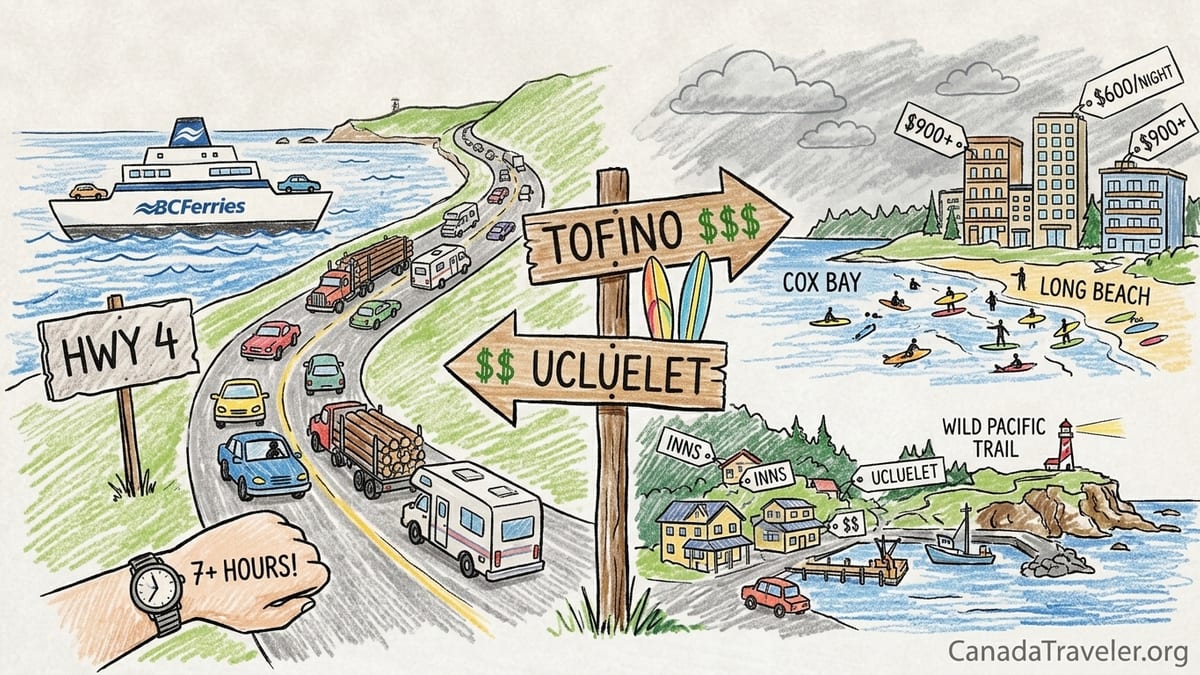
On paper, Tofino looks like a weekend escape from Vancouver. In practice, the trip eats most of a day before you even see the Pacific. My alarm went off before dawn in the city so I could make a morning BC Ferries sailing from Horseshoe Bay to Nanaimo, the standard route for most travelers. The crossing itself is about 1 hour 40 minutes in theory, but once you add early arrival, loading, unloading and the slow shuffle off the vessel, two and a half hours disappear quickly.
BC Ferries’ own pricing means the meter starts running long before you smell salt air on the west coast. In summer 2026, a return fare for a standard vehicle and two adults between Metro Vancouver and Vancouver Island easily sat in the low hundreds of dollars once fuel surcharges and reservation fees were included. That is money spent just to get your car onto the island, before gas, food, or a single night’s accommodation near Tofino enter the equation.
From Nanaimo, Highway 4 across Vancouver Island looks like a manageable distance on the map. In reality, the winding two-lane road and ongoing construction near Kennedy Lake regularly stretch the drive to at least 3 hours in good conditions, and often longer in summer when RVs, logging trucks and cautious visitors clog every passing lane. I found myself crawling behind long chains of vehicles, with few safe places to overtake and no alternate route. By the time I rolled into Tofino, I had been in transit from Vancouver for close to 8 hours including the ferry, breaks and inevitable traffic snags.
Travel blogs that casually suggest Tofino as a “simple day trip” from Vancouver feel detached from this reality. Unless you are chartering a floatplane, the round trip in one day would mean driving and sailing almost nonstop. For most people, that turns Tofino into a minimum two-night commitment, which magnifies every other cost. You do not casually pop in to see whether the town lives up to the hype. You commit, financially and logistically, long before you know whether it was worth it.
Sticker Shock: Accommodation in a Town With Finite Land
My first wake-up call in Tofino did not come from ravens or surf. It came from opening the usual booking sites. In July and August 2026, many of the better-located hotels and beachside resorts were posting standard rooms at well over C$600 per night, and it was not unusual to see beachfront suites and high-end lodges push past C$900 or more on peak weekends. On Reddit, frustrated would-be visitors swapped screenshots of “cheap” rooms above C$400 and joked that summer 2026 hotel prices had become “insane,” with C$1000 nights no longer a rarity.
Even stepping down a tier did not feel like a bargain. Simple motel-style properties on the highway between Tofino and the beaches, or cabins with partial views, often floated in the C$300 to C$500 range once taxes and fees were counted. Budget hostels still existed, but private rooms there tended to land around C$150 to C$250 in high season, and beds in shared dorms regularly filled months ahead. The notion of driving in on a sunny Friday and sniffing out a last-minute deal felt like something from another decade.
The core problem is straightforward: Tofino sits on a narrow peninsula pressed between ocean, inlet and protected parkland. Land is finite, zoning is tight, and the global popularity of the region has surged faster than new rooms can be built. Tourism Tofino’s own reporting in recent years has described hotel rates that crept higher year over year, with strong summer occupancy leaving little incentive to discount. Supply is limited, demand surges every time a travel magazine calls Tofino “Canada’s surf capital,” and travelers without deep pockets become collateral damage.
There are still ways to soften the blow, but each comes with trade-offs. Camping at nearby campgrounds can bring nightly accommodation down to roughly C$50 to C$80 for a basic site, but those sites book out nearly as far ahead as hotel rooms, and rainy coastal weather can turn a budget tent trip into a damp endurance test. Booking shoulder-season dates in October or March brings rates down somewhat, yet that is when storms slam the coast, restaurants reduce hours and daylight shrinks. The fundamental equation remains: if you want peak-summer Tofino, you will pay peak-summer prices that rival, and sometimes exceed, major cities.
Counting Every Dollar: Surf Lessons, Rentals, Parking and Park Fees
Because Tofino markets itself so heavily as a surf destination, I assumed that once I had paid to get there and checked into a room, the actual time in the water would not be a major expense. That assumption fell apart as soon as I started adding up prices. Mixed group surf lessons in 2026 commonly sat around C$99 per person before tax at established schools such as Pacific Surf Co and Swell Tofino, including gear for a roughly three-hour session. Private or semi-private lessons quickly climbed past C$200, with some operators listing one-on-one coaching around C$200 to C$250 for a single person.
If you already know how to surf and only need gear, the bills continue. One major rental outfit, Tofino Paddle Surf, published a 2026 price list that charged C$32 for a 24-hour surfboard rental and C$35 for a full wetsuit for the same period. Another well-known operator, Pacific Surf Co, set comparable rental rates and reminded customers that a credit card or deposit was mandatory. By the time two people rent boards and wetsuits for a day, the tally quickly approaches C$130, and that is before fuel to reach the beach or coffee to warm up afterward.
Then there is the quiet financial trap of parking and park fees. Within the District of Tofino, including hotspots like Cox Bay and some beach access points, municipal paid parking has become the norm. The town’s meters and app-based system charge by the hour, and staying long enough for a proper beach day can easily cost a family C$10 to C$20 just to leave the car without risking a ticket. This is separate from, not a replacement for, federal fees at Pacific Rim National Park Reserve, which covers Long Beach and other stretches of sand between Tofino and Ucluelet.
Parks Canada’s 2026 fee schedule for Pacific Rim listed adult daily admission around C$12.25, with a four-hour “beach” option at about C$7.75 for adults. That means a couple who spends the day at Long Beach might pay close to C$25 simply to enter the park, plus whatever Tofino or Ucluelet charge for parking elsewhere on the peninsula. None of these costs are outrageous in isolation. Surf lessons at roughly C$99 for professional instruction, or park fees that help protect sensitive ecosystems, can be defensible. What stings is the way every activity, every hour of parking, every board and wetsuit rental quietly layers on top of high accommodation and ferry fares until a simple three-day visit can rival the price of a far-flung international vacation.
Beaches in Detail: Beauty, Crowds and the Cold Pacific Reality
If any part of Tofino still matches the dreamy images, it is the beaches. Yet even here, the gap between romantic expectation and lived experience matters. Chesterman Beach, Cox Bay, Long Beach and Tonquin Beach all have distinct personalities, and it is unfair to dismiss them as uniformly crowded. But none of them are the untouched, empty arcs of sand that older guidebooks sometimes imply, at least not in high season.
Chesterman Beach, split into North and South by a rocky point, is where I felt the town’s wealth most visibly on display. The shoreline is lined with upscale vacation homes and well-known lodges hidden behind trees. The sand is wide, the sunset views are photogenic, and at low tide families spread out across the tidal pools while surfers cluster on the outer sandbars. It can be magical, but it rarely feels remote. This is the beach where you are likely to step around professional photo shoots, off-leash dogs and visitors juggling drones or elaborate picnic setups. On a summer afternoon, it felt more like a wealthy coastal suburb’s backyard than a frontier surf break.
Cox Bay, by contrast, is Tofino’s engine room for surfing. The bay funnels swell in a way that produces consistently rideable waves, and the entire back of the beach is backed by resorts, a surf-focused lodge and multiple access points used by schools. Walking down in 2026, I counted more foam boards and school tents than I could reasonably track. If you are here to learn to surf, Cox Bay is arguably perfect. If you dreamed of solitary walks under jagged cliffs, the reality is lines of students listening to instructors over the sound of crashing waves, and a constant background of whoops whenever someone manages to stand up for the first time.
Long Beach, within Pacific Rim National Park Reserve, comes closest to the cinematic mental image that draws many people to Tofino. Stretching for kilometres along the open Pacific, it genuinely feels big enough to swallow crowds, especially if you walk away from the main parking lots. On my visit, tour buses dropped groups at the most accessible sections, but a ten-minute stroll down the sand left only distant silhouettes. Still, you pay for that experience in the form of national park admission, and on days when swell and tide align, the water can fill with long lines of surfers from both Tofino and Ucluelet.
Tonquin Beach is smaller and more intimate, reached by a forested trail from the edge of town. It feels like a pocket cove, with rocky outcrops and views back over Clayoquot Sound rather than the open Pacific. Tonquin is lovely for a sunset stroll or a quick swim during a rare warm spell, but it is no secret, and at peak hours the narrow strip of sand can feel cramped as visitors hunt for patches of dry ground above the tide line. For a place marketed as wild and remote, none of these beaches are truly empty for long in summer. They are world-class, but they are also very much discovered.
Wilderness Marketing vs Wet, Windy, Cold-Water Truth
So much of Tofino’s branding revolves around dramatic coastal wilderness that it is easy to forget how often the weather simply punishes you. The open Pacific brings frequent rain, low clouds and wind even in months that the rest of British Columbia considers summer. Locals know this. Many visitors do not. In July 2026 I stepped out of my car to horizontal drizzle and a stiff onshore wind that drove fine sand into every exposed seam of clothing. The water temperature hovered in the low teens Celsius, far too cold for comfortable swimming without a proper wetsuit, hood, gloves and booties.
This is excellent for surfing. Consistent swell, cool water and strong storms from autumn through spring are what make Tofino legitimately world-class by cold-water surf standards. For a conventional beach holiday framed around playing in the shallows with kids or floating in bath-warm seas, it is completely wrong. Even on the calmest days, the combination of rip currents, chilly water and changing tides demands respect. Lifeguards are not posted across the entire coastline, and Parks Canada signage about surf hazards is there for good reason.
The environmental atmosphere can also be a disappointment if you have imagined endless sunsets. Fog often rolls in off the ocean and sits stubbornly offshore, muting colours and flattening the horizon. Wind can whip up suddenly, turning neatly packed beach setups into a scramble to catch flying towels. Rain jackets and rubber boots felt more useful on my trip than shorts. Tofino’s storm-watching season, loudly promoted in winter, leans into this harshness and offers its own unique magic. But the visitor who booked a mid-August escape expecting dry heat, warm water and reliable blue skies may arrive to find their dream holiday happening somewhere else.
This tension between branding and reality is not unique to Tofino, but it cuts deeper here because of the cost. When you have already spent several hundred dollars on ferries, hundreds more per night on a room, and triple-digit sums on surf lessons and rentals, waking up to another grey, wet day can feel less like “mood” and more like a very expensive compromise.
Ucluelet: A Less Polished, More Livable Alternative
To understand whether Tofino is overrated, it helps to drive thirty minutes south to Ucluelet. The two communities share the same wild coast and the same Pacific Rim National Park Reserve, but their personalities and price levels are markedly different. Ucluelet still has tourists, but it feels more like a working village with tourism layered on top, rather than a resort economy that has all but pushed everything else aside.
On accommodation alone, Ucluelet often undercuts Tofino by a significant margin. In summer 2026, basic motels and small inns there could still be found in the C$200 to C$350 range on busy weekends, sometimes less outside peak dates, compared with C$300 to C$600 for roughly equivalent options closer to Tofino’s beaches. Cabin-style properties and waterfront guesthouses existed too, but the ceiling on prices seemed lower, and more mid-range options survived where Tofino’s had already climbed upscale. Travelers swapping notes online repeatedly suggested “staying in Ukee” when Tofino’s prices and sold-out calendars shut them out.
The village atmosphere also felt different. Ucluelet’s central streets are more compact, with everyday services like a grocery store, hardware shop and working harbour infrastructure rubbing shoulders with cafes, fish-and-chips counters and small galleries. It felt easier to eat affordably. A solid fish taco or casual pub meal with a drink landed closer to C$25 to C$35 per person, and lineups, while present in summer, lacked the “Instagram famous” intensity around some Tofino names. There were fewer high-concept tasting menus and more no-nonsense plates of halibut and chips eaten at picnic tables under gulls.
The Wild Pacific Trail, wrapping around Ucluelet’s rocky headlands in several segments, turned out to be one of the trip’s genuine highlights. The trail is free to walk, maintained through local fundraising and grants, and offers cliffside views of crashing surf, offshore islands and storm-bent trees that rival anything I saw near Tofino’s town center. Lighthouse viewpoints, pocket coves and benches invite extended lingering. On sections of the trail in late afternoon, I passed more ravens than people. It drove home the point that you can get Pacific drama without threading your way through resort parking lots.
Importantly, staying in Ucluelet does not mean giving up access to the surf beaches. The same Highway 4 that brings travelers in from Port Alberni connects Ucluelet to the park and the Tofino peninsula. From a Ucluelet motel, I was parked at Long Beach or one of the other major surf spots in about 20 minutes. The drawback, of course, is that you are driving that stretch more often. The upside is that your nightly rate is lower, and your evenings are spent in a town that, at least in 2026, still felt more grounded and less overtly curated for affluent outsiders than its famous neighbour up the road.
Five Real Disappointments Behind the Hype
Every destination has trade-offs, but Tofino’s stand out because the town is sold so aggressively as a once-in-a-lifetime escape. Over several days, at least five disappointments kept surfacing. The first was the cumulative cost. By the time I added my share of ferry fares, gas across the island, three nights of mid-range accommodation, one group surf lesson at about C$99 per person, a day of board and wetsuit rentals close to C$130 for two people, multiple restaurant meals at C$30 to C$50 per head, national park fees and repeated paid parking, my personal spend for a long weekend was pushing into the low four figures. That is the kind of number more commonly associated with international city breaks or all-inclusive packages, not a small coastal town that still describes itself in language better suited to backpacker days.
The second disappointment was the sense of commercialization layered over a fragile ecosystem. Local operators, Indigenous communities and Parks Canada have worked hard on stewardship, and that matters. But on the ground in midsummer, it sometimes felt like every viewpoint had become a content backdrop, every quiet cove a scheduled stop on a tour. Visitor numbers have grown faster than infrastructure, and it shows in packed parking lots, full restaurants and rural roads that strain under high-season traffic.
The third frustration was how little room there was for spontaneity. Between strict booking windows for accommodation, limited surf lesson slots in busy periods, and timed entries for some tours, the dream of drifting around and discovering things on the fly mostly evaporated. I spent more time managing reservations and checking availability screens than I did wandering into unknown eateries. The fourth disappointment was weather exposure. I went in understanding the coast was wet and wild, yet several days of low grey cloud and sideways rain still wore me down, especially once I realized how much I had paid for the privilege of sitting in a cabin watching the forecast.
The fifth disappointment was the basic mismatch between Tofino’s marketing and the realities of cold-water beaches. Many visitors arrive with mental imagery borrowed from tropical surf films. Even in high summer, the Pacific off Tofino is unforgivingly cold, currents can be strong, and a thin beach towel does not cut it when the wind picks up. While surf schools brief students carefully, casual beachgoers sometimes looked blindsided by how bracing that first plunge felt. None of these factors make Tofino a bad place. But put together, they mean that for a large slice of potential visitors, the town is not just pricey. It is misaligned with what they actually want.
The Takeaway
So is Tofino overrated? That depends entirely on who is asking the question and what they hope to find. If you are an intermediate or advanced cold-water surfer who understands the realities of North Pacific weather, owns or happily rents proper gear, and values consistent waves over cheap beer and warm sand, then Tofino still delivers. The combination of accessible surf breaks, a tight cluster of highly experienced schools, and dramatic storm cycles make it one of the most compelling surf destinations in Canada, and perhaps the world, for those specific tastes.
If you are a high-budget traveler who treats the town as an upscale coastal retreat, the math can work too. Booking a C$700-per-night oceanfront suite with a private hot tub, then watching storms rip across Cox Bay from behind floor-to-ceiling glass, is a particular kind of luxury experience. For this demographic, the cost of a C$99 surf lesson or a C$12.25 park pass is marginal, and restaurant bills that creep north of C$100 for two become part of the expected spend. Tofino’s biggest fans in 2026 often seemed to come from these two camps: dedicated surfers or travelers for whom price simply mattered less than atmosphere.
Everyone else should think carefully. Families on tight budgets hoping for an affordable beach week, casual swimmers expecting warm water, and spontaneous weekenders from Vancouver looking for an easy escape are likely to feel let down. The combination of long travel times, high accommodation costs, steady add-on fees and weather volatility makes Tofino a risky bet if you need guaranteed sun or firm financial limits. If that description fits you, there are better options: Ucluelet for a more grounded version of the same coastline at slightly lower prices, other parts of Vancouver Island for lakes and gentler beaches, or even inland destinations where summer actually feels like summer.
You can still experience the Pacific coast without automatically paying Tofino prices. Base yourself in Ucluelet or another nearby community, walk the Wild Pacific Trail for free, buy a single day pass to Pacific Rim National Park Reserve for Long Beach, and treat Tofino as a day visit rather than the entire point of the trip. Time your visit for shoulder season when room rates fall and the surf is still good. Share rentals, cook some of your own meals, and be honest about whether you are going for surf and storms or for a traditional beach holiday. Tofino is not a scam, and its beauty is real. But in 2026, it is also a highly developed, very expensive coastal resort wrapped in the language of wilderness, and anyone planning a trip deserves to see the full price tag before they fall in love with the photos.
FAQ
Q1. Is Tofino worth visiting if I am not a surfer?
Tofino can still be rewarding without surfing, especially for storm watching, hiking and photography, but the town’s high costs and often wet, chilly weather mean non-surfers should think hard about whether they will use what they are paying for. If you simply want warm beaches and casual swimming, other destinations will likely suit you better.
Q2. How much should I budget for a long weekend in Tofino in 2026?
For two adults in summer 2026, a realistic three-night budget including return ferry from Vancouver, mid-range accommodation, a surf lesson each, one day of rentals, park fees, parking, fuel and restaurant meals can easily approach or exceed C$2000, and more if you choose higher-end lodging or extra activities.
Q3. Can I visit Tofino as a day trip from Vancouver?
In practical terms, no. The combination of ferry travel between Metro Vancouver and Nanaimo plus the 3 hour or more drive along Highway 4 means one-way travel often takes 7 to 8 hours. That makes a same-day return extremely tiring and leaves almost no time on the actual coast.
Q4. Are there any truly quiet beaches near Tofino in summer?
In July and August, all the main beaches see regular use, but Long Beach within Pacific Rim National Park Reserve and some lesser-known access points become quieter if you are willing to walk 10 to 20 minutes away from the parking lots. Total solitude is rare, yet you can still find relatively peaceful stretches of sand.
Q5. How cold is the water in Tofino, and do I really need a wetsuit?
The Pacific off Tofino generally stays in the low to mid teens Celsius year round, which is far too cold for extended swimming without protection. For surfing, a full wetsuit with hood, gloves and booties is standard. Even casual wading can feel bracing after a few minutes.
Q6. What is the difference between Tofino’s parking fees and national park fees?
Parking fees charged by the District of Tofino apply to municipal parking areas near beaches and around town and are collected by the local government. Separate entrance fees for Pacific Rim National Park Reserve, such as the 2026 adult daily admission around C$12.25 and four-hour option near C$7.75, are collected by Parks Canada and apply to federal park lands including Long Beach.
Q7. Is Ucluelet really that much cheaper than Tofino?
In 2026, Ucluelet typically offered lower accommodation prices than Tofino for comparable motels and small inns, often saving visitors tens or even hundreds of dollars over several nights. Restaurant prices were also somewhat more moderate, though still reflective of a remote coastal location.
Q8. When is the best time to visit Tofino for smaller crowds and better prices?
Outside of peak July and August, late spring and early autumn often bring a balance of lower accommodation costs, fewer visitors and still-decent surf. Weather is less predictable, but shoulder-season trips can feel calmer and more affordable than high summer.
Q9. Can budget travelers still enjoy Tofino?
Budget travelers can make Tofino work by camping or staying in hostels, cooking their own meals, sharing surf rentals, visiting in the off-season and basing in Ucluelet. However, the town’s baseline costs remain high, so expectations should be adjusted accordingly.
Q10. Who should skip Tofino entirely?
Travelers seeking hot, calm water for casual swimming, highly spontaneous last-minute trips, or strict low-budget vacations with little flexibility on weather or cost will likely be happier elsewhere. For them, Tofino’s long travel time, cold ocean and elevated prices make it a poor match.