


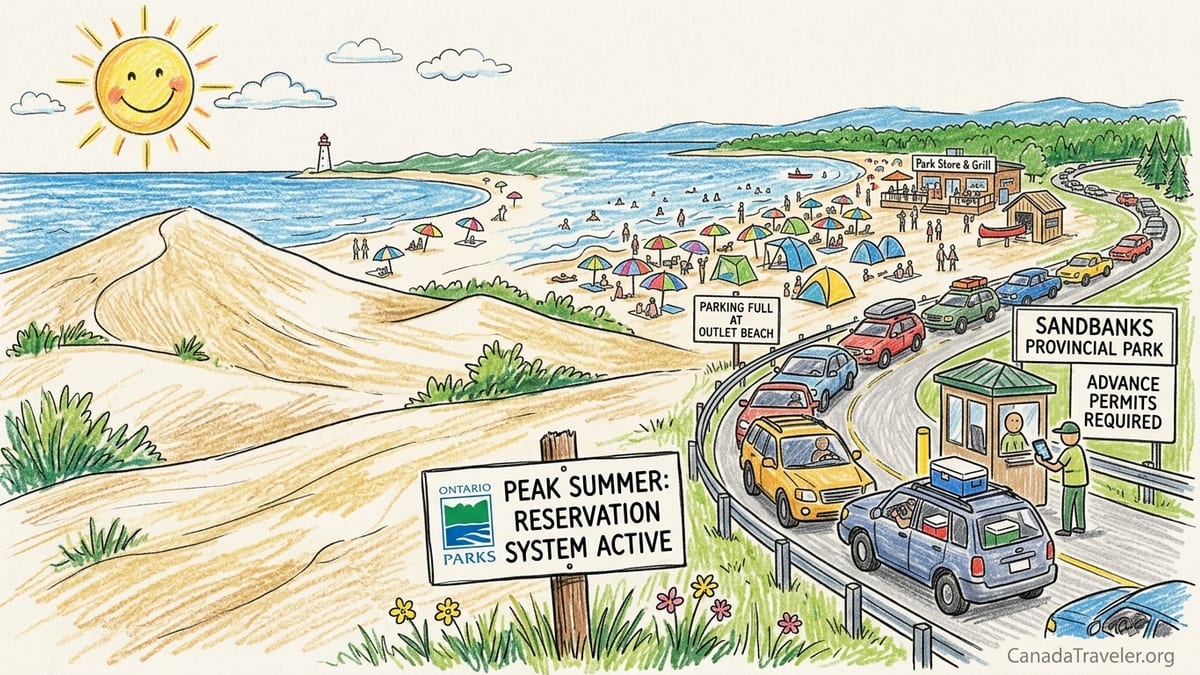
Sandbanks Provincial Park is the Ontario beach day that looks like a travel poster: pale sand, rolling dunes, and Lake Ontario water that can pass for coastal blue in the right light. I arrived expecting that version, the one you’ve seen a hundred times on social media, where a single set of footprints arcs toward the water and the horizon looks quiet. What I got instead, on a peak-summer Saturday, was a lesson in why access planning is now part of the experience at Sandbanks. The beach was still beautiful. The process of getting onto it was the part I wasn’t ready for.
What the Photos Promise (and What Sandbanks Actually Is)
Sandbanks sits in Prince Edward County, south of Picton, and it is famous for exactly the visuals that fill your camera roll: wide sandy beaches and an enormous dune system. The park has three major day-use beach areas people talk about most often: Outlet Beach, Lakeshore Beach, and Dunes Beach. Each one feels like a different park once you’re on the sand, which is part of the appeal and part of the problem when you arrive and realize you’re not the only one chasing the same “Ontario’s best beach” headline.
Online, Sandbanks often reads as effortless: pack a cooler, drive out, spread a towel, and you’re in. In real life, the park is one of the busiest in the province, and Ontario Parks has long acknowledged that demand is intense. The park has discussed day-use pressure for years, including weekend days when certain sectors exceed capacity, with parking acting as the practical limiter for how many people can be accommodated. In other words, even if there is still sand out there, there is not necessarily space for more cars and people to arrive safely and responsibly.
That context matters because it reframes what the reservation system is actually doing. It is not “making it harder” just for the sake of it. It is an attempt to meter an experience that more people want than the park can physically hold at once, especially on hot weekends. If you go in expecting a casual drop-in beach, you can end up frustrated. If you go in expecting that planning is part of the ticket, the day gets a lot smoother.
My Peak-Summer Visit: Date, Arrival Time, and the Permit Reality
I visited on Saturday, July 18, 2026, aiming for a classic beach day: swim, walk the dunes, grab something quick to eat, and head back before dark. I left from the Toronto area early, still underestimating how much Sandbanks has shifted from “destination” to “logistics.” Between traffic and the last stretch of County roads into the park, the drive itself already felt like a mini-commitment, the kind that makes you assume the reward will be instant once you arrive.
I had booked a day-use permit in advance through the Ontario Parks reservation system, securing entry ahead of time because Sandbanks regularly reaches capacity in summer. Ontario Parks’ day-use system releases advance daily vehicle permits five days before your arrival date, and the permit is tied to one passenger vehicle and its occupants. In practice, that means if you want a Saturday in July, you need to think about Sandbanks on Monday morning, not Saturday morning. I booked at 7:00 a.m. Eastern five days ahead, because that is when permits become available.
On the day of my visit, I arrived at roughly 10:20 a.m., which felt early by city standards. At Sandbanks on a hot weekend, it is not early. Even with an advance permit, I hit a slow-moving entrance queue at the gatehouse area. The line was not just a quick roll-up-and-scan moment; it was a steady crawl of vehicles with coolers and beach tents visible through back windows, everyone doing the same calculation: “Are we going to get in, and where will we end up parking?”
The permit process itself was straightforward, but only because I had it ready. Ontario Parks’ confirmation email contains a barcode, and at controlled-access gates that barcode is what opens the gate when scanned. I kept it pulled up on my phone at full brightness as I inched forward. The system is functional, but the emotional experience of a long entrance line after a multi-hour drive is still real, especially when you know people without permits may be turned away once capacity is reached.
Entrance Queue, Parking, and the Beach I Ended Up Choosing
Once inside, the next bottleneck was not the shoreline. It was parking. The truth about Sandbanks on a summer Saturday is that “entry is guaranteed” does not mean your preferred beach experience is guaranteed. It means you are allowed into the park. Where you can put your car and how far you will haul your stuff is the second half of the story.
My original plan was Outlet Beach, partly because it is the name most people recognize and partly because it is close to some key services. But by late morning the internal traffic pattern already had that familiar peak-day feel: cars circulating, people scanning for brake lights, drivers creeping forward hoping someone would leave. I made one pass, then another, and realized I was burning time and patience.
I pivoted to Lakeshore Beach, which generally offers a longer stretch of sand and can feel more spread out even when the park is full. The tradeoff is that, depending on where you land, it can involve a longer walk with your gear. From where I parked, it was roughly a 7 to 10 minute walk to the water at a relaxed pace with a backpack and a folded chair. If you’re carrying a cooler, a big pop-up shade, and a float, that walk suddenly becomes the workout you did not plan for.
The parking lots were busy enough that you could feel the park operating at a managed limit. There was no “easy spot near the entrance.” It was the kind of day where you accept you’re walking, then you adjust your expectations: fewer items, less glass, more collapsible gear, and ideally a wagon if you’re bringing a family set-up. The walk itself was not unpleasant, but it was not the breezy beach arrival the photos imply.
Crowds on the Sand: Water, Dunes, Noise, and the “Packed Saturday” Feeling
On the beach, the crowd level was unmistakable. There were still beautiful moments: the sand was soft underfoot, the lake looked clear in the shallows, and the sky did its part. But the human density changed the mood. Instead of picking a quiet patch and listening to wind and waves, I was threading between umbrellas and stepping carefully around sand toys, towels, and coolers.
The water was the saving grace. Lake Ontario was refreshing, and the shallower entry at the family-friendly beaches made it easy to wade in and cool down without committing to a full swim immediately. On a hot day, Sandbanks’ water access is genuinely excellent. It is why people keep coming back, even when they know the park can feel like a small beach city on weekends.
The dunes, too, were exactly as impressive as the photos suggest. At Dunes Beach, the sand formations are dramatic, and even if you don’t spend the whole day there, the dune landscape is the signature feature that makes Sandbanks feel different from many other Ontario shores. But dunes also concentrate people. The spots where you can get that iconic photo are the same places everyone else is trying to stand, walk, or pause for a panoramic view.
Did the packed Saturday match the quiet photos? Not at all. The photos are not lies, but they are selective. They capture Sandbanks at angles and moments when the scene reads empty. What they cannot convey is the noise of a thousand small decisions happening at once: music from multiple speakers, children running in overlapping games, and the constant trickle of people moving to and from the waterline. If your ideal beach day is a social, energetic atmosphere, you will be thrilled. If your ideal beach day is calm, you will have to plan hard to find it here.
Facilities, Food, and the Practical Side of a High-Demand Park
One reason Sandbanks can handle big crowds at all is that it has real infrastructure. There are comfort stations across the park, and the day-use areas have toilets, including vault privies in key beach zones. That matters on a long day in the sun, especially if you’re traveling with kids or anyone who needs dependable facilities without a long walk back to a distant campground loop.
Food is another place where Sandbanks behaves like a major summer attraction. At Outlet Beach, Currah’s Park Store and Grill is the kind of concession that can rescue an under-packed day, with basics like ice, snacks, and beach gear alongside hot food. At Dunes Beach, Currah’s Dunes Grill and Patio adds another option, and there is also a park store presence through the Friends of Sandbanks Nature Shoppe, which focuses more on souvenirs, nature items, and park-themed goods. If you forget sunscreen, need extra water, or want a quick meal without leaving the park, those services are genuinely valuable.
Rentals are part of the park’s toolkit for turning a day visit into a full experience. Canoes, kayaks, and stand-up paddleboards are offered through the park’s rental operation, with personal flotation devices available for loan with a refundable deposit. There is also a Tackleshare option for borrowing fishing gear, and the park offers specialized accessibility equipment including an all-terrain wheelchair and a floating wheelchair available on a first-come basis during the core operating season when the rental location is fully operational. These details are not the kind of thing you notice in a pretty beach photo, but they are part of what makes Sandbanks more than just a strip of sand.
I stayed about five hours, long enough to swim multiple times, walk a portion of the dunes area, eat a late lunch, and feel the peak-day rhythm. By mid-afternoon, the busiest window of the day was in full swing, and Ontario Parks has noted that the park is typically busiest in the late morning through mid-afternoon on hot days. Leaving felt like a relief not because the park was bad, but because the density of people was constant. I enjoyed what I came for, and I also felt ready to reclaim a little space.
Why the Reservation System Exists (and Why It Still Feels Bad)
If you drive several hours for a beach day, the idea of being turned away at the gate is infuriating. Even the possibility of it changes how you feel about the trip. Sandbanks has been explicit that it can reach capacity on summer days, especially weekends, and it recommends booking a day-use permit in advance to guarantee entry. That recommendation is not marketing language. It is the difference between “we’re going to the beach” and “we’re gambling on the beach.”
Ontario Parks’ broader day-use program is built around the same premise: certain parks fill up, so advance daily vehicle permits become a planning tool that guarantees access. Those permits become available five days in advance, and they are designed to reduce arrival uncertainty and time spent in long lines. The system also acknowledges a reality that surprises first-timers: a seasonal vehicle permit alone does not guarantee entry at the busiest parks. You still need to reserve your spot in advance where advance permits are used.
Even when you follow the rules, the experience can still feel like friction. The emotional hit is not the reservation itself. It’s the mismatch between how effortless a beach day sounds in conversation and how scheduled it can become in practice. You start thinking in constraints: “What if we’re late?” “What if parking is a mess?” “What if we need to switch beaches?” Those are normal thoughts at major attractions, but they can feel out of place at a provincial park, where many travelers expect nature to be open and forgiving.
The fairest way to say it is this: Sandbanks is a victim of its own excellence. The demand exceeds the space. The reservation system exists because the alternative is worse, a first-come free-for-all that produces unsafe congestion, endless lineups, and more people being disappointed at the gate. Planning does not erase frustration, but it makes the day more likely to happen at all.
What Was Genuinely Excellent, and How I’d Do It Differently Next Time
Despite the crowds, Sandbanks earned its reputation in the places that matter. The sand quality is outstanding by Ontario standards. The lake views are wide and bright. The dune landscape is memorable in a way that most casual beaches simply cannot match. When you are in the water and you look back at the shoreline, you can still catch glimpses of the “perfect day” you came for.
I would change the timing before I changed the destination. If you want a summer Saturday, treat it like booking a table at a popular restaurant: reserve early, arrive early, and accept that you’re attending a peak-time event. Ontario Parks has suggested that if you want your preferred beach area, arriving early helps even if your permit guarantees entry. Next time, I would aim to be at the gate closer to early morning, not late morning, and I would pack with a “long walk possible” mindset from the start.
A weekday visit would almost certainly change the verdict. So would shoulder season, especially late spring or after Labour Day, when Ontario Parks itself points out that May, June, and post-Labour Day can be some of the best times to visit for fewer crowds. If your schedule is flexible, this is the single most powerful upgrade you can make. The same is true of an overnight stay. Sandbanks has a large camping footprint, with over 600 campsites across multiple campground areas, and staying inside the park changes the whole feel. You are no longer arriving with a single, high-stakes entry moment. You are already there.
The park’s strengths are not fragile. They do not vanish in the off-season or on a cloudy day. But the crowd pressure absolutely is timing-dependent. If your main goal is a calm beach walk, dunes photography, or a relaxed swim without a shoulder-to-shoulder towel grid, the “wrong” time can make you think Sandbanks is overrated. The “right” time makes it obvious why it is so loved.
The Takeaway
Sandbanks is still one of Ontario’s best beach parks, but it is no longer a casual suggestion for a hot weekend. It is a plan. On my Saturday, July 18, 2026 visit, the day-use permit and barcode entry did what it promised: it got me in. The real challenge was everything after the gate, especially parking and the sheer density of people on the sand during peak hours.
If you go on a packed summer Saturday expecting the empty-beach photos, you will feel disappointed. If you go expecting a high-demand park with a reservation system designed to manage limited space, you can still have an excellent day. The best version of Sandbanks is early, off-peak, or overnight. The dunes, the swimming, and the big-beach feeling are real. The crowds are also real, and ignoring them is the fastest way to ruin your own trip.
If you want a less stressful Plan B that still feels like Prince Edward County summer, I would look hard at North Beach Provincial Park, also in the County, which uses the same advance day-use approach at busy times. For an alternative that is more “beach town” than “reservation gate,” I would research Wellington Beach near the village of Wellington, where you can get a classic sand-and-swim day with fewer of the provincial-park capacity dynamics. And if your priority is a guaranteed shoreline day with lots of services and you’re coming from the west, I would consider long, established Ontario beach destinations like Sauble Beach, where the experience is built around a town’s summer infrastructure rather than a single park entrance that can hit capacity.
FAQ
Q1. Do I need a reservation to visit Sandbanks for the day?
Sandbanks strongly recommends booking a day-use permit in advance to guarantee entry, because the park can reach capacity on summer days, especially weekends.
Q2. How far ahead can I book a Sandbanks day-use permit?
Ontario Parks releases advance daily vehicle permits five days before the arrival date, starting at 7:00 a.m. Eastern Time.
Q3. What does a day-use permit cover at Sandbanks?
It covers one passenger vehicle and all passengers in that vehicle, up to the maximum Ontario Parks allows for a passenger vehicle permit.
Q4. If I have an advance permit, does that guarantee parking at my preferred beach?
No. It guarantees entry to the park, but parking availability near a specific beach area can still be limited on busy days.
Q5. Which beach should I choose at Sandbanks if I want the classic dunes?
Dunes Beach is the signature dune landscape area, but it is also popular and can feel busy on peak summer days.
Q6. Are there lifeguards at Sandbanks beaches?
Sandbanks beaches have emergency phones, but Ontario Parks notes there are no lifeguards at the beaches.
Q7. Are there food options inside Sandbanks Provincial Park?
Yes. There are food concessions including Currah’s Park Store and Grill at Outlet Beach and Currah’s Dunes Grill and Patio at Dunes Beach, plus a nature shop in the park.
Q8. What time of day is busiest at Sandbanks?
On hot summer days, the park is typically busiest from late morning into mid-afternoon, so arriving earlier can make parking and setup easier.
Q9. Would a weekday or shoulder-season visit feel different?
Yes. Visiting on a weekday, in May or June, or after Labour Day often means fewer crowds and a calmer beach experience.
Q10. What are good alternatives if Sandbanks feels too crowded?
In Prince Edward County, consider North Beach Provincial Park as a managed alternative, or research Wellington Beach for a more town-based beach day that is less dependent on one park gate.