


I arrived in Wendake on a cool September afternoon with a notebook full of questions and, as I would quickly realize, a head full of assumptions. Québec’s tourism campaigns had introduced me to the idea of “Indigenous experiences,” but it was only when I booked an overnight stay with the Huron-Wendat Nation, just outside Québec City, that those words took on real meaning. My first Indigenous tourism experience in Québec was not a show or a checklist. It was a carefully hosted encounter on Wendat land, in Wendat time, with Wendat people leading every step. Here is what I learned, how it worked in practice, and what I would do differently next time to approach it even more respectfully.
Choosing One Community and One Experience, Not a Checklist
Before this trip, I had been tempted to “sample” as many Indigenous tourism offerings in Québec as possible. Official tourism materials talk about 11 Indigenous nations and experiences spread across 17 regions, from eco-lodges in Nunavik to Inuit art in Montréal. Faced with that variety, my instinct as a traveler was to try to fit several communities into a four-day itinerary. In conversation with an Indigenous tourism advisor in Québec City and after reading materials from Indigenous Tourism Québec, I began to understand why that could easily slide into treating cultures like collectibles rather than relationships. I decided to focus on one place: Wendake, the community of the Huron-Wendat Nation, located just northwest of Québec City on the banks of the Akiawenrahk River.
I chose an overnight package centered on the Hôtel-Musée Premières Nations and the traditional Huron-Wendat site Onhoüa Chetek8e. The hotel is owned and operated within the community and is directly linked to the Huron-Wendat Museum and cultural programming. Packages such as the Wendake Getaway include one night in a comfort room, dinner and breakfast at La Traite restaurant, and the option to add cultural activities like a guided museum visit or storytelling in a longhouse. Recent pricing for that package starts around 208 Canadian dollars per person in double occupancy, taxes extra, which placed it firmly in the mid to upper range of regional stays but with a clear indication that my spending would support a Wendat-owned business.
Equally important as the cost was the governance behind the experience. Both the museum and the traditional site emphasize that they are rooted in Wendat perspectives on history, territory and protocol. I was not buying a generic “First Nations show.” I was being invited to hear specific Wendat stories in a place that has been shaped by centuries of Wendat presence and adaptation. Making that mental shift from “seeing Indigenous culture” to “being hosted by a particular nation” shaped everything that followed.
This decision meant I would not be visiting other Indigenous communities on this short trip, including places I was very curious about such as Innu communities on the Côte-Nord or Abenaki heritage in Odanak. Instead of feeling like a missed opportunity, it quickly became clear that depth in one community was the only way to move beyond surface-level impressions in such a limited time.
Booking with Indigenous Hosts and Planning the Logistics
The logistics of booking my stay were straightforward, but they revealed a few important lessons. I reserved directly through the Hôtel-Musée Premières Nations website, which offers several packages combining accommodation, gastronomy, museum visits and evening activities. Availability and prices fluctuated depending on season and day of the week, but I could see package starting rates in real time and then write to the reservations team with questions about cultural options. For mid-September, my overnight package including dinner, breakfast and museum entrance came to just over 260 Canadian dollars with taxes and service charges included.
For the cultural components, I needed to pay attention to schedules and languages. The Huron-Wendat Museum offers guided tours in French and English; Onhoüa Chetek8e also offers guided visits, but their own information notes that English tours are not guaranteed every day and that, if necessary, they may replace them with a self-guided visit using a booklet. To avoid disappointment, I emailed the traditional site and the museum about two weeks in advance, explaining that I would prefer a guided visit in either English or French and asking which time slots would work best.
Transportation was simple. Wendake is about a 20 to 25 minute drive from Old Québec by car. I opted for a rental car since I planned to keep flexible hours, but travelers without a vehicle can also reach Wendake by regional bus and a short walk. Parking at the hotel is included in most packages. Check-in times were similar to other hotels in Québec, mid-afternoon around 3 p.m., which gave me time to settle in before the evening storytelling activity in the longhouse.
Before arrival, I asked explicitly about photography and social media. The hotel staff explained that photography is generally allowed in public areas of the hotel and museum unless indicated otherwise, but that some activities, particularly those involving oral traditions or certain objects, would have specific rules explained by the guide. They encouraged me to ask again on site and to prioritize listening over documenting, advice that would shape my behavior during the stay.
Arriving in Wendake: First Impressions and Quiet Corrections
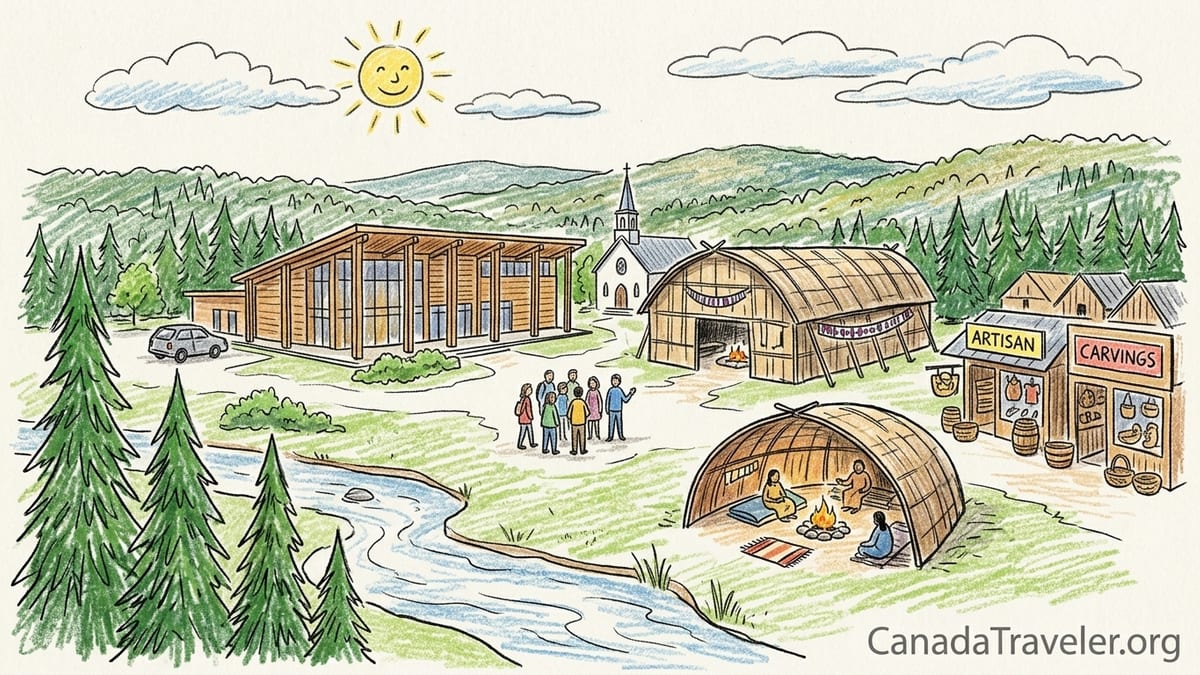
Arriving in Wendake felt different from arriving in a typical resort town. The first thing I noticed was that this is a living community, not a closed cultural park. The hotel sits near residential streets, a church, the Akiawenrahk River and local businesses. Children were walking home from school. People were coming in and out of a grocery store and a pharmacy. It immediately challenged my unspoken expectation that an “Indigenous tourism” site would be set apart from daily life.
The hotel itself is contemporary, with four-star comfort, timber architecture and a lobby that opens toward the forest and river. Next to the reception area, large windows showcased museum displays and Wendat artwork. This was my first quiet correction. I had imagined something more “rustic,” a loaded word that I now recognize often reflects non-Indigenous expectations of authenticity. Instead, Wendat hosts had built a space that was both luxurious and deeply grounded in their own aesthetic choices, including the representation of Clan animals and motifs tied to the Wendat worldview.
During check-in I was given a detailed schedule: a late afternoon guided tour of the museum, dinner at La Traite, and the Myths and Legends activity later in the evening in a reconstructed longhouse on the hotel grounds. The receptionist, herself from Wendake, invited questions about the community and encouraged me to explore the nearby walking path along the river, where interpretive signs explain aspects of Wendat history and territory. She also reminded me that certain areas of the longhouse and storytelling session would be designated as “no photos” and that the storyteller would explain why.
Walking through the village before my museum tour, I saw street signs in French and Wendat, small artisan shops and the Notre-Dame-de-Lorette Church, which plays a significant role in the community’s colonial-era history. I had imagined Indigenous tourism as something that happens in set-aside spaces, but here, cultural interpretation and daily life overlapped constantly, from the smell of traditional bread being baked in a local restaurant to the sound of drums faintly echoing from a rehearsal in a community hall.
What I Was Taught: Wendat Histories, Not Generic “Native Culture”
The Huron-Wendat Museum tour was the intellectual and emotional core of my stay. Our guide, a Wendat woman in her twenties, began by locating us in space and time: on the Nionwentsio, the traditional territory of the Wendat people, and in a community that had survived displacement, war and epidemic to maintain its language, governance and ceremonial life. She used Wendat words throughout, explaining their meanings and context, and was careful to distinguish between Wendat practices and those of other Indigenous nations in Québec.
One of my prior misconceptions became apparent within the first ten minutes. I had unconsciously lumped together longhouses, wampum belts and clan systems as “generic Iroquoian.” Instead, the guide showed us how Wendat longhouse organization, agricultural practices focused on the Three Sisters (corn, beans, squash), and specific patterns in wampum belts expressed Wendat legal and diplomatic ideas. She also pointed out that some widely circulated stories about “Huron” history in school textbooks simplified or distorted Wendat political structures and minimized the impact of colonial policies.
In the gallery, we spent time with objects that are still active in community life, such as ceremonial items used today, as well as archaeological finds from ancestral village sites. The guide emphasized continuity. Wendat culture was not a relic, but a living set of relationships adapted to contemporary realities. She talked about current land claims, language revitalization efforts and the role of tourism as one economic tool among others, not as a replacement for traditional livelihoods or modern careers.
What made the visit educational rather than performative was the pace and framing. There was no dance staged just for us, no costume change, no scripted “photo moment.” Instead, we were invited into a narrative that the community had clearly shaped for its own reasons, with room for questions but also clear boundaries. When someone in the group asked a question that veered into pan-Indigenous stereotypes about spirituality, the guide calmly refocused on Wendat-specific practices and politely declined to explain ceremonies that are not shared with visitors.
Food, Craft and an Overnight Longhouse: Experiencing Without Consuming
Food was another way I confronted my assumptions. Dinner at La Traite, the hotel’s restaurant, was included in my package. The menu blends contemporary techniques with ingredients important to various First Nations, particularly those of the Wendat territory. Game meats, berries, corn varieties and bannock appear in different forms, but the overall experience would not be out of place in a high-end Québec City dining room. My three-course meal, priced around 75 Canadian dollars before tax and tip when ordered à la carte, began with a dish highlighting smoked fish, followed by venison with a sauce made from local berries.
I had imagined “traditional food” as something simple and perhaps heavy. Instead, the chef’s approach was refined, playful and grounded in local sourcing. The staff explained the origin of certain ingredients and the stories attached to them, including the significance of corn in Wendat agriculture and social life. Rather than reproducing historical recipes exactly, La Traite interprets Wendat relationships to territory in a modern culinary language. That choice challenged my instinct to equate tradition with a frozen past.
Later in the evening, I joined the Myths and Legends activity in the longhouse on the hotel grounds, an option sometimes bundled in packages described as a “Back to the Roots” or similar stay. We entered after dark, with a firekeeper tending the central hearth. Our storyteller, a Wendat man, narrated origin stories and episodes from Wendat oral history in French, occasionally switching to Wendat terms and then translating them. Blankets were provided, and we lay on wooden platforms along the walls as the fire crackled.
Here, the line between experience and consumption felt especially delicate. At the beginning of the activity, the host told us clearly that photography and recording were not allowed inside the longhouse during storytelling. He explained that these stories belong to specific families and ceremonial contexts and that listening with full attention was a form of respect. I had planned to capture a few atmospheric images, but once that boundary was set, it felt natural and right to put my phone away. The result was a surprisingly intimate few hours where the only documentation was the notes I jotted down later, in private.
Earlier in the afternoon, at the traditional site Onhoüa Chetek8e, I had participated in a craft demonstration and short workshop focused on animal hides and traditional games. The site operates as an open-air interpretation center, with reconstructed longhouses, drying racks and spaces where guides demonstrate aspects of pre-contact and early contact-era life. Our guide, again from the Wendat Nation, showed how skins were tanned and talked about the roles of different community members in preparing them. Visitors could try certain techniques under close supervision. Once more, the emphasis was on explanation rather than performance, and there were clear instructions on when and where photos were acceptable.
Questions, Boundaries and What I Chose Not to Share
One of my biggest anxieties before arriving in Wendake was about what questions were appropriate to ask. I did not want to force my hosts into the role of educators on trauma or to ask questions that past visitors had already made exhausting. During the museum tour and longhouse storytelling, I adopted a simple rule: I would ask about topics the guides themselves had opened and avoid veering into areas they had not invited us into.
For example, when our museum guide mentioned current language revitalization, I asked how children in Wendake encounter the Wendat language today and whether there are community classes for adults. She seemed happy to share details, including the challenges of funding and curriculum development. When another visitor asked about residential schools, the guide answered briefly and compassionately, then suggested resources for those who wanted to learn more and reminded us that some members of her family still found it painful to discuss. I chose not to follow up with further questions on that topic, recognizing that it was not my role to extract more personal stories.
I also paid attention to what I photographed. Outside, I felt comfortable taking wide shots of the traditional site, the river and the exterior of the longhouse, as well as my meal. Inside the museum galleries, I only photographed objects where the guide explicitly said it was allowed and where there were no posted restrictions. I avoided close-ups of sacred objects or anything that felt like it might misrepresent context if cropped. In the village itself, I did not photograph private homes or people going about daily life without asking.
In my notes for this article, I have chosen not to describe every story told in the longhouse in detail or to reproduce traditional names that were clearly introduced as part of ceremonial contexts. Instead, I focus on what is already widely shared in public interpretive spaces and on my reactions as a guest. The most respectful thing I can do as a writer is to leave some knowledge where it belongs, within the community, and to encourage readers to hear it themselves from Wendat storytellers if they are invited to do so.
This approach does not mean tiptoeing nervously or refusing genuine engagement. It means understanding that Indigenous tourism experiences, when led by communities themselves, are not open-source archives. They have authors, protocols and limits, just like any other cultural institution. Honoring those limits is part of approaching these experiences in good faith.
Costs, Timing and How Long to Stay
On a practical level, my 24-hour stay in Wendake cost roughly what a night in a mid-range boutique hotel in Québec City would have, with the key difference that my spending circulated primarily within an Indigenous community. Between the accommodation, dinner, breakfast, museum entrance and longhouse storytelling, the total was around 300 to 320 Canadian dollars once taxes and tips were counted. A separate visit to the Onhoüa Chetek8e traditional site, if booked on its own, would add an additional entrance fee that, according to their posted information, can vary based on season and language of tour.
I had initially considered squeezing Wendake into a half-day excursion. In hindsight, that would have been a mistake. The rhythm of the experience benefits from at least one full afternoon, an evening, and a morning. Arriving mid-afternoon allowed me to explore the village on foot, join the museum tour, enjoy a slow dinner and then shift into a different pace for the longhouse storytelling, which can extend late into the night. The next morning, I could revisit parts of the museum alone, walk along the river path and spend time in the gift shop speaking with artisans about their work.
Season also matters. I visited in early autumn, when the foliage along the river was beginning to turn and temperatures in the evening were cool but comfortable with a warm coat. In winter, the experience shifts toward snow-covered paths and a different soundscape, while summer offers longer evenings and, at certain times, specific seasonal activities at the traditional site. For visitors combining Wendake with a trip to Québec City, it is worth checking cultural calendars. Some travelers time their visit to coincide with the Wendake International Pow Wow, while others prefer quieter periods to avoid large crowds.
If I return, I would stay two nights instead of one. This would give more space to attend additional workshops, support local restaurants such as La Sagamité in the village center and simply spend unprogrammed time in the community, without treating every hour as something that must deliver a new insight.
How This Changed My Understanding of Indigenous Tourism
Before Wendake, I understood Indigenous tourism in Québec mostly as an industry label, useful for planning but distant from lived realities. After a day and a night hosted by Wendat guides, hoteliers, cooks and storytellers, the term felt less like a category and more like a set of specific relationships and choices. I saw how community ownership, clear storytelling frameworks and control over protocols can make the difference between a performance shaped for outside expectations and an encounter rooted in local priorities.
One example was how colonial history was handled. Instead of centering European explorers or officials, the museum and guides organized narratives around Wendat diplomatic strategies, trade networks and migrations. This reframing did not minimize suffering or dispossession, but it placed agency where it belongs, with the community itself. As a visitor, I realized how often mainstream museums had trained me to expect Indigenous peoples to appear primarily as victims or as part of a distant past. In Wendake, I was being asked to recognize them as political actors, neighbors and hosts here and now.
I also noticed how quickly my own expectations could drift toward seeking emotional payoff. There were moments when I caught myself wanting a “powerful story” or a “moving testimony” that I could carry home. That impulse, though understandable, risks turning other people’s struggles and resilience into raw material for my personal transformation. By foregrounding the everyday, from school programs to economic projects, Wendat hosts gently redirected my attention toward long-term realities rather than one-off emotional peaks.
Most of all, I left with a sharpened sense of responsibility. Once you have benefited from the labour of Indigenous educators, guides and artists, what next? For me, that means supporting policy changes when I can, amplifying Indigenous voices rather than speaking over them, and being honest about the limits of what a short stay can deliver. A 24-hour visit does not make anyone an expert in Wendat culture or in Indigenous issues in Québec. It can, however, unsettle old habits of thought and open the door to more sustained learning.
The Takeaway
My first Indigenous tourism experience in Québec was not a spectacle to consume but a relationship to enter into cautiously and gratefully. By choosing one Indigenous-owned and Indigenous-led experience in Wendake, I had the time and space to listen to Huron-Wendat hosts on their own land, within frameworks they had built for themselves. The result was slower, less visually dramatic than some Instagram feeds might suggest, and far more meaningful.
Practically, there are several ways travelers can seek out similarly grounded experiences. In Québec, Indigenous Tourism Québec and regional Indigenous tourism organizations maintain lists of community-owned accommodations, cultural centers and outfitters. When planning, look for indicators of Indigenous governance: businesses based on reserves or in recognized communities, sites that explicitly identify the nation involved, and activities where local people lead the storytelling. When in doubt, reach out directly and ask who runs the operation and how benefits are shared.
Once you arrive, prioritize depth over breadth. Spend enough time in one community to hear more than one voice, to notice daily life, and to understand at least the basics of local protocols. Be ready to pay fair prices for guided tours, storytelling and workshops; these are skilled professions, not souvenirs. Ask questions that build on what your hosts choose to share, and accept that some knowledge, ceremonies or spaces are not for visitors, no matter how respectfully they ask.
If you have the means to visit multiple Indigenous communities in Québec over the years, consider spacing those encounters out, giving each the attention it deserves. Rather than trying to “collect” the Wendat, Innu, Cree, Inuit, Mohawk, Abenaki and others in a single overstuffed itinerary, return again and again, allowing your understanding to deepen slowly. For me, Wendake was a beginning, not a box ticked. The most respectful response I can offer is to remember that I was a guest, to honor the stories that were entrusted to me, and to make sure that any future Indigenous tourism I undertake is guided by the same principles of listening, reciprocity and care.
FAQ
Q1. Is Wendake an Indigenous-operated destination or just a themed attraction near Québec City?
Wendake is a living Huron-Wendat community with its own governance, businesses and institutions. The tourism experiences there, such as the Hôtel-Musée Premières Nations and the Huron-Wendat Museum, are rooted in that community, not separate from it.
Q2. How much should I budget for an overnight Indigenous tourism experience in Wendake?
Recent package prices that include accommodation, dinner, breakfast and cultural activities often start at a little over 200 Canadian dollars per person before taxes, with final costs for a full stay commonly landing between 250 and 350 dollars per person once meals, taxes and tips are included.
Q3. Do I need a car to visit Wendake from Québec City?
You can reach Wendake by car in about 20 to 25 minutes from Old Québec, which offers the most flexibility. There are also regional bus options combined with a short walk, but schedules can be limited in evenings and on weekends.
Q4. Are guided tours in Wendake available in English?
Many activities, including museum tours, can be offered in English, but availability depends on staff and season. Some sites indicate that English guided tours are not guaranteed every day, so it is wise to reserve in advance and confirm language options.
Q5. Is it appropriate to take photos during Indigenous cultural experiences?
Photography is generally allowed in many public spaces, but certain activities, especially storytelling, ceremonies or interactions with sacred objects, may prohibit photos or recordings. Always follow posted signs and your guide’s instructions, and ask permission if you are unsure.
Q6. How long should I plan to stay in Wendake?
An overnight stay of at least 24 hours allows time for a museum visit, a meal featuring Indigenous-inspired cuisine and an evening activity such as storytelling. Two nights offer a more relaxed pace and additional opportunities to explore the community.
Q7. What did you personally misunderstand before visiting Wendake?
I had unconsciously treated Indigenous cultures as a single category and expected more “rustic” or staged elements. In Wendake I learned to recognize the specificity of Wendat history, governance and aesthetics, and to see the community as contemporary rather than frozen in the past.
Q8. How can I tell if an Indigenous tourism experience is community-supported and not exploitative?
Look for clear identification of the nation involved, businesses based in the community, Indigenous staff in visible leadership roles and transparent links to local cultural institutions. When possible, book directly with Indigenous-owned operators and ask how benefits are shared.
Q9. Is it respectful to ask about difficult topics like residential schools or land claims?
These are important subjects, but they can also be painful and over-asked. Let guides lead; if they raise these topics, you can ask thoughtful follow-up questions. Avoid pressing for personal trauma stories, and respect any boundaries they set.
Q10. Why prioritize depth in one Indigenous community instead of visiting several in one trip?
Spending focused time in one place allows you to move beyond stereotypes, form genuine connections and respect local protocols. Treating Indigenous communities as a checklist risks turning living cultures into collectible experiences rather than relationships built on listening and reciprocity.