


Québec markets snowmobiling as one of its signature winter experiences, and for good reason. Bonjour Québec estimates that the province now offers about 33,300 kilometres of marked, interconnected and groomed snowmobile trails, with a core season that usually runs from mid-December to mid-March. That network links classic regions such as the Laurentides and Lanaudière–Mauricie with more remote destinations like Saguenay–Lac-Saint-Jean, Gaspésie, Côte-Nord, Abitibi-Témiscamingue and Eeyou Istchee Baie-James. This guide focuses on planning real trips in 2025–2026, with current information on permits, rentals and safety, organized by the kind of ride you want to do.
Understanding Québec’s Trail Network, Season and Conditions
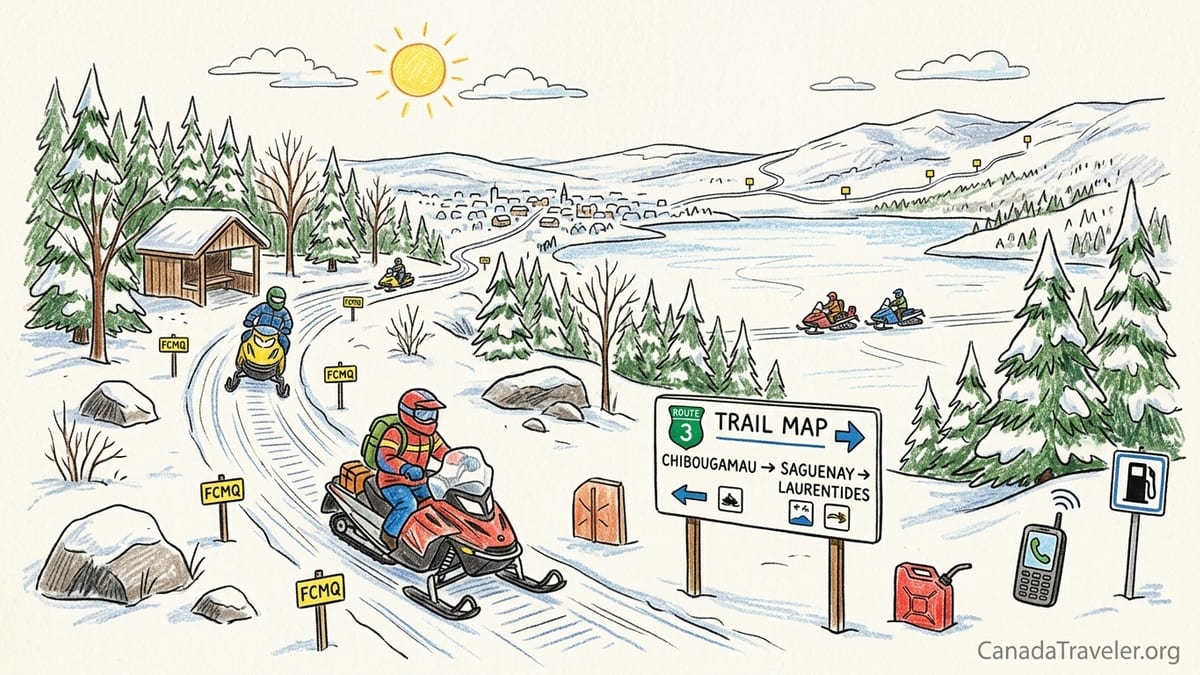
Québec’s snowmobile trails are managed by the Fédération des clubs de motoneigistes du Québec (FCMQ) through local volunteer clubs. The cumulative figure of roughly 33,300 kilometres comes from Bonjour Québec and reflects only marked, groomed club trails, not utility corridors or unmaintained forest roads. Because trails are interconnected, it is possible to ride from the Laurentides north of Montréal all the way to Saguenay–Lac-Saint-Jean, Abitibi-Témiscamingue or even Eeyou Istchee Baie-James without loading your sled on a trailer, provided conditions allow it.
The official season most tourism offices quote runs from around mid-December to mid-March, but a fixed December date never guarantees good riding. Early winter thaws, rain events and thin base snow often delay safe grooming. In some years, lowland regions near Montréal do not really open until late December or early January, while interior regions like Saguenay–Lac-Saint-Jean and Abitibi-Témiscamingue may open earlier and ride later into March. For any trip, you should plan dates but keep your first-day routes flexible until you have checked live conditions.
The FCMQ’s interactive map and the associated iMotoneige mobile app are the standard tools for checking current trail status. The map shows trail colours to indicate whether sections are open, closed or on private land with restrictions, and it overlays services such as gas stations, lodging, dealers and repair shops. Grooming information is updated roughly twice daily so you can see when a particular segment was last groomed, which matters a lot after fresh snow or a warm spell that causes bumps. Several regional tourism sites, such as Saguenay–Lac-Saint-Jean and Bas-Saint-Laurent, explicitly direct riders to this map for conditions and also note that a valid FCMQ trail permit is mandatory on groomed trails.
This province-wide system is what makes long-distance touring possible but it also means there are consistent rules. Whether you are planning a two-hour beginner ride in the Laurentides or a seven-day traverse of Abitibi-Témiscamingue and Eeyou Istchee Baie-James, you will be relying on the same map, permit system and signage conventions. The key differences from region to region are snow reliability, remoteness, terrain and how dense the network of services is.
Permits, Licensing, Helmets and Insurance
To ride on FCMQ club trails in Québec you must purchase a trail pass, which functions as a permit and partially funds grooming. For the 2025–2026 season, the FCMQ lists distinct rates for annual passes bought before and after a December advance-purchase deadline, as well as shorter duration options such as multi-day passes. The exact amounts are updated each season, and some marketing PDFs from regions like Abitibi-Témiscamingue show that rates are tied to specific validity periods and that online purchase is done through the FCMQ’s central system. Because prices can change and some options include bundled liability insurance while others do not, riders should always confirm the current trail pass type and cost on the FCMQ site before buying.
Helmet laws and licensing are enforced by Québec’s provincial regulations on off-road vehicles. In practice, that means every rider must wear a certified helmet, and drivers must hold a valid driver’s licence or recognized equivalent. Rental operators in tourist regions routinely ask for a valid car or motorcycle licence and often set their own minimum age limits above the legal minimum. Liability insurance for your snowmobile is also compulsory on public land. The FCMQ offers an annual pass option that includes third-party liability coverage, and for those who opt out, it warns that proof of separate coverage is required and may take a processing delay of several working days to come into effect.
For international visitors or riders from other provinces, the simplest approach is usually to buy the trail pass option that includes insurance and to book guided packages where the outfitter owns and insures the fleet. Well known multi-region rental groups such as Contant highlight that seasonal trail passes and insurance are part of the planning checklist for anyone renting in Mauricie, Saguenay–Lac-Saint-Jean or Abitibi-Témiscamingue. If you are bringing your own sled across the border, contact your regular insurer to confirm Québec coverage in writing, and carry that confirmation with your registration in case you are checked on the trail.
Helmet and gear rentals are widely available at snowmobile centres and outfitters, but availability of high-quality, heated equipment can be limited during peak weeks such as late December holidays and Québec’s school break in early March. Even if your rental includes a helmet, consider bringing your own thin balaclava for hygiene and face warmth, and verify that the helmet has a double lens visor or electric shield designed to resist fogging in very low temperatures.
Beginner Guided Rides: Safe First Turns in the Laurentides and Lanaudière–Mauricie
For a first-ever snowmobile ride, a half-day or full-day guided excursion in a developed region close to Montréal or Québec City is ideal. The Laurentides north of Montréal and the combined Lanaudière–Mauricie area position themselves as “Snowmobile Country” and emphasize that they often have some of the best snow and trail conditions within roughly a two-hour drive of both major cities. In practice, this means you can land in Montréal in the morning, transfer by shuttle or rental car to a lodge near Saint-Michel-des-Saints or Mont-Tremblant, and be suited up for an introductory ride the same afternoon if conditions are good.
Specialized operators in the Laurentides such as established snowmobile tour companies offer packages that bundle a guide, machine, fuel, basic clothing and trail permits for rides on signposted circuits like the Discovery Circuit, Station-to-Station Circuit or Picturesque Circuit, which range roughly from 179 to more than 300 kilometres in total length. First-timers typically ride only a portion of these over a few hours, stopping at warm-up shelters and village relais along the way. In Lanaudière–Mauricie, outfits that partner with snowmobile-friendly hotels along key Trans-Québec trails use similar formulas, often offering evening or night rides when the trails are quieter and the lighting is atmospheric but visibility is good.
These beginner experiences are structured to minimize complexity. The guide sets the pace, explains trail signage, handles navigation and manages fuel stops. Rental fleets are usually composed of current or recent model touring sleds from brands like Ski-Doo or Polaris with electric start, reverse and often heated grips. Operators use hand signals and safety briefings to manage group riding, and they typically limit group sizes or subdivide groups by ability so that true beginners are not pressured by more aggressive riders. For a visitor, this is the easiest way to sample Québec snowmobiling without dealing with trail passes, insurance details or route planning.
From a regional comparison standpoint, the Laurentides feels more wooded and hilly, with shorter distances between villages, while Lanaudière–Mauricie offers slightly longer stretches of forest and lake crossings but still has frequent relais and gas. Both areas are relatively busy on weekends and during holiday periods, which is reassuring for beginners because there is near-constant traffic and help is never far away. At the same time, new riders should prepare for cold. Early January days can easily see temperatures between minus 15 and minus 25 Celsius, so even on a guided excursion you will want proper base layers, warm mitts, neck protection and face coverage.
Lodge-Based Weekends: Saguenay–Lac-Saint-Jean, Gaspésie and Classic Circuits
Once you are comfortable piloting a sled for a few hours, a lodge-based weekend in a destination region is the natural next step. Saguenay–Lac-Saint-Jean brands itself as a “snowmobiler’s paradise” thanks to its inland location, substantial lake effect snow around Lac Saint-Jean and a well-maintained trail network that links major towns like Alma, Roberval and Saint-Félicien. Local tourism offices highlight that trail conditions are posted through the FCMQ interactive map and that many hotels directly on the trail offer secure sled parking, on-site fuel or at least fuel within a short signed spur from the main trail.
In practice, a typical weekend might involve trailering or shuttling to a hotel on the lakeshore, then riding loop routes of 150 to 250 kilometres per day. For example, one day could circle a large portion of Lac Saint-Jean on Trans-Québec and regional trails, while another ventures into the Laurentian foothills north of the lake for more elevation and viewpoints. Because the region’s trails sit at moderate altitude and inland from the St. Lawrence, they often maintain good snow cover even if lower elevation regions nearer the river are marginal, although midwinter thaws can still affect them.
Gaspésie is better known in summer for its coastal road trip, but in winter it offers spectacular lodge-based snowmobiling where mountains plunge directly into the Gulf of St. Lawrence. Multi-day touring outfits routinely feature loops around the Gaspé Peninsula on Trans-Québec trails with nights in towns like Sainte-Anne-des-Monts or Chandler. For a weekend rider, basing yourself at a coastal hotel in northern Gaspésie lets you ride challenging but scenic mountain trails up toward the interior plateau while returning to the same warm bed each night. Snow reliability is generally strong due to maritime snowfall, but wind can create drifts and visibility issues on exposed ridges.
Compared to the Laurentides and Lanaudière–Mauricie, these lodge-based regions begin to feel more remote between services. On a typical Saguenay–Lac-Saint-Jean or Gaspésie day ride, gas stops may be 80 to 120 kilometres apart rather than every 40 to 60. Trails can include long lake or river crossings where wind chill is extreme, and climbing sections where reading signage and GPS tracks is essential in snowfall. For riders transitioning from guided day trips, it is often wise to book at least the first weekend in these regions with a guide or as part of a semi-guided package arranged by the hotel or tourism office.
Experienced Self-Guided Trips: Abitibi-Témiscamingue, Côte-Nord and Fuel Planning
Self-guided multi-day trips are where serious planning begins to matter. Abitibi-Témiscamingue in western Québec promotes itself as one of the province’s largest snowmobile trail networks, with routes connecting towns such as Val-d’Or, Amos, Rouyn-Noranda and Ville-Marie. Regional snowmobile maps show Trans-Québec trunk trails linked by wide, fast local routes and indicate the locations of relais, gas stations and snowmobile-friendly hotels. Some official loops there cover several hundred kilometres and even connect across regional lines toward Mauricie, Saguenay–Lac-Saint-Jean and Eeyou Istchee Baie-James.
Côte-Nord, running northeast along the St. Lawrence from near Tadoussac toward Sept-Îles and beyond, offers a different self-guided challenge. Here, the trail network frequently parallels the river but also dives inland to access villages that, in some cases, have limited winter road connectivity. Snowfall is generous but weather can be harsh, with blowing snow off the Gulf and fast-changing temperatures. Distances between services on certain stretches, particularly farther east, can be significant, so daily itineraries must account for fuel range and daylight.
On any self-guided trip, fuel planning is one of the most important safety tasks. The FCMQ map and regional PDFs list gas symbols along the trail, but operating hours vary. On a February weekday in Abitibi-Témiscamingue, for instance, a relais shown on the map might operate from mid-morning to early evening, while a village gas station stays open later. Riders should call a day or two ahead to confirm that critical gas stops will be open when they expect to arrive, especially on Sundays or Mondays. Many experienced riders in these regions carry an approved auxiliary fuel container, particularly when planning 250 kilometre or longer days in cold weather that increases fuel consumption.
Terrain in these experienced regions is more varied than the rolling woods of the Laurentides. Abitibi-Témiscamingue mixes long forest corridors with open cutovers and lake crossings, while Côte-Nord can involve steep wooded valleys descending to the St. Lawrence, with icy sections where studded tracks are helpful. Remoteness is also more pronounced. There may be long stretches where you see few other groups, and cell coverage is intermittent outside major towns. Satellite communication devices, articulated trip plans left with someone at home, and conservative riding speeds become part of normal risk management.
Long-Distance Touring and Remote Routes: Eeyou Istchee Baie-James and Beyond
For riders who already have multi-day touring experience and are comfortable with self-rescue basics, Québec’s far north offers some of the most remote trail experiences in eastern North America. Eeyou Istchee Baie-James markets itself to snowmobilers by emphasizing its abundant, dry snow and the sense of vast open territory. Official tourism information explains that snowmobile routes pass through or near Cree communities and remote service villages, providing access to lakes, hydro corridors and boreal forest that feel a world away from southern Québec’s more crowded corridors.
Several promoted snowmobile circuits cross between Eeyou Istchee Baie-James, Abitibi-Témiscamingue, Saguenay–Lac-Saint-Jean and Mauricie, linking towns such as Chibougamau, Senneterre, Lebel-sur-Quévillon and Saint-Félicien. One example highlighted in regional materials involves a loop that passes through these four tourist regions, which can take a week or more depending on daily distance. In this zone, planning daily legs of 200 to 300 kilometres is common, but it requires meticulous verification of trail openings, gas availability and lodging capacity. In winter 2023–2024, for example, some northern sectors saw temporary closures due to extreme cold, wind or mechanical issues with grooming equipment, reminding riders that contingency planning is essential.
Long-distance touring in these remote areas also brings cultural considerations. Many of the communities along Eeyou Istchee Baie-James routes are Cree or feature a mix of Cree and non-Indigenous residents. Tourism boards encourage visitors to respect local customs, use designated trail corridors when crossing reserves and inquire locally about sensitive areas, especially on frozen lakes and rivers that may have traditional fishing activity. Booking lodging well in advance is important because some inns cater to hydro workers, miners and local business travellers and may be near capacity during weekdays.
From a terrain and snow perspective, these northern routes offer excellent reliability but can also present some of the most punishing cold. Overnight lows below minus 30 Celsius are not uncommon in January and early February, and daytime highs can remain near minus 20. At these temperatures, exposed skin can freeze in minutes at trail speeds, and mechanical issues like frozen throttle cables become more likely. Riders should travel in groups, carry redundant navigation devices and tools, and be prepared to lay up in a village for a day if a major storm or dangerous wind chill is forecast.
Gear, Luggage, Frozen Lakes and Everyday Trail Etiquette
Whether you are on a two-hour guided ride or a ten-day traverse, Québec snowmobiling requires serious attention to clothing. The classic setup uses moisture-wicking base layers, a warm mid-layer like fleece or lightweight down, and a windproof, insulated snowmobile suit or jacket-and-bib combination. Cotton has no place in this system. Good mitts or gloves with liners, balaclava, neck gaiter and warm winter boots are essential. Many experienced riders now invest in heated gloves and socks or heated insoles, particularly for long days at temperatures colder than minus 15 Celsius. On guided rentals, check what clothing is included and where it may be worth upgrading with your own gear to avoid being cold.
Luggage management changes with trip style. For short guided outings, you need only a small backpack for a water bottle, spare mitts and a phone. On lodge-based weekends where you return to the same hotel, duffel bags can stay in your room and sleds run with light, day-use tunnel bags. Multi-day touring through Abitibi-Témiscamingue or Eeyou Istchee Baie-James, however, usually means investing in hard or semi-rigid tunnel bags and possibly saddlebags that attach to the snowmobile’s rear rack system. Waterproof packing cubes or dry bags inside these protect clothing from snow dust and condensation.
Frozen-lake caution is one of the most important safety topics for Québec riders. Many official FCMQ trails cross lakes and wide rivers. In those corridors, local clubs assess ice thickness and mark a brushed or staked route. Riders should stay exactly on this marked course and avoid venturing off to explore pressure ridges or head toward unmarked fishing cabins. Early season and late season are particularly sensitive times when shorelines and inlets may be weak even if the main ice is thick. Riding outside official corridors on unfamiliar lakes is strongly discouraged, especially at night or during storms when reference points are hard to see.
Trail etiquette helps keep this massive shared network functioning smoothly. Québec’s snowmobile trails have posted speed limits, typically 70 kilometres per hour on most club trails and lower near villages or at road crossings. Guides usually brief beginners on basic etiquette: keep right except when passing, slow down and pull over safely when being overtaken, use hand signals to indicate stops or hazards, and respect private property by staying on the groomed base. Noise and speed near homes, farms and villages are particularly sensitive issues that affect land access agreements with clubs. Alcohol is illegal to consume while operating a snowmobile, and enforcement blitzes occasionally target busy corridors on weekends, making a zero-tolerance approach the only safe strategy.
How to Use Live Trail Maps and Why Dates Alone Are Not Enough
Snowmobilers planning a Québec trip increasingly rely on two connected digital tools: the FCMQ interactive map and the iMotoneige smartphone app. The interactive map, accessible from any modern browser, allows you to zoom in by region, overlay services and see open or closed status on each trail segment. The app replicates this functionality on your phone, adding GPS positioning, turn-by-turn style route guidance, grooming timestamps, club contact information and quick search for services such as gas stations, lodging and snowmobile rental locations. Regional tourism offices like Saguenay–Lac-Saint-Jean and Bas-Saint-Laurent explicitly reference these tools as the source of truth for daily decisions.
To read the maps effectively, start by selecting your intended region, then toggling layers for services so that icons for gas, lodging and food appear. Plot each day’s route along Trans-Québec (TQ) trunk trails and regional connectors, noting distances between fuel points. Before departure each morning, check trail colours: green typically indicates open, while red or grey show closed or unavailable sections. Grooming layers will show the last time a groomer passed. If a critical segment has not been groomed for several days after a thaw or snowfall, be prepared for rough conditions or consider an alternate route.
The reason a fixed date like “December 15” or even “January 5” does not guarantee good riding is that early season conditions vary widely from year to year and by region. In some recent seasons, Lanaudière–Mauricie and the Laurentides opened significant stretches by mid-December, while in others warm rain eliminated base snow and trails did not fully open until early January. Inland plateaus such as Saguenay–Lac-Saint-Jean or Abitibi-Témiscamingue may hold snow better, but they are not immune to midwinter thaws. For anyone booking flights, it is prudent to set a rough time window, for example the last week of January or first half of February, and then fine-tune the specific starting point and region one to two weeks out based on live maps.
Printed regional maps still have value, especially in areas with poor cell coverage like parts of Côte-Nord or Eeyou Istchee Baie-James. Many tourism offices mail free snowmobile maps that show Trans-Québec routes, local loops and relais. These are particularly useful as backup navigation tools and for visualizing multi-region routes. However, only the digital maps will tell you if a club has closed a bridge, rerouted a trail around logging, or temporarily suspended grooming due to mechanical problems. Serious trip planning today combines both: paper maps for overview and digital tools for real-time decisions.
The Takeaway: Matching Regions and Trip Styles
Choosing where to snowmobile in Québec starts with an honest look at your experience, appetite for remoteness and tolerance for cold, then matching that to the province’s regions and infrastructure. For absolute first-timers, guided half-day or full-day rides in the Laurentides or Lanaudière–Mauricie offer an accessible, structured entry point with rental sleds, clothing, permits and navigation handled by experienced operators. These areas combine relatively short distances between services with confidence-inspiring traffic and well-marked loops that stay close to roads and villages.
Scenic weekend riders who already know how to control a sled will find excellent lodge-based circuits in Saguenay–Lac-Saint-Jean and Gaspésie. Snow reliability is strong, especially around Lac Saint-Jean and the Gaspé mountains, and the mix of rolling forest, sweeping viewpoints and village relais makes two- or three-day trips rewarding without feeling extreme. Booking snowmobile-friendly hotels on the trail, using the FCMQ map to plan 150 to 250 kilometre day loops and checking grooming status each morning are the keys to a smooth weekend.
Experienced long-distance riders ready for self-guided itineraries can look to Abitibi-Témiscamingue and Côte-Nord. These regions offer wide, fast trails, longer stretches between services and a sense of true travel rather than just day riding. Here, detailed fuel planning, backup navigation and conservative weather decisions become routine. Finally, travellers wanting the most remote experience, both culturally and geographically, should consider circuits that include Eeyou Istchee Baie-James or other northern corridors that connect several regions in a loop of a week or more. These routes demand the most preparation, group discipline and cold-weather resilience but deliver unforgettable expanses of boreal wilderness and long, uninterrupted days on pristine trails.
Whatever your style, the fundamentals remain the same. Confirm trail permits, insurance and licensing before you leave home. Invest in proper cold-weather clothing and do not underestimate minus 25 Celsius wind chill on an exposed lake. Learn and respect trail etiquette, especially around frozen lakes and private land. And perhaps most importantly, use live trail maps and local information instead of dates on a calendar when deciding where and how far to ride. With that mindset, Québec’s 33,000-plus kilometres of interconnected trails open up as one of the world’s most compelling winter playgrounds.
FAQ
Q1. Do I need a trail permit to ride any snowmobile trail in Québec?
Yes. To ride on groomed club trails managed under the FCMQ network, you must purchase a valid trail pass for your machine. Short-term passes are available, but you should always confirm current options and prices with the FCMQ before your trip.
Q2. When is the best time of winter to plan a Québec snowmobile trip?
The most reliable period for good conditions across multiple regions is usually from early January to late February. Mid-December openings and mid-March closing dates vary by year and region, so you should always verify live trail status a week or two before travelling.
Q3. Can beginners safely ride a snowmobile in Québec?
Yes, if they join a reputable guided tour in a developed region such as the Laurentides or Lanaudière–Mauricie. Guides provide instruction, set a safe pace and manage navigation, permits and fuel stops, allowing first-timers to focus on learning basic control and enjoying the scenery.
Q4. Which region is best for a scenic weekend based at one hotel or lodge?
Saguenay–Lac-Saint-Jean and Gaspésie are strong choices for lodge-based weekends. Both offer reliable snow, impressive scenery and loops of 150 to 250 kilometres that return to the same hotel each night, with access to fuel and restaurants directly from the trail.
Q5. How do I check current trail conditions and grooming information?
Use the FCMQ interactive map or the iMotoneige mobile app to see which trails are open, when segments were last groomed and where services such as gas and lodging are located along your planned route.
Q6. What licence and insurance do I need to ride in Québec?
Drivers must hold a valid driver’s licence and carry registration and liability insurance for their snowmobile. Many visitors choose the FCMQ trail pass option that includes liability coverage, while guided rental packages often include insurance on the outfitter’s machines.
Q7. How should I plan fuel stops on long-distance routes?
On experienced and remote routes, you should use the interactive map and regional information to locate gas stations and relais along your route, calculate distance between them, confirm opening hours by phone and consider carrying an approved auxiliary fuel container for days over 200 kilometres.
Q8. Is it safe to ride on frozen lakes in Québec?
Official club trails cross many lakes and rivers only after local volunteers have checked ice thickness and marked a corridor. It is important to stay strictly on the staked or brushed route and to avoid unmarked lake travel, especially early and late in the season or during thaws.
Q9. Which regions offer the most remote snowmobiling experiences?
Eeyou Istchee Baie-James, northern Abitibi-Témiscamingue and parts of Côte-Nord provide the most remote riding, with long distances between communities, intermittent cell coverage and very cold temperatures. These areas are suitable only for well-prepared, experienced groups.
Q10. What clothing is essential for a Québec snowmobile trip in very cold weather?
You should pack moisture-wicking base layers, warm mid-layers, an insulated snowmobile suit or jacket-and-bib combo, certified helmet with proper visor, warm mitts or gloves with liners, a balaclava, neck gaiter and insulated winter boots. Heated gloves or socks are highly recommended for long days below minus 15 Celsius.