


Pacific Canada is where mountains drop straight into the sea, ferries feel like city buses and rainforest, islands and wildlife shape every itinerary. For first-time visitors, it can be hard to understand how Vancouver, Vancouver Island, Whistler, the Sunshine Coast, the Gulf Islands and the remote Great Bear Rainforest fit together on a map and in a realistic trip. This guide explains how the coast works in practice so you can choose the right mix of city time, coastal highways, island stays and wilderness expeditions for your first journey west.
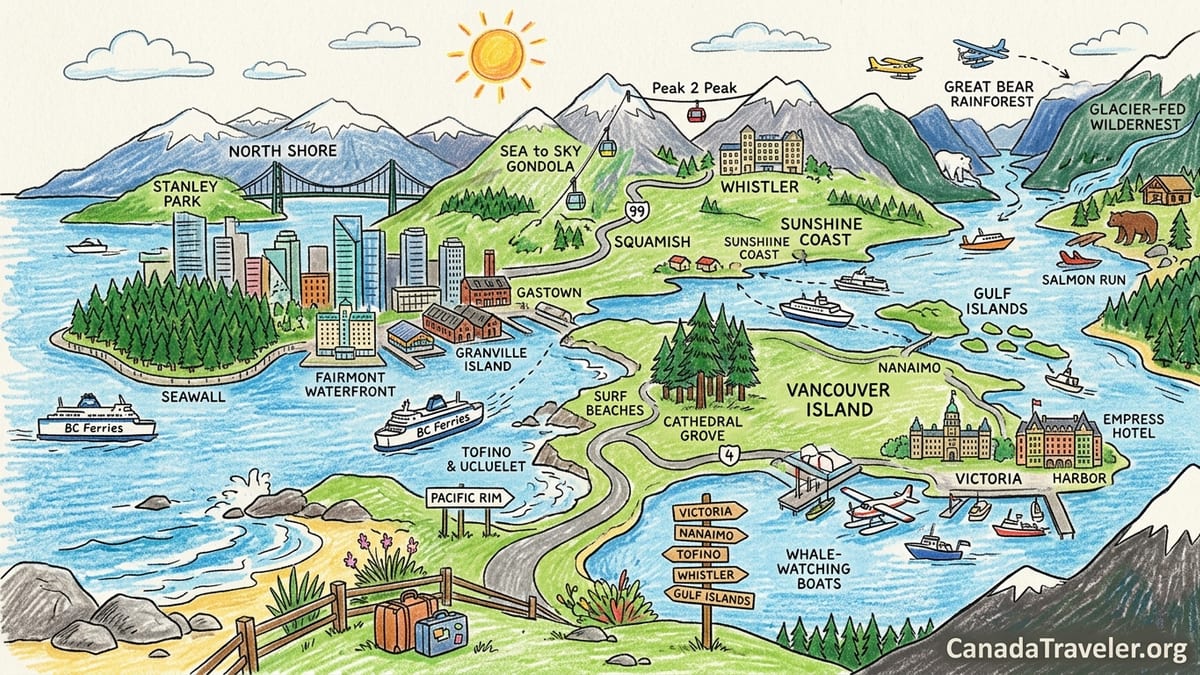
How the Pacific Coast Is Laid Out
British Columbia’s Pacific coast stretches roughly 1,000 kilometers from the US border up toward Alaska, but most first-time visitors focus on the southwest corner around Vancouver and Vancouver Island. Vancouver sits on the mainland, framed by the North Shore mountains and connected to the rest of the coast by a web of ferries and highways. To reach most islands or smaller coastal communities, you either sail with BC Ferries or fly in on small planes or seaplanes.
Vancouver Island, home to Victoria and popular regions like Tofino and Ucluelet, lies across the Strait of Georgia. The island is roughly the size of Belgium, with its own highway system and varied regions, from calm, sheltered east-coast towns like Nanaimo and Parksville to the storm-battered beaches of the Pacific Rim. Reaching it generally means a 90 to 120 minute ferry from terminals near Vancouver, then a drive of one to four hours once you land depending on where you are going.
North of Vancouver, the Sea-to-Sky Highway leads through Squamish to Whistler and on toward more remote interior plateaus. The Sunshine Coast, despite its name, is also on the mainland, but there is no road connecting it directly to Vancouver. Instead, you drive to Horseshoe Bay and board a 40-minute vehicle and passenger ferry to Langdale near Gibsons, then continue by car or bus up Highway 101 to Sechelt and Powell River. Farther north and harder to reach are the Great Bear Rainforest and North Coast communities such as Bella Coola, Bella Bella and Prince Rupert, reached by regional flights, long-distance ferries and sometimes gravel roads.
Vancouver: Urban Hub Between Ocean and Mountains
Most international visitors land in Vancouver, and it makes a logical base or starting point. The city combines a compact downtown with fast access to beaches, parks and mountains. It is entirely possible to land at Vancouver International Airport in the morning, check into a downtown hotel such as the Fairmont Waterfront or a boutique spot in Yaletown, and be hiking in the forests of Stanley Park or on the North Shore by mid-afternoon.
Public transit from the airport to downtown is simple: the driverless Canada Line train takes around 25 minutes. Once downtown, you can explore on foot or by bike. A full loop of the Stanley Park Seawall is about 10 kilometers and takes two to three hours at a leisurely walking pace, with views across to the North Shore mountains and Lions Gate Bridge. For first-time visitors, neighborhoods like Gastown, the West End and Granville Island give a good feel for the city’s mix of glass towers, heritage warehouses and working harbor.
From a planning perspective, Vancouver is also where you connect to the rest of the coast. Horseshoe Bay in West Vancouver, about a 30 to 40 minute drive from downtown in light traffic, serves ferries to Nanaimo, the Sunshine Coast and Bowen Island. Tsawwassen, roughly a 45-minute drive south, is the major terminal for ferries to Victoria, Nanaimo and the Southern Gulf Islands. If you are traveling without a car, coach companies run combined bus and ferry tickets, and there are hotel shuttles and tour coaches linking Vancouver to Whistler and Victoria.
Vancouver Island and Victoria: Ferries, Coastal Highways and Surf Towns
Vancouver Island is often a trip within a trip. Once you sail across, distances feel larger and travel slows down. Ferries from Tsawwassen to Swartz Bay near Victoria or to Duke Point near Nanaimo take about 1 hour 35 minutes, not including check-in. In summer and on long weekends, it is common to reserve a vehicle space in advance and arrive 60 to 90 minutes before departure, especially if you are catching a specific sailing to fit lodging check-in times or whale watching tours.
Victoria, the provincial capital at the southern tip of the island, feels more intimate than Vancouver, with a lively harbor overlooked by the Parliament Buildings and the Empress Hotel. Visitors often spend one to two nights here, using it as a base for harbor kayak tours, afternoon tea, or whale watching trips searching for humpbacks and orcas in the Juan de Fuca Strait. Inner Harbor hotels are priced accordingly, while more budget-friendly motels and vacation rentals are scattered along Douglas Street and in neighborhoods like James Bay.
Beyond Victoria, Highway 1 and then Highway 19 and 4 carry you to the island’s interior and west coast. The drive from Nanaimo to Tofino on Highway 4 takes approximately three hours in good conditions, with winding mountain stretches and frequent slow-moving RV traffic. It is a classic coastal road trip with stops at Cathedral Grove’s giant Douglas firs and lakeside pullouts near Sproat Lake. Tofino and Ucluelet are small but very popular, with limited accommodation stock, so first-time visitors should book months ahead for summer and expect mid-range hotels to cost as much as central-city rooms in Vancouver.
Because of the combination of ferry time, highway distances and the temptation to stop often, Vancouver Island works best as a separate trip or a major focus of your itinerary. A realistic first visit might be three nights in Victoria and three in Tofino or Ucluelet, with an overnight in Nanaimo or Parksville if you want to break up the driving. Trying to pair a full island loop with Whistler and the Sunshine Coast in less than 10 to 12 days tends to feel rushed.
Whistler and the Sea-to-Sky Corridor
The Sea-to-Sky Highway (Highway 99) runs from North Vancouver to Whistler and beyond, hugging the fjord-like waters of Howe Sound before climbing into the Coast Mountains. The drive from downtown Vancouver to Whistler typically takes about two hours in good summer conditions, but it is wise to allow extra time for traffic or photo stops at viewpoints such as Porteau Cove or the Shannon Falls parking area near Squamish. The road is modern and mostly divided, but has curves, changing weather and slower trucks, so planning for daylight driving makes the trip more relaxing.
Squamish sits roughly halfway and has grown from a logging town into a major outdoor hub. On a first-time trip you might stop for half a day to ride the Sea to Sky Gondola for views over Howe Sound, or try beginner-friendly rock climbing and mountain biking lessons. Continuing to Whistler, you arrive in a purpose-built alpine resort with pedestrian-only village strolls, large hotels such as the Fairmont Chateau Whistler, and a network of trails and lakes just beyond the main squares.
In winter, Whistler is focused on skiing and snowboarding, with lift tickets and accommodation priced accordingly. In summer, the emphasis shifts to hiking, mountain biking and alpine sightseeing on the Peak 2 Peak Gondola. Many visitors simply book a two- or three-night stay and leave their car parked while they explore on foot and by gondola. Given its relative proximity, Whistler combines naturally with a few days in Vancouver, requiring only one scenic highway journey rather than ferry logistics.
It is possible to drive from Whistler to the interior or to connect with long-distance road trips through the Cariboo and up to Prince George, but for most coastal-focused first visits, Whistler marks the upper limit of a Sea-to-Sky side trip. Attempting to pair it with the far North Coast and Great Bear Rainforest in a single short itinerary often leads to too much time in transit and not enough time outside the car.
Sunshine Coast and Gulf Islands: Semi-Remote Coastal Life
The Sunshine Coast begins at the Langdale ferry terminal near Gibsons and stretches north along Highway 101 through Roberts Creek, Sechelt, Halfmoon Bay and Pender Harbour toward Powell River. The ferry trip from Horseshoe Bay to Langdale takes around 40 minutes and operates as part of BC Ferries’ major routes, carrying vehicles and foot passengers. While reservations are available on many daytime sailings, this route often sees a mix of booked and drive-up travelers, and traffic spikes on summer Fridays as locals head to cabins and campgrounds.
Because the Sunshine Coast is mainland but not linked by road to Vancouver, it has a semi-remote feel. In practice, this means life revolves around the ferry schedule, with visitors planning check-in and restaurant reservations around arrival and departure times. Highway 101 itself is not long, but it winds through small communities, with speed limits that keep driving relaxed. Activities range from sea kayaking tours out of Sechelt Inlet to short hikes in dense second-growth rainforest around Smuggler Cove or Skookumchuck Narrows, where powerful tidal currents create standing waves that kayakers and surfers ride.
The Gulf Islands, scattered between Vancouver Island and the mainland, offer a different kind of island escape. Main islands such as Salt Spring, Galiano, Pender and Mayne are reached by BC Ferries routes from Tsawwassen or Swartz Bay, with crossings typically in the 40 to 70 minute range, sometimes with intermediate stops. Schedules can be complex, and on some smaller islands you may only have a few sailings a day, so first-time visitors should build in buffer time and avoid tight same-day connections with flights.
Sunshine Coast and Gulf Island trips are well suited to slower travel. You might rent a waterfront cottage near Sechelt for a week, walking down to the beach each evening to watch seals and occasional porpoises, or stay at a bed-and-breakfast on Salt Spring Island within cycling distance of farm stands and wineries. Because grocery stores and fuel can be more expensive and limited than in Vancouver or Victoria, it pays to fill your car and do a main shop before boarding the ferry, especially if you are traveling with a family or on a tight budget.
Great Bear Rainforest and the North Coast
The Great Bear Rainforest covers a huge stretch of central and northern BC coastline, with deep fjords, glacier-fed rivers and some of the richest temperate rainforest on the planet. Travel here is fundamentally different from time in Vancouver or Victoria. There are no large cities, and access is typically by regional flights, small boats and in some cases multi-day ferries. Many visitors reach communities such as Bella Bella or Klemtu via flights from Vancouver’s South Terminal on regional carriers, then transfer to lodge boats for the final leg to remote accommodations.
Wildlife viewing is a primary reason to visit, particularly in late summer and early autumn when salmon runs draw bears and other animals to river systems. Specialized lodges offer multi-day packages focused on grizzly viewing, the chance of seeing the rare white-furred spirit bear, and marine life such as humpback whales, sea lions and eagles. These trips can be expensive compared with self-planned travel elsewhere on the coast, but they include transport, guiding, meals and gear, and they give access to territories and knowledge that independent travelers would struggle to match.
Another North Coast access point is Bella Coola, at the end of Highway 20, sometimes called the Freedom Road. Travelers can drive from Williams Lake in the interior over a steep mountain pass to reach the coastal valley, or arrive by scheduled flights and seasonal ferries. From Bella Coola, local operators run bear viewing, fjord cruises and cultural tours in partnership with Indigenous communities. Weather here is highly unpredictable, with heavy rain and autumn storms common, and visitors should be ready for itinerary changes.
Because of the cost, remoteness and time needed to reach the Great Bear Rainforest and North Coast, this region is generally best treated as a dedicated trip of at least five to seven nights. Trying to tack it onto a week that already includes Vancouver, Whistler and Vancouver Island rarely works well. Instead, many travelers plan a future journey once they have a feel for BC logistics and understand how comfortable they are with small planes, boats and off-grid stays.
Building a First-Time Itinerary: What Combines Well
When you start plotting points on a map, it is tempting to try to see everything: Vancouver, Victoria, Tofino, Whistler, the Sunshine Coast, Gulf Islands and perhaps even the Great Bear Rainforest. In practice, ferries and mountains slow down movement, and a thoughtful first trip chooses two or three regions that combine naturally rather than chasing too many highlights.
One classic combination is Vancouver, Whistler and Victoria in 10 days. You might spend three nights in Vancouver without a car, exploring on foot. Then you rent a vehicle and drive up the Sea-to-Sky for three nights in Whistler. After returning to Vancouver, you continue directly to Tsawwassen, sail to Swartz Bay and finish with three or four nights in Victoria before flying out. This itinerary keeps driving days relatively short and uses major ferry routes that run frequently and are easy to reserve.
Another natural pairing is Vancouver Island with the Gulf Islands or the Sunshine Coast with Vancouver. For example, a couple with two weeks might spend five nights between Victoria and the Cowichan Valley, three nights on Salt Spring Island and four nights in Tofino, with travel days spread out to allow for grocery stops and unplanned beach walks. Families with a car might combine a week on the lower Sunshine Coast near Sechelt with three nights in Vancouver at the beginning or end, using a single ferry crossing each way and minimizing packing and unpacking.
By contrast, the Great Bear Rainforest and North Coast typically work best as stand-alone experiences or paired only with one city. A traveler might fly into Vancouver for two nights to adjust to the time zone and see some urban sights, then move on to a six-night lodge stay reached by flight and boat from the city. The contrast between downtown high-rises and remote estuaries full of bears and salmon can be intense but rewarding when given enough time.
How the Experience Changes: City, Coast, Islands and Wilderness
Travel in Pacific Canada shifts character as you move from city cores to ferries, island backroads and remote inlets. In Vancouver or Victoria, a typical day might involve coffee in a busy neighborhood cafe, gallery visits, and a sunset drink overlooking a harbor full of commuter ferries and floatplanes. Transit is frequent, dining options are numerous, and you can decide on most activities a day or even an hour ahead.
On coastal road trips like the Sea-to-Sky or the drive to Tofino, the journey itself becomes a highlight. You notice how quickly weather changes as you climb from sea level to mountain passes and back, or how the light shifts on fjords and lakes over the course of an afternoon. Fuel, rest stops and viewpoints are relatively frequent on main corridors, but distances between services can still feel long to visitors used to dense European or East Coast networks. Booking a roadside motel in advance for busy weekends can remove some stress, but spontaneous stays are still possible in shoulder seasons.
Island stays on the Gulf Islands, Vancouver Island’s west coast or the Sunshine Coast tend to be quieter and more routine-driven. You might find yourself timing grocery runs to avoid ferry traffic, picking up fresh seafood from a small harbor as boats come in, or walking the same shoreline each morning and noticing different birds and tides. Options for nightlife and shopping narrow, but opportunities for encounters with seals, deer or even black bears at a distance increase. Power outages during storms or slow mobile signals become part of the experience rather than an exception.
Remote wilderness expeditions in the Great Bear Rainforest and North Coast are another step removed. Days are often structured around the tides, wildlife movements and the safety considerations of boat or floatplane travel. Packing lists from lodges emphasize waterproof clothing, layering systems, and respect for wildlife and cultural protocols. Guests might spend hours in a covered boat watching a single river mouth, listening to guides explain salmon ecology and Indigenous stewardship before returning to lodges accessible only by water. This kind of travel feels less like sightseeing and more like temporary participation in a living coastal ecosystem.
The Takeaway
Planning a first trip to Pacific Canada starts with understanding the basic grammar of the coast: ferries instead of bridges, fjords carved deep into the mainland, islands that function like small towns and mountains that funnel highways along narrow corridors. Once you appreciate that geography, choosing between Vancouver, Vancouver Island, Whistler, the Sunshine Coast, the Gulf Islands and the Great Bear Rainforest becomes less a matter of collecting destinations and more about matching your time, budget and comfort level with remoteness.
If you have a week, focus on Vancouver and one nearby region such as Whistler or Victoria. With two weeks, you can confidently add a coastal road trip to Tofino or a slow island stay. Save the far North Coast and Great Bear Rainforest for a future journey when you are ready to commit the time and resources they deserve. Whatever combination you choose, the same essentials apply: respect the weather, build in buffer days for ferries and highways, and leave space in your schedule for that unplanned stop at a viewpoint, harbor or trailhead that becomes your favorite memory of the coast.
FAQ
Q1. How far in advance should I book BC Ferries for summer travel?
For peak summer and long weekends, try to reserve vehicle spaces one to two months ahead on major routes, and at least a couple of weeks ahead on less frequent runs.
Q2. Can I visit Vancouver, Victoria and Whistler in one week?
It is possible but feels rushed. With seven days, consider two nights in each place and accept that you will only see the main highlights, or drop one destination for a more relaxed pace.
Q3. Do I need a car for Vancouver Island and the Sunshine Coast?
A car is highly practical for both, especially outside main towns. Public transit exists but is limited, and many trailheads, beaches and viewpoints are easiest reached by private vehicle.
Q4. What is the best time of year for a first trip to Pacific Canada?
Late May to September usually offers the most reliable weather and longest days. July and August are busiest and most expensive, while May, June and September are good shoulder seasons.
Q5. Is it realistic to include the Great Bear Rainforest on my first visit?
For most travelers, it is better as a dedicated trip because of the cost, remoteness and travel time involved. Consider it if you have at least 10 to 12 days and a flexible budget.
Q6. How different is driving the Sea-to-Sky Highway from typical urban driving?
It involves mountain curves, changing weather and varied traffic speeds. The road is well maintained, but first-time visitors should allow extra time and aim to drive in daylight.
Q7. Are there bears in towns like Whistler, Tofino and on the Sunshine Coast?
Black bears are common around many communities, especially in spring and autumn. Follow local guidance on garbage, food storage and trail closures, and keep a safe distance if you see wildlife.
Q8. Can I rely on mobile coverage and internet along the coast?
Cities and larger towns have good coverage, but reception can be weak or absent on some highways, islands and in remote inlets. Download maps offline and confirm key details before leaving coverage areas.
Q9. How expensive is accommodation compared with other parts of Canada?
Major destinations like Vancouver, Whistler, Victoria and Tofino can be among the most expensive in the country, especially in summer. Smaller Gulf Islands and Sunshine Coast towns offer some mid-range and budget options but also see peak-season price rises.
Q10. Is it necessary to join tours, or can I explore independently?
Independent travel works very well in Vancouver, Vancouver Island, Whistler and the Sunshine Coast. In the Great Bear Rainforest and some North Coast areas, guided tours or lodge packages are usually the most practical and responsible way to visit.