


I arrived in Montréal on a late summer afternoon with an embarrassingly confident thought in the back of my mind: "It’s Canada. I’ll be fine in English." By the end of a week that took me from downtown high-rises to tiny villages along the St. Lawrence, I had eaten wonderful food, gotten mildly lost, parked where I probably should not have, and learned that traveling in Québec without French is entirely possible but feels very different once you get beyond the city. What follows is a firsthand account, not a language policy debate: exactly where English carried me, where it suddenly did not, and the simple French I wish I had learned before I turned the ignition key.
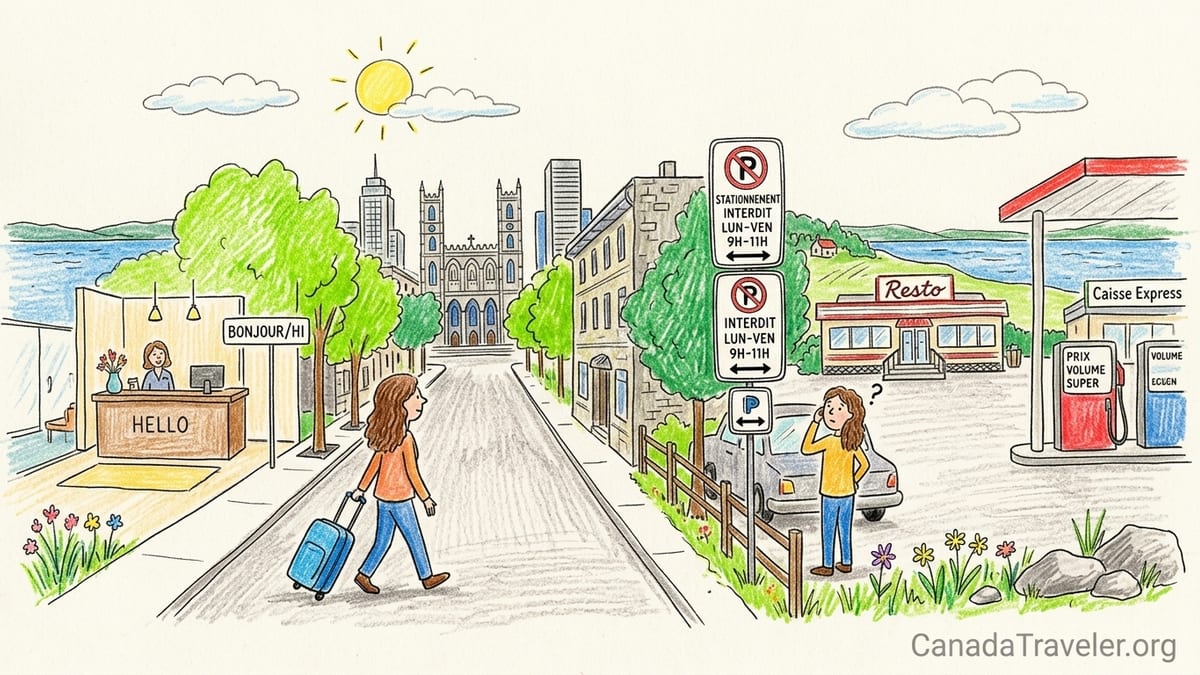
Landing in Montréal: The Bubble Where English Works
My first stop was downtown Montréal, near the Quartier des spectacles. From the moment I rolled my suitcase into the hotel lobby, my lazy assumption seemed to be confirmed. The front desk greeting switched from "Bonjour" to "Hello" before I even answered, and check-in happened in smooth, idiomatic English. The clerk explained parking rules, breakfast hours, and Wi-Fi details without hesitation. Later I learned that in the greater Montréal area more than half the population can hold a conversation in both English and French, and English-language service is easy to find in tourism jobs. On the ground, that meant I could book a room, ask for a later checkout, and clarify charges at the front desk exactly as I would in Toronto or Chicago.
The same was true in the usual tourist zones. At a café near Place des Arts, I ordered a latte and a croissant in English. The barista replied in French to the colleague behind the machine, then turned back to me with perfect English, asking, "For here or to go?" In Old Montréal, staff at the Notre-Dame Basilica ticket counter seamlessly served visitors in English, French, and occasionally Spanish in the same two-minute window. It was easy to forget that French is Québec’s sole official language because, in these central neighborhoods, service workers routinely adapt to whichever language they hear first.
This comfort zone can be deceptive. Surrounded by bilingual signage from international chains, hearing playlists in English, and reading museum labels that provide competent English translations, I slipped into an expectation that English would be available everywhere. That expectation held in the city’s core, but Montréal is only one part of Québec, and even within Montréal I started to hit the limits of my monolingual optimism as soon as I left the most touristed streets.
Road Signs and Parking: Where the French-Only Rules Hit Fast
My first reality check came not from a conversation but from a pole stacked with parking signs in Plateau-Mont-Royal. Québec’s traffic and parking signs are, by law, written in French. The iconography is familiar, but the small words matter. On one stretch of Rue Rachel, I stared at a forest of green and red rectangles announcing "Stationnement interdit," "Lun–Ven," "9 h–11 h," and a big arrow pointing exactly where I had just parked. Tourisme Montréal even jokes that locals themselves scratch their heads over these signs, and I understood why as I tried to decode whether I would get a ticket if I stayed longer than an espresso.
Here is where I felt the difference between visiting a bilingual country and a unilingual province within one. It was unreasonable to expect the city to duplicate every sign in English, and the solution was not to complain but to learn a few key words: "stationnement" (parking), "interdit" (forbidden), "réservé" (reserved), and "sauf" (except). Once I knew those four, the signs suddenly made sense. "Stationnement interdit" meant no parking at certain hours, "sauf vignettes" meant except permit holders, and I could glance at the schedule rather than treating each block as a puzzle.
Out on the autoroute, the pattern continued. Direction signs are mostly numbers and city names, but information boards use French vocabulary like "ralentir" (slow down), "sortie" (exit), and "bretelle fermée" (ramp closed). Québec’s driver handbook and transportation department emphasize pictograms to help all road users, which worked in my favor when I saw icons for gas, lodging, or tourist information on blue background signs. Still, when a temporary sign flashed "Circulation en alternance" in a construction zone, it took me a moment to realize it meant alternating one-way traffic controlled by a flagger. By the time I had translated it in my head, I was already braking behind a line of cars.
From City Bistros to Village Diners: Menus and Meal-Time Misunderstandings
Eating in Montréal with no French was straightforward. In neighborhoods like Old Montréal and the Old Port, English menus are almost automatic. Hosts would greet me with "Bonjour, hi" and often present bilingual menus without being asked. Ordering smoked meat in a Saint-Laurent Boulevard institution or a poutine in a casual bar felt as linguistically simple as eating in any major North American city. Staff might chat among themselves in French, but they would ask me, in English, whether I wanted my steak medium rare and bring the bill with clear item descriptions.
The tone shifted as soon as I followed the St. Lawrence northeast, stopping for lunch in smaller towns on the road toward the Côte-Nord region. At a roadside motel-restaurant complex near Baie-Comeau, the sign outside advertised fuel, a diner, and a convenience store. Inside the restaurant, the menu was entirely in French, hand-laminated and seasonally stained, with familiar words like "hamburger" sitting beside less obvious ones like "poutine galvaude" and "guédille." The server greeted me with "Bonjour," waited for my reply, and continued in French when I hesitated. This was the first time on the trip that I realized my default expectation of instant English was not just unrealistic but a bit self-centered.
I did not want to force anyone into a language they were not comfortable with, so I tried a simple approach: "Bonjour, je parle un peu français. Est-ce que vous parlez anglais un peu?" Often the answer was, "Un peu," and we met in the middle with a mixture of gestures, slow French, and essential English nouns. The misunderstandings that followed were minor but memorable. I once ordered what I thought was a plain "hot chicken" sandwich and received the classic Québécois version: sliced chicken on white bread drowned in gravy with peas on top. Another time I misunderstood "table d’hôte" as something special and expensive, when it is simply a fixed-price set menu, usually a good deal.
Québec French vocabulary tripped me up more than I expected. When a server asked if I wanted my coffee "à emporter," I knew enough to say yes, but "un trio" on a fast-food board turned out to mean a combo meal, and "guédille" was the local word for a lobster or seafood roll. The phrases I eventually wrote down in my phone, and wished I had learned earlier, included "Qu’est-ce que vous recommandez?" (What do you recommend?), "C’est quoi, exactement?" (What is that, exactly?), and the life-saving "Sans porc, s’il vous plaît" (No pork, please), which clarified one dish I had almost misread.
Hotels, Motels and Fuel Stops Outside the Montréal Comfort Zone
Accommodation highlighted the split between urban bilingualism and rural reality even more clearly. My Montréal hotel staff were all comfortable in English. When I booked a modest motel along the Saguenay, communication became more situational. The online booking platform itself was bilingual, but the confirmation email from the property came only in French, with phrases like "arrivée" (arrival), "départ" (departure), and "politique d’annulation" (cancellation policy). When I arrived, the owner welcomed me with cautious English, then reverted to French for details I had not thought about in advance, such as where to leave the key if I left at 5 a.m.
I learned to check in with a prepared sentence: "Bonjour, j’ai une réservation au nom de…" followed by my name, then "pour deux nuits" or however long I was staying. Most hosts could then switch to enough English to cover the basics: payment, breakfast hours, and parking. Where English ran out, they would ask me to follow them outside so they could physically point at my numbered space or show me the path to the river behind the property. I discovered that a few words like "clé" (key), "rez-de-chaussée" (ground floor), and "compris" (included) made written house rules far less intimidating.
Gas stations and self-serve fuel pumps were where I felt the language divide most sharply, and unexpectedly. On the autoroute, big-brand stations near major towns often had attendants who could answer a question about payment in English. Farther from Montréal, the pump interfaces were typically in French only. The first time I encountered "Retirer la carte rapidement" after inserting my foreign credit card, I fumbled because I expected the machine to walk me through options in English. Once I understood that "Retirer" meant "remove" and that "Appuyer sur le bouton" meant "press the button," I stopped holding up the line behind me.
In one village, the card reader rejected my chip and the cashier explained in rapid French that I needed to pay inside first, specifying an amount, then pump. I did not catch her full explanation, but the key word was "avance" (in advance). It would have saved time to know how to say "Je veux faire le plein" (I want to fill the tank) and "Je paierai en espèces" (I will pay in cash). Without those phrases, I resorted to showing her a banknote and pointing at the car. She smiled, set the amount slightly higher than the likely total, and later rounded down when I came back inside, but I walked away knowing I had made things harder for both of us.
Museums, Attractions and the English I Expected Automatically
One of the most striking contrasts of the trip came in cultural spaces. In Montréal’s larger museums, English is standard. At the Pointe-à-Callière museum, for example, staff sold tickets in either language and exhibits included English panels alongside French, sometimes with audio guides offered in multiple languages. My expectation that "Canada means bilingual" held firm there, which is reasonable because many major museums cater to international visitors and often receive federal funding that encourages bilingual signage.
Smaller regional museums told a different story. In a community history center along the Route des Navigateurs, every panel was in French only, and the volunteer at the desk looked mildly alarmed when I asked, "Do you have anything in English?" She wanted to help but had very little English, and it was unfair of me to assume she would. After a moment of mutual awkwardness, I switched to "Je peux essayer de lire en français" and we both relaxed. She slowed down her explanations, pointed out highlights on a map, and suddenly I was less of a helpless outsider and more of a curious guest.
Audio-visual presentations also highlighted my overconfidence. At one historic site, the film introducing the region played only in French at scheduled times. I walked in expecting a headset dispenser with language choices, like in big European museums. Instead, I followed the story through images, place names, and dates on screen. It was still moving, but I realized that a short phrase such as "Le film est seulement en français" on the brochure, which I had glanced at without fully understanding, had already told me this. I simply assumed there would be English because I was used to that at home.
The French phrases I would now memorize before visiting such places include "Est-ce qu’il y a des informations en anglais?" (Is there information in English?), "Pouvez-vous m’expliquer un peu en anglais?" (Can you explain a bit in English?), and "À quelle heure commence la visite guidée?" (What time does the guided tour start?). Even a partial question in French seemed to make people more patient and often led to someone, a staff member or fellow visitor, chiming in with ad hoc translation help.
Casual Conversation, Accents and Small Embarrassments
Québec French has its own accent and vocabulary, and my classroom French from years ago did not fully prepare me for hearing it in full speed at a grocery store or campground. In Montréal, when I tried simple phrases, people often replied in near-native English, which made it hard to practice. Outside the city, my attempts were met with genuine encouragement but also some confusion when my pronunciation slipped toward Parisian textbook norms.
One small embarrassment sticks with me. At a bakery in a small town, I wanted two plain croissants. I confidently ordered, "Deux croissants nature, s’il vous plaît," but the baker heard my accent and switched to English: "Do you want them warm?" Relieved, I said yes. She then asked a follow-up question in French that I did not catch. After an awkward pause and a repeat, I realized she was asking if I wanted them in a box or a bag. The word I missed was "sac" (bag). I had assumed that once English appeared, the rest of the interaction would stay in English, but she was just code-switching casually. My expectation of a clean boundary between languages did not match how locals actually talk.
Vocabulary particular to Québec also caused misunderstandings. When someone at a café asked "Voulez-vous un breuvage?" I froze, unfamiliar with "breuvage" as a common word for drink. I knew "boisson" from school, so I tried to replay the sentence in my head while the line moved around me. Later I learned that "breuvage" is widely used in Québec in everyday speech. Similarly, at a supermarket, the sign above the cash registers read "Caisse express" and the self-checkout said "Libre-service." I guessed correctly that "caisse" meant checkout and "libre-service" meant self-service, but "Panier" on a smaller sign took me a moment to realize it referred to a hand basket.
Most of these hiccups were resolved with patience and smiles on both sides. What helped most was opening each interaction with "Bonjour" rather than "Hi" and signaling that I was making an effort. Phrases I came to rely on included "Je ne comprends pas bien" (I do not understand well), "Parlez-vous anglais un peu?" and "Pouvez-vous répéter plus lentement?" (Can you repeat more slowly?). None of these turned me into a fluent speaker. They simply softened the edges of each situation so that people felt more comfortable meeting me halfway.
What I Wish I Had Learned Before Driving into Québec
Looking back, the gap between what I expected and what I encountered was not about hostility or hospitality. It was about my preparation. I had downloaded offline maps, checked my car insurance, and even made restaurant reservations, yet I had spent almost no time preparing for the language reality outside Montréal. If I could redo that planning, I would devote an hour before the trip to learning a narrow set of phrases tied to the exact situations I ended up facing.
For driving and signs, that would mean "sortie" (exit), "ralentir" (slow down), "déviation" (detour), "bretelle fermée" (ramp closed), "stationnement interdit" (no parking), and "sauf" (except). For food, "table d’hôte" (set menu), "plat du jour" (daily special), "sans" (without), "boisson" or "breuvage" (drink), and "addition" (bill) would have gone a long way. For accommodation and services, words like "réservation," "clé," "Wi-Fi compris," "taxes en sus" (taxes not included), and "paiement à l’avance" (payment in advance) would have made check-in and checkout smoother.
Beyond vocabulary, I also wish I had adjusted my mindset. Expecting that every service worker in a small Gaspésie village should be able to serve me in English was not fair. Québec’s language laws apply to signs, government and businesses, not to tourists, and they do not guarantee that a given cashier in a grocery store far from Montréal will have studied English at school or be comfortable using it. Once I accepted that I was the one crossing into a French-speaking space, not the other way around, the awkward moments turned into part of the learning curve instead of frustrations.
Technology helped, but only up to a point. Translation apps were useful for decoding written French on menus and printed notices, especially when I pointed my camera at a paragraph and let the app overlay English text. At the same time, rural data coverage could be patchy, and it felt intrusive to hold my phone between myself and the person I was talking to. A balance emerged: look up the key words in private, then walk into the interaction with my eyes and hands free, ready to listen carefully and improvise.
The Takeaway
After several days on the road, I ended the trip back in Montréal with a clearer picture of what it means to travel in Québec without speaking French. In downtown Montréal, Old Montréal, and other major urban neighborhoods, an English-speaking traveler can function almost entirely in English if they want to. Hotel staff, restaurant servers, museum employees, and many shopkeepers can handle English with ease. It is possible to eat well, navigate the metro, attend festivals, and tour major attractions without learning much French beyond "bonjour" and "merci." For some visitors, that is enough, and there is nothing wrong with enjoying the city that way.
Outside those urban centers, the equation changes. Road signs are in French, small-town menus are often French-only, and the person behind the counter at a gas station or bakery may have limited English. That does not make rural Québec unfriendly. On the contrary, I found patience and good humor almost everywhere, from a motel owner who walked outside to show me a parking spot to a museum volunteer who slowed down her speech so I could follow along. What changed the quality of those encounters was my willingness to meet people partway, linguistically and culturally.
Perfect French is not necessary for most tourist itineraries in Québec, especially if you stay in Montréal or Québec City. What does make a clear difference is a small amount of preparation aimed at everyday realities: reading French-only parking signs, paying for gas at self-serve stations, checking into a family-run motel, ordering from a handwritten menu, and asking a stranger for directions. Learning a few dozen words and phrases, accepting that English is not automatic once you leave the city, and approaching each interaction with patience turns awkward moments into memorable parts of the journey instead of obstacles.
If you are planning your own trip, consider Montréal your comfortable starting point, not the whole story. Enjoy how easy it is to get by in English there, but also treat the rest of Québec as a chance to stretch a little. Pack your phrase list next to your guidebook, expect your first attempts in French to sound clumsy, and be ready to laugh at small misunderstandings. The province will still be there to meet you more than halfway, as long as you take a few steps toward it.
FAQ
Q1. Can I visit Montréal with no French at all?
Yes. In central Montréal, especially downtown and Old Montréal, you can book hotels, eat in restaurants, and visit major attractions entirely in English without major difficulty.
Q2. Is English widely spoken outside Montréal and Québec City?
Outside the big cities, English is less common. You will usually find some English in larger tourist areas, but in small towns and rural regions you should expect many interactions to happen mainly in French.
Q3. Are road signs in Québec bilingual?
No. By provincial law, standard road signs are in French only, although they rely heavily on international symbols. Direction signs use city names and numbers, but text like "sortie" or "ralentir" appears only in French.
Q4. Will restaurants always have an English menu?
In central Montréal and other very touristed spots, English menus are common. In small towns and family-run places, menus are often only in French, so knowing a few food words or using a translation app helps.
Q5. Can I check into hotels and motels in English?
Most hotels in major cities can handle full check-in in English. In rural motels or bed-and-breakfasts, owners may speak only limited English, so basic French phrases for arrival and payment make check-in smoother.
Q6. How hard is it to use parking meters or pay stations without French?
Machines generally use icons and simple French text. Once you know words like "payer" (pay), "billet" (ticket), and "durée" (duration), you can manage them; otherwise, you may need to take an extra minute to translate.
Q7. What key French phrases should I learn before driving in Québec?
Useful words include "sortie" (exit), "ralentir" (slow down), "stationnement interdit" (no parking), "déviation" (detour), and "sauf" (except), plus polite phrases like "Bonjour" and "Merci".
Q8. Do museums and attractions provide information in English?
Major museums and federal sites usually offer English labels, brochures, or audio guides. Smaller regional museums and community attractions often provide information only in French.
Q9. Is it considered rude to start speaking English right away?
Locals generally appreciate it if you begin with "Bonjour" and then ask politely whether the person speaks English. Jumping straight into English is not forbidden, but it can feel less respectful.
Q10. Can I rely entirely on translation apps during my trip?
Translation apps are very useful for menus and written signs, but mobile coverage can be patchy in some rural areas. Knowing a few key phrases and words makes you less dependent on your phone and eases face-to-face conversations.