


British Columbia’s coast offers two irresistible post-Vancouver side trips: the big, bold sweep of Vancouver Island and the quieter, close-to-Vancouver charm of the Sunshine Coast. Both promise fjord-like inlets, mossy forests, and salty air. Yet they deliver very different experiences, especially if you have only a few extra days and cannot comfortably do both. This guide compares them head to head, from ferries and driving time to wildlife tours, beaches, food, and crowds, to help you choose the right coastal escape for your style of travel.
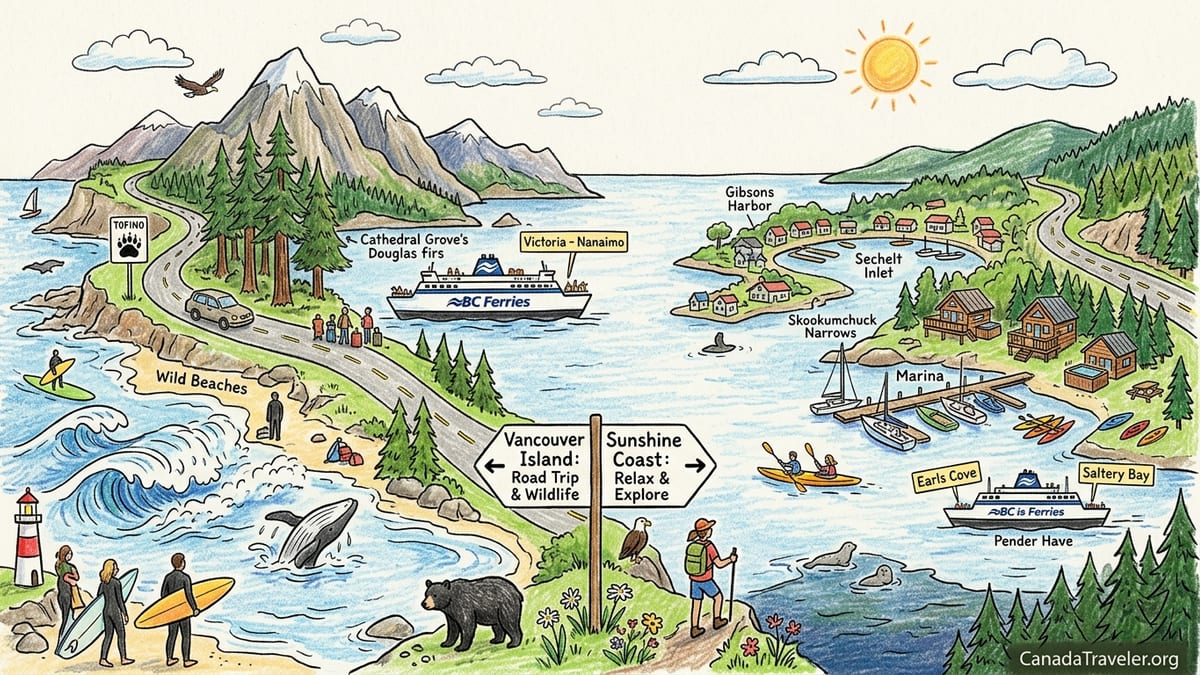
Big Island vs Compact Coast: How They Feel On The Ground
Vancouver Island is large enough to feel like its own province. From Victoria in the south to Port Hardy in the north is roughly a full day of driving, with distinct regions that each feel like separate trips: the capital-city culture of Victoria, surf-town energy in Tofino and Ucluelet, the agricultural Comox Valley, and the logging and fishing heritage of Port Alberni and Campbell River. Travelers often underestimate the distances. A drive from Victoria to Tofino can easily take 4.5 to 5 hours with stops for Cathedral Grove’s old-growth trees and viewpoints, which means you need at least three to four nights on the island to experience even one region without rushing.
The Sunshine Coast, by contrast, feels intimate and linear. It technically is still mainland BC but is only accessible by ferry or air, so it has an island-like atmosphere. The classic stretch runs from Langdale, near Gibsons, up through Sechelt and Pender Harbour to Earls Cove and then, for those who continue, across a second ferry to Powell River. Everything is strung along a single coastal highway backed by forested hills. Instead of major towns hours apart, you get a sequence of small communities: Lower Gibsons with its working harbor and breweries, Roberts Creek with its laid-back beaches, Sechelt with essential services and waterfront paths, and tiny marinas tucked into sheltered coves.
In practice, this means Vancouver Island offers significantly more geographic and activity variety, but you spend more time on the road connecting those varied areas. The Sunshine Coast offers fewer “must-see” icons but lets you settle in quickly and explore from a single base with short drives or walks. For travelers who like to unpack once, read the tide charts over coffee, and wander to the beach in ten minutes, the Sunshine Coast is particularly appealing.
For visitors deciding between them, it can help to think in terms of energy. Vancouver Island feels like an adventurous road trip with multiple chapters. The Sunshine Coast feels like a low-key coastal retreat where the days blur together in a good way.
Ferry Logistics, Driving Time, And Ease Of Getting There
Most visitors reach Vancouver Island via BC Ferries from the Vancouver area. The main routes link Tsawwassen to Swartz Bay for Victoria and Tsawwassen to Duke Point for Nanaimo, with typical crossing times of around 1 hour and 35 minutes plus check-in time. Horseshoe Bay to Departure Bay in Nanaimo is another common route. Car fares vary by season, but for a small car and two adults you can expect to spend roughly in the low to mid three-figure range return, depending on time of year and route. Summer and long weekends often require advance bookings, especially for morning and late afternoon sailings.
If you are focused on minimizing transit time, a newer high-speed passenger ferry service runs between downtown Vancouver and Nanaimo in about 70 minutes, cutting out the drive to Tsawwassen. This suits travelers without a car who plan to rent a vehicle on the island or base themselves in Nanaimo and explore nearby, such as to Parksville or the Cowichan Valley, using tours and local buses. Floatplanes also connect downtown Vancouver’s Coal Harbour with Victoria and Nanaimo, a scenic option that trades higher cost for dramatic aerial views and very short travel time.
The Sunshine Coast requires less overall travel time from central Vancouver but adds a second ferry if you go all the way to Powell River. From Horseshoe Bay, the car and passenger ferry to Langdale typically takes about 40 minutes. Once you disembark, it is roughly a 30‑minute drive to Sechelt and around an hour to Earls Cove on a winding but scenic two‑lane highway. If you continue north, the Earls Cove to Saltery Bay ferry adds another 50 minutes of sailing plus loading time. For a three-night trip, many people simply stay between Gibsons and Sechelt to avoid the second ferry and keep logistics straightforward.
If your priority is minimizing ferry and driving time, a short Sunshine Coast break focused around Gibsons or Sechelt is clearly simpler than a multi-stop Vancouver Island loop. If you have four or more nights and are comfortable with a longer first-day transfer, Vancouver Island opens up far more choices. A popular compromise is to fly into Victoria or Nanaimo, pick up a rental car there, and limit your driving to one region, such as Victoria plus the Cowichan Valley or Nanaimo plus Parksville and Qualicum Beach.
Beaches, Wilderness, And Outdoor Adventure
Vancouver Island’s range of landscapes is its biggest draw. On the west coast, Pacific Rim National Park Reserve between Tofino and Ucluelet serves up long, wild beaches like Long Beach and Chesterman Beach, where surfers in thick wetsuits dot the waves year-round and driftwood logs pile up at the high-tide line. Inland, Cathedral Grove near Port Alberni protects stands of old-growth Douglas fir where short boardwalk trails wind between trees several centuries old. Farther north around Campbell River and Port McNeill, the island feels wilder still, with fjord-like inlets, grizzly and black bear habitat, and access to remote islands.
The Sunshine Coast offers a softer, more sheltered coastal environment. Think pebbly and sandy pocket beaches along the Strait of Georgia, forested points with picnic tables, and protected bays that are ideal for paddleboarding and kayaking. Davis Bay near Sechelt has a long waterfront promenade and shingle beach popular with families on summer evenings, while Bonniebrook Beach in Gibsons stretches for several kilometers of stones and sand with views back toward the coastal mountains on the mainland. Inland, hiking trails loop around lakes and up to modest viewpoints rather than major alpine areas.
For paddlers, Vancouver Island delivers both open-Pacific and sheltered-inlet experiences. In Tofino, guided sea kayaking in Clayoquot Sound explores islet-studded channels and tidal shallows, often in the company of harbor seals and bald eagles. In the more protected waters around Nanaimo and Ladysmith, outfitters rent kayaks for calm-day explorations between small islands and sandstone shorelines. The Sunshine Coast specializes in glassy inlets and multi-day camping trips: Sechelt Inlet and the Narrows Inlet area are classic routes, with outfitters in Sechelt and Porpoise Bay offering guided day trips and overnight tours where you camp on small beach sites reached only by water.
If your dream is dramatic surf beaches, roaring Pacific swell, and the feeling of standing at the edge of the continent, Vancouver Island’s west coast is unmatched. If you picture calm bays, evening paddles on sheltered water, and quick access from town to trailhead, the Sunshine Coast feels tailored to that slower, more accessible style of coastal wilderness.
Wildlife Tours And On-The-Water Experiences
Vancouver Island is one of Canada’s premier wildlife-viewing destinations, especially for whales and bears. In Tofino and Ucluelet, multiple operators run whale watching trips of roughly 2.5 to 3 hours, with typical adult prices in the range of about 130 to 170 Canadian dollars per person as of 2026, depending on vessel type and season. These tours commonly see gray whales in spring and early summer, humpbacks through the warmer months, and occasionally orcas, plus sea lions, sea otters, and harbor seals. Most tours operate in Clayoquot Sound’s maze of islands, combining open ocean stretches with more sheltered channels.
Bear-watching boats depart Tofino and Ucluelet as well, usually timing departures to low tide when black bears come down to the rocky shoreline to forage. Near Campbell River, spring and fall tours venture into inlets to look for grizzly bears fishing for salmon, often combined with visits to small First Nations communities or remote lodges. Around Victoria and Nanaimo, smaller whale-watching boats head into the Salish Sea in search of humpbacks, Bigg’s killer whales, and other marine life, with most trips lasting around three hours.
The Sunshine Coast does not have the same concentration of formal wildlife tours but offers a quieter style of wildlife viewing. Paddling on Sechelt Inlet or out of Pender Harbour, you are likely to see seals hauled out on rocks, river otters, bald eagles, and in late summer the occasional porpoise. Guided kayak tours from outfits based near Porpoise Bay often integrate cultural interpretation and local history, highlighting Indigenous connections to the land and waterways as much as the animals themselves. Anglers can book fishing charters out of Gibsons, Sechelt, or Powell River targeting salmon and bottom fish in the Strait of Georgia.
If wildlife is your primary focus and you want a dedicated whale or bear tour, Vancouver Island is the stronger choice, with established operators, multiple departure times, and high chances of sightings in season. If you are happy with more spontaneous encounters while paddling or beachcombing, the Sunshine Coast can be very rewarding without committing to structured tours.
Hiking, Day Trips, And How Much You Need To Move Around
Vancouver Island invites road tripping. Many visitors design loops: Victoria to the Cowichan Valley for wineries and farm visits, across to Nanaimo and Parksville for beaches and family-friendly resorts, then onward to Tofino for surf and national park trails. Each segment involves 2.5 to 5 hours of driving, not counting stops, so you are constantly weighing whether to linger or move on. Popular hikes range from short rainforest loops near Tofino to the rugged full-day climbs of Mount Arrowsmith or multi-day routes like the Juan de Fuca Trail near Sooke, which require more planning, shuttles, or backcountry experience.
The Sunshine Coast works better for hub-and-spoke exploring. Arrange a cabin or vacation rental in Gibsons, Roberts Creek, or Sechelt and you can reach many of the main hikes and beaches within 15 to 45 minutes of driving. Trails such as the Skookumchuck Narrows hike near Egmont offer a half-day outing to view powerful tidal rapids, while short walks like Soames Hill near Gibsons deliver quick viewpoints over Howe Sound and Keats Island. Around Pender Harbour, short lake trails and shoreline walks are easy to string together between café stops and swims.
Because distances are shorter on the Sunshine Coast, it is easier to travel without a rigid schedule or to respond to weather. If a morning starts with rain, you can linger in a café in Lower Gibsons and head out later for a shorter hike without worrying about a long transfer day. On Vancouver Island, rearranging plans often means adjusting ferry bookings or driving several extra hours.
For travelers who tire of driving or for families with small children, this difference matters. Three nights on the Sunshine Coast can feel restful and full of activity without ever spending more than 45 minutes in the car at a stretch. Three nights on Vancouver Island can feel either thrilling or exhausting, depending on how ambitious your itinerary is.
Accommodation, Food, Crowds, And Seasonal Feel
Accommodation options on Vancouver Island cover the full spectrum: city hotels and boutique inns in Victoria’s Inner Harbour area, oceanfront resorts in Tofino and Ucluelet, chain hotels in Nanaimo, rustic motels and campgrounds in Port Alberni, and fishing lodges and eco-lodges farther north. Prices reflect this variety. In peak summer, a mid-range hotel in Tofino can easily run into higher three-figure nightly rates, while more budget-friendly motels and hostels fill quickly. Shoulder seasons in May, June, September, and early October often bring lower rates and a calmer feel while still offering good weather and wildlife viewing.
The Sunshine Coast has fewer large properties and more character stays: waterfront cabins near Gibsons, small motels in Sechelt, bed-and-breakfasts perched on wooded hills, and campgrounds around Roberts Creek and Porpoise Bay. Prices are often slightly lower than the most in-demand parts of Vancouver Island, though premium waterfront cabins and designer tiny homes can rival Tofino rates in midsummer. Because the area is smaller, desirable properties for long weekends and holidays book out early.
In terms of food, Vancouver Island has the advantage of scale. Victoria alone offers a dense mix of restaurants ranging from casual fish and chips to multi-course tasting menus that highlight local seafood and produce. In Tofino and Ucluelet, travelers find everything from acclaimed destination restaurants to food trucks serving tacos and smoked fish, plus bakeries and cafes geared to surfers and families. Smaller communities like Cumberland, Ladysmith, and Chemainus add their own coffee roasters, breweries, and local bakeries that make road-tripping particularly satisfying for culinary travelers.
The Sunshine Coast’s dining scene is quieter but still appealing. Gibsons features waterfront pubs, a local brewery taproom, and seafood-focused restaurants with views across the harbor, while Roberts Creek and Sechelt add small cafes, pizza places, and farm-to-table spots that lean heavily on local produce and coastal ingredients. Outside the main hubs, options thin out to a single café or general store, so travelers with dietary restrictions or those arriving late should plan ahead with groceries.
Crowd patterns differ too. Vancouver Island’s most famous destinations, such as Tofino, Pacific Rim National Park Reserve, and central Victoria, can feel busy in July and August, especially on weekends and holiday periods. Parking lots at trailheads and beaches fill early. The Sunshine Coast certainly gets summer visitors, but outside of a few popular spots like Davis Bay on a sunny afternoon or the Skookumchuck Narrows trail on strong-tide days, it rarely feels as intensely busy. Travelers seeking a sense of breathing room without traveling far from Vancouver often find the Sunshine Coast more relaxing in high season.
Who Should Choose Which: Families, Couples, Wildlife Fans, And Road Trippers
For families, the decision often comes down to pace versus variety. Vancouver Island offers more attractions that can be pieced together into a varied trip: Victoria’s Royal BC Museum and Inner Harbour for an educational day, Parksville’s shallow, warm beaches and mini-golf for kids, aquariums and wildlife centers in communities like Ucluelet or Campbell River, and easy rainforest walks in Pacific Rim National Park Reserve. However, this variety requires more driving and more transitions between accommodations. Families who dislike packing up frequently or who have nap schedules to protect may find the short hops and beach access of the Sunshine Coast more manageable.
Couples looking for a romantic getaway have strong arguments either way. Vancouver Island’s west coast, especially Tofino and Ucluelet, offers storm-watching suites with fireplaces, high-end dining, and dramatic beach walks in all seasons. Victoria provides evening strolls along the harbor, pub and wine-bar hopping, and boutique hotels in historic buildings. The Sunshine Coast leans more toward cozy cabins, hot tubs on decks overlooking quiet bays, sunset walks on pebble beaches, and simple seafood dinners. If you imagine long beach walks under big skies and elevated dining, Vancouver Island excels. If you picture reading on a deck, kayaking at sunset, and doing very little else, the Sunshine Coast fits better.
For wildlife-focused travelers, Vancouver Island is the clear winner. Purpose-built whale watching and bear viewing tours with multiple daily departures, plus the chance to combine them with hiking and beach time in one trip, are a major draw. Visitors might spend a morning on a whale watching boat out of Tofino, an afternoon walking the beaches of Long Beach, and the next day driving to a trailhead near Ucluelet. On the Sunshine Coast, wildlife encounters are more incidental: seals near the marina, eagles overhead, and perhaps salmon in local rivers in season, but fewer structured experiences.
Road trippers and those who love journey as much as destination tend to gravitate to Vancouver Island. The multi-hour drive from Nanaimo or Victoria to Tofino crosses mountain passes, lakes, and river valleys, with frequent viewpoints, waterfalls, and quirky roadside stops. Continuing north toward Campbell River or Port Hardy adds another scenic chapter. The Sunshine Coast, while beautiful, offers a more uniform drive that many travelers prefer to break up with short hikes, beach stops, and bakery visits rather than long-distance cruising.
Trip Length, Itinerary Ideas, And Minimizing Ferries And Driving
With only two or three extra days after Vancouver, the Sunshine Coast is usually the better match. A simple itinerary might include taking an early Horseshoe Bay to Langdale ferry, driving 10 minutes to Gibsons for lunch and a walk along the waterfront, then settling into a cabin or hotel near Roberts Creek or Sechelt for two nights. Day two could be a half-day kayak tour on Sechelt Inlet and an afternoon on Davis Bay or Bonniebrook Beach, with dinner at a local pub. On day three, a short hike near Gibsons or Soames Hill before an afternoon ferry back to Vancouver keeps driving and logistics light.
For the same two or three days on Vancouver Island, travelers would likely need to choose a single base such as Victoria or Nanaimo. From downtown Victoria, you could spend one day exploring the Inner Harbour, museums, and nearby coastal walks in places like Dallas Road and Gonzales Bay, then perhaps a second day touring wineries in the Cowichan Valley with a local operator or rental car. From Nanaimo, you might visit nearby Parksville and Rathtrevor Beach for a day of tide pools and sand, then explore downtown Nanaimo’s harborfront and short viewpoints the next. Attempting to include both Victoria and Tofino in only three days would involve more time in the car than on the beach.
With four to six days, Vancouver Island becomes a stronger contender, especially for travelers comfortable with a bit more driving. A typical five-night route might include two nights in Victoria, one night in the mid-island area such as Parksville or Qualicum Beach, and two nights in Tofino or Ucluelet, with at least one dedicated day to Pacific Rim National Park Reserve and a half-day for whale watching or kayaking. The Sunshine Coast with this much time might include two bases, such as Gibsons and Pender Harbour, and room for a day trip to Skookumchuck Narrows or an extra paddle on Sechelt Inlet.
For visitors wanting to minimize ferries and driving above all, the most efficient option is usually a three-night Sunshine Coast stay between Gibsons and Sechelt, or a two- or three-night stay in Victoria only, reached via ferry or floatplane and explored largely on foot or by local tours. Attempting a loop that combines both Vancouver Island and the Sunshine Coast in under a week is technically possible but often results in more time queuing for ferries than enjoying the coast.
The Takeaway
Choosing between Vancouver Island and the Sunshine Coast is less about which destination is objectively better and more about which style of coastal BC experience suits you. Vancouver Island is larger, wilder in places, and packed with headline experiences: Pacific Rim beaches, whale and bear watching tours, a provincial capital with cultural attractions, and long, scenic drives that feel like classic West Coast road trips. It rewards travelers with at least four or five days and a willingness to cover distance.
The Sunshine Coast offers a different kind of richness: smaller coastal communities, short hops between beach, trail, and café, and an easygoing rhythm that makes even a two-night stay feel like a proper break. It favors travelers who want to avoid long drives, families with young kids, and anyone who prefers to settle into one place and explore close by rather than chase a long list of sights.
If you dream of dramatic surf, iconic wildlife tours, and a sense of reaching the outer edge of the continent, prioritize Vancouver Island. If you picture strolling from your cabin to a quiet beach at sunset, sipping coffee on a small-town wharf, and paddling calm inlets without checking the clock, make the Sunshine Coast your first coastal BC escape. With more time on a future trip, you can always come back for the other side of this remarkably varied coast.
FAQ
Q1. Which is better for a short 2 or 3 day trip from Vancouver, Vancouver Island or the Sunshine Coast?
For two or three days, the Sunshine Coast is usually better because you can be in Gibsons or Sechelt within a few hours of leaving Vancouver, spend more time at beaches and cafés, and less time in transit than if you tried to reach and explore both Victoria and Tofino or another distant part of Vancouver Island.
Q2. If I want to minimize ferry time, which destination should I choose?
If minimizing ferry time is key, choose the Sunshine Coast and focus on the area between Gibsons and Sechelt, which involves a single, relatively short ferry between Horseshoe Bay and Langdale plus modest driving distances.
Q3. Where are the better whale watching and wildlife tours, Vancouver Island or the Sunshine Coast?
Vancouver Island is stronger for formal wildlife tours, with established whale watching and bear viewing operators in places such as Tofino, Ucluelet, Victoria, and Campbell River offering multiple departures daily in season and high chances of sightings.
Q4. Which destination is more family friendly?
Both are family friendly, but they suit different styles: Vancouver Island offers more attractions like museums, aquariums, and national park beaches, while the Sunshine Coast is simpler for families who prefer short drives, easy beach access, and a slower pace with one main base.
Q5. Is Vancouver Island worth it if I only have three nights?
Yes, if you are willing to focus on one region such as Victoria or Nanaimo and nearby beaches or wineries, Vancouver Island can be rewarding in three nights, but you should avoid trying to cram in long drives to places like Tofino on such a short timeline.
Q6. Which place feels less crowded in summer?
The Sunshine Coast generally feels less crowded, with a more low-key vibe even in July and August, while Vancouver Island hotspots such as Tofino and central Victoria can feel quite busy at peak times and popular beaches and trailheads fill early.
Q7. Where will I find better beaches?
For dramatic, wide sandy beaches with Pacific surf, Vancouver Island’s west coast around Tofino and Pacific Rim National Park Reserve is the standout, while the Sunshine Coast offers smaller, often pebbly beaches and sheltered bays that are great for swimming and paddling but less dramatic in scale.
Q8. How far in advance should I book ferries and accommodation?
In peak summer and around Canadian holidays, you should aim to book BC Ferries sailings and popular accommodations on Vancouver Island and the Sunshine Coast several weeks ahead, while shoulder seasons often allow more flexibility but still reward booking key sailings and preferred stays in advance.
Q9. Can I visit both Vancouver Island and the Sunshine Coast on one trip?
You can, but combining both typically makes sense only if you have at least a week and are comfortable with multiple ferry rides and a road-trip style itinerary; with fewer days it is usually better to choose one and explore it more deeply.
Q10. Which is better for a car-free traveler?
For car-free visitors, Victoria on Vancouver Island is often easier, with walkable attractions, local buses, tours, and floatplane or ferry connections from Vancouver, while the Sunshine Coast is more spread out and generally works best if you have a car or are comfortable arranging local transfers.