


Few trip planning questions come up as often for Pacific Canada as this one: if you only have a handful of days, should you base yourself in big, glassy Vancouver or charming, waterfront Victoria? The two cities sit less than 100 kilometers apart as the crow flies, but deliver very different experiences, and getting between them takes more time and money than many visitors expect. This guide compares the cities head to head, with real examples of prices, transport times and neighborhoods, to help you decide which one fits your first trip best.
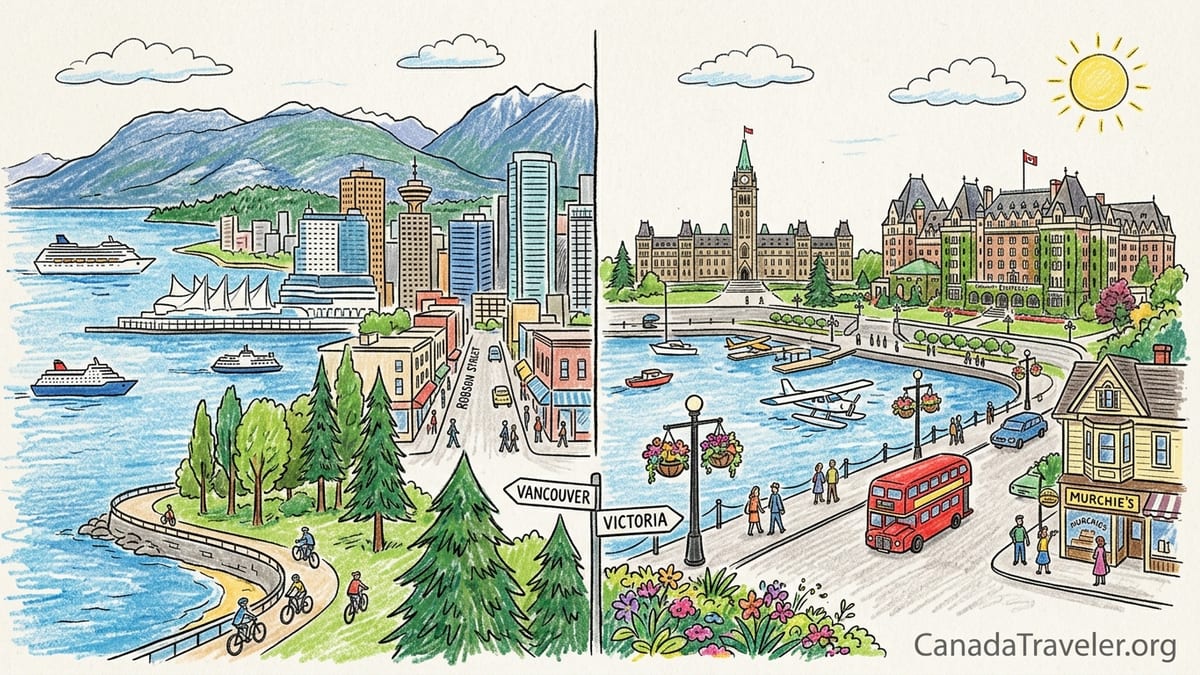
City Atmosphere: Big-City Energy vs Relaxed Capital
Vancouver feels like a major international gateway: dense downtown towers, cruise ships at Canada Place, and busy streets lined with coffee chains and indie cafes. Walk the blocks around Robson Street and Granville Street and you are in a North American metropolis, with office workers on lunch breaks and late-night crowds spilling out of cocktail bars. The surrounding neighborhoods each have distinct personalities, from hip Mount Pleasant with its murals and microbreweries to upscale Kitsilano with beach volleyball and yoga studios overlooking English Bay.
Victoria, by contrast, is smaller and more intimate. Around the Inner Harbour you see historic stone buildings like the Fairmont Empress hotel and the provincial Parliament Buildings, flower baskets on lamp posts and buskers playing guitar on Government Street. The pace is slower, especially in the evenings, and it is easy to walk from the harbor to residential streets of heritage houses in ten minutes. Many visitors describe Victoria as feeling like a compact European seaside city combined with classic Canadian coastal scenery.
That contrast affects how your trip feels day to day. In Vancouver you might spend a morning in a busy downtown museum, then ride the SkyTrain to a neighborhood restaurant and finish the night in a packed music venue. In Victoria you are more likely to stroll the harbor, visit the Royal BC Museum, then walk back to a harbor-view pub where you can still get a table at sunset without reserving weeks in advance. If you want urban buzz and nightlife, Vancouver wins; if you are drawn to historic streets and a calmer rhythm, Victoria will likely feel more satisfying.
Weather is similar on paper, with mild, often rainy winters and dry, comfortable summers, but it plays out differently in practice. Vancouver’s tall buildings and mountain backdrop can make low cloud feel dramatic and moody; Victoria’s slightly drier, sunnier microclimate on southern Vancouver Island means a higher chance of blue-sky days in shoulder seasons like April and October, which can be attractive if you plan on a lot of harbor walks and patio dining.
Scenery and Outdoor Access
Both cities are surrounded by water and mountains, but the scale changes your experience. From downtown Vancouver you can walk to Stanley Park, a 400 hectare forested peninsula with a seawall loop of roughly 10 kilometers, beaches, and views toward the North Shore mountains. Within an hour by public transit you can be on trails at Grouse Mountain, Lynn Canyon or Deep Cove. This makes Vancouver an ideal base for travelers who want a mix of city time and serious hiking without renting a car for every outing.
Victoria’s scenery is gentler but very accessible. The Inner Harbour is ringed by promenade paths and small parks, and just outside the center you reach coastal viewpoints like Dallas Road and Clover Point, where locals fly kites and watch storms roll in across the Strait of Juan de Fuca. The famous Butchart Gardens lie about 30 minutes north by car or tour bus and are a major draw for first-time visitors, especially in spring and summer when the rose and Japanese gardens are in bloom.
Outdoor enthusiasts looking for multi day adventures often use Vancouver as a gateway to the mainland mountains. Whistler is roughly a two-hour drive north along the Sea to Sky Highway, and summer brings options like gondola rides, alpine hikes and mountain biking. Day tours from Vancouver frequently combine the drive with stops at Shannon Falls or the Sea to Sky Gondola. From Victoria, your longer forays tend to be along Vancouver Island: surfing in Tofino and Ucluelet, storm watching on the west coast, or wine tasting in the Cowichan Valley. Those destinations usually require a car and at least two or three days.
If you prefer dramatic, high alpine vistas and classic mountain towns, Vancouver makes a more practical base. If your vision of the trip centers on rugged coastline, beaches, and island road trips, Victoria plus the rest of southern Vancouver Island can be more rewarding, with less time lost crossing back and forth to the mainland.
Restaurants, Cafes and Nightlife
Vancouver’s dining scene is far larger and more diverse, driven by its size and international population. You can eat excellent sushi in the West End, sample regional Chinese cuisines in nearby Richmond, and find innovative tasting menus at high-end spots in Yaletown or Gastown. For casual meals, you might pay around 22 to 30 Canadian dollars for a main course in a mid-range downtown restaurant, with higher prices at top venues and in peak summer. Coffee culture is strong, and it is easy to build a day around brunch in Kitsilano, snacks from food trucks near the Art Gallery, and craft beer in East Vancouver breweries.
Victoria punches above its weight for a city of its size, especially when it comes to local seafood and farm-to-table menus. The compact center means many of the best restaurants are within a 10 to 15 minute walk of the Inner Harbour. Expect to find oyster bars, small bistros highlighting Vancouver Island produce, and laid back pubs serving halibut and chips. Prices are often a little lower than in Vancouver: a main in a mid-range downtown Victoria restaurant might run closer to 18 to 26 Canadian dollars, with lower bar prices outside of peak tourist periods.
For nightlife, Vancouver clearly offers more variety. There are multiple live music venues, cocktail bars in Gastown, and late night clubs on Granville Street, although locals will tell you that the city still feels quieter than some American counterparts. Victoria has a lively pub scene, but the energy fades earlier and many venues close by midnight on weeknights. If you picture your evenings centered on craft cocktails and live shows, choose Vancouver; if your ideal night is a harbor stroll followed by a pint in a characterful pub, Victoria fits well.
Both cities accommodate dietary needs and preferences. Vegetarian and vegan travelers will find plenty of options in Vancouver’s Commercial Drive and Mount Pleasant districts, while Victoria’s brunch spots and cafes are used to gluten free and dairy free requests. Advance bookings are wise in both places in July and August, particularly in Vancouver where big conventions or cruise ship days can fill popular restaurants.
Cultural Attractions and Urban Experiences
As a metropolitan hub, Vancouver offers a wider range of museums, galleries and urban experiences. The Museum of Anthropology at the University of British Columbia is known for its collection of Northwest Coast Indigenous art and artifacts, although its main building has been undergoing renovation and reopening schedules change, so you should check current status before visiting. The Vancouver Art Gallery regularly hosts international touring exhibitions, and the city’s neighborhoods provide their own cultural flavor, from independent shops and murals in Mount Pleasant to the historic but gentrifying streets of Chinatown.
Victoria’s cultural strengths are more concentrated. The Royal BC Museum, a short walk from the Inner Harbour, combines natural history and human history with a strong focus on British Columbia. It is widely regarded as one of Canada’s best provincial museums and can easily fill half a day. You can also tour the Parliament Buildings, explore smaller galleries, or visit historic house museums and gardens scattered across the city. The compact layout makes it easy to string several sights together without using public transport.
In Vancouver, culture often blends with the outdoors: you might pair a visit to Granville Island’s public market and artisan shops with a False Creek ferry ride, or join a walking tour in Gastown that ends at the waterfront. In Victoria, cultural experiences are closely tied to its role as provincial capital; summer brings festivals on the Inner Harbour, outdoor performances, and events that showcase local artists and food producers.
If you want a dense menu of big city attractions, more live events and varied neighborhoods to explore over several days, Vancouver is the stronger choice. For visitors who value a walkable center with one standout museum, historic architecture and a clear sense of place, Victoria can feel more cohesive and relaxed.
Hotel Prices and Where Your Money Goes
Accommodation tends to be the single biggest budget difference between the two cities. Downtown Vancouver hotel rates have climbed in recent years, with city reports noting average daily rates in the downtown core well above the Canadian average and summer peak prices that can easily exceed 400 Canadian dollars per night at central full service hotels. Recent traveler reports show even mid-range properties jumping to 350 to 500 dollars or more during busy summer weeks or major events, with higher rates for upscale chains overlooking the harbor.
Searches across mid-range downtown properties suggest that in a normal shoulder season week you might find basic but well-located Vancouver rooms around 250 to 320 Canadian dollars per night, with budget options occasionally dipping below 200 in the off season if you are willing to stay outside the core and ride the SkyTrain. Parking and breakfast are often additional charges, so it is common for a couple’s total nightly cost to rise by 40 to 60 dollars once taxes, parking and a light breakfast are included.
Victoria is typically a little easier on the accommodation budget, especially outside peak summer and long weekends. Tourism and hotel industry bulletins indicate average room rates for the Greater Victoria area in the low to mid 200 dollar range, with downtown and Inner Harbour properties slightly higher but still often below comparable Vancouver waterfront hotels. In practical terms, that can mean finding a comfortable, centrally located room in Victoria for 200 to 260 Canadian dollars most months, rising above 300 for top harborfront addresses in July and August.
For travelers who want to minimize costs, this gap matters. Two nights in a solid mid-range hotel might cost 700 to 900 dollars in central Vancouver in high season once fees and extras are added, compared with perhaps 500 to 650 in central Victoria under similar conditions. Some visitors respond by basing themselves in suburban Vancouver neighborhoods along the SkyTrain to save on nightly rates, or by giving Victoria a slightly larger share of a short itinerary to stretch their budget.
Public Transport, Walkability and Getting Around
Vancouver has an extensive public transport network run by TransLink that includes SkyTrain lines, buses, the SeaBus passenger ferry to North Vancouver and a commuter rail service. The Canada Line connects Vancouver International Airport to downtown in about 25 minutes, which makes arrival logistics very simple if you are coming on an international flight. Once in the city, neighborhoods like the West End, Downtown, Gastown and Yaletown are highly walkable, and the SkyTrain covers longer hops with frequent service from early morning into late evening.
For visitors, this means you can comfortably skip renting a car for several days in Vancouver, especially if you focus on urban attractions, Stanley Park, and a few hikes reachable by bus or tour shuttle. Daily caps and day passes for TransLink keep costs predictable, and the system accepts contactless payments, making it easy to tap in and out without pre-purchased tickets. Taxis and ride-hailing services fill gaps late at night or for specific trips, such as returning from a restaurant in Kitsilano or Commercial Drive after the last frequent buses.
Victoria’s public transport is simpler and more limited but still adequate for many visitors. The central area around the Inner Harbour is compact and walkable, so you may only need a bus for trips to Butchart Gardens, the university district or suburban malls. Standard city buses serve these routes, and there is also a network of bike lanes and scenic cycling paths such as the Galloping Goose and Lochside Trail that appeal to confident cyclists. For travelers staying centrally and focusing on local attractions, it is quite feasible to manage without a car for two or three days.
However, if your plans include exploring southern Vancouver Island beyond the immediate Victoria region, a rental car quickly becomes practical. Distances to places like Sooke, Jordan River or the Cowichan Valley wineries are manageable, but service by public transport is infrequent at best. In Vancouver, organized day tours can substitute for a car; in Victoria and on the island, independent exploration tends to work better with your own vehicle.
Travel Between Vancouver and Victoria: Time and Cost
Despite appearing close on a map, moving between Vancouver and Victoria is not a quick hop. The standard route uses BC Ferries between Tsawwassen, south of Vancouver, and Swartz Bay, north of Victoria. The ferry crossing itself takes about 1 hour 35 minutes, but you must add travel time to and from the terminals and any waiting or check in period. For most visitors, the journey door to door takes between 4 and 5 hours in each direction.
If you are driving, a one way ferry fare for a standard vehicle up to 6.1 meters plus one adult driver is typically in the range of around 60 to 70 Canadian dollars, with additional adult passengers paying roughly a little over 20 dollars each. Exact prices vary by season, time of day and any fuel surcharges, and BC Ferries has introduced different fare types and occasional discount promotions, so you should always check current fares. Summer sailings and holiday weekends can book up well in advance for vehicles, and it is wise to reserve a spot or aim for less popular sailing times.
Foot passengers and those using public transport have several options. You can take local buses from downtown Vancouver to Tsawwassen, walk onto the ferry, then connect by bus again from Swartz Bay to downtown Victoria. This is usually the cheapest method, with the ferry foot passenger fare itself sitting in the low 20 dollar range one way and standard city bus fares added on at each end. Travel time typically lands around 4.5 to 5 hours total. A more streamlined but pricier option is the BC Ferries Connector coach, which sells through tickets that combine downtown or airport pickup, the ferry crossing and drop off in the other city; fares for this service often run to well over 70 dollars one way per adult.
There are also small seaplane and helicopter services linking the downtown harbors and the airport with Victoria’s harbor and nearby terminals. Flights on these tend to take around 35 minutes in the air and offer spectacular scenery, but per person fares are significantly higher than the ferry, often starting in the low to mid hundreds of dollars one way depending on season, schedule and availability. These can make sense if you are short on time or want a memorable experience and are comfortable with the cost.
Onward Travel: Whistler and the Mainland vs Southern Vancouver Island
Vancouver is the principal international gateway for this part of Canada. Vancouver International Airport receives direct long haul flights from Asia, Europe and across North America, which is a major reason many visitors start or end their trip here. It is also the main jumping off point for the mainland mountains and interior. The Sea to Sky Highway to Whistler is fully on the road network, so there is no need to coordinate ferry times: rental cars, shuttle buses and day tours can reach Whistler in roughly two hours each way, making both overnight and day trips straightforward.
Other popular onward options from Vancouver include driving up the Sunshine Coast with its series of short ferry hops, exploring the Okanagan Valley wine region around Kelowna, or heading east toward the Canadian Rockies on longer road trips. Many of these routes are supported by tour operators, and there is a substantial infrastructure of rental car offices, bus connections and domestic flights radiating from Vancouver.
Victoria’s onward travel is shaped by the fact that it sits on an island. Southern Vancouver Island, however, offers enough variety to fill several days. Within about an hour’s drive west you can reach Sooke, where coastal trails and beaches like those in East Sooke Regional Park offer rugged ocean scenery. Farther up the island, a three to four hour drive from Victoria, lie the surfing towns of Tofino and Ucluelet, which have become iconic for Pacific storms, long beaches, and a relaxed surf culture. To the north and east, the Cowichan Valley provides winery visits, cider houses and farm experiences.
Getting beyond Vancouver Island usually means returning to the ferry or flying. There are routes from Victoria and nearby terminals to other parts of the Gulf Islands and to the US state of Washington, though schedules and border requirements vary, and recent years have seen some services scaled back or reconfigured. In practice, many first-time visitors either pair Victoria and southern Vancouver Island together as an island-focused leg, or fold Victoria into a trip that starts and ends through Vancouver’s international airport.
How to Choose: One City vs Splitting Your Time
If you can only choose one city and this is your first visit, the deciding factor is usually what you want your core experience to be. Travelers who are flying in from overseas, want an easy airport transfer, see themselves spending at least a day in a major urban park and are planning a side trip to Whistler or the mainland mountains are generally better served by basing in Vancouver. You can fill three or four days with a mix of downtown exploration, Stanley Park cycling, North Shore hikes and a day or overnight in Whistler without ever boarding a ferry.
On the other hand, if you are most excited by historic waterfronts, a smaller city feel, gardens, and island drives, Victoria is a strong choice for a stand-alone base. Two to three full days allow you to explore the Inner Harbour, the Royal BC Museum, Butchart Gardens and some coastal viewpoints, with time left for a half day drive along the peninsula or into nearby wine country. You will still likely fly through Vancouver or connect via ferry, but once you arrive in Victoria the pace of the trip will feel gentler and more focused.
For travelers with five to seven days who are open to splitting time, the key is to avoid spending too much of the trip in transit. A common pattern is to start with two or three nights in Vancouver to recover from a long flight, see the core sights and perhaps take a day trip to the North Shore mountains, then travel to Victoria for two or three nights as a slower-paced finish with harbor walks and gardens. In this scenario, schedule the ferry crossing in the middle of the day so you are not packing and unpacking late at night, and factor in the roughly half day it will consume.
If your total trip is very short, such as three or four nights in the region, it is often wiser to choose one city and explore it properly rather than losing a full day to ferry transfers. For budget conscious travelers, spending more nights in Victoria and fewer in central Vancouver can help the numbers, but do not underestimate the cost of moving back and forth. A return ferry trip for a car and two adults can easily approach or exceed 200 Canadian dollars, money that might be better spent on one extra night in a single base.
The Takeaway
Vancouver and Victoria are not interchangeable stops; they offer complementary versions of Pacific Canada. Vancouver delivers the big city skyline, direct international flights, extensive public transport and straightforward access to Whistler and the mainland mountains. It suits travelers who want an energetic base where they can combine urban culture, diverse dining and ambitious hikes in a single stay.
Victoria trades sheer scale for intimacy. Its historic Inner Harbour, walkable center, and slightly softer climate create a gentler experience that pairs well with gardens, coastal drives and an extended exploration of southern Vancouver Island. Hotel prices are generally a bit lower than in central Vancouver, and the city’s size makes it easy to settle in quickly even on a short visit.
Because the ferry crossing is scenic but time consuming, your best choice often comes down to where your limited days will feel richest. With only a few nights, pick the city that most closely matches your interests and stay put. With a week or more, consider a split itinerary that starts in Vancouver for the metropolitan highlights and finishes in Victoria for island charm and a calmer send off, accepting that you will trade one of your days for the journey between them.
FAQ
Q1. Is Vancouver or Victoria better for a first trip to Pacific Canada?
Vancouver is usually better if you want big city energy, easy airport access and a side trip to Whistler or the mainland mountains. Victoria is better if you prefer a smaller, historic harbor city and plan to focus on southern Vancouver Island.
Q2. How long does it take to travel between Vancouver and Victoria?
Door to door the journey typically takes 4 to 5 hours each way, including travel to the ferry terminal, the 1 hour 35 minute crossing and onward transport into the other city.
Q3. How much does the ferry between Vancouver and Victoria cost?
As a rough guide, a standard car with its driver usually pays somewhere around 60 to 70 Canadian dollars one way, and additional adult passengers pay a bit over 20 dollars each, with exact fares varying by season and fare type.
Q4. Is Vancouver really more expensive than Victoria?
Yes, particularly for hotels. Central Vancouver hotel rates in high season often run significantly higher than comparable properties in Victoria, and parking and meals also tend to cost a bit more.
Q5. Can I visit both cities as a day trip from the other?
It is technically possible but not recommended, as you would spend most of the day in transit. For a meaningful visit, plan at least one or two nights in whichever city you are adding.
Q6. Do I need a car in Vancouver or Victoria?
In Vancouver, extensive public transport means many visitors skip a car, especially for stays focused on the city and nearby hikes. In Victoria, you can manage without a car in the city itself, but a rental is helpful if you want to explore more of Vancouver Island.
Q7. Which city is better with kids?
Both work well for families. Vancouver offers big parks, beaches and attractions accessible by SkyTrain, while Victoria’s compact center, harbor walks and nearby gardens can be easier with younger children who tire quickly.
Q8. When is the best time of year to visit Vancouver and Victoria?
Late spring through early fall, roughly May to September, offers the best chance of dry, pleasant weather and full access to outdoor activities, though it is also the most expensive and crowded period.
Q9. Which city has better access to nature?
Vancouver is stronger for quick access to mountain hikes and alpine scenery, while Victoria is better as a gateway to coastal trails, beaches and the broader landscapes of Vancouver Island.
Q10. How should I split a week between Vancouver and Victoria?
A common approach is three or four nights in Vancouver for city sights and a possible Whistler side trip, followed by two or three nights in Victoria for harbor walks, gardens and a slower pace before departure.