


Few journeys capture the romance of rail travel like crossing Western Canada from Vancouver into the Canadian Rockies. Between glass-domed sightseeing cars, overnight sleeper cabins and mountain towns like Jasper and Banff, this route combines big landscapes with practical transport links across British Columbia and Alberta. Planning it well, though, means understanding the difference between luxury sightseeing trains, scheduled intercity services, ticket types and how rail compares with simply renting a car and driving the Icefields Parkway yourself.
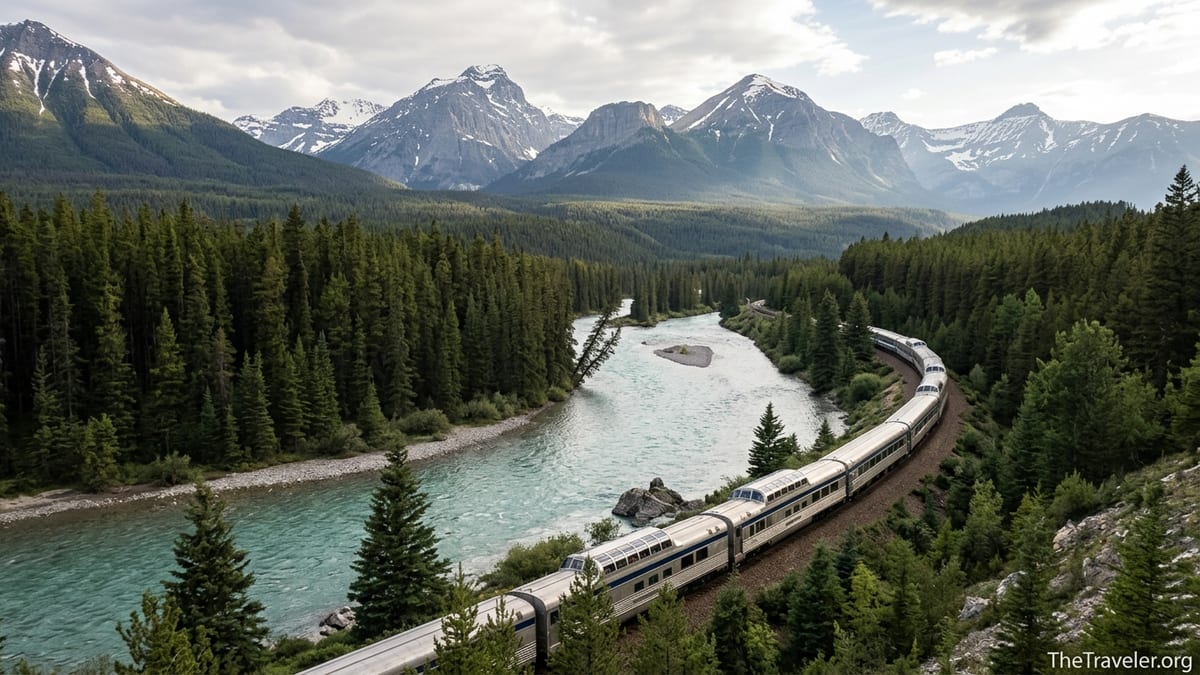
Choosing Your Route: Vancouver to the Rockies by Rail
The two main rail players between Vancouver and the Rockies are Rocky Mountaineer and VIA Rail’s Canadian. Both connect Vancouver with the mountains, but in very different ways. Rocky Mountaineer is a premium daylight sightseeing train that runs in the main season roughly from mid April to early October, with set itineraries from Vancouver to Banff, Lake Louise and Jasper. VIA Rail’s Canadian is a national long-distance service linking Toronto and Vancouver year-round, with Jasper as its key Rockies stop. This means Banff and Lake Louise are only reachable directly by train on Rocky Mountaineer, while Jasper is served by both.
If your goal is a once-in-a-lifetime scenic showcase with hotel nights and guided touring options, Rocky Mountaineer’s First Passage to the West (Vancouver to Banff/Lake Louise) and Journey Through the Clouds (Vancouver to Jasper) are the flagship options. Recent schedules show these routes typically starting around mid April and ending in early October, with eastbound departures three or four days per week at the height of summer. By contrast, VIA’s Canadian operates on a multi-day schedule all year, usually with two or three departures per week in each direction between Vancouver and Toronto, and a travel time of roughly 19 to 20 hours between Vancouver and Jasper depending on freight traffic and time of year.
Many travelers combine rail and road. A common pattern is to travel Vancouver to Jasper by train, stay several nights in Jasper National Park, then rent a car to drive the Icefields Parkway to Lake Louise and Banff before continuing to Calgary for a flight out. Others choose the reverse, starting in Calgary, driving to Banff and Jasper, and then boarding the train in Jasper for the overnight trip back to Vancouver. Knowing which mountain town you want as your base is the first step in selecting the train that matches your route and budget.
Rocky Mountaineer: Premium Daylight Scenic Trains
Rocky Mountaineer positions itself as a luxury tourist experience rather than transportation, and that shapes almost every aspect of the trip. Trains travel only in daylight so you do not miss the Fraser Canyon, Kicking Horse Pass or North Thompson River scenery. On a Vancouver to Banff itinerary, you spend one full day rolling from Vancouver to Kamloops, overnight in a hotel there, then reboard for a second full day into the Rockies. The Vancouver to Jasper route follows the same pattern, sharing the first day as far as Kamloops before diverging northeast toward Mount Robson and Jasper.
Service is divided into SilverLeaf and GoldLeaf. SilverLeaf guests travel in roomy single-level coaches with large picture windows and at-seat meals. GoldLeaf travelers ride in bi-level dome cars with wraparound glass upstairs and a dedicated dining room downstairs, plus an outdoor vestibule for photography. Typical 2026 lead-in prices for a two-day Vancouver to Banff journey are often in the low to mid four-figure range per person in SilverLeaf, with GoldLeaf adding several hundred dollars more. Packages that include additional hotel nights in Vancouver, Banff or Jasper, plus transfers and excursion options, can push a week-long itinerary well into the several thousand dollar range for a couple.
What you are paying for is a curated, almost cruise-like experience: assigned hosts who narrate the landscape, plated meals prepared on board, alcoholic drinks included, luggage transferred between train and hotel in Kamloops so you simply walk off with your day bag. For some travelers, especially those celebrating milestones or unused to independent travel, this justifies the premium. For others mainly seeking to get from Vancouver to the Rockies with decent views, that level of service is more than they need. It is important to be candid about expectations: Rocky Mountaineer does not run overnight, does not carry point-to-point commuters and does not function like public transportation. It is essentially a rolling high-end tour with fixed departure dates and limited capacity that often books out months in advance for peak summer dates.
VIA Rail’s Canadian: Sleeper Trains and Long-Distance Options
VIA Rail’s Canadian is the workhorse transcontinental train that links Vancouver and Toronto and serves Jasper along the way. Between Vancouver and Jasper it runs on a roughly once- or twice-weekly schedule depending on the season, with the segment typically taking about 19 hours on the timetable but sometimes longer due to freight priority. Travelers board in the evening at Vancouver’s Pacific Central Station, sleep as the train climbs through the Fraser Valley and North Thompson corridor, and wake up to mountain scenery as the line approaches the Rockies near Mount Robson and then drops into Jasper late the following morning.
Classes of service range from Economy seats to Sleeper Plus cabins and the top-end Prestige class. Economy is the cheapest way to ride, with recent sample fares from Vancouver to Jasper sometimes appearing around the low hundreds of Canadian dollars when booked early or on sale. You get a reclining seat, access to a shared Skyline dome car for views and the option to buy food in the café or bring your own. There is no included bedding or private space, and the overnight portion can be challenging for light sleepers. For many budget travelers, however, the trade-off is acceptable because the journey covers both a night’s accommodation and long-distance transport in one ticket.
Sleeper Plus represents a substantial step up. Classic berths and cabins include seats that convert into bunk beds at night, access to separate shower facilities and the all-important inclusive meals served in a dining car. From traveler reports in 2025 and 2026, Vancouver to Jasper Sleeper Plus prices can be several times the economy fare and vary widely with demand and season, often falling somewhere in the mid to upper triple-digits per person in the shoulder seasons and rising higher in peak summer. Prestige class, with large double beds and dedicated concierge service, is considerably more and sells out quickly. The key point: booking early is crucial, because sleeper space between Vancouver and Jasper is limited and popular departures routinely sell out several months ahead.
The experience on the Canadian is more mixed than on Rocky Mountaineer, because it shares tracks with busy freight trains and can run hours late. Schedules are designed to showcase scenery, but in practice some mountain stretches can end up being passed in darkness, especially in winter. On the plus side, you are traveling with Canadians going about their lives, rail enthusiasts doing the full coast-to-coast run and backpackers stringing together legs, so the social element is strong. There is flexibility to break your journey in Jasper, spend a few days in the park and then continue on a later train, which many travelers use to create a longer Rockies stay without renting a car both ways.
Planning, Booking and Luggage: What First-Time Rail Travelers Need to Know
Timelines matter when planning Western Canada rail trips. For Rocky Mountaineer, April and May departures can offer lower prices and quieter trains, but you may encounter lingering snow on high passes and cooler temperatures at Lake Louise or Jasper. June through early September is peak season for both the train and the national parks, with higher fares and accommodation selling out. By late September and early October, foliage adds color but daylight hours shorten, affecting how much scenery you see each day. Because departures on each route run on specific days of the week rather than daily, you should check upcoming season calendars before locking in flights or hotel stays.
VIA Rail opens bookings many months in advance, and sleeper cabins on the Canadian have a reputation for selling out long before economy seats. Fare categories include non-flexible, semi-flexible and fully flexible tickets, with increasing change and refund rights. Promotional fares and discount periods appear periodically outside the highest-demand summer weeks, and tools such as fare calendars and independent tracking sites can help you spot cheaper days. It is common for travelers to secure their sleeper space first, then add domestic flights and car rentals once they know their train dates will work. Given the possibility of delays, many people schedule at least one buffer night after arriving in Vancouver or before flying home from Calgary or Edmonton.
Luggage policies differ between operators. On Rocky Mountaineer, checked bags are taken at boarding and delivered directly to your hotel room in Kamloops and at the final destination, while you carry only a small day bag on the train with essentials such as camera gear, medication and a warm layer for stepping onto open platforms. VIA Rail allows each passenger to bring carry-on bags into the cabin, with the option to check larger suitcases in the baggage car between major stations such as Vancouver and Jasper at no extra cost on many fares. If you are transferring straight from train to rental car in Jasper or vice versa, planning one medium suitcase per person plus a smaller day pack usually keeps things manageable through station platforms, hotel lobbies and mountain town sidewalks.
Train Versus Rental Car: Weighing Freedom, Cost and Comfort
Deciding whether to travel entirely by rail or to mix train and car hire is one of the biggest planning questions for Western Canada. A car offers flexibility: you can stop at trailheads, lakes and viewpoints whenever you like, detour to lesser-known places such as Yoho National Park or Mount Edith Cavell, and adjust plans around weather. It also allows you to stay outside the most expensive tourist hubs and still reach the parks each day. Recent examples from Canadian rental agencies in 2026 suggest that a one-way rental from Vancouver to Calgary in summer, for a compact SUV over six or seven days, can easily run into the mid-hundreds of dollars before fuel, parking and any one-way drop fees, which can add a significant surcharge for dropping the vehicle in another province.
By comparison, a single Vancouver to Jasper economy ticket on VIA Rail might cost around what you would spend on two or three days of car rental, but that ticket also covers one night’s accommodation and brings you directly into the mountains. Add a few days of local rentals from Jasper or Banff instead, and you reduce overall driving time while still having wheels where they matter most. Travelers who opt for Rocky Mountaineer often treat it as a splurge and then use shuttle buses, day tours and occasional short-term car rentals within the Rockies rather than maintaining a vehicle for the entire trip. This can work well if you prefer not to drive on mountain highways or are nervous about conditions in shoulder seasons.
Comfort is another factor. If long days behind the wheel leave you exhausted, letting a locomotive do the work while you sit in a dome car with coffee may feel like money well spent. On the other hand, rail travel builds in fixed timetables and limited daily departure options. Weather changes, wildfire smoke or a rainy day at Lake Louise cannot simply be shifted by leaving an hour later or taking an alternate road. Many travelers strike a balance: they use VIA Rail for the long overnight haul between Vancouver and Jasper, then rent a car for three to five days to explore Jasper, the Icefields Parkway and Banff at their own pace before returning it in Calgary and flying on.
Scenic Highlights and Realistic Expectations
Regardless of operator, several scenic sections define the Vancouver to Rockies rail journey. Leaving Vancouver, trains follow the Fraser River past the steep walls of the Fraser Canyon, with places like Hell’s Gate and the town of Boston Bar marking the transition from temperate rainforest to drier interior plateaus. Near Kamloops, the landscape opens into rolling ranchland and sagebrush hills before the line either climbs toward the Kicking Horse Pass en route to Banff or swings north along the North Thompson River valley toward Mount Robson and Jasper. On clear days, the approach to Jasper offers glimpses of glaciated peaks and, occasionally, wildlife such as elk near the tracks.
Rocky Mountaineer’s First Passage to the West adds specific rail landmarks such as the historic Spiral Tunnels near Field, a marvel of early 20th century engineering that allows trains to gain elevation while avoiding dangerously steep gradients. Journey Through the Clouds highlights Mount Robson, the highest peak in the Canadian Rockies, and passes through rugged canyons and waterfalls that can be difficult to appreciate from the highway. VIA Rail shares much of this trackage, but because it runs year-round and overnight, some views may fall in darkness, especially in winter. Travelers boarding in summer and choosing Vancouver to Jasper in that direction generally report waking to some of the best mountain scenery during breakfast and late morning.
Expectations are critical for enjoyment. Rocky Mountaineer markets an almost flawless experience, yet weather can still obscure views, and wildfires in recent summers have occasionally brought smoke or schedule adjustments. VIA Rail’s Canadian, operating on shared freight lines, can suffer significant delays, meaning arrival times into Jasper or Vancouver can shift by several hours. Building slack into your itinerary and approaching the journey as part scenic experience, part transportation, helps avoid frustration. It is also wise to consider mobility needs: some heritage sleepers on the Canadian have narrow corridors and steps, while Rocky Mountaineer coaches offer more level boarding but still require short walks along platforms and in stations.
Practical Tips for Sleeper Travel, Food and Packing
On VIA Rail, choosing the right accommodation type dramatically shapes your trip. Economy seats are fine for hardy travelers willing to sleep upright for one night between Vancouver and Jasper. Bringing a small travel pillow, eye mask, light blanket and noise-cancelling headphones makes a significant difference. Sleeper Plus berths and cabins trade higher fares for genuine rest: beds are turned down by attendants, and the ability to shower and change before rolling into Jasper or Vancouver leaves you better prepared for a day of sightseeing. Travelers doing longer segments, such as all the way to Toronto, almost universally recommend booking sleeper space if at all possible, especially in peak season when trains are busy.
Food planning depends on class and operator. Rocky Mountaineer includes multi-course meals and alcoholic drinks in the fare, served at your seat in SilverLeaf or in the GoldLeaf dining room. On VIA Rail, Sleeper Plus includes meals in the dining car, with menus that feature regional dishes and a rotating selection of mains. Economy passengers either purchase simpler options from the café, such as sandwiches and snacks, or bring their own cool bag with groceries from Vancouver or Jasper. Given that café prices are higher than supermarket rates and that menu variety can be limited on busy departures, many economy travelers pick up items like wraps, fruit and snacks before boarding, especially for the overnight stretch.
Packing light pays off. For both operators, a layered clothing system suits the changeable weather between coastal Vancouver and high mountain passes. A light insulated jacket, fleece or sweater, and a packable waterproof shell cover most situations in late spring through early autumn. Comfortable shoes matter for walking along platforms, exploring Jasper or Banff on arrival and any short excursions. Inside the train, casual clothing is acceptable, with some passengers choosing slightly smarter outfits in the Rocky Mountaineer dining room or VIA’s Sleeper Plus restaurant but no formalwear required. Electronics should be charged before boarding, as not every older railcar has individual power outlets at all seats, especially in heritage sleepers, and mobile coverage can be patchy in canyons and remote areas.
The Takeaway
Traveling from Vancouver to the Canadian Rockies by train is less about getting from A to B and more about how you want to experience the journey. Rocky Mountaineer delivers a polished, daylight-only showcase of Western Canada’s landscapes, at a price point similar to an upscale cruise or tour. VIA Rail’s Canadian offers a more down-to-earth long-distance rail experience that mixes practical transportation with memorable scenery, particularly between Vancouver and Jasper, and gives budget-conscious travelers options like economy seats or more modest sleepers. Neither is objectively better; each serves a different style of trip.
The most satisfying itineraries start with clarity about your priorities: Is this a once-in-a-lifetime splurge, or a longer Canadian adventure where cost matters? Do you prefer a seat in a dome car with hosts narrating every valley, or the independence of bringing your own food and mingling with locals in the café car? Are you comfortable driving mountain highways, or would you rather let the train handle the long distances and pick up a rental car only for a few concentrated days in the parks? Once you answer those questions, matching routes, ticket types and travel dates becomes far easier, and Western Canada’s rails open up as a flexible backbone for an unforgettable Rockies trip.
FAQ
Q1. What is the best time of year to travel by train from Vancouver to the Rockies?
The main rail season for premium sightseeing trains runs from around mid April to early October, with June to early September offering the longest days and warmest weather but also the highest prices and busiest national parks. VIA Rail operates year-round, but if you want a good chance of seeing the Rockies in daylight between Vancouver and Jasper while avoiding the worst crowds, late May, early June and mid September are often attractive compromises.
Q2. Is Rocky Mountaineer worth the price compared with VIA Rail?
Rocky Mountaineer is significantly more expensive but includes hosted commentary, plated meals, alcoholic drinks and hotel accommodation in Kamloops, and it runs only in daylight so you see every canyon and pass. VIA Rail is cheaper and functions as public transportation, with simpler service and the chance to travel in economy or sleeper cabins. Travelers who value comfort, service and a curated experience often feel Rocky Mountaineer is worth the splurge, while budget-minded or independent travelers frequently prefer VIA Rail and spend the savings on extra nights in Jasper, Banff or additional activities.
Q3. Can I take a train from Vancouver directly to Banff or Lake Louise?
At present, the only direct train service from Vancouver to Banff and Lake Louise is operated by Rocky Mountaineer on its First Passage to the West route, which runs as a two-day daylight journey with an overnight hotel stay in Kamloops. VIA Rail’s Canadian does not go to Banff or Lake Louise; instead it serves Jasper, from where you can reach Banff and Lake Louise by rental car, coach or organized tours along the Icefields Parkway and Trans-Canada Highway.
Q4. How far in advance should I book a sleeper on VIA Rail’s Canadian?
Sleeper cabins on the Canadian between Vancouver and Jasper can sell out months before departure, especially during July and August and around major holidays. Booking three to six months ahead is a sensible target for peak season, while shoulder-season trips may offer more flexibility. If you have fixed international flights or must travel on a specific date, securing your sleeper as early as practical reduces the risk of finding only economy seats or no availability at all.
Q5. What are typical costs for a Vancouver to Jasper train ticket?
Economy fares between Vancouver and Jasper on VIA Rail can sometimes be found in the low hundreds of Canadian dollars when purchased early or on promotion, though prices vary with demand and flexibility. Sleeper Plus cabins usually cost several times more than economy, reflecting the inclusion of meals, beds and access to additional lounges and domes. Rocky Mountaineer’s Vancouver to Jasper packages are considerably higher again, often reaching into the low to mid four-figure range per person depending on class of service and included hotels.
Q6. Is luggage transfer easy when combining train and rental car?
Yes, but planning ahead helps. On VIA Rail, you can check larger suitcases between Vancouver and Jasper and carry a smaller bag to your seat or cabin, which keeps boarding simple. In Jasper, the station sits close to several car rental desks and hotels, so rolling one medium case per person plus a day pack is usually manageable on foot or by short taxi ride. On Rocky Mountaineer, checked bags are moved directly between the train and overnight hotels, so you mostly handle only your day bag until you reach your final Rockies destination.
Q7. Will I see wildlife from the train?
Wildlife sightings can never be guaranteed, but many travelers report glimpses of elk near Jasper, eagles along the Fraser River and occasionally bears or mountain goats on distant slopes. The slower pace of the train and elevated dome cars on both Rocky Mountaineer and VIA Rail’s Canadian help, but you may still be too far away for close-up views. If wildlife is a priority, consider booking dedicated tours or self-driving within Jasper and Banff National Parks, where early-morning and evening drives offer better chances.
Q8. What should I pack for a Vancouver to Rockies train journey?
Pack light layers, including a warm sweater or fleece, a light insulated jacket and a waterproof shell, plus comfortable walking shoes. Onboard temperatures are generally comfortable, but air conditioning and varying outside weather mean an extra layer is useful. A small day pack for camera gear, documents and medications, along with a travel pillow and eye mask if you are in economy on VIA Rail, will improve your comfort. Power banks are handy because outlets are not guaranteed at every seat.
Q9. How reliable are train schedules for connections and flights?
Sightseeing trains such as Rocky Mountaineer usually keep to their planned timetables but can still be affected by weather or operational issues. VIA Rail’s Canadian runs on freight tracks and is more prone to delays that can add hours to the journey. For this reason, it is wise to avoid same-day flight connections after a long-distance train, especially from Jasper or Vancouver. Building at least one buffer night before international flights, cruises or tours helps protect your wider itinerary from any rail timetable surprises.
Q10. Is it better to do the train first or the Rockies road trip first?
Both sequences work, but many travelers enjoy flying into Vancouver, taking the train east to Jasper and then renting a car to drive the Icefields Parkway to Lake Louise, Banff and finally Calgary for a flight home. This puts the most dramatic mountain driving after you have already relaxed on the train. Others prefer to start in Calgary, explore Banff and Jasper by car, then board VIA Rail in Jasper or Rocky Mountaineer in Banff or Lake Louise for a relaxing finale into Vancouver. Your decision may come down to flight prices, car rental availability and whether you prefer to front-load or end your trip with the rail experience.